
A supplier sourcing approach is a plan for how a company will obtain the products, materials, components, or manufacturing services they require, given cost, quality, continuity of supply, responsiveness, and risk. Many companies still buy on a reactive basis, only when they are in a rush, their current supplier can't perform or a quote is deemed to be low cost. This ad hoc approach is replaced by a repeatable supplier sourcing strategy that determines who are the most important suppliers, what supplier risks are acceptable, and how supplier performance should enable the overall business plan.
What Is a Supplier Sourcing Strategy?
A supplier sourcing strategy is a decision making framework that dictates how a company approaches finding, selecting, managing and developing suppliers for various purchasing categories. It is an initial direction that is set prior to the issuance of any individual RFQ or purchase order. The strategy addresses questions like: What can be sourced locally versus internationally? Which categories should have dual sourcing? Who are the preferred or strategic supply partners to be? What are some of the compromises that the business can make on price, lead time, quality, flexibility, and risk?
It's not just a single document. It is a dynamic selection of decisions, which day-to-day buying links to margin protection, product quality, production continuity, stock management, market expansion, innovation, compliance and risk resilience.
Supplier Sourcing Strategy vs Supplier Sourcing Process
The supplier sourcing process is the series of execution steps to be taken to search, screen, evaluate, negotiate with and select a supplier for a specific need. That selection is the first aspect of the business where the strategy dictates how the business should proceed.
For some critical components that could cause the end of the assembly, dual sourcing might be necessary in the strategy. It then outlines the process for locating, auditing, sampling and approving the candidates. The process follows the rules of engagement, which are established in the Strategy. Most companies tend to fall for the trap of confusing the two, and as a result, every new purchase is a new and unstructured search.
Why a One-Size-Fits-All Sourcing Approach Fails
There are specific criteria and supplier models that cannot be applied to standard office supplies, basic packaging, custom-made machinery parts, safety-critical components and outsourced manufacturing. The disruption of supply, switching difficulties, complexity and supplier dependence vary greatly by category.
A carton product with defined specifications and minimal risk of quality and minimal switching costs is available and can be competitively bid by a business each year. The same company might require a longer term development partnership with a supplier, who made a proprietary molded component with buyer owned tooling and buyer owned process knowledge, which takes months to transfer. Either provides an unnecessary complexity to the carton or exposes a molded part to single source risk.
Start With Business Goals, Not Supplier Lists
A supplier sourcing strategy begins with what the business needs to achieve, not with a list of companies found online. Suppliers should be selected and managed in ways that support commercial priorities, operational demands, product quality expectations, and customer commitments. Sourcing is a cross-functional activity. Procurement should involve engineering, operations, finance, quality, product development, and leadership early enough to prevent conflicting priorities from appearing after suppliers are shortlisted.
Define the Business Outcomes the Strategy Must Support
Sourcing goals can range from decreasing TCO, increasing delivery reliability, stabilizing quality, decreasing lead times, assisting with product launches, decreasing inventory exposure, increasing traceability or decreasing reliance on a single supplier. Such goals should be defined in detail enough to impact supplier-selection criteria.
It's easy to fall into the trap that “lower cost” is the only objective. When a firm only considers the lowest cost of a unit, it may pass on the additional costs to the downstream because of defects, expedited freight, excess safety stock, or production shutdowns.
Identify Internal Stakeholders and Their Non-Negotiables
There are many different perceptions of supplier risk in each internal function. Engineering is about the capability of the material and process. Quality requires inspection controls and traceability. Finance monitors Cash-flow Exposure and Payment Terms. Stable production schedules are needed for operations. Sales require product availability to make customer commitments.
Know what the must-haves are before undertaking any sourcing activity. A supplier should not be approved just because the unit cost appears to be a good option, if it cannot deliver a critical quality, compliance, capacity or delivery that is required by another function.
Turn Broad Objectives Into Measurable Sourcing Targets
Only when business goals are translated to measurable sourcing target they become useful. It can take the form of fewer late deliveries on a critical component line, determining and approving alternate suppliers for materials that are currently sole-source, decreasing the lead time to replenish high velocity materials, improving first pass quality, or stipulating more defined change-control requirements with strategic suppliers.
Establish realistic targets based on the company's own historical data, production requirements, customer needs and risk tolerance. Other industries' generic benchmarks seldom apply.
Analyze What You Buy and Where the Risk Sits
To be effective, a strategy must have a clear understanding of spend category, purchase frequency, concentration of suppliers, quality impact, supplier switching difficulty, and supply disruption exposure. If all the purchases are treated to be of equal importance, businesses can't work effectively in prioritizing their suppliers.
This analysis isn't intended to generate complex procurement reports. To determine which categories need focused supplier management, increased market research, contingency plans, or qualification.
Review Spend, Volume, and Supplier Dependence
Analyze purchase information such as annual spend, order frequency, number of units purchased, supplier price changes, number of suppliers used, and sole-source supplier. This immediately shows if the company is buying too much from one supplier or if they are failing to take advantage of low risk purchasing opportunities.
Although a specialty gasket may be a small annual spend, it has much more business impact if it prevents final assembly than its invoice value. Spend is not a good indicator of priority.
Identify Supply Risk Beyond Price
Limited supplier availability, long qualification cycles, proprietary tooling, single-source materials, volatile raw materials, production-capacity constraints, cross-border logistics exposure, geopolitical changes, compliance requirements and poor supplier financial health are among the common sources of supply risk.
Risk is contextual. This could be acceptable for stable, predictable products, but not for parts required for a “must” maintenance or customer service obligation.
Segment Categories by Business Impact and Supply Risk
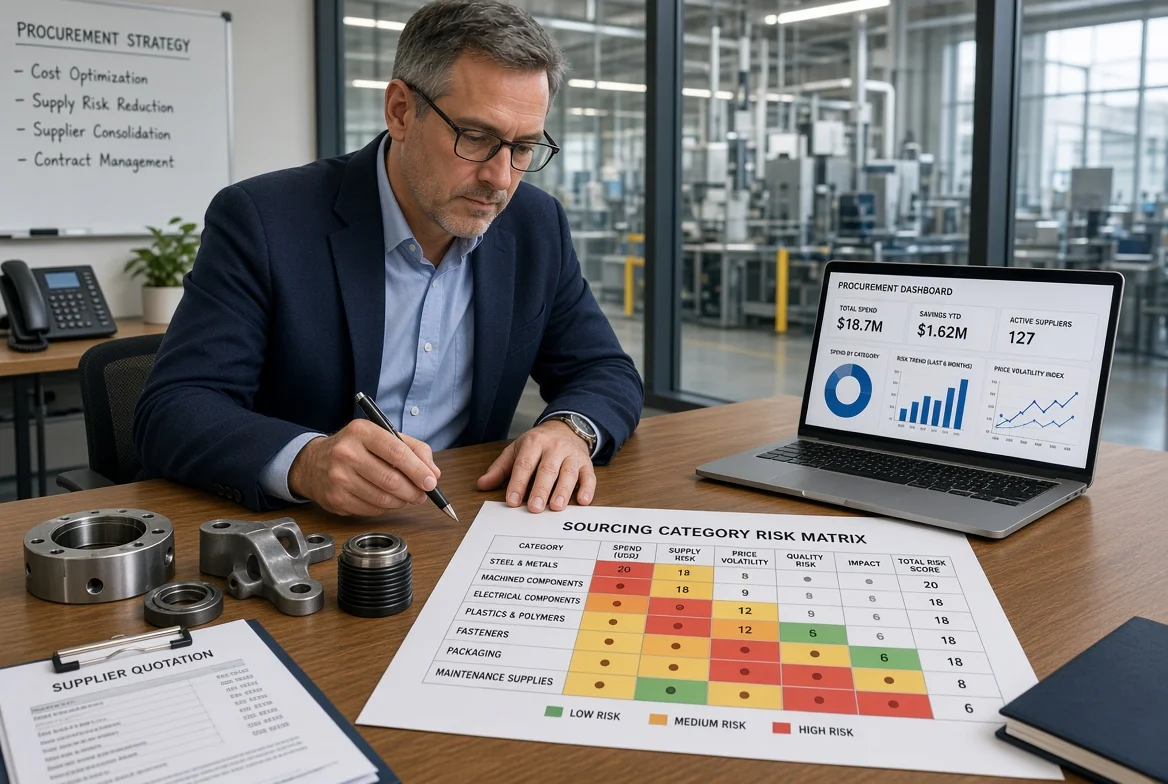
Category segmentation facilitates applying the appropriate sourcing model to purchase appropriate categories. Routine purchase, leverage, bottleneck and strategic supply categories are easily identifiable through a simple two axis matrix that categorizes them based on business impact and supply risk.
The matrix is a tool for decision making, not a formula! It allows buyers to decide when to implement competitive bidding, supplier consolidation, supplier development, long-term agreements, dual sourcing and additional protection against inventories.
Research the Supply Market Before Choosing a Sourcing Model
The sourcing strategy to be adopted depends on the requirement of the buyer but also on the structure of the supplier market. A buyer should be aware of the numbers, locations and types of capable suppliers as well as the technology they hold, cost drivers that drive prices and conditions that may constrain supply.
Market research is particularly relevant when entering a new product category, when sourcing internationally, when the product requires special manufacturing processes, and when suppliers look to be powerful.
Understand Supplier Availability and Capability Distribution
There could be a number of suppliers but only a few will be capable of delivering the desired quality, size, certification or technical specifications. Separate out supplies that can quote from supplies that can reliably deliver.
While a number of factories may end up making a product that is similar to that required for a certain project, only a selected few might possess the testing capacity, material traceability, export experience or automated capacity required.
Identify Cost Drivers and Supply Constraints
Comprehend supplier prices and availability factors: raw materials, labor, energy, tooling, freight, currency, capacity utilization, compliance and production complexity. This knowledge will assist in intelligently assessing price changes instead of just believing that all price increases are uncalled for and all low prices are unsustainable.
Custom products can have high tooling and engineering charges. A more commodity-like product might be more vulnerable to material-price or logistic changes.
Compare Local, Regional, and Global Sourcing Options
The factory pricing should not be the only factor in determining locations. Look at transit time, freight, duties and customs complexity, communication time zones, production inspection, inventory requirements, technical support, trading restrictions, and resilience.
Domestic sourcing does not necessarily mean that it is safer and overseas sourcing does not necessarily mean that it is less expensive. To learn more about cross-border issues, refer to the International Supplier Sourcing Guide for Global Buyers and China Supplier Sourcing Guide: How Global Buyers Find Reliable Manufacturers.
Select the Right Sourcing Model for Each Category
Select sourcing model according to category importance, supply risk, product complexity, supplier availability and relationship needs. Various models can and must be coexistent in the one business. A company can have preferred suppliers for routine purchases, strategic partnerships for highly critical items, leverage categories for use of competitive bidding and backup suppliers for high-risk parts.
Competitive Sourcing for Comparable, Low-Risk Categories
Competitive RFQs or periodic bidding is suitable for products that have well-defined specifications, several suppliers capable of delivering the product, low switching costs and little risk of disruption of product quality or supply. The aim is to ensure market discipline without causing unnecessary supplier turnover.
Frequent re-bids for each category may lead to poor supplier relationships, decreases in supplier investment, and quality risks if products require technical knowledge and/or stable processes.
Preferred Supplier Programs for Repeat Purchases
For repeatable categories, a preferred supplier approach minimizes effort to transact and increases consistency. Through an ongoing relationship, preferred suppliers can be more likely to see more volume, more defined purchasing paths, and opportunities to enhance pricing, service, lead time, or quality.
A “Preferred” status should be based on well-defined capability and performance criteria. There must be a performance review component and/or an alternative market check to prevent the program becoming a default arrangement.
Strategic Partnerships for Critical or Complex Supply
Deeper supplier relationships make sense for custom manufacturing and difficult-to-switch components and for high volumes, high regulatory exposure, or products where supplier engineering support becomes a factor in the buyer's competitiveness, and for proprietary tooling. Prioritize joint planning, quality improvement, capacity visibility, change control and problem solving.
Strategic partnerships must be of value to both parties. Buyers should not expect suppliers to invest, prioritize their business, or innovate, and treat the supplier as a “cheap commodity” source of price.
Dual Sourcing & Backup Suppliers for Resilience
Dual sourcing minimizes risk of disruption in supply if one source is operationally critical or if one source is critical to halt production. It can include volume split, backup supplier qualification, protection of buyer owned tooling etc.
Having multiple suppliers drives up qualification, management expenses and can cause consistency issues due to lack of volume leverage. Many factors are involved in determining the right choice, including criticality, supply risk, switching difficulty, and the actual availability of qualified alternatives.
Build Supplier Selection Criteria Around Total Business Value
Supplier selection criteria should reflect the strategy already established, not be invented after quotations arrive. Decide what matters most before price comparisons begin to influence the decision.
Supplier selection criteria must be a result of the strategy that has been determined in advance rather than a product of finding quotations. Make a decision before you start making price comparisons.
Price is one of the many factors in an overall value analysis. Effective decisions consider Quality, Delivery, Technical Fit, Capacity, Commercial Terms, Compliance, Communication and Supply Risk in addition to Price.
When purchasing, consider not only the unit price, but also Total Cost of Ownership.
TCO includes purchase price, tooling, sample cost, shipping, duties, packaging, inspection, defects, rework, warranty claims, inventory carrying cost, stockout exposure, payment terms, and administrative effort are considerations.
An overseas supplier might offer a lower unit price but may have a higher MOQ, shipping lead time, stock, and/or frequent third-party inspection. The final total price may not be as appealing as the initial quote would have been. A higher unit cost, shorter lead time, reduced safety-stock required and better quality co-operation with a domestic supplier may be commercial.
Establish Quality and Capability Standards that are Not for Negotiation
Some requirements should be considered a pass/no pass requirement, not a preference. These could be things like necessary qualifications, manufacturing processes, material sourcing, the ability to test, compliance records, clean room facilities or production capacity to meet forecasted demand.
Even an appealing supplier can't make up for an essential failure to meet product or compliance specifications. This helps to ensure that the decision is not made purely on price.
If you're making a major decision, employ a Weighted Scorecard.
A weighted scorecard enables cross-functional teams to consistently and fairly compare shortlisted suppliers. Some areas may be Quality capability, Technical fit, Total cost, Delivery performance, Capacity, Compliance, Supply risk, Communication and Financial stability.
Weighting should be in proportion to the role of the category in the business. When they become available, please refer to Supplier Evaluation Criteria: 10 Factors Every Buyer Should Check and Supplier Scorecard: How Procurement Teams Measure Supplier Performance for practical ways to build and apply these tools.

Turn the Strategy Into an Executable Sourcing Plan
If it doesn't alter actual buying, the strategy is worth nothing. There must be a clear plan in place that identifies the roles and responsibilities, when various activities are to be performed, what supplier actions are required, and what documents or approvals are needed at each stage.
Even if your organization doesn't have the advanced procurement software of its dreams, a disciplined approach can be achieved through a structured spreadsheet, sourcing calendar, supplier tracker, approval checklist, and regular review meetings.
Generate a Category Level Sourcing Plan
Plans should be practical, and include the following data for each significant category: sourcing objective, supplier model, current suppliers, target suppliers, sourcing-risk exposure, market research required, contract or RFQ timing, internal owners, and planned review dates. The plan should define what has to take place before the business reaches a crisis of supply.
A company can establish a six-months program to find and qualify a second supplier for a critical component before the original supplier's contract is up.
Set Clear Decision Gates and Ownership
There should be clear decision points within sourcing projects: requirement approval, longlist completion, shortlist approval, RFQ release, sample/audit completion, supplier selection, contracting, and onboarding. A person should be responsible for each gate and evidence should be specified for each gate.
Ownership ensures no delays or confusion. Procurement can co-ordinate the process but the decisions made within their scope of responsibility must be approved by engineering, quality, finance and management. approve the decisions that fall within their responsibilities.
Standardize Sourcing Documents Without Making the Process Bureaucratic
Reusables like supplier information form, RFQs, supplier scorecards, sample-approval forms, audit checklists, supplier onboarding checklists, and performance review records facilitate a quicker, easier comparison of decisions and minimize reliance on individual employee knowledge.
Don't need to have lots of paper work for each purchase. Use an appropriate degree of process control appropriate for the value, complexity, risk, and operational impact of the purchase.
Manage supplier relationships and performance after selection
The supplier sourcing strategy is more than just supplier award. The company must have a system to assess if suppliers are meeting the value, quality, capacity and risk profile they were selected for.
The key elements of good supplier relationship management are segmentation, communication, performance measures that are well understood by both parties, regular supplier reviews, and remedial actions if the outcome is not as expected.
Classify Suppliers by their Relationship Score
Not all supplier relationships are worth the same investment of time for businesses. Commercial checks may be required from time to time on routine suppliers. Structured business reviews, capacity discussions, joint quality improvement, forecast sharing and executive escalation paths may be required with strategic suppliers.
Segmentation focuses on limited procurement resources where supplier performance has the greatest business impact.
Define KPIs Before Problems Occur
Supplier metrics should be agreed prior to performance issues arising. Some of the key performance indicators that could be relevant to the department would be on time delivery, inwards defect rate, response time, closing of corrective actions, quote accuracy, lead-time adherence, cost stability, and compliance-document performance.
Identify a reasonable set of appropriate indicators. Too much KPI reporting can obscure the problems that are impacting operations and customer commitments.
Performance Reviews – To Improve Not Penalize.
Supplier reviews should seek to determine the root causes, corrective actions, improvement opportunities, and future capacity or product-development needs. A review shouldn't just be a response to late deliveries or defects.
Clear communication of expectations and data can have a positive impact from capable suppliers on process yield, packaging, lead time, engineering support, and cost structure.
Some of the typical pitfalls of a supplier sourcing strategy.
Treating LP as the entire strategy is wrong.It is incorrect to treat LP as entire strategy.
While it is useful to have a low price, it is not an entire sourcing strategy. Considering only price, results in higher overall cost and operational instability when it comes to quality risk, freight risk, MOQ, capacity and delivery reliability.
Specify "total value" criteria prior to RFQs and ask suppliers to share assumptions that can impact commercial comparisons.
If you use the same supplier for all categories, you can use the Same Supplier Model for Every Category option.
Tools such as competitive bidding, preferred suppliers, single sourcing, dual sourcing, and strategic partnerships are not blanket solutions. Investing in a single model for all purchases adds complexity or falls short on protection for essential supply categories.
Prioritize segments by business impact and supply risk and choose the sourcing solution.
Building a Strategy Without Cross-Functional Input
A procurement strategy that is developed without engineering, quality, production, finance or sales input may fail if it does not fit with any one or all of these requirements. Buyers have to redo the supplier selection process and the launches are delayed due to late objections from stakeholders.
Define clearly the involvement of stakeholders, particularly in the case of custom products, high value sourcing, regulated products and suppliers affecting customer delivery.
Failure to review the strategy as conditions change.
Changes in supplier markets, supplier costs, freight conditions, designs of products, customer expectations, capacity needs and trade requirements. Re-check the strategy from time to time and following significant supplier breakdowns, product changes, demand change and market disruptions.
Changing suppliers a lot is not a reason for strategy review. It's a formal approach to ensure existing sourcing decisions remain aligned with the business needs and risk profile.
Final Takeaway: Create a Sourcing Strategy that Works for Your Business and Not a Template
A good supplier sourcing strategy starts with business goals, supplier sourcing risk and supplier sourcing commercial importance, adopts different sourcing models and models by sourcing category, sender supplier total business value evaluation, and supplier sourcing performance post selection.
Start small instead of doing all your supplier relationships at once. Map existing suppliers, design a high risk dependency, establish category selection criteria, or develop a backup plan for a single item that is critical to production. This targeted approach yields longer-lasting results than going wild on a company-wide overhaul that is too ambitious and incomplete.
FAQ
What is the frequency of review for a supplier sourcing strategy?
Evaluate the overall strategy at least once a year, and whenever there are significant changes in demand, product design, supplier performance or external market conditions. Some categories may require more frequent check-ins, such as high-risk categories or strategic ones.
What are the differences between dual sourcing and multi-sourcing?
Dual sourcing is usually defined as qualifying two sources for the same item with the intent of splitting or alternating volume. Multi-Sourcing - More approved suppliers. If the risk of a single source is great, dual sourcing is sometimes used because more than two sources adds complexity without a commensurate reduction in risk, particularly for critical components.
What is the supplier sourcing strategy for small companies that don't have a big procurement team?
Prioritize high quality and/or high risk categories first. Don't use enterprise software, a spend analysis spreadsheet, a simple risk matrix, and clear selection criteria will do. Spend a short period of time on suppliers and categories that have the potential to halt production or cause damage to customer commitments.
Do all categories need to be measured by the same KPIs?
No. Ensure that the KPIs are in line with the purpose of the category. While on-time delivery and defect rate is important for most products, capacity visibility, change-control compliance and engineering responsiveness are critical for strategic or custom supply.
When is single sourcing still acceptable?
Single sourcing is acceptable if a supplier has a unique technical capability, if qualification of two suppliers would be excessively costly or time-intensive, or if the volume of items is not sufficient to maintain two sustainable sources. In such instances, reinforce the relationship, safeguard the tooling ownership, and have contingency plans — safety stock and/or alternative material qualification.
How is the Supplier Segmentation Strategy related to the sourcing strategy?
The supplier segmentation determines the amount of management attention that will be provided. Commercial reviews are conducted periodically on routine suppliers and formal performance reviews, capacity planning and joint planning with the strategic suppliers. Segmentation does not allow the same level of resources to be used on all relationships.
How does TCO fit into the strategy?
Unit-price decisions do not lead to increased downstream costs through Total cost of ownership. It makes teams aware of the costs associated with freight, stock, quality failure, administration and risk when deciding to give business.