
The process to finding overseas suppliers for international manufacturing is to find the factories with the capability to meet your product requirements, not to choose your country or platform first. Buyers find potential partners via search engines, B2B services, trade shows, industry networks, referrals and current supply chain. The hard part really starts once the longlist has been published, in the areas of screening, capability verification, quotation comparison, sample evaluation and controlled trial orders to see if a supplier can deliver on time and meet the requirements consistently. The need for structured verification is greater than sometimes is the case in domestic sourcing because of distance, time zones, language differences, legal frameworks, and logistics. The choice of country is not the only issue. The success of a manufacturing relationship overseas hinges on capability, total cost, lead time, quality risk, and communication.
Define Your Product and Sourcing Requirements Before Searching Overseas
Until you know what you need, you won't be able to find suitable overseas suppliers. General descriptions lead to off-topic search results, inaccurate quotes and conflict after an order is placed. Establishing clear requirements is a practical safeguard. They allow suppliers to quote without guessing, and they show suppliers that they have relevant experience.
Describe the Product, Material and Manufacturing Process
Create a short package containing a description of the product, drawing or CAD, critical dimensions, tolerances, surface finish or colour, technical performance to be expected from the product, reference photos or samples, packaging and labelling requirements, testing requirements and mandatory certifications.
In the case of a custom metal part, this usually includes material requirements, tolerances, type of thread (if applicable), surface finishes, the inspection parameters, and the anticipated number of parts per year. If information is incomplete, suppliers have to make assumptions and these assumptions can become a cost or quality issue later. When an overseas manufacturer quotes or produces based on a product name that is merely one-line, they will not be able to accurately quote and produce.
Explain Order Volume, MOQ, Lead Time and Delivery Requirements
Commercial fit is as important as technical fit. State expected order size, purchase frequency, minimum acceptable order size, lead time, delivery location, packaging requirements, and if the supplier is required to provide repeat or seasonal orders.
Even if a factory has the right process, they might not be the right factory if their MOQ requires you to keep too much inventory, or if their regular lead time is not acceptable for your customers. Set these parameters early, to avoid commercial mismatches prior to detailed discussions.
Identify Non-Negotiable Supplier Requirements
Differentiate between needs and wants. This may be a particular manufacturing process, a certain certification, experience in exporting, material traceability, maximum allowable lead time or the proven capacity to fulfill your quantity.
A supplier who does not meet the non-negotiable item should NOT be selected as a supplier despite the seemingly good unit price. This simple filter prevents that the buyer is forcing an unsuitable partner into the project.
Where to Find Overseas Suppliers for Manufacturing
The search for suppliers starts not with proof of reliability, but with the search itself. When product or industry has warranted, use more than one channel. Publications bring to the fore different kinds of suppliers, and different degrees of specialization, by channel.
Search Engines, business-to-business platforms, and industry directories.
Look beyond, and look at the product, material, process, application, industry, certification and location. Queries like “precision CNC machining supplier for aerospace alloys,” “food-grade packaging manufacturer,” or “injection molding supplier for engineering plastics” are typically more likely to return more pertinent results.
To create a long list, use platform rankings, paid placements, and catalogs that are polished. They are not indicative of actual production capacity or dependability. Consider them leads and don't assume they are ready to be processed.
Trade Shows, Industry Associations, and Professional Referrals
You can get product access and technical discussions at trade shows, professional associations, engineering networks and from people who have already used a supplier. Come with well-defined needs. Inquire on process capability, process capacity, experience and lead time. Write down contact information and ask for follow-up documentation. A booth display is not proof of process control at the factory level.
Existing Supply Networks and Related Manufacturers
Sometimes candidates come via other suppliers, tooling or raw-material suppliers, inspection companies, logistics suppliers or customers who are already purchasing similar products. These routes are particularly valuable for niche industrial products, as well as for specialised processes.
Referrals are still a beginning point. You need screening, capability and product validation of your own.
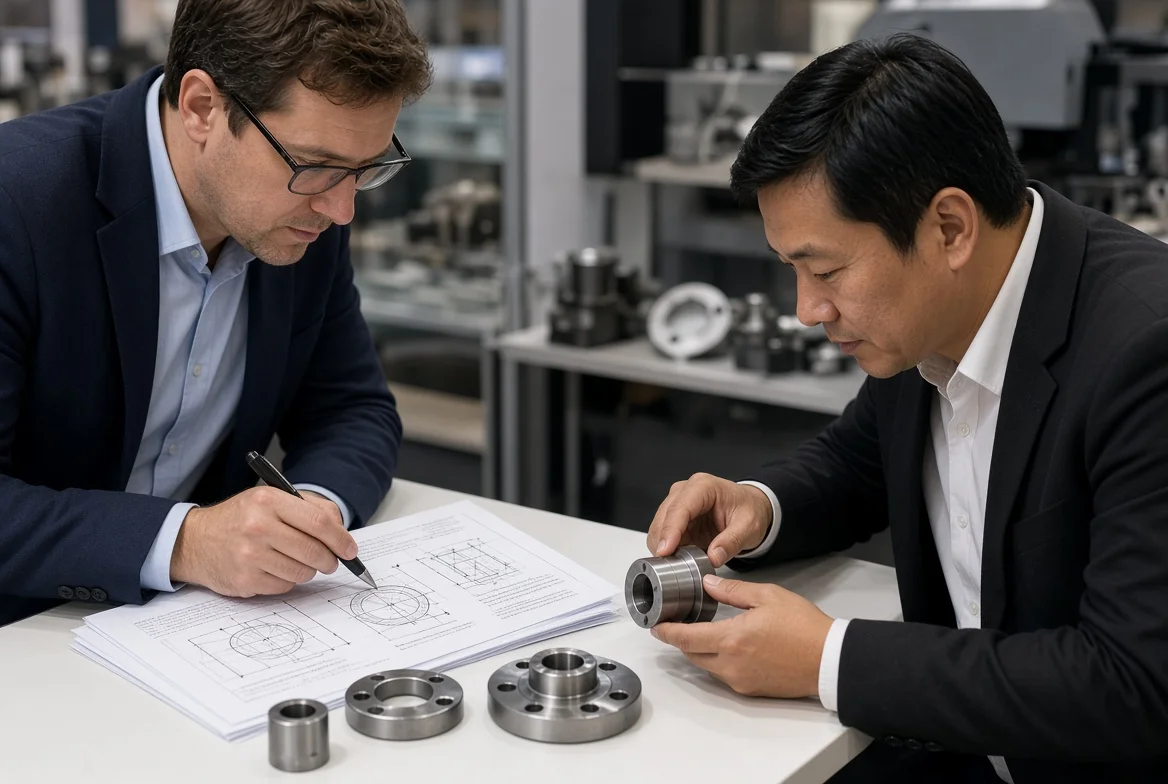
Screen Overseas Suppliers Before Sending Detailed RFQs
Screening saves you time in dealing with obviously unqualified prospects. Before asking for detailed quotations, samples or audits, establish the basic relevance, transparency, commercial viability and fit of the non-negotiables.
Verify supplier identity and supplier business model
Understand the difference between a manufacturer, trading company, distributor, sourcing agent and contract manufacturer. Both models are viable, but the buyer must know who is responsible for production, quality, pricing, communication and delivery.
Direct inquiry: Where the product comes from? Where is the production carried out? Does the company own the equipment or are you responsible for it? What processes are subcontracted? Final inspection done by whom? If there are quality problems who is responsible?
Seek Questions to Understand True Manufacturing Ability
Appropriate preliminary inquiry: What will the process of production be for this part? What equipment is applicable? What types of materials are usually processed? What kinds of testing are they doing? What is the normal production lead time? What quantity is the monthly capacity for similar items? Is there any similar product that the supplier has already produced?
A reliable supplier will typically have questions for clarification in return. A firm price without drawing reviews, materials, tolerances, or quantity is a sign of lack of understanding about the project.
Check Initial Communication Quality and Commercial Clarity
The initial responses can tell you a lot. Check for completeness, relevance of technical ideas, consistency, recognition of limitations, and supporting detail. The speed of response is a poor indicator. A later, but definite technical answer with some realistic assumptions is more likely to be reliable than an instant pat answer.
Verify Overseas Supplier Capability Before Making a Commitment
The extent of verification should be commensurate with risk. If it is a low value item, then it requires less review. Deeper evidence is typically needed for a custom product or a high value item, a regulated product, or a component that is required by a critical production line – this includes information about the factory, process capability data, quality records, capacity confirmation, and frequently a trial order.
Review the Factory, Equipment, and Process Capability
Ensure the supplier has the necessary equipment, know-how, personnel, engineering, and testing capacity for your product. Relevant equipment is not sufficient if the factory does not have the capacity to meet the tolerances, material control, or production volume required.
For CNC work, inquire about the size and type of machines, how tolerances are controlled, inspection equipment, material traceability, finishing processes and experience with similar parts.
Assess Quality Control and Documentation Practices
Inquire about the supplier's defect avoidance, nonconforming product detection, inspection data recording, incoming material control, revision control, corrective action and traceability (if required). Quality management certificates may be helpful supporting information however not the sole verification of actual controls in the project.
Check Capacity, Lead Time, and Continuity of Supply.
Any overseas supplier that you find reliable should be able to create over one order. Evaluate current capacity, production planning, production lead time, raw material supply security, equipment maintenance, current backlog and capacity to accommodate changes in volumes. Lead times quoted can indicate ideal conditions. Inquire about capacity allocations and what occurs when the availability of materials or labor changes.
Research References, Past Performance, and Relevant Experience
Appropriate references are used to give context. Instead of asking general satisfaction, ask specific questions regarding consistency of quality, timeliness, communication and corrective-action behavior. Complete reference sharing may be restricted due to confidentiality. In such instances, ask for anonymous case studies, samples of production, inspection reports, or an order for a controlled trial.

Compare Overseas Supplier Quotations Beyond Unit Price
Quotations from overseas vary in scope, assumption, materials, quality requirement, packaging, delivery terms. It is unusual for two prices to be directly comparable and given the same product name.
Use quotes as a way to compare prices.
Move the key variables: material grade and specification revision, quantity and MOQ, tooling costs, sample and testing charges, quality documentation, packaging and labelling, Incoterms, freight assumption, lead time, payment terms, warranty.
One supplier could quote a lower unit price if they are not including testing or are using a different grade of material. The other can be the addition of the mentioned material, testing and export packaging. Don't assume that the lower number is necessarily the lower-risk or lower total-cost choice.
Evaluate TCO
Ignore the unit price. Consider tooling, samples, freight, duties, inspection expenses, possible defects and rework, warranty liability, additional inventory, administrative resources and cost of late delivery. Practical visibility into real landed cost and operational risk; not a complex financial model.
Identify Quotation Red Flags
Be wary of any missing material information, unclear scope, low pricing with no explanation, missing lead times, vague quality commitments, inconsistent MOQ statements, missing tooling information, sudden price changes, unclear payment terms, or refusal to confirm any technical requirements in writing. Ask for clarification. A good supplier will provide for assumptions and adjust the quotation as requirements are clarified.
Use Samples and Trial Orders to Test Overseas Supplier Reliability
Samples and trial orders are used to bridge the gap between claims and actual performance. They are particularly significant for custom-made products, new suppliers from other countries and complex manufacturing.
Evaluate Samples Against Written Acceptance Criteria
Assess samples against established criteria: material, dimensions, fit, function, performance, appearance, packaging, labeling, test results and durability (if applicable). Document the evaluation. If changes are required, be sure to clearly communicate them and verify that the next sample or production run is the revised version.
Check if the Sample is a Mass Production
Inquire about the process of creating the sample. Have production tooling been used? Did normal production materials used? Was a standard testing sample used? What inspection procedure will be used during the production? Does the supplier have a pre-production sample or pilot run before order? Just because a sample is carefully made, doesn't necessarily mean it can be done in mass production.
Follow a Controlled Trial Order.
A trial order is used to check out actual performance: order confirmation / communication, production time, quality uniformity, packing, document correctness, delivery, and response to issues. Set up acceptance criteria beforehand. Determine what needs to be demonstrated before expanding volume or adding the supplier to an approved supplier list for continued purchases.
Warning Signs That an Overseas Supplier May Not Be Reliable
There is a single caution sign that might have an innocent explanation. If the supplier repeatedly fails to be consistent, to answer questions, to make realistic promises or to provide relevant evidence, this should take the process longer or the supplier should be eliminated from the short list.
Unusually Low Prices or Unrealistic Lead Times.
If the quotation is very low, or the lead time is very short, ask questions, don't accept it. Confirm material assumptions, quantity basis, capacity availability, testing scope, packaging and delivery conditions. Low prices for offers often end up costing a lot when essentials are either not specified or the production is unable to deliver on the promised schedule.
Lack of agreement in emails, documents and phone calls
Be wary of any discrepancies in the company name, place of manufacture, product description, terms, capacity, certificates or explanations provided by various contacts. The dependable supplier will be able to explain any confusion with supporting data, not just ‘yeah it's fine’.
A reluctance to discuss production, quality or problem handling.
Professional suppliers should be able to explain how they produce, what they check, what are their standards, how many they can produce, where the raw materials come from, and what they do if there is some quality problem or failure in production. The legitimate confidentiality is understandable. The concern comes when a supplier gives almost no information on their operations which would be relevant to a risk assessment.
Before Basic Verification, pressure to pay or commit.
Watch out for a supplier who requires a big deal, big deposit, or exclusive deal before basic specification, commercial terms, samples and capability checks are completed. The bigger the financial involvement, quality of exposure, or impact on customers, the more robust the verification should be prior to financial commitment or firm commitments.
Manage International Sourcing Risks Beyond Supplier Selection
Post first order supplier reliability must be maintained. Performance may vary when subject to volume pressure, schedule pressure, product change or demand increase. Continuous monitoring makes qualification a dynamic process.
Monitor the quality, delivery and responsiveness
Track practical metrics: delivery on time, incoming defect rates, customer returns, response time, corrective action effectiveness, documentation accuracy and consistency of quoted and actual performance. Tracking key metrics is possible with a simple spreadsheet by a small team. Formal scorecards can be used with larger teams!
Apply supplier issues to evidence for future decisions.
Decisions should be based on late deliveries, recurring defects, lack of communication and poor corrective action. Record issues, request remedial action if necessary, and determine acceptability of the supplier for the risk of the product. If there is one isolated issue, it does not necessarily mean that the whole thing needs to be replaced. Determine if the supplier is taking ownership, root cause, preventing recurrence, and communicating professionally.
Qualify Backup Suppliers for Critical Overseas Purchases
When sourcing products that are hard to replace, vital to production, are customer-facing, regulated or rely on proprietary tooling or special processes, consider dual or backup sourcing. Dual sourcing adds to the qualification effort and may have a negative impact on volume leveraging, but also may lower the risk of disruption if one supplier fails. Use the approach sparingly, on a category-by-category basis.
Final Guidance – Overseas Suppliers Are Verified Before They Are Trusted
One quotation, one certificate, one platform badge or one successful sample is not sufficient to choose a reliable overseas supplier for international manufacturing. They are chosen by well defined requirements, screening, verification based on evidence, comparable quotations, controlled trial orders and continuous performance review.
Use the process in a risk proportional manner. A routine low-risk purchase might require just a simple check and a test order. If it is a custom manufacturing project, a high-value product, or a product critical to production, there is a need to deepen the qualification of the part, inspection, factory evaluation, or backup sourcing. The buyers who consider the discovery of overseas suppliers to be the starting point of verification instead of the end of the search, consistently minimize surprises related to quality, delivery and cost.
Frequently Asked Questions
What is the typical time spent on finding and qualifying an overseas supplier?
The time varies depending on the level of product complexity and risks. The simple basic products can get from search to trial order in a few weeks. Requirements clarification, screening, verification, and sampling are often required for custom or high risk products, and may take several months for a controlled trial.
Should only work with manufacturers and not trading companies?
Not necessarily. Manufacturers have direct control over the manufacturing. For smaller volumes of items, for many items, or for markets where you have no local presence, a trading company or agent may be helpful. It's about knowing who is in charge of production, quality and accountability.
Should a factory Audit always be required prior to first order?
No. Align the depth of the match verification with risk. Some low value standard products might only require a sample or trial order and documentation review. Custom tooling, regulated products, high value products or critical parts typically warrant a more in-depth investigation such as a factory visit, third party inspection or formal audit.
What is the worst thing buyers do when they are looking for something overseas?
Taking the first low quotation, or polished platform profile, as an adequate testament of capability. The most frequent cause for quality, delivery and cost issues is not doing structured requirements definition, screening and verification.
How can I make a fair comparison of quotes from suppliers in different countries?
Normalize scope first – Material grade, quantity, tooling, testing, packaging, Incoterms, Lead time, payment terms. Next consider total cost of ownership (TCO) which incorporates freight and duties, quality risk, and potential rework or delay costs.
When is the right time to resort to dual sourcing of an imported product?
When the item has a long lead time or is essential to your production or customers, is regulated, or requires special tooling or processes. Dual sourcing requires additional effort and can lead to less volume leverage, thus use it only on higher-risk categories.
Are 'verified' badges or certificates on a platform enough on their own?
No: Platform badges and certificates as screening signals are a good idea. They are not a substitute for project-specific evidence of process capability, quality controls, capacity and performance during actual production.