
Supplier sourcing is the systematic process of identifying, evaluating, selecting, and engaging suppliers to fulfill a company's specified commercial, technical, quality, delivery and risk requirements. It begins well before an inquiry is sent and follows up after the first purchase order has been released.
The wrong supplier can lead to a lack of stability in product quality, delivery problems, unexpected costs, poor communication, failed product launches, or production delays. From understanding requirements to discovery and evaluation, supplier selection and onboarding to continuous monitoring, this guide provides a practical view of the supplier sourcing process and how to make clearer decisions and minimize sourcing risk.
What Is Supplier Sourcing?
Upstream activity of the supplier sourcing is the process of finding the suppliers, real capability of the suppliers, comparison of Total Commercial Value of the suppliers and finally the selection of the supplier who can provide the required product or service on the repeatable basis. It is used for raw materials, industrial parts, final products, packaging, machinery manufacture, custom manufacturing and some professional services, OEM and ODM projects.
It starts with an idea of what to buy, and not finding suppliers. Any other supplier list that follows without these specified, as well as any quotation comparison, will lack completeness and reliability.
The Core Purpose of Supplier Sourcing
The overriding objective is to get the most comprehensive supplier match, not the cheapest per unit. Fit is a combination of quality consistency, production capacity, technical competency, geographical and logistics exposure, compliance readiness, financial stability, and on-the-day responsiveness.
For instance, when a buyer is purchasing custom electronic assemblies, it may be willing to pay a little more per unit from a supplier that already performs in-process testing, has a secured supply chain for components and can document process controls. The cheaper option without such controls is likely to result in greater rework, greater scrap, delayed delivery and customer complaints – making the total cost significantly higher than the initial difference in quotation.
Supplier Sourcing in a B2B Environment, please continue reading to learn more about the process.
In B2B buying, there are typically more factors to consider than consumers. When buying, one needs to consider drawings, material specifications, dimensional tolerances, ownership of tooling, MOQs, production schedules, export documentation, quality plans and continuity of supply. Regular catalog items can enable quicker comparison and price, availability and delivery. Custom engineered or regulated products will require more thorough technical validation, process audits, and formal qualification before the volume commitment.
Where does Supplier Sourcing fit in Sourcing, Purchasing and Procurement?
The sourcing is mainly the identification and selection phase. Typically, purchasing and procurement involves ordering, receiving, payment, contract administration and follow-up supplier performance management. Decisions made upstream are clearer, meaning issues are less likely to occur downstream. You can read more about the differences between the three activities in our article on the topic: Supplier Sourcing vs Procurement: What Is the Difference?
Supplier sourcing is crucial for B2B buyers for several reasons.
The decisions of suppliers have a direct impact on product quality, gross margin, on-time delivery, inventory, customer grievances, time to market and the ability to cope with disruption. Weak sourcing is not just troublesome invoices; it has operational implications that show up on the production line and in relationships with customers.
The price per unit is not the only factor that influences the total cost of a supplier.
Total cost of ownership consists of the unit price, freight, duties, inspection labor, rework and scrap, warranty claims, inventory carrying cost, downtime and administrative work necessary to deal with issues. A supplier with a 12 percent lower quote, but with poor quality and longer lead time can easily create a higher landed cost when these factors are calculated. It is important that, therefore, the complete commercial effect of each supply arrangement is compared and not just the headline price.
Supplier Sourcing decreases supply and top quality risk.
Structured sourcing is a method that eliminates assumptions, marketplace badging and selling promises and substitutes documented evidence of production capability, quality systems, references, export experience, capacity and communication practices. Whilst risk cannot be removed, particularly from international supply chains, it can be identified, prioritised and managed before it turns into an expensive operation.
Good Sourcing is an Enabler for Long-Term Supplier Relationships.
With strategic components, custom products, or repeat orders, it is often a supplier that can support you with process improvements, engineering change support, quality problem resolution, and capacity scaling. Transactional suppliers continue to be suitable for low criticality items. Well-known supplier sourcing strategy includes matching the relationship model to criticality/complexity of purchase.
Supplier Sourcing Process: From Requirements to supplier selection
It is important to understand that supplier sourcing is best done as an iterative process and not a one-time effort. The subsequent steps offer a useful guideline for any level of risk and complexity in any purchase.
Stage | Buyer Objective | Key Output |
|---|---|---|
1. Define requirements | Establish clear commercial, technical, and supply criteria | Specification package and decision criteria |
2. Identify potential suppliers | Build a relevant longlist | Qualified longlist of candidates |
3. Screen and verify | Confirm basic fit and eliminate obvious mismatches | Shortlist for deeper review |
4. Request quotations, samples, evidence | Obtain comparable commercial and technical data | Normalized RFQ responses and sample results |
5. Evaluate, select, onboard | Choose and prepare the supplier for production | Approved supplier and onboarding plan |
Step 1: Define Product, Commercial, and Supply Requirements
Without clear requirements, a buyer cannot do a proper evaluation of suppliers. They usually contain specifications or drawings, material requirements, required performance, quantity estimates, a target price range, minimum order quantities, and lead time, packaging requirements, required certifications, testing requirements, delivery address, and regulatory or customer compliance requirements. A lack of requirements leads to partial quotations and makes it difficult to compare them later and aggravates the risk of scope disputes after the order has been placed.
Step 2: Search for Potential Suppliers – Multiple Searches
Online B2B platforms, search engines, trade shows, industry associations, professional referrals, sourcing agents, import databases, and supply-chain contacts are all possibilities for potential suppliers. However, certain channels are best suited for particular requirements, for instance, a specialized industrial component supplier is often found through industry networks, instead of a general marketplace. The first step is to make a longlist, then narrow. Supplier Search Methods: Online Platforms, Trade Shows, and Sourcing Networks and Where to Find Manufacturers and Suppliers for New Products provide practical methods for finding suppliers.
Step 3: screening and verifying supplier suitability.
Initial screening involves assessing if the supplier is a manufacturer or supplier of the relevant product, if they have the capacity to supply the product, if they also supply similar products to the same market, if they can meet the MOQ requested and if they can be deemed commercially responsive. Issues to watch are when they don't return calls to ask for technical details, when they don't look at the specifications before quoting, when they promise leads times that are too quick, or when they cannot answer questions on their quality processes. How to Identify Real Manufacturers vs Trading Companies is covered in this topic.
Step 4: Ask for Quotes, samples and technical evidence
A structured RFQ will request that suppliers break out the elements of tooling, unit price, packaging, testing, freight assumptions, payment terms, lead time, validity period, and conditions that impact price. Samples should be assessed based on agreed criteria and not made on the fly. If a sample of custom work is being used, be sure to request whether it was hand-built, made using temporary tooling, or made using regular production conditions.
Step 5: Check, Choose, and Acquire the supplier
Suppliers' information is translated into a documented decision using the technical, commercial, quality and risk criteria. Onboarding next validates specifications, quality requirements, contact points for communication, purchase-order terms, inspection requirements, change-control expectations and escalation procedures. This information is covered in greater detail in the guidance: Supplier Qualification Process: A Guide for Procurement Teams.
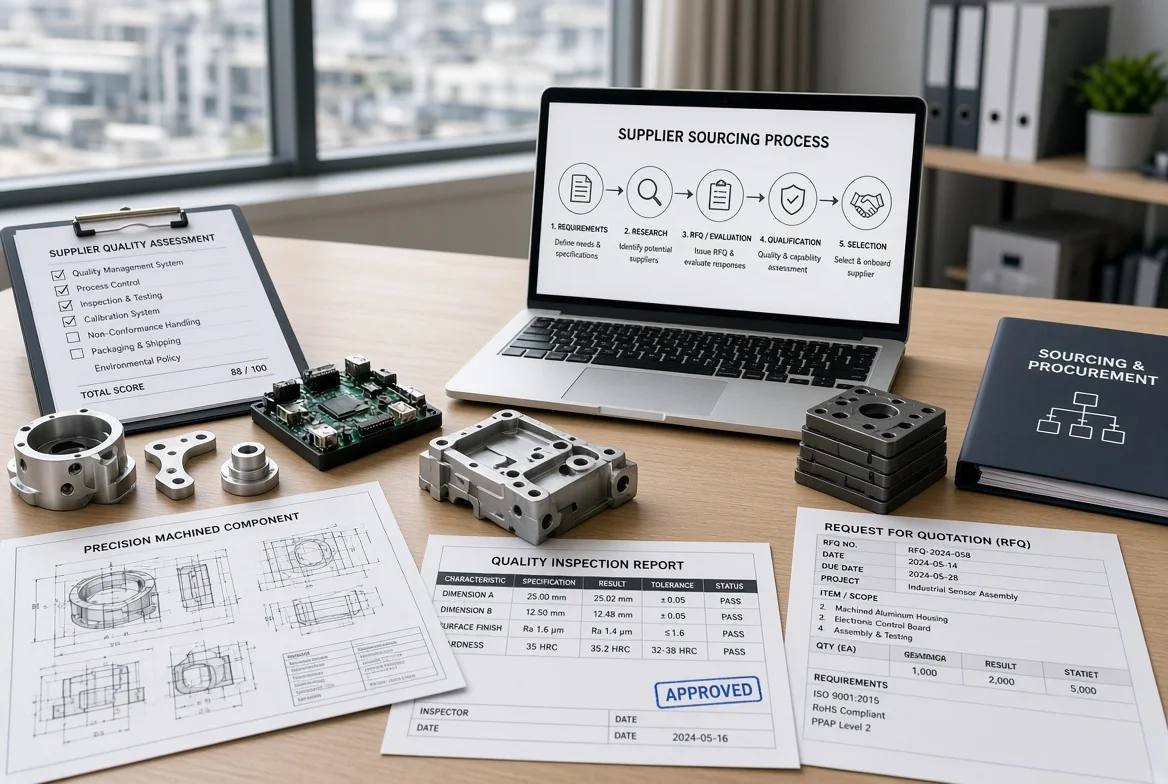
How to Find Suppliers That Match Your Requirements
Just any company that can make an article with a similar appearance is not the right supplier. It is a company that has the capabilities, commercial model, geographic positioning and operating standards adapted to what the buyer really needs. Search criteria should therefore be driven by requirements, and not the other way around.
Select Appropriate Supplier Type For Project
The typical buyers are manufacturers, trading companies, distributors, contract manufacturers, OEM suppliers, ODM suppliers and specialized service providers. Mixed-product consolidation might be achieved by a trading company. A direct manufacturer is typically better for custom development, process visibility and large volume repeat orders. There is no one model superior to other, depending on the project. Also refer to How to Identify Real Manufacturers vs Trading Companies.
Correlate Supplier Capabilities to Product Complexity
For simple standard items, these are mostly assessed with respect to pricing, availability, certification and delivery. The required documentation and quality, engineering review, material traceability, and production equipment capability, test capability, and tooling expertise are needed for custom parts. Before you start the outreach, make a short list of essential capabilities, such as CNC tolerance capability, food-contact packaging or electronics testing, or injection-molding or export packaging.
Look at Local, State and International Sources of Supply
Geographic decisions are more than about the price of the factory or the price of the labor. Freight, transit time, import taxes, communication time zones, site-visit feasibility, trade restrictions, IP exposure, currency risk, and supply-chain resilience all are important. Location is determined by product complexity, volume, technical requirement, market timing, quality exposure, regulatory requirements, and the risk appetite. For more details, you can refer to International Supplier Sourcing Guide for Global Buyers, How to Find Overseas Suppliers for International Manufacturing and China Supplier Sourcing Guide: How Global Buyers Find Reliable Manufacturers.
Before you make a supplier decision, you need to know how to evaluate a supplier.
Evaluation of the supplier shall be based on evidence. Claims made on websites and catalogs, certificates and sales presentations are starting points and not proof of consistent performance under real operating conditions with the buyer.
Capability for Technical and Manufacturing
Check production equipment, process control, engineering support, tooling capability, sourcing of materials, testing equipment, capacity planning and experience with similar products. Questions to ask include: What will be the production process? What inspection points exist in the process? What is the normal amount of production? What are the methods of controlling engineering changes? More information can be found in How to Assess Supplier Manufacturing Capabilities Before Cooperation.
Quality Systems and Product Consistency
Review the supplier's defect prevention, defect detection, defect documentation, corrective action and traceability. A quality certificate may be helpful supporting evidence but is not a substitute for the need for product and process specific verification. Ask for sample test results, process flow documentation or relevant quality manuals, if applicable. Refer to Factory Evaluation Checklist for International Buyers.
Commercial Reliability & Communication Quality
Evaluate the clearness of quotations, payment terms, responsiveness, ownership of issues, willingness to disclose limitations, lead-time realism and consistency of communication. Lack of scope clarity and communication often turn into conflicts once production is underway. Record any agreed assumptions prior to issuing an order.
Compliance, Sustainability and Supply Risk
Compliance varies according to the product and market country. Considerations may include product safety, restricted substances, labour practices, environmental requirements, documentation, export controls, or industry specific requirements. Before final approval, identify the regulations and customer requirements that are applicable for the specific product, market and/or industry. Don't consider generic certificates as generic evidence of fitness.
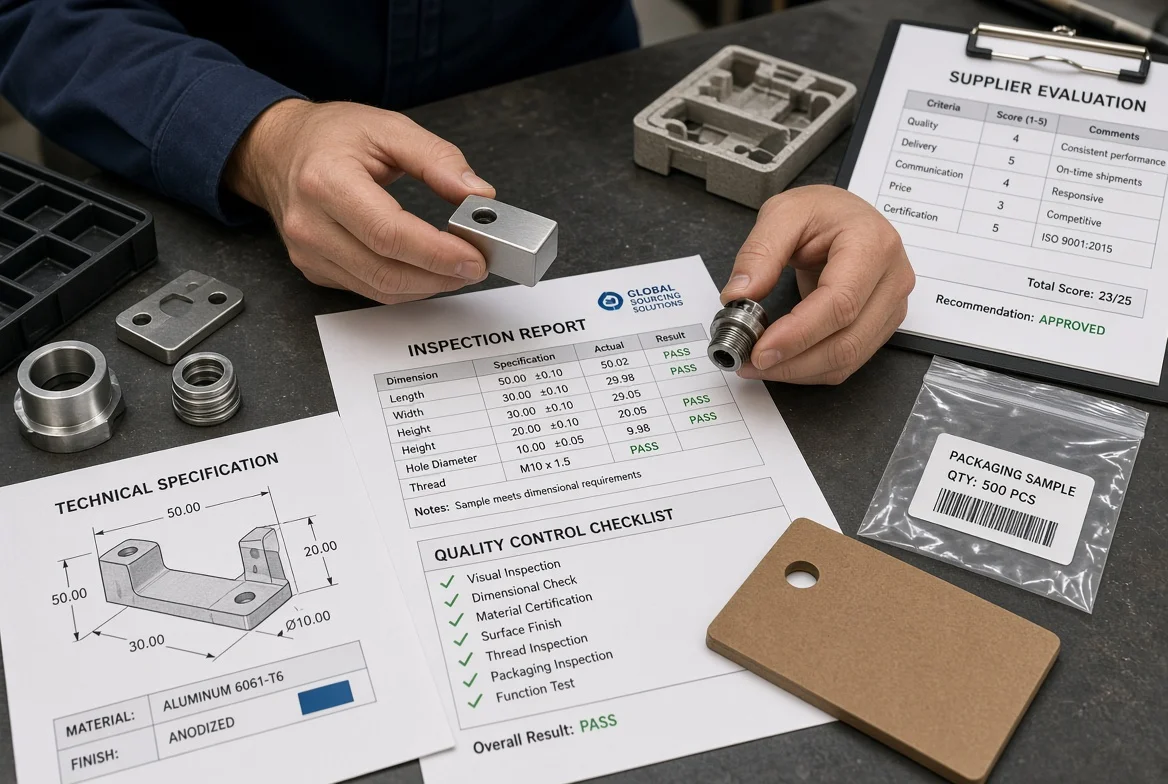
Common Supplier Sourcing Mistakes B2B Buyers Should Avoid
Quick sourcing or incomplete sourcing leads to expensive issues which are hard to rectify once production has started. Knowing what kind of error a mistake is in practice, will enable buyers to intervene earlier.
Making a selection based on the Lowest Quote without comparing scope.
Often, quotes are not comparable due to the fact that the supplier assumes other materials, tolerances, tooling, packaging, testing, freight terms, or order quantities. A low price could just be an omission of requirements and not necessarily a sign of greater efficiency. Do not assume any two prices to be equal without first normalizing scope and assumptions.
Not Conducting Supplier Verification Due to the Appearance of an Established Supplier
Clean websites, marketplace badges, catalogues, certificates, and salespeople can only be seen as a beginning of the validation process, and certainly not as guarantees of production capacity – or financial security for that matter. Practical verification consists of process evidence, sample review, video calls, business-detail checks, references as appropriate, third party audits for high-risk projects, and/or controlled trial orders.
A decision to Approve a Sample before Mass-Production Readiness is validated.
Samples can be made by skilled people, with hand picking, with temporary processes and/or with extra attention and care during the making of the product than is given during regular production. Approved samples should be correlated to production specifications, inspection requirements, packaging requirements, and change control requirements. A pilot run or pre-production sample under normal conditions is recommended prior to large-scale purchasing for products with a higher risk.
Not planning for supplier dependence and disruption
When a buyer is sole-source reliant on a critical item, they are vulnerable to limits on supply, quality issues, materials shortages, logistics delays, and trade disruptions. Practical risk reduction solutions include: Approved backup supplier, dual sourcing of critical items, safety stock, capacity reviews, documented tooling ownership and periodic performance reviews.
What is a Good Supplier Sourcing Strategy?
A sourcing strategy is a repeatable framework for decision making about what to buy, where to buy it, how many suppliers to engage, what level of risk is acceptable and how supplier performance will be managed over time. It needs to be simple, both for small businesses and formal procurement units.
Categorize Suppliers according to Spend, Risk and Business Impact
All suppliers do not need the same level of due diligence and control. If a packaging item is low value and easy to replace, it does not require such a complex process as a custom safety critical component or a sole source contract manufacturer. Segmentation enables buyers to focus time and resources where it is most needed.
Develop Selection Criteria for Suppliers Prior to the Search
Prior to receiving the quotations, identify weighted decision criteria, quality capability, technical fit, total cost, capacity, delivery performance, compliance, location, responsiveness, financial stability. This gives less incentive to select according to how they communicate and/or the initial ‘best looking' price. Check out Supplier Evaluation Criteria: 10 Factors Every Buyer Should Check.
Repeat the supplier performance review process post-selection.
The process of sourcing doesn't stop once it is approved. Track on-time delivery, defect rates, responsiveness, corrective action performance, cost changes and overall relationship quality. Performance information should be used as input for future sourcing decisions, supplier development and contingency planning. Supplier Scorecard: How Procurement Teams Measure Supplier Performance describes practical methods.
When should a Buyer take advantage of a Formal Supplier Qualifications / Audit Process?
Due diligence should be commensurate with the risk of the purchase. Formal Qualification or Audit is particularly relevant if the supplier can have an impact on product safety, regulatory compliance, customer commitments, high volume production, proprietary tooling or on Business Continuity. Don't assume every low dollar purchase is a large audit engagement and don't assume that a strategic supplier is a simple purchase on the internet.
Circumstances where more detailed supplier due diligence is warranted
These are generally items that require more extensive evaluation for custom product development, regulated or medical products, high dollar tooling investments, critical industrial components, long-term supply contracts, high annual spend, first-time sourcing overseas and suppliers with the authority to hold buyer owned material and/or intellectual property. Document review, factory visits, sample testing, financial checks, reference checks, third party audits and formal quality agreements are examples of methods. The requirements will vary from industry to industry and from region to region.
The difference between Supplier Evaluation and Supplier Audit.Supplier Evaluation and Supplier Audit.
Supplier evaluation is the general evaluation of suitability in terms of technical, commercial, quality and risk. An audit is a more systematic review of systems, processes, records and operating conditions. An audit can be a component of a qualification, but is not the sole instrument. For more distinction, see the articles about Supplier Audit vs Supplier Evaluation.
Key Takeaway: Supplier Sourcing Must be a Repeatable Business System
The important elements of effective supplier sourcing are the clear definition of requirements, search for suppliers, confirmation of supplier's ability through evidence, comparing value rather than just price, and managing suppliers following selection. Think of it as a repeatable business system and not just a series of one-off searches.
Use this guide as a good starting point for a more serious method. Take a look at how you are currently choosing your suppliers, and find one thing that is weak in your approach – perhaps you don't have clear specifications, or you don't compare quotations thoroughly, or you don't get sufficient verification, or you don't do a good enough job of reviewing your performance? – and correct it before your next major supplier purchase.
FAQ
What is the difference between supplier sourcing and supplier procurement?
Supplier sourcing is involved in the identification, evaluation and selection of suppliers. Procurement generally includes the overall processes of ordering, receiving, paying, contract management and continuous supplier performance monitoring.
What is the average supplier sourcing process?
It can take days or a few weeks to make simple catalog purchases. The time for custom or higher-risk projects can be several weeks to months including the requirements definition, screening, sampling, and qualification.
Does it always make sense to go with the cheapest supplier?
No. Unit price is not the total cost. The headline price is often not the deciding factor as quality consistency, lead time reliability, technical support and exposure to risk are often important factors.
When is an Audit needed in a Factory?
Audits come into greater effect when the product is safety critical, regulated, spends a lot of money annually, large investment in tooling, first time supplier from foreign country, or where supply disruption would have a large impact on the business.
Does a sample approval ensure the quality of production?
No. Samples can be manufactured under conditions that are not necessarily normal production. Attach sample approval to specific production requirements, inspection plan, change-control process, and potentially consider a pilot run for higher risk items.
What is the optimum number of suppliers for a critical part?
This depends on how critical the item is, how much it's in use, and whether there are qualified alternatives available. While some parts may only be available from one source, many critical parts can be sourced from two or more sources, or from an approved backup supplier, minimizing the risk of disruption.