
# Supplier Scorecard: How Procurement Teams Measure Supplier Performance
A supplier scorecard is a structured tool that procurement teams use to measure supplier performance across defined criteria such as quality, delivery, cost, responsiveness, and risk. It converts subjective impressions into comparable, data-driven assessments that support consistent decisions on volume allocation, development plans, escalation, or exit.
Effective scorecards are never generic templates filed away after creation. They reflect the buyer’s actual priorities, product risk profile, and supply-chain strategy, and they create a shared language for supplier reviews. When designed and used properly, a supplier scorecard moves teams from gut feel to evidence-based management and reduces the chance of repeating the same performance problems across categories.
What Is a Supplier Scorecard and Why It Matters
A supplier scorecard aggregates multiple performance metrics into a clear, comparable view of each supplier over time. It is the practical bridge between raw operational data and the decisions procurement teams must make every quarter.
Purpose of a Supplier Scorecard
Scorecards serve several concrete purposes. They allow side-by-side comparison of suppliers competing for the same volume. They surface trends—improving or deteriorating—before a single major incident forces reactive action. They supply objective data when internal stakeholders challenge a sourcing recommendation. And they give structure to improvement conversations with the supplier itself.
In practice this means a category manager can point to three consecutive quarters of rising defect rates and declining on-time delivery rather than relying on anecdotal complaints from the production floor. The same data can justify shifting volume to a higher-scoring supplier or opening a formal development plan with the under-performer.
Benefits for Procurement Teams and the Business
For procurement teams the immediate benefits are reduced bias and consistent comparisons. Two buyers evaluating the same set of suppliers arrive at similar conclusions because the criteria and weighting are predefined. Early-warning signals appear in the numbers long before quality escapes or line stoppages become visible at the plant level.
The wider business gains more reliable supply, more predictable quality, and clearer total-cost visibility. Quality, operations, finance, and even executive teams can reference the same scorecard when discussing supply-chain risk or capacity planning. The scorecard stops being a procurement document and becomes a shared management tool.
Common Misuses and Pitfalls
The most frequent failures are easy to recognize. Teams load the scorecard with twenty metrics that no one has time to update. Ownership is left undefined, so data becomes stale. Results are reviewed once a year and never linked to volume decisions or contract renewals. Or a single corporate template is forced onto every category, ignoring that a critical electronic component and a standard packaging item need different emphasis.
A usable scorecard is simple enough to maintain and directly tied to real sourcing decisions. If the numbers never change allocation, development priority, or exit timing, the process has already failed.

Core Dimensions of a Supplier Scorecard
Most practical scorecards cover a core set of performance dimensions. The exact mix and relative importance depend on the product’s risk level, the company’s strategic priorities, and the structure of the supply base.
Quality Performance
Quality is almost always a foundational dimension. Typical metrics include incoming defect rate (PPM or percentage), line-reject rate, customer returns attributable to the supplier, number of quality incidents, effectiveness of corrective actions, and findings from process or system audits.
Definitions must be precise and consistent. “Defect rate” should specify whether it is measured per million pieces, per shipment, or per production lot, and the data source (incoming inspection, production quality system, or customer complaints) should be documented. Without clear definitions, scores become incomparable across buyers and time periods.
Delivery and On-Time Performance
Delivery performance tracks whether the supplier ships what was promised, when it was promised. Core measures include on-time delivery rate (to the original confirmed date), lead-time adherence, frequency of expedites, and the operational impact of late deliveries on the buyer’s production schedule or customer service levels.
A useful distinction is “on-time to original promise” versus “on-time after the buyer expedited.” The second figure can mask chronic capacity or planning problems. Teams that only track the second number often discover too late that the supplier is systematically over-promising.
Cost and Commercial Performance
Cost metrics may cover unit-price trends over time, elements of total cost of ownership, price competitiveness relative to the market, documented cost-improvement initiatives, and billing accuracy. For many standard items these factors carry significant weight.
For critical or high-risk suppliers, however, cost should rarely dominate. A supplier that is 5 % cheaper but consistently late or shipping defective material usually costs the business more in overtime, scrap, and lost sales than the apparent unit-price advantage.
Responsiveness, Communication, and Service
Soft factors—response time to inquiries, clarity of communication, problem-solving behavior, flexibility when demand changes, and willingness to invest in process improvement—often determine whether a relationship is workable day to day. These are best captured through structured 1–5 or 1–10 ratings with written definitions for each score level, rather than free-form comments that vary by reviewer.
Risk, Compliance, and Strategic Fit (Optional)
For critical suppliers, regulated products, or long-term partnerships, additional dimensions are frequently added: audit scores, open corrective-action status, regulatory or ethical compliance, financial health indicators, geographic concentration risk, and strategic alignment with the buyer’s technology or capacity roadmap. These elements help surface risks that pure quality-delivery-cost metrics may miss.
Selecting Metrics and KPIs for Your Scorecard
Choosing the right metrics matters more than the absolute number of metrics. A focused, decision-useful scorecard outperforms a complex one that is inconsistently maintained.
Start With Business Priorities and Risk Profile
Begin with the business’s current pain points and risk profile. A company suffering frequent line stoppages will weight delivery and quality heavily. A cost-driven private-label business may emphasize total cost of ownership and price competitiveness. A regulated medical-device buyer will elevate compliance and quality-system metrics. The scorecard should mirror these priorities rather than follow a generic industry list.
Choose Measurable, Data-Backed KPIs
Every metric should be measurable from existing systems or a clearly defined rating process. Defect rates, on-time percentages, average response times, number of quality incidents, and audit scores are examples of data-backed measures. Vague notions such as “good communication” need to be translated into observable behaviors or calibrated rating scales before they enter the scorecard.
Avoid Metric Overload
Too many metrics dilute focus and increase the administrative burden. Most mature teams settle on five to eight core metrics per supplier category. Additional metrics are added only when they demonstrably improve decision quality. A scorecard that cannot be updated reliably every review cycle is worse than a simpler one that is.
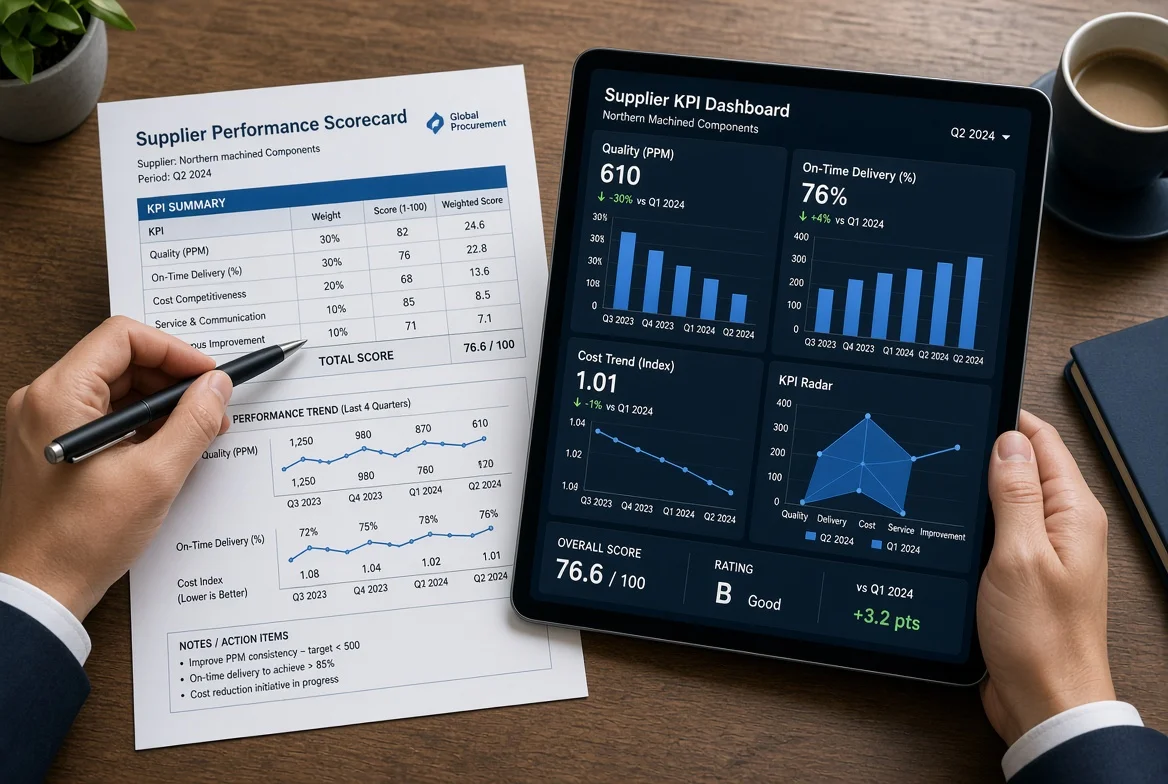
Weighting and Scoring Models
Weighting and scoring turn individual metric results into an overall supplier score that can be compared and tracked over time.
Simple Weighted Scoring
A common approach assigns percentage weights to each dimension—for example quality 40 %, delivery 30 %, cost 20 %, service 10 %—scores each dimension on a consistent scale (1–5 or 0–100), then calculates a weighted total. Weights should reflect current business priorities and risk, not historical habit. When priorities shift, the weights should be reviewed and adjusted deliberately.
Category-Specific Weighting
Different categories often require different weightings. Critical custom components may place 50 % or more of the weight on quality and delivery combined, while standard catalog items may give higher weight to cost and service. Documenting category-specific rules keeps scoring consistent across buyers and prevents arguments about why two suppliers in different categories received different overall grades for similar raw performance.
Traffic-Light or Grade-Based Models
Some organizations prefer traffic-light (red / yellow / green) or letter-grade (A–F) presentations because they communicate faster to non-procurement stakeholders and to suppliers. The underlying data and calculation method must still be transparent and consistent; the simplified presentation is only a communication layer on top of the same rigorous scoring.
Data Collection, Ownership, and Review Cycles
A scorecard has no value if the data is incomplete, outdated, or never reviewed.
Data Sources and Systems
Data typically comes from ERP transaction history, quality management systems, incoming-inspection records, logistics and ASN data, supplier portals, and structured manual ratings. Each metric needs a defined source and calculation method. For smaller teams a well-designed spreadsheet is often sufficient, provided the definitions and update responsibilities are written down and followed.
Ownership and Accountability
Someone must own the process—usually a category manager, supplier-quality engineer, or dedicated procurement analyst. That person ensures data is refreshed on schedule, reviews are held, and low scores trigger the agreed escalation path. When ownership is diffuse, the scorecard quietly dies.
Review Cycles and Cadence
Critical or volatile suppliers are commonly reviewed monthly or quarterly. Lower-risk, stable suppliers may be reviewed semi-annually or annually. The review itself should be linked to decisions: volume allocation for the next period, whether a development plan is required, or whether escalation or exit planning should begin. A review that produces no action is largely ceremonial.
Using Scorecard Results in Sourcing Decisions
The real test of a supplier scorecard is whether the numbers change actual sourcing behavior.
Volume Allocation and Supplier Rationalization
High-performing suppliers can receive preferential volume, longer-term agreements, or preferred-supplier status. Low-performing suppliers may see volume reduced or be placed on formal development plans. Because the scores are documented and consistent, these decisions are easier to explain to both internal stakeholders and the suppliers themselves, reducing perceptions of favoritism or sudden change.
Supplier Development and Improvement Plans
Scorecards highlight specific areas for improvement—quality consistency, delivery reliability, communication discipline, or cost trajectory. Joint improvement plans with measurable targets and review dates turn the scorecard into a development tool rather than a pure rating mechanism. Many suppliers respond constructively when they understand exactly where they stand and what “good” looks like.
Escalation, Risk Mitigation, and Exit Decisions
Persistent low scores, especially on quality or delivery for critical items, should trigger predefined escalation: senior management discussion, addition of backup capacity, or formal exit planning. Acting on trend data is far less disruptive than reacting after a major quality escape or prolonged shortage has already damaged customer relationships.

Communicating Scorecards to Suppliers
How results are shared with suppliers strongly influences whether the scorecard improves the relationship or creates defensiveness.
Sharing Results and Expectations
Relevant scorecard results and the underlying expectations should be shared with the supplier. Transparency reduces surprises and helps the supplier focus resources on the dimensions that matter most to the buyer. Most professional suppliers prefer clear, data-based feedback over vague dissatisfaction.
Joint Reviews and Continuous Improvement
Scorecard reviews can form a standing agenda item in regular business reviews. Trends, root causes, and joint improvement actions are discussed together. Strong performance can be recognized; persistent weak performance is addressed directly but factually. The goal is continuous improvement, not public ranking.
Balancing Transparency and Sensitivity
Not every internal risk rating or strategic assessment needs to be fully disclosed. Teams should share the performance dimensions that the supplier can influence while protecting confidential commercial or risk information. The overall stance remains constructive: the scorecard exists to improve mutual performance, not to create a public league table.
Designing a Practical Supplier Scorecard Process
A workable process starts simple and is refined only after it is used consistently.
Start Simple, Then Refine
Begin with a limited set of core metrics, clear weights, defined data sources, and a realistic review cadence. Once the routine is stable and decisions are actually influenced by the scores, metrics, weights, and frequency can be adjusted. Over-engineering at the launch stage is one of the most common reasons scorecard programs are abandoned within a year.
Link Scorecards to Existing Processes
Scorecards gain staying power when they feed existing processes—supplier qualification gates, contract-renewal decisions, sourcing-event shortlists, quality-system reviews, and risk assessments—rather than sitting as a parallel, optional activity. When the scorecard is required input for volume decisions or preferred-supplier status, it is maintained.
Monitor and Improve the Scorecard Itself
Periodically examine the tool: Are the metrics still aligned with current business priorities? Is the data reliable and timely? Are the weights still appropriate? Is the scorecard actually changing decisions for the better? Treating the scorecard as a living management instrument, not a one-time project, keeps it relevant as the supply base and the business evolve.
A well-designed supplier scorecard does not eliminate judgment. It disciplines judgment with consistent data so that procurement teams, and the business as a whole, can allocate volume, develop suppliers, and manage risk with clearer eyes and fewer surprises.
Frequently Asked Questions
What is the difference between a supplier scorecard and a simple KPI list?
A KPI list tracks individual metrics. A supplier scorecard aggregates those metrics under defined weights, produces a comparable overall score, and is explicitly linked to sourcing decisions such as volume allocation or development plans.
How many metrics should a practical supplier scorecard contain?
Most effective scorecards use five to eight core metrics per category. More metrics increase administrative load and often reduce consistency of data collection.
Should every supplier be scored the same way?
No. Critical or high-risk suppliers usually carry heavier weight on quality, delivery, and risk dimensions. Standard or low-risk items can place more emphasis on cost and service. Category-specific weighting keeps the tool relevant.
How often should supplier scorecards be reviewed?
Critical suppliers are commonly reviewed monthly or quarterly. Lower-risk suppliers may be reviewed semi-annually or annually. The cadence should match performance volatility and the speed at which volume or contract decisions are made.
Can a small procurement team run a supplier scorecard without expensive software?
Yes. A disciplined spreadsheet with clear metric definitions, named ownership, and a fixed review calendar is sufficient for many mid-sized teams. The discipline of use matters more than the technology platform.
What should happen when a supplier consistently scores poorly?
Persistent low scores, especially on quality or delivery for critical items, should trigger a formal development plan, volume reduction, escalation to senior management, or exit planning—according to pre-agreed thresholds rather than ad-hoc reaction.
Is it useful to share the full scorecard with the supplier?
Sharing the performance dimensions the supplier can influence, together with clear expectations, usually improves focus and trust. Internal risk or strategic ratings may be kept confidential. The intent remains joint improvement, not ranking for its own sake.