
The information that should be included in the manufacturing RFQ is the set of information that the factory requires to quote the same product in the same manner: basics of the buyer and project, scope of the product, drawings and product specifications, materials, quantity, quality or testing, packaging, delivery, commercial terms, and instructions for response. Manufacturers never quote by a photo or a Product Name. They quote materials, process, labour, tooling, inspection, volume and risk. Without any fields to be completed, assumptions must be made.
Even if a photo or CAD file is provided, a lot of different material grades, tolerances, quantities, testing, packaging and delivery options can still exist. The point isn't the length of the document. A controlled package means that several suppliers are quoting the same scope and you can compare like for like. To view the entire writing sequence, refer to How to Create an RFQ for Manufacturers.
Start with the RFQ Project and Buyer Information
An RFQ should start with sufficient administrative background to ensure that the supplier understands the requester, the project in which the request is being made and how that request should be responded to. Until the same factory is preparing for three revisions, two part numbers, and a sample request from the same buyer, that doesn't seem so simple. If there are no identifiers, the quote returns to the incorrect drawing and/or the incorrect deadline.
Buyer Company and Contact Information
Add company name, contacts name and phone number (if you have one to receive technical issues), department, email address, and business location or targeted delivery area. This is a way for suppliers to create a formal quotation, verify export conditions and communicate with the appropriate person rather than an inbox shared by everyone.
RFQ Number, Project Name, and Issue Date
Assign a reference number, project name, a project issue date and a quotation date. It's important to keep track of documents when sending revisions. The supplier should be able to state the RFQ number that the response is for, the drawing revision, quantity schedule and date of due. Tolerances can be revised at any time and the revised tolerance should be dated in the next issue, with a revision note to prevent mixing older quotes with the current one.
Sourcing Stage and Project Objective
Specify if the requirement is for prototyping, sample builds, production to be qualified for a pilot run, first order for mass production, repeat order, cost benchmarking, alternate supplier qualification, or future sourcing. Prototype pricing is not equal to low volume pricing; it is not equal to recurring volume pricing. The stage has different tooling and setup, it buys different materials, it has different labour efficiency profiles and it has different production planning requirements. This can be part of the bigger RFQ Supplier Selection to Final Quotation.
Define the Product and Scope of Supply
The RFQ should include the supplier's quotation. Identify the product and draw a line under the responsibility: a part, a sub-assembly, a complete product, a kit, packaging, labelling, testing, or goods for shipment. One of the primary causes that quotations cannot be compared is scope confusion. Both factories quote the body that has been machined. Other quotes the body, hardware, and assembly along with the export carton. They are two looks that resemble “the product.”
Product Name, Part Number, and Revision
Each line item must have a product name, a buyer part number, drawing number if there is a drawing, and a revision level. The identifiers should be as per the attached files and samples. Unless there are controlled dimensions, materials, and criteria for acceptability, don't use “same as last order” or “similar to sample” or “same as competitor part.” The informal language is the language used by two suppliers when they quote two products.
Scope of Supply and Responsibility Boundaries
Write what is in and what is out: raw material, bought out components, fabrications, assembly, testing, labelling, packaging, tooling, spare parts, documentation, delivery. Connectors and/or electrical testing can be part of a cable-assembly RFQ. The OEM consumer product RFQ may contain assembly, retail pack, label and outgoing inspection. An industrial-part RFQ might contain material certificates and dimensional reports. If buyer provides a critical component, indicate this. If it must be obtained from outside the factory, indicate that.
Reference Samples, Photos, and Existing Products
Samples and photographs for appearance, structure and function. They don't replace controlled requirements. Indicate if the sample is for reference, approval, reverse engineering or comparison. Determine sample numbers, revision status, ownership, and return rules. If the two documents are contradictory, state which one is correct.
## Include Technical Specifications and Manufacturing Documents
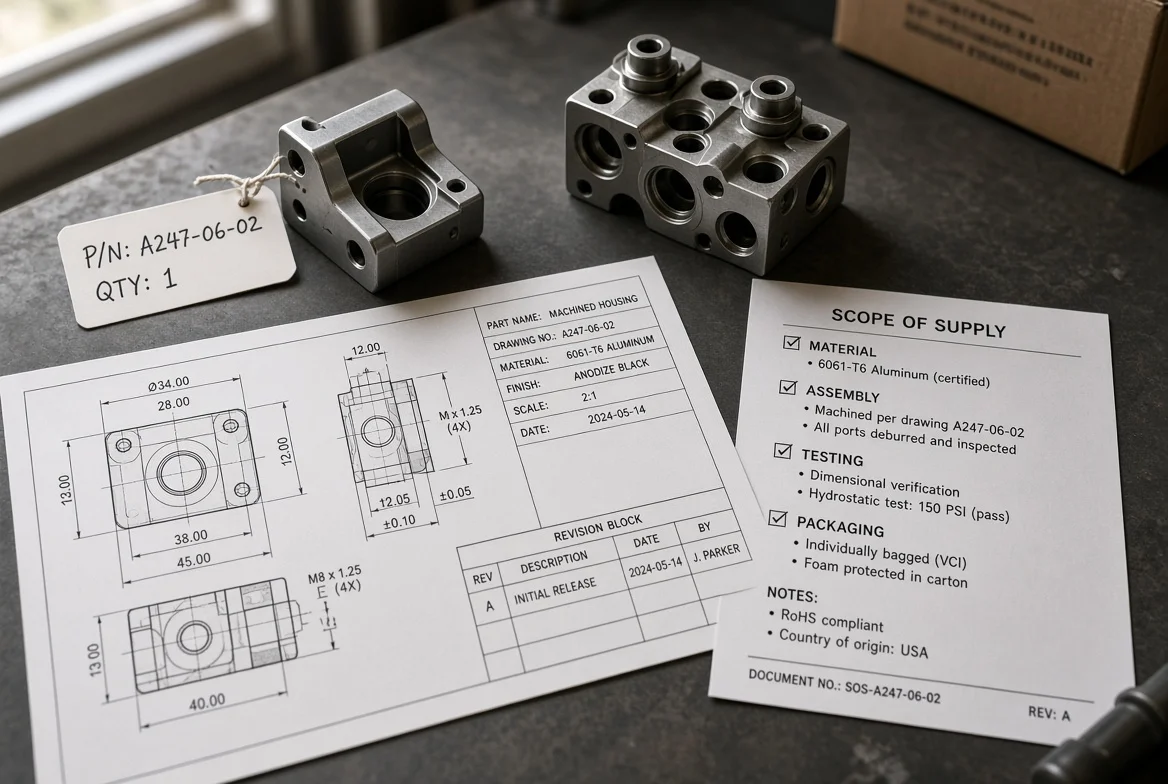
The key component of manufacturing RFQ requirements is technical information. Suppliers must have dimensions, materials, function, and expectations of the process and quality-critical features before they can realistically price. The exact files are dependent on the product. Send what you have, confirm, estimate or leave as open for supplier recommendation.
2D Drawings and 3D CAD Files
A 3D model represents shape. Dimensions, tolerances, materials, finishes, notes and inspection callouts are typically included in a 2D drawing. Determine the file format, revision, units, and if the model is for reference or production. If the CAD file does not include dimensions, tolerances, materials and notes for making and checking the part, then the CAD file is incomplete.
Dimensions, Tolerances, and Critical Features
Include dimensions, tolerances, fit, threads, hole patterns, flatness, concentricity, rougheness, or other limits that are important in the process. With tight tolerances, you'll need more capable equipment, additional operations, increased inspection or slower cycles, or a more capable shop. Separate critical-to-quality (CTQ) features from general dimensions to avoid treating all numbers equally costly in the factory.
Material, Grade, Finish, and Color Requirements
Specify the material type/grade, thickness, hardness, coating, plating, surface finish, color reference, resin grade, paper structure, jacket material, or whatever it is that your product is made with. Categories are not specifications, such as “Aluminum” are not a specific type of aluminum, they are simply a category. If it is permissible to use equivalents, identify the performance level and the approval process.
Functional and Performance Requirements
Explain what the product should be able to do. This could be electrical performance, load, range of pressure/temperature, dimensional stability, strength, signal integrity, water resistance, chemical resistance, service life, or whatever. There is no test for "durable" or "heavy duty. Add test methods, limits, operating conditions or an approved standard where performance is critical.
Bill of Materials and Approved Components
Assemblies require a BOM: Items, quantities, manufacturer part numbers, approved brands, and substitution rules. When substitutions are silent, a supplier can select a lower cost substitute that does not meet compatibility, certification, durability or customer approval requirements. Indicate whether substitutions are prohibited, permitted by written permission, or allowed under certain performance constraints.
State Quantity, Volume, and Order Pattern
Quantity changes Material buying, Setup allocation, Labour, Tooling amortisation, Capacity, Packaging, Freight. It's not a footnote. Distinguish between the immediate order and a forecast.
Initial Order Quantity and Quantity Breaks
Determine the number of this quote. When testing volume, request setup, material lots, and efficiency costs at various breaks (e.g., 100, 500, 2,000 and 10,000) to observe how setup, material lots, and efficiency affect the unit price. Avoid comparing cost per volume with a sample lot price. To learn how volume impacts supplier pricing, read how MOQ affects supplier pricing.
Annual Forecast and Expected Order Frequency
Where you have it, give estimated annual volume, reorder frequency, seasonality, or a planned schedule. A forecast is not a commitment unless you say it is. Suppliers should not treat a non-binding range as guaranteed demand.
MOQ, Batch Size, and Production Schedule
Ask the supplier to state MOQ, typical batch size, schedule assumptions, and whether partial shipments are possible. MOQ may come from material lots, setup time, carton quantities, or test setups. Ask whether a smaller first order is possible with standard materials, combined production, phased deliveries, or a different pack.
Define Quality, Inspection, and Testing Requirements
Quality must be part of the RFQ since inspection, testing, traceability and records are additional costs and time. There is no quality criterion. Communicate measurable limits, approved samples, standards, or defined procedures.
Product Acceptance Criteria
Specify meaning of “accepted”: dimensions, material compliance, appearance, function, defect limits, approved samples, color standards, or assembly condition. The dimensional compliance requirement may apply to a machined part. Cable assembly can be subject to continuity, insulation and pull testing. Print register, board structure, compression and visual standards may be required for packaging.
Inspection Level and Sampling Requirements
Identify if the inspection is 100 percent, every batch, first article only or a sampling plan that can be named and applied to the product and risk. Avoid using a sampling letter that is different from this part. Schedule an inspection to coincide with important features, customer expectations and your quality procedure.
Functional Testing and Reliability Testing
List Tests, Methods, Limits, Frequency, and Reporting. Equipment, fixture, trained personnel, cycle time and records are all necessary for electrical, pressure, load, life or leak testing. A quote that does not include those will be missing.
Quality Records and Compliance Documentation
Indicate if you are required to have material certificates, test reports, inspection reports, certificates of conformity, traceability, batch records or declarations. Maintain the proportion of the request to the risk. If it is important that the format, frequency, retention or signing off, etc. then indicate this.
## Include Packaging, Labeling, and Delivery Information

Packaging and delivery should be included in the RFQ. They impact on materials, labour, protection, cube and freight. Avoid using just a city's name. State whether it is a basic factory wrap, export pack, pallets, retail packaging, labels or delivery to a named warehouse or port.
Unit Packaging and Product Protection
Explain unit packs, separators, bags, trays, foam, moisture barriers or anti-static requirements. Inserts are required for fragile parts. ESD protection is frequently required for electronics. Care must be taken with the winding of cables and labelling. Printed packs must have stack control and moisture management.
Cartons, Pallets, and Shipping Marks
Set pieces/carton, carton size, max weight, pattern on pallets, mixed-sku rules, marks, barcodes and/or destination warnings. Those decisions affect the amount of material used, the labor required, the amount of space the containers occupy, the risk of damage, and the handling in the warehouse.
Delivery Location and Required Date
Specify location of delivery and date or date lead time. If the dates of factory completion, ready to ship, port departure and warehouse arrival are different, please differentiate. Urgent is not a schedule!
Incoterms, Freight, and Logistics Scope
When preparing a quotation for Cross Border work, please specify the requested Incoterm or request different bases as separate lines. Establish scope for freight, insurance, customs support, duties, taxes and last mile delivery. Do not rely on the RFQ as a substitute for your trade or logistics advisor giving you their advice as to trade terms. A common reason for two quotes being different is the hidden freight and pack costs; see hidden costs in supplier quotations.
Specify the Commercial Terms Suppliers Must Quote
Specify in the quotation what commercial fields need to be included. More than one unit price is required. It's necessary to have both the cost structure and the conditions. The standard response format is the reason that manufacturing quotes can be compared.
Unit Price, Total Price, Currency, and Price Breaks
Request the unit price and total price for each quantity, currency and any assumptions about price. There is no "unit price" comparison between a high volume unit and a small batch unit. Compare unit price to total price, for the same quantity and the same scope.
Tooling, Setup, Sample, and Engineering Charges
List tooling, molds, dies, fixtures, set up, programming, samples, engineering, test fixtures, artwork and pack development charges as separate lines. Post-payment, who owns the tooling, where it is stored, whether it may transfer or not, how maintenance is taken care of, whether replacement cost may apply. These are the things that are included in the tooling cost, setup cost and hidden charges.
Payment Terms and Quotation Validity
Ask for payment terms, deposit, when the balance is due, any credit conditions and validity. You can get a quote for 15 or 30 days, depending on the movement of the metal, resin or capacity. Never accept an expired quote as a “locked in” long term quote.
Lead Time, Capacity, and Production Assumptions
Request samples, production lead time, capacity notes, materials available, tooling lead time, and what is considered the start of the lead time. “30 days” may be defined as 30 days from the date of deposit, 30 days from the date of approval, 30 days from the date of tooling, or 30 days from the date of material confirmation.
Exclusions and Supplier Assumptions
Need a written list of exclusions and assumptions: Freight, testing, certificates, packaging, tooling, inspection, engineering changes, buyer-supplied material, installation, taxes, duties, or spares. Exclusions are clearer to compare than silent gaps. Apply them when considering supplier quotations.
Tell Suppliers How to Submit Their Quotations
Regulate both the initiator and the recipient sides of an exchange. The RFQ should include the date by which the quote is due, its format, which fields will be required, who will answer questions and whether assumptions and exceptions are required to be included. Part of writing an effective RFQ for better supplier responses is the clear instructions given.
Required Supplier Response Fields
Request part number, quoted revision, unit price, total price, quantity basis, MOQ, tooling, setup, sample charges, lead time, payment terms, validity, packaging, delivery basis, exclusions and assumptions. An email reply to a structured email is easier to audit than a free-form email.
RFQ Deadline and Contact Person
Identify one due date and contact for technical and commercial questions. A catalog part requires less review time than custom tooling, multi-level BOMs, testing and export packs. Incomplete quotes are the result of unrealistic deadlines.
Clarification, Revision, and Confidentiality Instructions
Explain how questions need to be passed, how revisions will be made, confidentiality, and that assumptions can be found in the quote. Maintain a clarification chart and authoritatively communicate with all the suppliers in the same comparison.
How Much Information Is Enough for a Manufacturing RFQ?
You don't need all of the details of the production on day one. There is a need for a sufficient amount for the quotation stage. Distinguish between confirmed requirements and estimates, acceptable ranges, supplier options and questions. If the core is still not known, you'll receive a budget number, not a production quote. If the need is still exploratory, an RFI, RFQ, and/or RFP might be the best first step.
What Must Be Confirmed Before Requesting a Production Quote
Usually you need product identity, key dimensions, material or performance intent, quantity basis, quality expectations, delivery location, and timing. The more those items float, the more the supplier will pad risk or decline a firm price.
How to Handle Unknown or Flexible Requirements
Name the unknown. Ask for two material options, a range, a recommended process, or a cost impact table. Example: you know the mechanical load but not the final grade. Ask suppliers to quote two approved materials and explain cost, lead time, and performance.
Avoiding Over-Specification
More pages are not automatically better. Unnecessary tolerances, extra certificates, or inspection that does not match risk raise cost without improving the product. Specify what is critical and why. Capable suppliers can then propose a more efficient process without touching the features that actually matter.
Common Information Gaps in Manufacturing RFQs
Small omissions create large differences in price, lead time, and quality. These are the gaps that most often send you back into clarification cycles. Related patterns are covered in common RFQ mistakes buyers make.
Missing Material Grade or Component Specification
Broad terms such as steel, plastic, aluminum, rubber, paper, or cable do not give a cost or a performance baseline. Add grade, thickness, hardness, standard, approved brand, or required performance. Substitutions are acceptable only when performance and approval are defined.
Unclear Quantity or Forecast Assumptions
If one message sounds like a prototype and the RFQ never states quantity, each factory will pick a different production basis. State immediate quantity, breaks, annual forecast, order frequency, MOQ, and whether the forecast is binding.
Missing Quality, Testing, or Documentation Requirements
Testing, FAIR, certificates, and traceability added after the quote change labor, equipment, and time. Put mandatory documents in the original package.
Unclear Packaging, Delivery, or Commercial Scope
Do not assume freight, labels, duties, tooling, or inspection are included. Many factories quote the part at the factory unless you define a wider scope. Ask for exclusions in writing before you pick a winner. Those differences are also why supplier quotes diverge.
Common RFQ Information Gaps and Their Consequences
Missing information | How suppliers may respond | Potential buyer consequence |
|---|---|---|
Material grade | Quote a broad or assumed material | Cost, performance, or approval problems |
Quantity and forecast | Quote a different production basis | Unit prices that cannot be compared |
Tolerances | Use standard process assumptions | Fit, function, or inspection issues |
Testing requirements | Exclude testing from scope | Added cost or delayed approval |
Packaging details | Quote basic factory packing | Damage, relabeling, or extra logistics cost |
Delivery terms | Quote a different shipping basis | Unexpected freight or import costs |
Tooling requirements | Exclude molds, fixtures, or setup | Unplanned non-recurring charges |
Final Manufacturing RFQ Information Checklist
Please use this Manufacturing RFQ information checklist prior to sending. Indicate whether an item has been confirmed, estimated, optional, suggested by the supplier or not applicable. A brief and consistent list is better than a long list. Use with the buyers' RFQ checklist and the manufacturing RFQ template.
Buyer and Project Information
- Company and contact
- The RFQ number, project name, issue date.
- Response deadline
- Sourcing objective
- Confidentiality
- Quotation submission instructions
Product and Technical Information
- Each part number is followed by a 2- to 3-digit revision number.
- Drawings and CAD
- BOM and approved components
- Materials, dimensions, tolerances, finish, color - Materials, dimensions, tolerances, finish, colour.
- Performance requirements
- Take samples and manufacturing documentation.Take samples and manufacturing notes.
Quantity, Quality, and Delivery Information
- The details regarding quantities, quality, and delivery.Information about quantity, quality and delivery.
- First quantities and quantity breaks.
- Make projections and set expectations for forecasts
- Quality Standards, inspection & testing, documents
- Packaging and labeling
Commercial and Supplier Response Information
- Currency, unit price, total price
- Tooling, set-up, sample charges
- The terms of payment and validity of the payment.
- Lead time, capacity, exclusions and assumptions.
- Required quotation format
- Anything that the supplier cannot do is listed in Writing.
## Summary Guidance — Give Suppliers the Information They Need to Quote Accurately
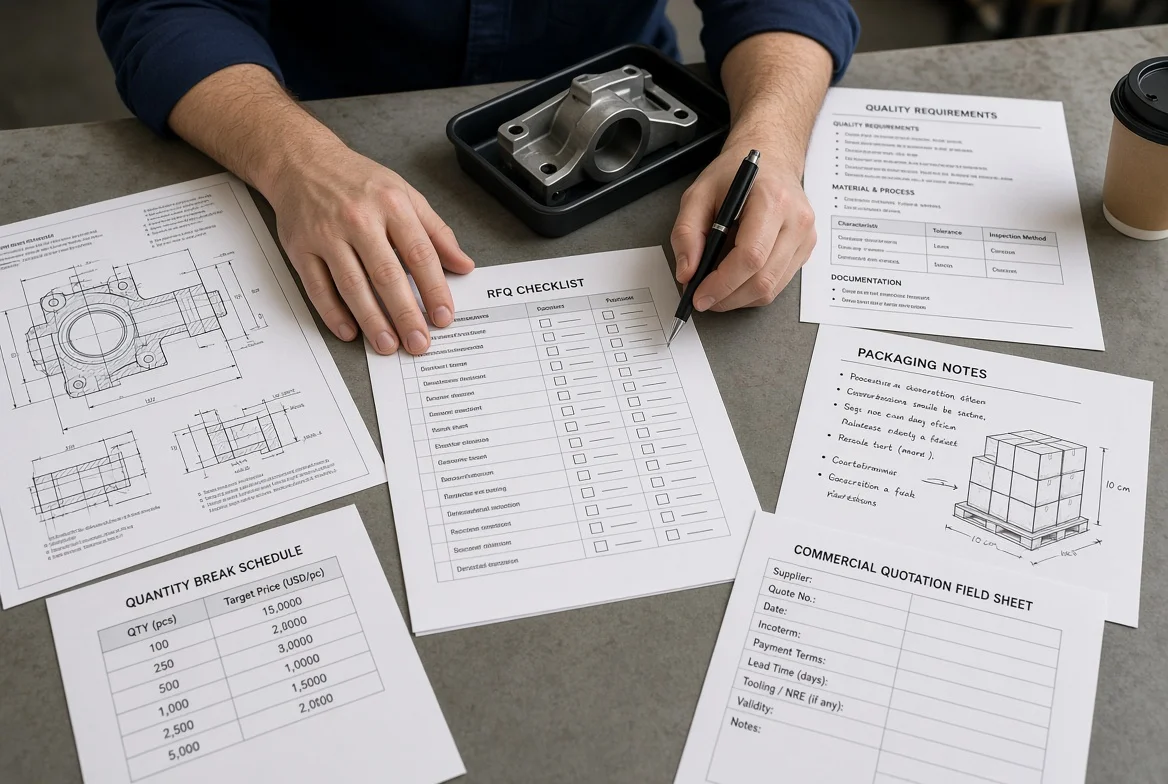
An effective manufacturing RFQ should clearly and precisely specify the product, its specifications, the quantity, the quality, testing, packaging, delivery and commercial terms, so that suppliers can quote the same requirement. Use the RFQ as a dialogue, and not a repository of all files on the project drive. If there is an unknown or exclusion, it should be shown prior to assessing price. Use a full information set and then write and send the request using How to Create an RFQ for Manufacturers.