
A manufacturing quote is not a unit price. When making a quote in manufacturing, you will be breaking down the price from the factors that make up the quote: materials and purchased components, labour time and machine time, factory overhead, tooling and set up, quality lab work, packaging, logistics, and the commercial assumptions the supplier took. The full cost ledger from the factory is not necessary. The information required should be sufficient to establish scope, resolve the most significant cost drivers, identify one-offs costs from the recurring costs and understand why one offer is not the same as another.
The quote review is not just a negotiation tool; it is a risk control measure as well. A neat and tidy unit price might mask an older drawing revision, a lower resin cost, lack of testing, or omitted freight or tooling that the buyer has to cover. It is not the role of the job to beat down every supplier's margin. It is important to understand what you are getting and if the commercial basis is the same as the sourcing requirement.
What Is Manufacturing Quote Analysis?
Manufacturing quote analysis involves examining the cost factors, technical scope, commercial conditions and supplier assumptions of a quote. It provides answers to practical questions, such as what's included? What is excluded? What makes for the price? Which costs are the same for each order? Which expenses are just one-time? If the volume, material, quality, packaging, or delivery conditions change, what changes?
A Quote Is More Than a Unit Price
Depending on the way the supplier has set up the unit price, there can be various components in a unit price. A single number might encompass the costs of the factory for rolling, labour, overhead, assembling, inspecting, packaging, and profit. Another may be the same but exclude any of the following in the unit price: tooling, programming, first article inspection, electrical testing, export packing, or freight.
The problem is demonstrated by two quotes for cable assemblies: A supplier offers a finished harness at a price that includes connectors, 100% continuity testing and export cartons. Supplier B is offering a lower unit price for cutting, stripping and crimping, and connectors, overmolding, test fixtures and packaging are extra. Until those scopes are the same, the lower number is not the lower. It is incomplete.
Cost Analysis vs Quote Comparison
Quote comparison compares quotes across supplier offers. Cost analysis: Exploring the details of one quotation to make sense of drivers and assumptions. The two tasks supplement each other. Review all quotes' cost logic. Then normalize to make a later comparison like-for-like.
The inside is still required for a fair comparison. Two injection molding quotes are not quoting the same job if one assumes the customer owns the mold, has a higher annual production volume and the mold is inspected for samples, while the other assumes new tooling, lower volume and the mold is inspected for cosmetic.
How Deep Should Buyers Go?
Match the depth of review with purchase risk. For a low value and standardized fastener or carton, price, MOQ, delivery and basic quality might suffice. Whether it's a custom machined housing, a safety-critical cable, a long-term OEM molded part or a printed packaging program with brand-sensitive artwork, there's a detailed review of materials, process routing, tooling, labor, quality, logistics and capability that should be done.
Avoid the assumption that you should get open book costing in confidence. Request specifics to make an informed choice: What's included in the cost, not included in the cost, which process is assumed, and which conditions might alter the number?
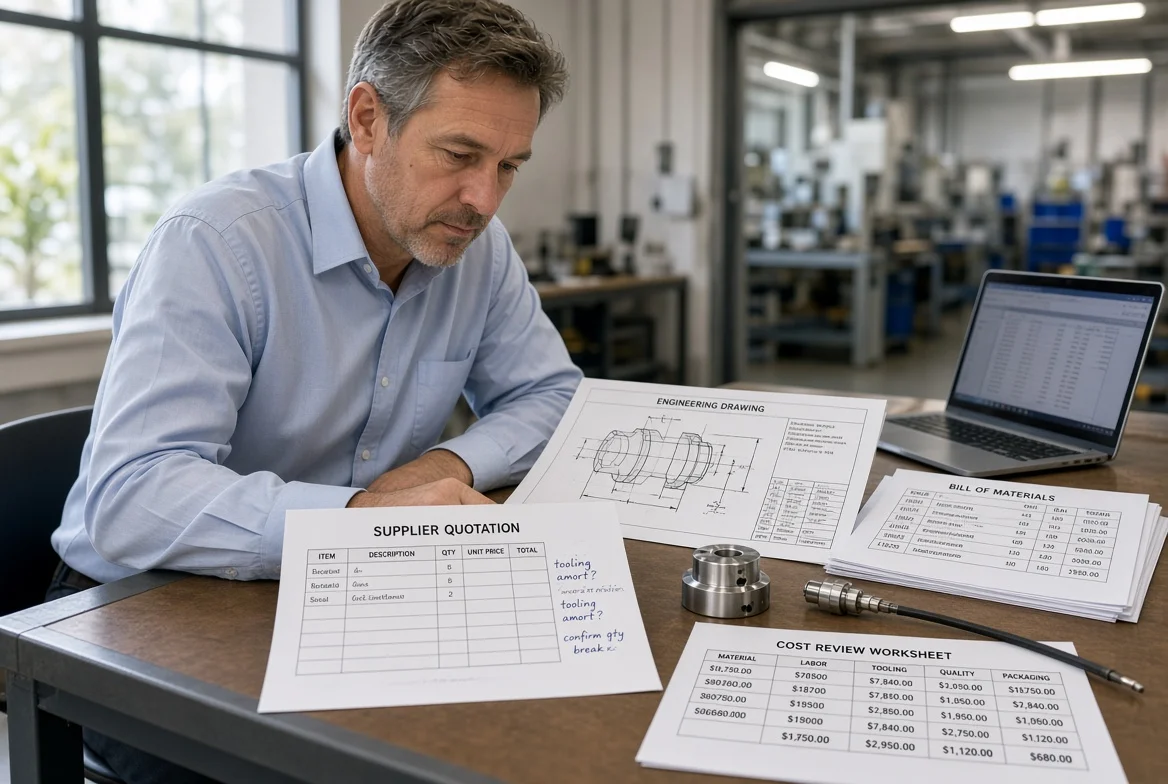
Start by Confirming the Quoted Scope
Don't break down the cost until you have confirmed the cost quoted by the supplier. When the wrong edition, subject or number of copies, or grade level of writing is available, the result is a confident but unproductive conclusion.
Verify Product Revision and Configuration
Compare the product name, part number, drawing revision, BOM and CAD file, approved sample, configuration and quantity to the RFQ. The standard error is a supplier of a lower tolerance, different connector, old surface finish, or a less elaborate packaging form than the drawing called for.
If the material remains the same, but the part is revised to include a tighter positional tolerance and a second setup, the machine time and inspection cost may be affected. Packaging: There is a change both in material and process with a 5 print color or window patch. If the quote does not reference the same revision as the one you sent, then STOP and align the file prior to discussing price.
Verify Materials, Components, and Substitutions
Specify the material grade, thickness, coating, finish, resin, paperboard structure, connector model, component brand or other detail that were used in the quote. Don't use a generic term such as “steel,” “aluminum,” “plastic” or “cable” as a specification.
If the supplier offers an alternative alloy, resin, connector or board grade, this must be stated and, if possible, put at a different price. One of the quickest methods to make false lower costs is through silent substitution. Lower cost connector brand, thinner copper conductor or lower quality paperboard might appear to be efficient until the field failure or print complaint.
Verify Quality, Testing, and Documentation Scope
Ensure inspection level, test and certifications, traceability, reports, approved samples, first-article requirements and any third party inspection are confirmed. Not included is material certificates for fabricated steel, electrical testing of cable assemblies, dimensional reports on machined parts or print or structural checks on packaging.
Explain which of these activities are within the unit price, which would only be done once, and which would be optional. A quote without first-article inspection or lot traceability is not necessarily more economical to perform. There still is some work to be done or a risk to take.
Verify Packaging, Delivery, and Commercial Scope
Verify inner packaging, label, export protection, delivery location, Incoterm, freight, taxes, and payment terms, as well as quote validity and exclusions. It is often the case that while the price may appear more competitive due to the incomplete commercial scope, it isn't because the factory isn't working as efficiently as it is designed.
It is not possible to compare an EXW unit price with a DAP price when either one or the other does not cover export cartons, pallets and freight. The validity of the payments should be placed in the first review, as well as the terms. A 15-day quote on a volatile metal is a commercial product that is distinct from a 60-day quote on a purchased component which is relatively stable.
Direct Material and Purchased Component Costs
The most obvious contributors to a manufacturing price quote are materials and purchased parts. It is important for the buyer to be aware of the exact grade or part being taken and the implications for cost, quality and availability.
Direct materials are any materials that are converted to the final product. Purchased components: These are parts bought in from the factory which include connectors, electronic components, fasteners, adhesives, motors, sensors, labels and in some cases packaging materials. Both require the same discipline: they must be described, then the quote must be checked against the description.
Material Grade, Form, and Specification
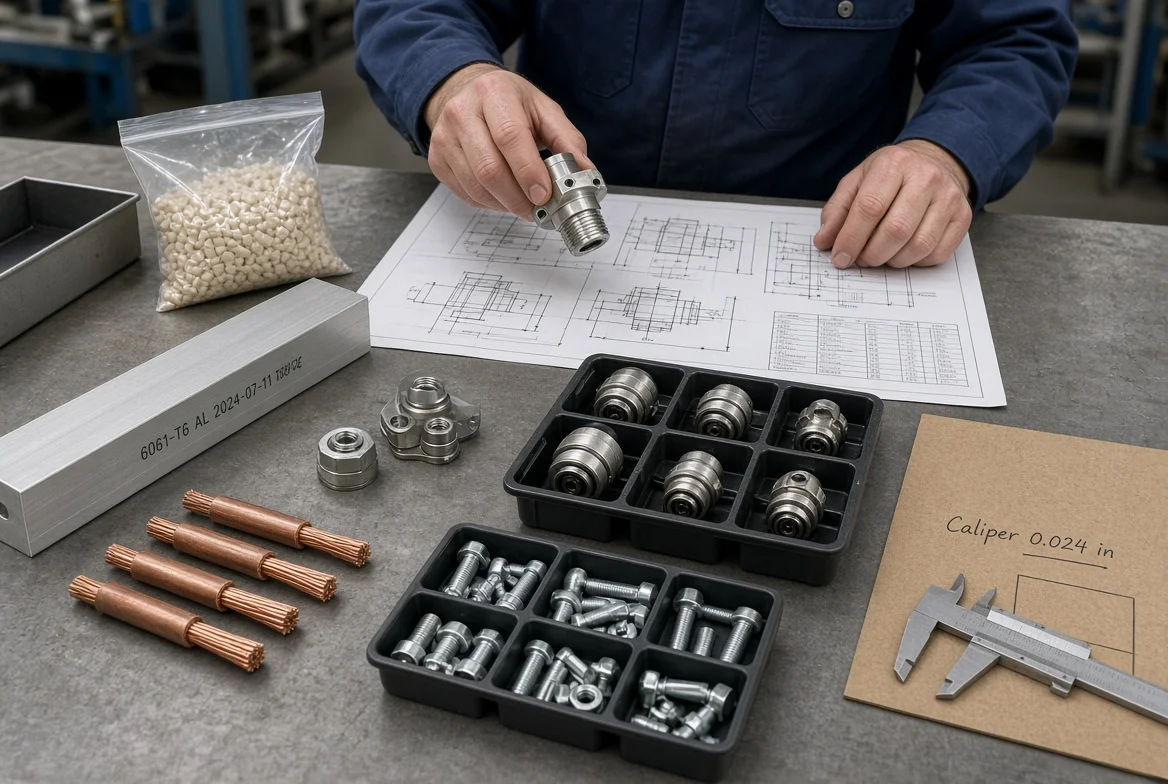
The generic material name is not the most important factor in determining price; other factors such as grade, thickness, hardness, formulation, color, conductivity, surface treatment and performance requirements can also influence the price. The price of the 6061 and 7075 aluminum machine is different. Commodity polypropylene and engineering resin, both UV or flame resistant, will not interchange. A 22 AWG copper conductor is NOT a 24 AWG alternate conductor. Paperboard material (300 gsm) is NOT the same as thinner, less crush-resistant folding carton.
Request the supplier to identify the grade, form (sheet, bar, pellet, conductor, board), finish and any approved equivalent. Verify the coating or plating is the process and thickness, if required by RFQ, not just “coated”.
Purchased Components and Approved Brands
Connectors, bearings, fasteners, adhesives, or electronic parts can be purchased from various vendors for use in the factory. Confirm part numbers, approved brands, substitution guidelines, availability and lead time. Ensure that the quote includes buyer nominated parts/parts selected by supplier.
Connector cost and availability can have a significant impact on the overall price of a cable assembly. If the sensor or motor is nominated on an electromechanical assembly, both cost and schedule are set. When requesting a second source, make sure it is a second source request and consider the technical and commercial trade-off.
Material Yield, Scrap, and Waste
The factory purchase of material is usually more than the material in the finished part. Offcuts from sheet metal nesting. CNC work is a process of removing material. The process allowance is added to the cable's length. Runners and start-up shots are created by injection molding. Make-ready and leave trim waste generated due to die-cutting and print operations. It is a further complication that quality is rejected.
There is no universal scrap percentage. It is important to understand if the quote is based on a realistic yield for this process/geometry. The material cost may be high when compared to the finished weight and may be due to a complex nested blank, deep machined pocket or a high-scrap print layout.
Material Price Validity and Volatility
There are several different ways suppliers can price, such as using current market, inventory, a contract, or an estimated future cost. Review whether a quote is valid, any escalation language, any substitutions requirements and what the supplier will do after a material move has been approved.
Allocated electronic components, certain resins, specialty alloys, and copper can move within a validity window. If a quote doesn't say anything about this, it's not “simple.” It does not define what the adjustment method shall be.
Direct Labor, Machine Time, and Production Process Costs
A quote also represents the time, skill, machines and steps necessary to manufacture the part in question. The routing, cycle time, labour content, automation, set up and secondary operations are not necessarily identical in two factories, which is why they can sell a similar material for different prices.
Direct Labor Content
Direct Labor is the labor that is associated with the unit, such as cutting, forming, machining, wiring, soldering, welding, finishing, inspection, packing. Cost is influenced by the time, skills, training, local wage rates, exposure to rework, and the efficiency of line design. But a lower labour rate isn't necessarily a lower overall rate, as this might be the case if the process is slower, less stable or more rework intensive.
A load consisting of many discrete crimps and a manual overmolded cable assembly is going to be more labor intensive than a cut and terminate harness. The labor profile of a multi-piece welded fabrication with multiple fixtures and a qualified welder is not equal to one pass laser cut blank. Read the process not the country!
Machine Time and Equipment Requirements
Suppliers can opt for the use of CNC machine, presses, molding machines, printing equipment, test stations, or special assembly lines. Machine time impacts cost in the following ways: Utilization, Energy, Maintenance, Programming, Fixtures, and if the job is a bottleneck resource.
You don't have to have all of the internal machine rates. In order to know when a special process is driving the quote, you must be familiar with five-axis work, a tight tolerance grinding operation, long molding cycle, a dedicated electrical test, and a coating line with limited capacity. If the part is only available on a limited machine, it will be apparent on both lead time and price.
Process Routing and Secondary Operations
The typical moving of a finished part may go through several operations such as cutting, forming, machine, welding, heat treating, coating, plating, assembling, inspecting, testing, and packing. Verify the quoted steps.
The machine shop might offer to mill only and have the final inspection and anodizing be buyer-arranged. One of these is a dimensional report, and another is coating and packing. For an fabricated assembly the welding, stress relieving and painting may cost more than the cutting. For a molded part, loading, gate trimming and decorating can be beyond a “molding only” price. First, line up the routing, then number it.
Cycle Time and Production Efficiency
Per unit cost is related to cycle time, changeover time, handling time, automation and batch size. A slow process is okay for prototypes and severe at volume. A long cooling time part or a print requiring frequent changes of plates will not act like a standard part – a high throughput item.
Find what happens in the real quantity for the quoted process. If efficiency seems at "10,000" it may not be at 300. The converse is equally true: if the sample quantity is small, the highly manual approach appears to be very cost-effective, but it can become the most costly approach when volumes increase.
Manufacturing Overhead and Factory Support Costs
Manufacturing overhead is factory costs that are incurred for production, but cannot be directly attributed to an individual unit like material or direct labor. Common cost items include equipment depreciation, utilities, maintenance, indirect labor, supervision, quality systems, facility cost, insurance costs, and production support. The various allocation methods vary from supplier to supplier and process to process.
A player does not have to use their hands to pad to get a good shot. It can indicate true investment in machines, controlled environments, maintenance discipline, and a quality system which maintains process stability.
Equipment, Facility, and Utility Costs
Compressed air, water, maintenance, depreciation, energy and machines are all costs to the factories. If you need a climate controlled molding room, a calibrated metrology lab or a plating line with environmental controls, it will be more expensive to operate than a simple bench assembly room. That difference will be reflected in the quote even if the drawing is simple.
The actual question is: Does the production model correspond to the part? The cost of a precision house should not be bid as a low control shop job.
Indirect Labor and Quality Support
Supervisors, planners, quality technicians, maintenance, warehouse teams and engineers are typical roles that can be overhead. Even if production labor is apparently short on visible labor, more of that support is required for quality-critical and complex products.
Support work occurs when a first-article package, incoming component control or a documented process exists for a regulated market. It fails to appear in the quote, it gets absorbed somewhere else or it is not planned.
Overhead Allocation Differences
Overhead can be allocated to suppliers via machine hours, labor hours, cost centres or through internal commercial rules. Do not assume that two factories use the same method. It is unlikely to be possible to compare two 'overhead' figures line by line.
Determine if the quoted price is based on the appropriate production model, quality, capability and scope of service. Reducing numbers or a smaller percentage from a factory that doesn't have enough space to accommodate the process is not a savings.
Supplier Margin and Commercial Risk Allowance
Price also includes margin and, often, an allowance for commercial risk: material volatility, unclear drawings, tight delivery, warranty exposure, or forecast uncertainty. Avoid the idea of a “normal” margin and consider anything else as an excess. What are the assumptions that form the risk buffer? There may be a better case for being honest in quoting a higher price on a new design that has uncertain tolerances, than a lower price that's based on the same uncertainty.
Tooling, Setup, and Non-Recurring Engineering Costs
Distinguish repetitive product cost from start-up or project cost. The cost of tooling, set-up, samples and engineering can be the largest contributor to prototype, launch and low volume product economics.
Tooling, Molds, Dies, Fixtures, and Jigs
Suppliers reserve the right to quote for molds, dies, fixtures, jigs, gauges, test fixtures or cutting tools. Inquire about the following: Design, Manufacturing, Trials, Maintenance, Storage, and Tool Life & Replacement. Ownership and transfer rights are a matter of the commercial discussion, subject to the appropriate legal review. The buyer is not responsible for a mold that the buyer does not have control over.
Productivity is not matched with a low price that assumes that a tool is already in place. This is the same with a welding fixture or a cable test fixture which it will be the only program to use.
Setup, Changeover, and Programming
Setup may consist of machine preparation, fixture installation, CNC programming, material preparation, line clearance, artwork changeover, parameter setting and first piece approval. Determine if setup is a one-time fee, by order, by batch, by SKU or is part of the unit price.
This cost is incurred by a CNC Job that has multiple operations, molding color changes and print plate changes and cable-program changeovers. The small batch that seems like a cheap thing on paper can end up being a costly thing once setup is just said.
Engineering, DFM, and Prototype Development
Design-for-manufacturability review, process planning, sample development, drawing changes, or support for validation may be included in some quotes. That work can alleviate subsequent scrap and delay. Use it as an aid, not a bloated production cost.
A supplier who charges a DFM pass and a prototype loop might appear to be more expensive up front and less expensive later. The supplier who avoids this kind of work might appear to be cheaper until the first production hold.
Amortization Across Production Volume
There are times when the factories distribute the tooling, setup or development over a specified amount or over the year. Confirm the basis. When actual volume proves to be less, the supplier reserves the right to increase the unit price or send the due amount on the invoice. 2,000 is a unit price that is different from 20,000, and so is the unit price of a unit that works at 20,000 pieces/year versus the unit price of a unit that works at 2,000 pieces/year.
Cost type | Common examples | Buyer review question |
|---|---|---|
Recurring unit cost | Materials, assembly, routine inspection, standard packaging | What is included in every production unit? |
Tooling cost | Mold, die, fixture, jig, test fixture | Who owns it, and what does the charge cover? |
Setup cost | Programming, machine preparation, changeover | Is it one-time, per batch, or amortized? |
Sample cost | Prototype, first article, pilot units | Is it credited against a future order? |
Engineering cost | DFM, process planning, drawing changes | What technical work is included? |
Testing cost | Validation, reliability, certification | Which tests and reports are included? |
Packaging development | Artwork, custom inserts, retail structure | Is production packaging included afterward? |
Quality, Inspection, Testing, and Compliance Costs
Cost is an issue with quality requirements because it takes skilled man-hours, fixtures, equipment, documentation and sometimes outside labs. Don't take it for granted that the required quality scope is covered.
Inspection Requirements
Work content is changed with incoming checks, in process inspection, first-article inspection, final inspection, sampling plans, 100% inspection, dimensional report, and visual standard. A part that has been machine produced with a complete CMM report is not the same job as one that has some critical dimensions checked. Each of the packaging print inspection, cable continuity and cosmetic standards for consumer facing parts presents a different load.
If the RFQ indicated a sampling plan or a first-article package, the quote needs to include whether the quote includes the package or not.
Functional, Reliability, and Validation Testing
Fixtures, trained operators, cycle time, or customer-specific validation — or a third party lab — may be needed for electrical, pressure, load, environmental, and other tests. Inquire about the tests required, optional, outsourced or excluded.
A cable assembly that is missing the required hipot or continuity test is not a completed cable assembly. Even if the enclosure is molded, but there is no fit or drop check, it could still have not yet been produced. Charge the test to the part, or acknowledge that it will be forthcoming later.
Certificates, Traceability, and Documentation
Administrative and quality work due to material certificates, certificates of conformity, inspection reports, lot traceability, serialization, customer-specific records. Ensure that the format and frequency are confirmed, and who approves.
The traceability of a fabricated or medical related component is a procedure of course, not a stamp. When there is no citation, assume the documentation is not confirmed.
Compliance, Certification, and Regulatory Requirements
Both cost and lead time can be impacted by market standards, restricted substance controls, certification testing and customer approval. Check with the relevant technical, regulatory, and/or legal source for the actual requirement. A supplier's assertion of 'compliant', or any other phrase, should not be interpreted as a replacement for the named standard and the test method and evidence to keep on file.

Packaging, Logistics, and Delivery Cost Factors
The packaging can be a polybag, a tray, foam, a moisture barrier, anti-static material, a wound cable reel, a carton, a pallet or a retail ready pack. Printed packaging, electronics, cables and fragile parts may require more than a factory's standard wrap.
Unit Packaging and Product Protection
omer-specific paperwork count as material and labor. Ambiguous label regulations lead to label rejections, delays, warehouse mistakes and relabeling. If your warehouse or customer requires a specific type of label then specify that in the RFQ and confirm this is specified in the quote.
Labeling, Carton Marks, and Documentation
Labels, barcodes, carton marks, country-of-origin marks, warnings and customer-specific paperwork count as material and labor. Ambiguous label regulations lead to label rejections, delays, warehouse mistakes and relabeling. If your warehouse or customer requires a specific type of label then specify that in the RFQ and confirm this is specified in the quote.
Incoterms, Freight, and Landed-Cost Scope
When using EXW, FOB, CIF, DAP or DDP, the logistics costs and risks are transferred to the buyer. Verify the names of the places. Next, include any freight, duty, tax, insurance, customs or last mile expenses which are not included in the quote with a qualified logistics or trade professional. This article is not customs or legal advice. The procurement point is simpler: never consider an EXW number as a landed cost.
Delivery Timing and Expedite Costs
Overtime, priority material purchases, line interruption, air freight or a different routing may be required with short lead times. Inquire if expedited timing is offered, available, contingent, or not. Another type of incomplete scope is a standard-lead-time price, which is quoted with an urgent date.
Quantity, MOQ, and Production Volume Effects
From one cost factor to another in manufacturing, quantity has an impact on nearly everything. Volume does change material buys, allocation of set up, tooling amortization, labour efficiency, machine utilisation, inspection method, packaging, freight and commercial risk.
Initial Order Quantity and Price Breaks
Verify the unit price of the given quantity. A figure at 10,000 units is not a figure at 1,000. If you are looking around for different suppliers, make sure you quote them on the same quantities to compare them on the same basis.
MOQ and Minimum Efficient Batch
MOQ can come from material purchase lots, machine setup, standard carton quantities, test requirements, or planning rules. A low unit price that only exists at a high MOQ can create inventory and working-capital exposure. Check whether the quantity matches real demand, not only whether the unit price looks attractive.
Volume-Based Tooling and Setup Allocation
MOQ may be due to material purchase lots, machine set-up, standard carton quantities, test requirement or planning rules. Having a low unit price only at a high MOQ can lead to inventory and working capital risk. See if there is a demand for the quantity, not just if the unit price seems good.
Capacity and Production Scheduling
If the tooling and/or set up are distributed over a projected order or over an annual volume, record that assumption. Ask them what would happen if the demand is less. A conditional price is one that is contingent on an annual volume not committed to.
Supplier Assumptions, Risk Allowances, and Margin
There are many quotations that have commercial assumptions, which are not shown as a cost line. Don't sign a quote until you have found them.
Technical and Commercial Assumptions
Before producing, suppliers can take advantage of a material substitute, standard packaging, tooling provided by the buyer, one year volume, normal lead time, routine inspection or approval by the customer. The assumptions should be identifiable in the quote. These shouldn't appear in your email after you have decided on the supplier.
Risk Allowances
Tight tolerances, new design, volatile materials, low volume, unpredictable payments, etc. can be a risk buffer. Increased quote does not necessarily indicate that an insurance company is not efficient.If an insurance company has increased quotes, it may just be trying to reflect the uncertainty as opposed to it being an indicator of poor efficiency. Inquire who's uncertainty is being priced? When the uncertainty is eliminated, by freezing the drawing, naming the materials or making a more concrete prediction, then the commercial discussion becomes concrete.
Supplier Margin
Suppliers must have a sustainable margin for production, quality, warranty, engineering support and future capacity. Don't insist on a full margin disclosure. Evaluate the technical feasibility, the commercial viability and the sustainability of the quote for the desired relationship.
Quote Validity and Price Adjustment Conditions
The quotation should include the term of validity and what factors can affect the price – raw material movement, currency, shortage of components, freight, scope change or quantity change. Check those conditions before issuing a purchase order or use that quote as a long-term benchmark.
Practical Questions Buyers Should Ask About Manufacturing Cost Factors
Ask questions that will make the quote clear, but do not seek a "confidential internal ledger". Record the answers on the quotation file.
Questions About Product Scope and Materials
- What was the drawing, BOM and revision number/s you are referring to?
- What material, finish and component brands are included?
- Are there any assumptions or proposals for alternatives made?
- What are the key product characteristics that cause the primary process or cost problem?
- What is the unit price including and excluding?
You need to confirm the technical aspects with these questions before discussing a lower number.
Questions About Process, Tooling, and Volume
- What are the primary production process and major production operations included?
- Do you include 'tooling, fixtures, set up, programming, and samples' or is it 'tooling, fixtures, set up, programming, and samples'?
- Who will own the tooling and how will it be maintained?
- What are the number of quantities and annual volume of usage that justify the quoted price?
- What is meant by MOQ? What causes MOQ?
If you are looking to compare another quantity, material or process, request that as an additional choice.
Questions About Quality, Delivery, and Commercial Terms
- What are the inspection, testing, certificates and reports?
- What packaging and labeling are you being provided with?
- What are delivery basis, Incoterm, freight scope?
- When does the "lead-time" begin?
- Are there any assumptions, exclusions, or price adjustment conditions?
Complete the answers, right to the quote. If a verbal clarification is not documented, then the order is likely to be lost within the process.
Common Mistakes Buyers Make When Reviewing Manufacturing Cost Factors
Even a detailed quotation can be misread.
Comparing Unit Prices Without Aligning Scope
Do not rank unit prices until material, quantity, quality, tooling, packaging, testing, and delivery match. Two numbers without a shared scope are not a comparison.
Treating Missing Costs as Included
A missing tooling, testing, freight, packaging, or inspection line is unknown or excluded until the supplier confirms otherwise. Silence is not inclusion.
Assuming Material Cost Is the Only Driver
Material can be large, but labor, routing, machine time, overhead, tooling, yield, quality, packaging, logistics, capacity, and risk can explain the rest of the gap. A cheaper resin that needs more inspection is not automatically a cheaper part.
Ignoring One-Time Costs and Volume Assumptions
The remainder of the gap is due to material, labor, routing, machine time, overhead, tooling, yield, quality, packaging, logistics, capacity, and risk. Faster, less expensive resin does not necessarily result in less expensive part.
Using a Cost Breakdown as a Negotiation Weapon
The differences between low and high volume economics will be discussed, as the allocation of setup, tooling, engineering and purchasing lots will differ. A proto-friendly price might just be a poor production price and vice versa.
Ignoring Supplier Capability and Quality Risk
When reviewing the offer, use cost analysis to understand what the offer is, and to find clarification or value engineering options. We have seen many "unchosen" demands that are built around a "trusted" margin damage that in fact is not. And often they yield a quote that just looks like it costs less, but doesn't.
Final Manufacturing Quote Cost Review Checklist
Use this list before you approve a manufacturing quote or open a price discussion.
Scope and Technical Cost Checks
- The drawing and the BOM are in accordance with the RFQ and the revision.
- The materials, components, finishes, tolerances and substitutions are stated.
- Major process steps and secondary processes are comprehended.
- Includes or excluded is clearly included in the scope of quality, testing, inspection, certificates and documentation.
- Packaging, Labeling and Delivery scope are defined.
Cost Structure and Volume Checks
- Assumptions for direct material and purchased components are explicit.
- Practical understanding of labor, machine time, routing and overhead drivers.
- Tooling, set up, samples, engineering and testing costs are different from the recurring unit cost.
- Distinguished between one-time and recurring costs.
- Initial quantity, MOQ, price breaks and volume assumptions are confirmed.
- You can't predict how much capacity there will be or how much time will be available for the next order, just this order.
Commercial and Risk Checks
- The currency, unit of measure and price basis are ascertained.
- Payment terms and conditions of validity and adjustment are clear.
- The right experts know the intricacies of Incoterms, freight, duties, taxes and local delivery.
- Exclusions/Assumptions are documented.
- Quality exposure and supplier capability has been taken into account and not just the quantity.
- Clarification questions and answers are in the file prior to approval.
The most useful last question is not “Can you lower the price?” It is “What assumptions and cost drivers make this the right price for the required scope?”
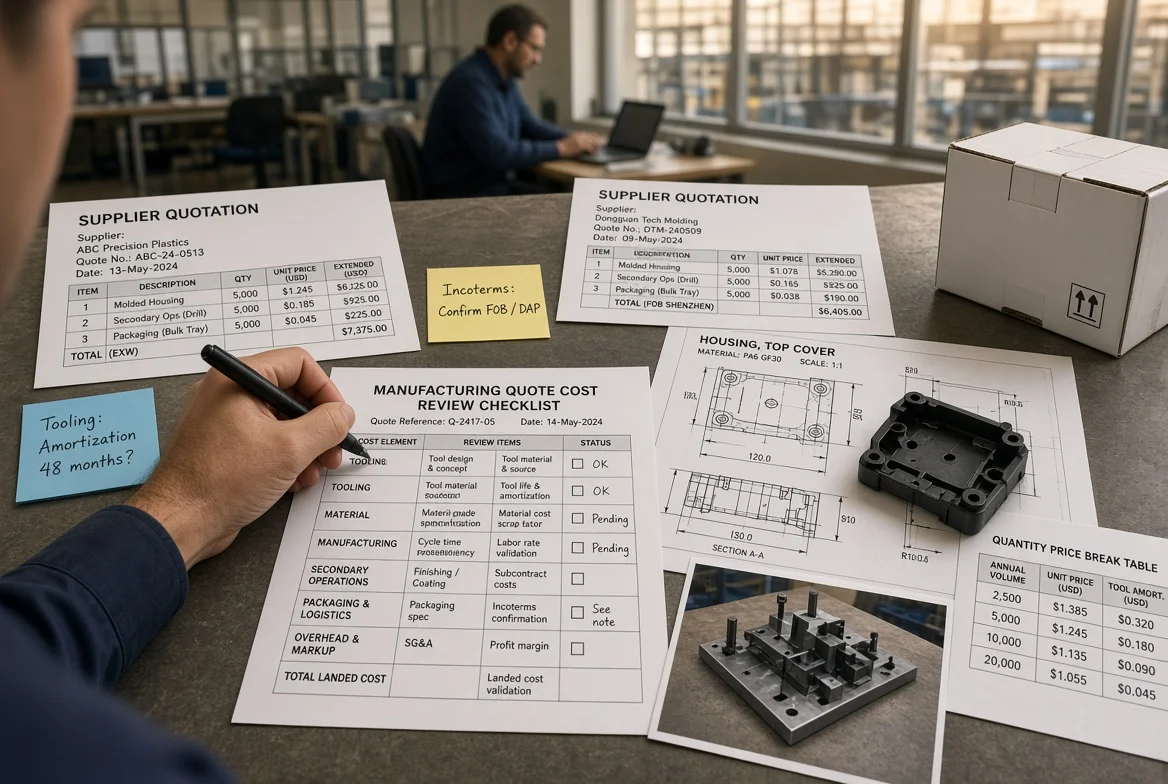
Summary Guidance — Review the Cost Drivers Behind the Quote
Manufacturing quote analysis will enable you to comprehend the scope of a price and the cost generators behind it. Does not mandate that all suppliers use the same internal accounting book. Prior to approving the quote, review the materials, process, labour, overhead, tooling, quality, packaging, delivery, quantity and commercial assumptions. When those things are on display, there is a verifiable itemized difference of price and not a guess. The next step is to ensure the identity of what is being purchased then determine if that commercial basis is appropriate for the work.