
Procurement teams need to understand that they should not line unit prices from the lowest to the highest bidder to analyze supplier quotations in stages. First, be sure that each supplier mentioned the same requirement. Next, verify technical and quality compliance, normalise commercial conditions, evaluate the total cost, evaluate delivery and supplier risk and document decision. The lowest unit price is just a beginning. An offer may seem more attractive due to the fact that the tooling, testing, packaging, freight, or inspection was not included, or due to the fact that the supplier included a different material, quantity, or quality level in the offer, or a different delivery basis.
A quotation is not a single number as is often thought, but a series of technical and commercial assumptions. That's not what spreadsheet ranking does. A good review may ask the following three questions of the supplier: Did the supplier quote the right product/service? Do they have the scope of work and conditions supplied? Is the offer a good overall value and execution risk?
What Is Supplier Quotation Analysis?
Supplier quotation analysis is the process of reviewing suppliers' offers in a structured way and comparing them with the buyer's RFQ, technical requirements, commercial terms, delivery requirements and the criteria and parameters of risk for the supplier. It is not for the purpose of decorating a price list. It is to discover what has been missed, to compare offers, to learn the reasons for price variations, to seek clarification and to assist in making a documented sourcing decision.
It is better to have a quote that is full, exact and fits the RFQ than it is to have a cheaper quote that no one can explain.
Quotation Analysis vs Simple Price Comparison
Unit prices are ranked using simple price comparison. Quotation analysis can verify the underlying assumptions of these prices. If testing is not needed, if the material is different, if a higher MOQ must be ordered, or if there are longer lead times, a lower unit price is not enough to make the execution path better or the total cost lower.
Consider one of the custom cable assemblies. Supplier A offers full electrical testing, connector certification and export packaging of finished assemblies. Supplier B offers a lower piece rate with the same part number – and the notes indicate “standard packing” with no testing line and a different connector. If those notes are removed from the two numbers, they're both performing the same task.
What a Procurement Team Should Learn from a Quote
The usable quotation should communicate to the buyer:
- The product that the supplier provides.
- What is included
- What is excluded
- Any of the technical requirements that the supplier accepts or modifies
- What are some of the assumptions of price and lead time?
- What are some risks that might arise in production or delivery?
If these points are not included the price is incomplete information. Request the missing record before it can be considered to be comparable.
When Quotation Analysis Is Especially Important
Detailed review is most important for custom manufacturing, new suppliers, complex assemblies, tooling projects, imported products, high value purchases, quality critical components, long lead items and when the demand is still uncertain. If it is a routine purchase from an established supplier, with a consistent specification and predetermined price, the review may be simplified. Fit the level of analysis to the level of commercial and operational risk.

Step 1 — Collect and Organize All Quotation Information
Responses and analysis become unreliable when left in emails, PDFs, spreadsheets, chat threads and informal notes. Before comparing offers, collect the entire response pack. Do not alter the original quotations. Identify the supplier, revision, date and attachments that correspond to each response.
Record Supplier and Quotation Identification
Log each offer for the following details: Supplier name, quotation number, quotation date, supplier contact person, RFQ reference, quotation revision, currency, and validity period. Such information is relevant if a supplier changes a price or when finance, engineering or management ask what was the reason for using a specific version.
Confirm the RFQ and Document Revision Quoted
Inquire what drawing, BOM, specification, sample, packaging file and quantity schedule the supplier utilized. The quotation should mention the current revision or clearly identify that another document was quoted.
An offer may change with a minor rewording. Price and lead time can shift if a change in the material, a different type of connector, tighter tolerance or carton structure occurs. If the number is for the drawing of last month, last month's price cannot be used to calculate the number for the current requirement.
Preserve Supplier Notes, Attachments, and Exceptions
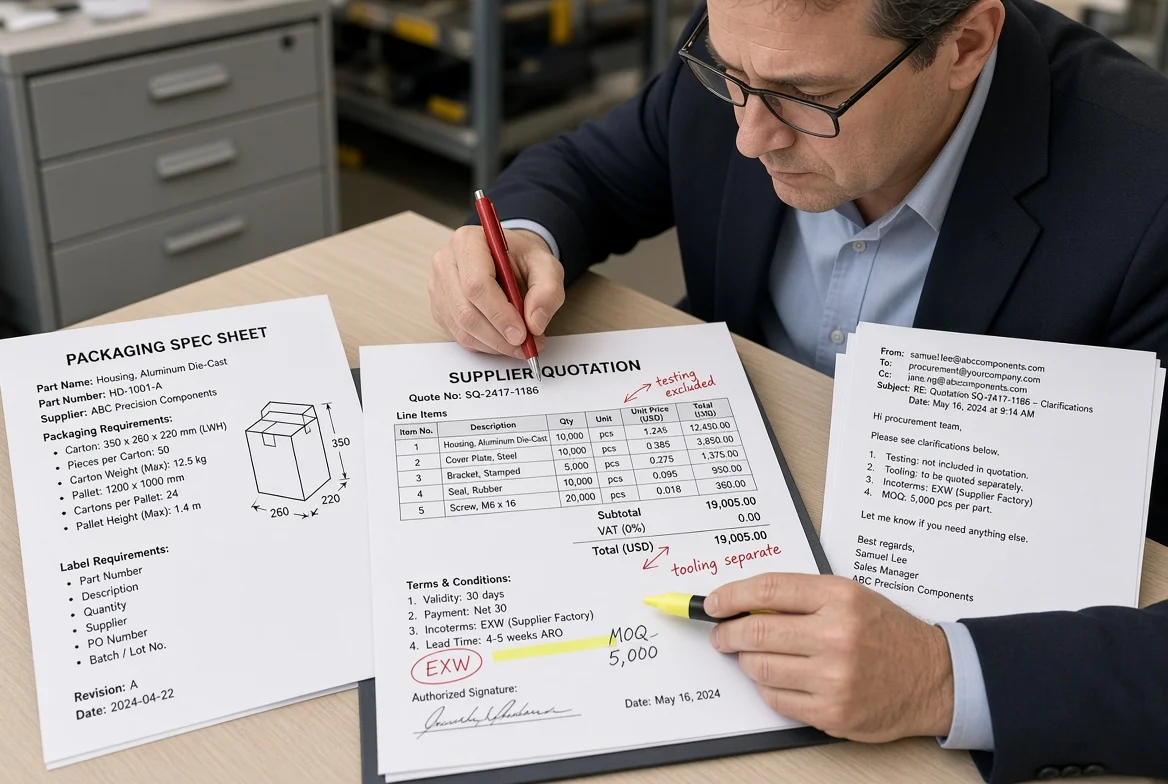
The quotation includes comments, exclusions, technical notes, alternate proposals, capacity statements and clarification emails. Don't take them off the top price. A common error made is to record only the unit price, and forget to record the conditions.
Step 2 — Check Technical and Scope Compliance First
The first question to ask is: did the supplier provide the requested product/service? Never compare prices until the quotation is matched with the scope of the RFQ.
Record each supplier as either compliant, partially compliant, non-compliant, or requiring clarification on items of importance that may require technical and scope clarification.
Verify Product Identity and Revision
Verify the product name, part number, drawing revision, specification version, quantity, material, finish, and configuration. A supplier may provide a correct price on the incorrect revision. The name of the product should not sound familiar.
Check Materials, Components, and Substitutions
Confirm material grade, thickness, hardness, finish, plating, resin, paper structure, connector model, electronic component, cable construction or others that relate to the products.
Where there is an alternative offered by the supplier the quote should refer to the alternative and explain the technical basis and quote separately if that assists with comparison. Silent substitutions are not an offer, but a clarification issue.
Confirm Dimensions, Tolerances, and Performance
Inspect for dimensional, tolerance, fit, surface finish, electrical characteristics, load, pressure, temperature, durability or other functional specifications. Small differences matter. A relaxed tolerance may decrease the machining cost, but not meet the assembly fit. Electrical performance may vary from one cable conductor or connector to another. A lighter board structure can cause a carton to become weaker.
Verify Quality, Inspection, and Testing Scope
Check to see if any inspection, testing, certificates, traceability, first-article approval, third-party inspection, reliability testing or customer specific documentation is included in the quote.
Many offers end up splitting at this point. 100% testing from one supplier, routine sampling from another. One offers material certificates, while another does not. These are not the same quality of scope.
Technical Scope Checks Before Comparing Supplier Prices
Scope Area | Buyer Should Verify | Common Quotation Problem |
|---|---|---|
Product identity | Part number and current revision | Supplier prices an outdated version |
Material | Grade, thickness, finish, and approved alternatives | Supplier uses an unapproved material |
Dimensions | Critical tolerances and fit requirements | Different process capability or quality level |
Performance | Functional limits and test conditions | Supplier quotes a lower-performance option |
Quality | Inspection, testing, and documentation | Required quality work is excluded |
Packaging | Unit, export, labeling, and pallet requirements | Supplier quotes basic packing only |
Step 3 — Normalize Supplier Quotations for a Fair Comparison
In quote normalization, all suppliers' quotes are presented on a common basis of comparison but their differences are not concealed. List what each supplier excluded, assumed and/or priced differently. The offer remains unchanged after normalisation. It is used to record the conditions, as this is needed for procurement to compare with equivalent scope.
Normalize Quantity and Volume Basis
The quantities, price breaks, MOQ, Batch Sizes, Annual volumes or Production schedules may vary from supplier to supplier. Write each price on the corresponding quantity base on which it was formed.
However, if the cost of 1,000 units is $x from Supplier A, and the cost of 10,000 units is $y from Supplier B, the units are not yet a comparison because the cost per unit is not yet known. You should always ask for aligned quantity pricing in order to make sure that you aren't choosing the cheaper option.
Normalize Currency and Unit of Measure
Ensure that currency, unit of measure, pack quantity, conversion basis and whether taxes, duties, freight and other charges are included or not are confirmed. Avoid comparing a per-piece price to a per-set price or a price per carton to a price per unit. Calculate with some small unit-of-measure differences results in large calculation errors.
Normalize Delivery Basis and Incoterms
EXW, FOB, CIF, DDP and other terms of delivery carry different costs and responsibility. Determine what costs and risks are included in each supplier's price. For the actual trade, discuss the trade-term interpretation and responsibility for imports with an expert in the logistics/trade industry.
Separate Recurring and Non-Recurring Costs
Isolate unit price from molds, tooling, fixtures, set-up, programming, samples, engineering, testing, certification, artwork, packaging development and other one-time or conditional costs.
Two suppliers can have the same overall project cost, but very different combinations of up-front investment and unit price costs. This combination can be significant when the production time frame is short, volumes are unpredictable or cash is limited.
Step 4 — Review Supplier Cost Structure and Quote Assumptions
Don't always require a breakdown that is fully open. They must be aware of key cost drivers and assumptions. The question lies whether the price difference is due to materials, volume, process, the labor, the tools, the quality, the logistics, the risk, or whether it means the difference is actually in the efficiency of the process.
Review Material and Component Cost Assumptions
Confirm material grade, source, specification, approved brand, scrap allowance, and whether material-price changes can affect the quotation. Copper in cable assemblies, resin in molded parts, steel or aluminum in machined components, paperboard structure in packaging, and electronic components in assemblies all change the offer when the assumption changes.
Review Tooling, Setup, and Engineering Assumptions
Confirm that any tooling, set up, programming, fixture, sample, engineering or design-for-manufacturing work is part of the job. Dedicated tooling are used for what? Who owns it? Is maintenance included? Is set-up a one time charge or per batch? Does engineering wait for production?
One supplier may offer tooling and first article testing. Another might leave the two items out and appear to be less expensive until you add them again.
Review Volume, Capacity, and Efficiency Assumptions
Annual volume, batch size, machine utilization, material purchasing or a schedule may influence prices. Ensure that the price quoted is not based on future volumes that are not guaranteed. The lower unit price is determined by a high forecast but if actual orders are lower, this may not materialize.
Review Supplier Risk Assumptions
Risk pricing by suppliers can occur if the specification is incomplete, the stock is volatile, the tools to be used are uncertain, the lead time is short or the forecast is not clear. A higher quotation does not necessarily indicate that it is not efficient. It might contain actual permits for quality control, engineering assessment, capacity reservation, or material risk not identified by another supplier.
Step 5 — Identify Exclusions, Assumptions, and Hidden Charges
Exclusions and assumptions are usually the second most significant factor of the quotation, after the price. Read them one at a time and evaluate them for impact on the cost, quality, schedule, and responsibility. Never consider a quotation finished until it is known what is not in the quotation.
Common Supplier Exclusions
Common exclusions are tooling, testing and inspection reports, packaging improvements, freight, customs support, taxes, installation, spare parts, engineering changes, samples, rework and customer supplied materials.
A supplier might decline to include an item in a Request for Quotes for a number of reasons, including that the Request for Quotes did not define that item, it is expected to be provided by the buyer, or the supplier would like to provide an option. All of those reasons require a written decision.
Common Supplier Assumptions
Look out for the following words or phrases:
- The price is based on the annual volume.
- Material equivalent accepted
- Lead time begins post deposit.
- Subject to final drawing approval.
- Standard packaging only
- Freight excluded
- Testing not included
- Tooling charged separately
- The price is valid for limited time only!
Write down decisions for important assumptions prior to supplier selection. Disputes begin after the purchase order is issued, leaving them as footnotes.
Categorize Exclusions by Impact
A practical group is:
- Significant: impacts product compliance, safety, function and/or utilization of the quote
- Commercial: has an impact on overall cost, payment, freight, tooling or delivery.
- Operational: impacts lead time, packaging, documentation or supplier workload
- Minor: requires clarification but will not likely have a significant impact on sourcing decision.
Work the high-impact items first.
Step 6 — Evaluate Lead Time, MOQ, Quality, and Supplier Capability
Another element of a quotation is a statement of how the supplier intends to perform the work. Take into consideration lead time, minimum order quantity, capacity, quality control, communication and experience in addition to cost. Consider all these factors, based on the product risk and priority of the buyer's operations.
Review Sample and Production Lead Time
Identify the difference between sample lead time, tooling lead time, production lead time, ready to ship date and final delivery date. When is the clock ticked: Deposit, Drawing approval, Material confirmation, Tooling completion, Purchase-Order release. Four weeks with no starting condition is not a scheduled time.
Review MOQ and Order Flexibility
Confirm MOQ, batch size, price-break, partial-shipment and flexibility on initial order. When the price is cheaper, and there is a need for a large MOQ it may lead to inventory and cash-flow exposure. Determine if the suggested number is in line with demand.
Review Quality Capability and Evidence
Review quality systems, inspection capability, test equipment, certifications, sample results, traceability and relevant production references where applicable. The certificate logo is not a full proof of the capability of the product. The question is whether the supplier will be capable of fulfilling the technical and documentation needs of this project.
Review Capacity and Supply Continuity
Evaluate if supplier can provide the required volumes, peak demand, material availability, backup and the given time schedule. A shop with prototyping capability may not have the mass production capability. A short quoted lead time can be based on one limited machine and/or one material source.
Step 7 — Compare Total Cost, Not Just the Quoted Unit Price
Total cost analysis is a review that goes beyond the unit cost of the supplier. This can include ongoing cost, tooling, set-up, samples, testing, packaging, freight, duties, taxes, payment costs, inventory impact, quality risk, re-work, delays, and subsequent lifecycle costs.
One size doesn't fit all purchases. The pertinent cost components are determined by the product, buying conditions, place of purchase, quality risk and business model.
Direct Supplier Cost
Direct cost can be unit price, quantity, samples, set up, engineering, testing, packaging, freight and others as stated by the supplier. Rank this figure based on comparing all suppliers on the same scope and quantity.
Logistics and Landed-Cost Factors
The ranking may be different if the freight, insurance, duties, taxes, customs handling, local delivery, port charges, packaging volume, and shipment frequency are different. Actually use logistics and customs inputs that are accurate to the destination. Never use an "out of the box" landed cost model that does not take into account the route and the Incoterm.
The ex-works price may yield a better delivered price if freight, packaging cube, payment terms and quality risk are taken into account.
Quality and Failure-Related Cost
The quality risk can produce inspection cost, sorting cost, rework cost, replacement cost, customer rejection cost, production interruption cost, return freight cost and warranty cost. Never make up probabilities. Determine exposure by means of testing scope, process control, sample evidence and supplier's attitude to nonconforming product.
Inventory, Payment, and Working-Capital Impact
Even if the unit price is low, MOQ, long lead time, deposits, payment milestones and large batch can increase the need for inventory and working-capital. Just because one supplier offers a lower piece price than another doesn't mean it is necessarily cheaper, if it insists on an annual order when a competitor offers a higher price for smaller quantities, shorter replenishment.
Cost Elements to Consider Beyond Supplier Unit Price
Cost Category | Examples | Why It May Matter |
|---|---|---|
Recurring product cost | Unit price and quantity basis | Core supplier price |
One-time cost | Tooling, setup, fixtures, samples | Affects launch investment |
Quality cost | Testing, inspection, rework, rejection | Affects usable product cost |
Packaging cost | Unit, export, retail, pallet packaging | Affects protection and freight |
Logistics cost | Freight, insurance, duties, local delivery | Affects landed cost |
Inventory cost | MOQ, batch size, safety stock | Affects cash flow and storage |
Payment cost | Deposit, milestones, credit conditions | Affects working capital |
Risk cost | Delay, supply interruption, failure exposure | Affects operational continuity |
Step 8 — Use a Structured Supplier Quotation Comparison Matrix
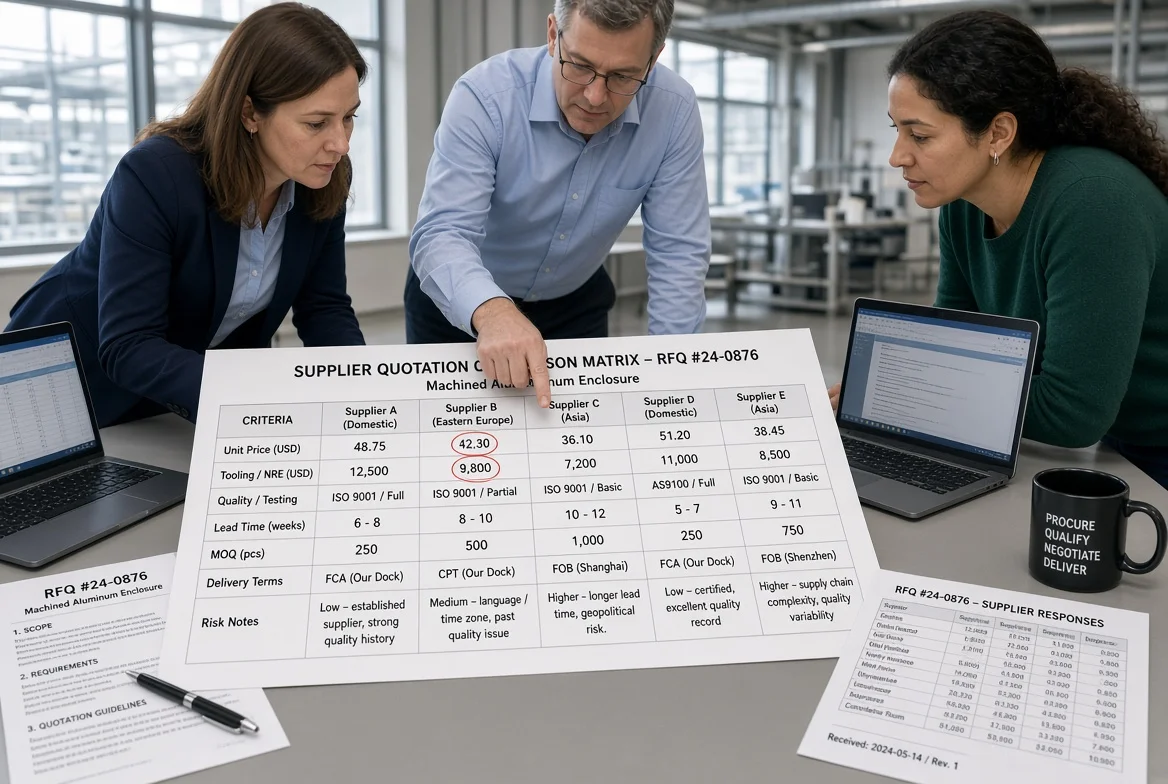
A comparison matrix provides an organized view of normalized information, identifies missing data, documents clarifications, and enables the decision to be traced. It shouldn't assume that a complicated sourcing decision always boils down to one score. Do not use it as a choice machine, but as a decision support.
Define Evaluation Criteria Before Scoring
If possible, establish a set of criteria to rank suppliers. Common attributes are technical compliance, quality, price, total cost, lead time, MOQ, capacity, tooling, payment, packaging, delivery, supplier risk and communication.
Weight should be based on risk of purchase. Product quality and technical requirements could be important considerations for a safety-critical component. If a commodity is considered to be low risk, it may be more important to be concerned with the price and delivery. Don't use a single scorecard for all purchases.
Separate Compliance Screening from Weighted Evaluation
First, remove or reword quotations which do not meet the mandatory requirements. Quotes must be compliant or conditionally compliant to be added to a weighted comparison. This will ensure that a supplier is not achieving a high price rating and yet not meeting a key requirement, such as material, test, tolerance, certification or delivery.
Record Clarifications and Revised Supplier Offers
Questions should be captured in the matrix along with the buyers responses, proposed changes to the quotations, scope changes and outstanding assumptions. The team should have the original quotation next to the revised quotation to see how the final offer came together.
Document the Final Recommendation
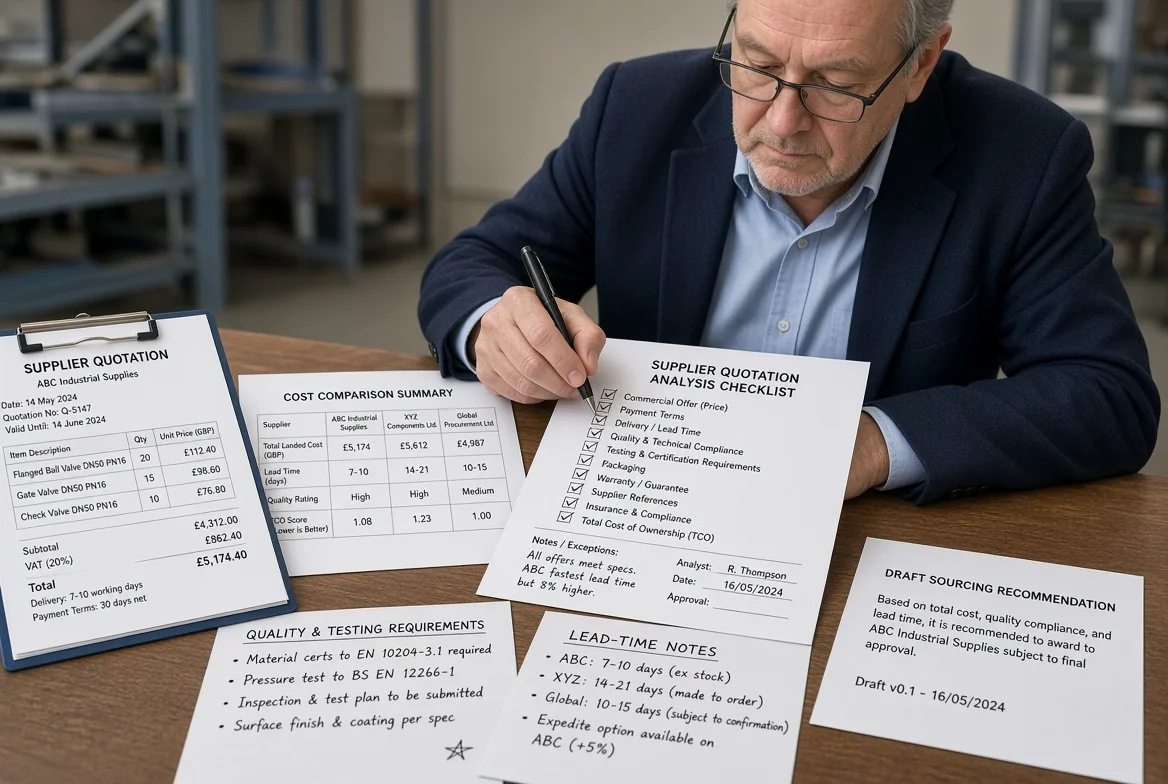
The recommendation should include the chosen supplier, decision rationale, main commercial terms, any remaining risks, necessary follow-on actions and rejected/kept alternatives. This record will be particularly significant if it is not the lowest bidder. The buyer should be able to articulate the value, risk and scope reasons.
Red Flags to Check Before Approving a Supplier Quote
A supplier is not automatically excluded from being considered if they have a red flag. It implies that the quotation is in need of further review for approval.
Price Is Far Below All Other Quotations
A low price could be for a different material, quantity, scope, quality, currency basis, or for a cost that would otherwise need to be added on.When the price is unusually low, it is because of a different material, quantity, scope, quality, currency basis, or cost that was omitted. Be sure to verify scope and exclusions prior to using that number as a negotiation benchmark.
The Quote Contains No Assumptions or Exclusions
A statement that does not contain any assumptions might be considered a complete quotation. It could also be incomplete or superficially written. Confirm that the needs for tooling, testing, packaging, delivery, quality and material were actually covered. If there are no exclusions, it does not mean that everything is included, except when confirmed in writing by the supplier.
The Supplier Does Not Reference the RFQ Revision
It is difficult to validate a quote if there is no drawing revision, RFQ number, product configuration or quantity basis. Ask to receive a written statement of the documents and assumptions utilized.
Lead Time Is Unusually Short or Vague
A very short lead time could be reliant upon non-approved tools, optimistic capacity, outsourced work, and/or unconfirmed material. “Fast delivery” is not a viable promise. Request the timeline, initial state, production and delivery basis.
The Supplier Avoids Technical or Commercial Questions
If the supplier doesn't explain material, quality, tooling, lead time, or exclusions, there is execution risk, even with a great price. Separate a new supplier who requires time to explain, from a supplier who consistently fails to provide basic quotation information.
How to Handle Supplier Clarifications and Negotiation
Many times the process of quotation analysis results in clarification and negotiation. Identify scope, clarify assumptions, ask for alternatives, and enhance commercial clarity at this stage. The objective isn't merely a reduced number.
Ask Clarification Questions Based on Evidence
Specific questions yield better answers than the blanket question “confirm everything”. Useful questions include:
- Which revision of the RFQ are you quoting?
- Is the quoted material the same as described?
- Which tests and inspections do they involve?
- Is the tooling, sample and set-up separated?
- What amount and projection does the price make?
- When is the lead time clock turned on?
- What delivery basis and packaging is covered?
- What are the requirements that can't be met as written?
Request Alternative Quotes Separately
Purchasers can ask for alternatives regarding acceptable materials, packaging, quantity levels, delivery terms or production processes. They should be each identified and priced separately. That ensures the base quote remains similar yet gives the supplier flexibility in terms of cost or lead time.
Preserve the Audit Trail
Document clarifications, supplier reactions, re-quotes, approved changes and final commercial terms. This safeguards the sourcing choice and minimizes the odds of losing an informal point when the purchase order or contract is issued.
Common Mistakes in Supplier Quotation Analysis
These issues come after quotes have been received.
Ranking Quotes Before Checking Compliance
Do not rank prices before confirming that suppliers quoted the correct product, material, quantity, quality, and delivery scope.
Treating Missing Information as Zero Cost
An omitted tooling charge, testing requirement, freight cost, or packaging item should be marked as unknown or excluded. It is not free.
Comparing Supplier Quotes Without Normalizing Quantity
Price comparisons mislead when suppliers quote different volumes, MOQ, batch sizes, currencies, units, or delivery bases.
Overusing a Weighted Score
Scoring tools can create false precision if the underlying information is incomplete, or if a critical non-compliance is hidden by a strong price score. Screen for compliance first. Weight scores second.
Selecting the Lowest Quote Without Documenting the Decision
Record why the selected offer is the best overall fit, especially when it is not the lowest price. The file should show the scope, risk, and total-value reasons, not only the unit-price ranking.
Final Supplier Quotation Analysis Checklist
Product identity and configuration matches the requirement.
Technical and Scope Checks
- There is clarity in scope of testing, inspection and documentation in relation to quality
- Deviations from suppliers and alternatives are detected
- The packaging and labelling specifications are incorporated.
- Commercial and Cost Checks
- The quantity/price break basis is matched.
- Currency and unit of measure are consistent
Commercial and Cost Checks
- MOQ and batch size is taken into account
- The costs of tooling, set-up, samples and engineering costs are distinguished.
- Clear scope of delivery, duties, taxes and freight.
- Payment terms and validity of quotes are agreed.
- Exclusions and assumptions are addressed
- Supplier and Decision Checks
- Sample and/or validation requirements are specified
- Lead time and initial condition is verified
Supplier and Decision Checks
- Quality evidence and certifications are considered if necessary
- Total cost, operational risk is taken into consideration
- Clarifications and revised quotations are noted
- The documentation of the basis for final recommendation and decision is provided
Summary Guidance — Analyze the Offer Behind the Price
Supplier quotation analysis is all about deciphering the offer behind the number. Verify scope first. Normalize the quotes. Recognize that exclusion and assumption exist. Compare overall commercial value. Assess execution risk. Document the decision.
Not the lowest price is necessarily the best quotation. It is the offer that is capable of meeting the requirement with an acceptable cost, quality, delivery, capability and risk.