
Global supplier sourcing strategies help growing businesses access broader manufacturing capabilities, improve supply resilience, and balance cost, quality, lead time, and risk. Effective global sourcing is not only about finding cheaper suppliers; it is about building a supply base that can scale with the business. Supplier discovery is only the first step. A longlist of potential global suppliers must be followed by screening, capability verification, quotation comparison, sample evaluation, controlled trial orders, and ongoing performance review before a buyer can consider a supplier reliable at scale. Growing companies often assume global sourcing is reserved for large enterprises or exists solely to cut unit cost. In practice, it can also open specialized capabilities, diversify risk, and support product expansion—provided the approach is deliberate and risk-aware.
Align Global Sourcing Strategy With Business Growth Plans
A workable global supplier sourcing strategy starts with the company’s growth plans, product roadmap, market expectations, and current operational maturity. What works for an early-stage team rarely fits a business that is already scaling volume or entering new markets.
Map Product Requirements to Sourcing Priorities
Begin by mapping each product family against clear priorities. Cost-sensitive, high-volume items usually push toward capacity and unit price. Premium or safety-critical products demand quality systems, certification, and traceability. Fast-moving consumer goods often prioritize lead time and production flexibility. When a product depends on specialized processes or regulated materials, those constraints should rank higher than pure price.
Decide Where Global Sourcing Adds Strategic Value
Not every category needs a global footprint. Global sourcing creates the most value when it unlocks capabilities unavailable domestically, reduces concentration risk, supports international market entry, or delivers a clear total-cost advantage. Applying the same model to every SKU simply because “everyone is sourcing overseas” usually adds complexity without corresponding benefit.
Consider Operational Readiness and Internal Capacity
Managing suppliers across time zones and regulatory environments requires clear specifications, quality oversight, logistics coordination, and cross-functional alignment. Many growing teams underestimate the internal bandwidth needed. A practical starting point is to limit the first wave to one product family or supplier category, then expand once processes and people capacity are proven.
Design a Multi-Country, Multi-Supplier Sourcing Model
A robust approach rarely relies on a single country or a single factory. The goal is a model that balances cost, risk, lead time, and the real effort required to manage the network.
Evaluate Country and Regional Sourcing Options
Assess each region against manufacturing capability, cost structure, lead times, trade agreements, logistics cost, regulatory environment, and geopolitical exposure. High-volume standardized products may fit one region, precision or specialized components another, and fast-turn or highly variable items a nearshore or domestic base.
Decide Between Single, Dual, or Multi-Sourcing
Critical or high-risk products often benefit from dual or multi-sourcing to limit disruption. Standardized, lower-risk items can usually be managed efficiently with a single supplier. Multi-sourcing raises management effort and can dilute volume leverage, so apply it only where the risk reduction clearly justifies the added complexity.
Balance Global, Regional, and Local Suppliers
A balanced portfolio mixes global suppliers for cost and capability advantages with regional or local suppliers for faster response, lower inventory, and greater flexibility. One common pattern is to keep high-volume stable products with global partners while routing fast-turn or custom demand to nearshore sources.
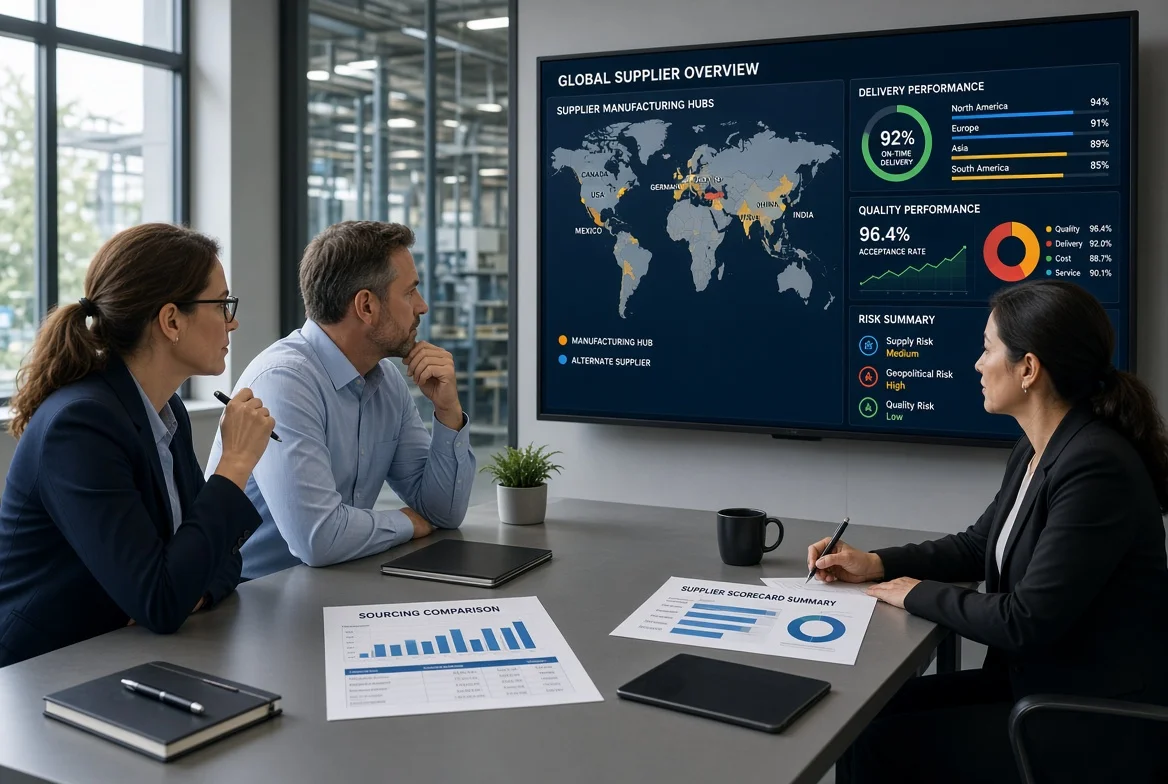
Build a Structured Global Supplier Discovery and Screening Process
Discovery without structure wastes time and lets unsuitable candidates reach the shortlist. A repeatable process keeps teams focused on suppliers that can actually support growth.
Use Multiple Discovery Channels Strategically
Combine online platforms, search engines, trade shows, industry associations, referrals, existing supply networks, and specialized sourcing partners. Technical or highly customized products usually yield better results from industry networks, trade shows, and referrals than from generic platform searches alone.
Screen Suppliers Against Clear Criteria
Apply consistent filters: manufacturing capability, quality systems, available capacity, typical lead time, export experience, communication quality, commercial terms, and alignment with the buyer’s priorities. Screening is not full qualification, but it should eliminate suppliers that clearly cannot meet basic requirements.
Document and Standardize Screening Outcomes
Capture results in simple templates or scorecards so different buyers reach consistent conclusions. Documented criteria reduce personal bias, improve decision quality, and make it easier to onboard new team members.
Verify Global Supplier Capability Before Scaling Orders
Claims on a website or in a quotation are not proof of performance. Verification depth should match the risk: a low-value standard item may need only light review, while a supplier holding buyer-owned tooling, producing customer-facing goods, or supporting an essential production line usually requires formal qualification, factory evaluation, third-party inspection, or a controlled trial.
Review Factory, Equipment, and Process Capability
Confirm that the supplier has the machinery, process knowledge, workforce skills, engineering support, testing capability, and process controls required for the specific product. A factory listing CNC capability still needs checks on machine size, tolerance control, inspection equipment, material traceability, and experience with comparable parts.
Evaluate Quality Controls and Documentation Practices
Ask how defects are prevented, how nonconforming product is detected and segregated, how inspection data is recorded, how incoming materials are managed, how revisions are controlled, and how corrective action is handled. A quality-management certificate is useful background, not a substitute for project-specific verification.
Verify Capacity, Lead Time, and Supply Continuity
Assess available capacity, production planning discipline, expected lead times under normal conditions, raw-material sourcing, equipment maintenance practices, current backlog, seasonal exposure, and ability to absorb volume changes. Quoted lead times often reflect ideal schedules; ask how capacity is allocated and what happens when materials or labor availability shifts.
Check References, Past Performance, and Relevant Experience
Request specific feedback on quality consistency, delivery performance, communication, responsiveness, and corrective-action behavior rather than general satisfaction statements. When confidentiality limits direct references, request anonymized case studies, production examples, inspection reports, or a controlled trial order.

Compare Global Supplier Proposals Using Total Cost and Risk
Two proposals for the same product name are rarely equivalent. Differences in material grade, specification revision, quantity, tooling, testing, packaging, Incoterms, freight assumptions, lead time, and warranty terms must be normalized before any cost comparison is meaningful.
Normalize Proposals Before Comparing Costs
Align every commercial and technical factor so the comparison is like-for-like. A lower unit price that excludes required testing or uses a different material grade is not automatically the lower-cost or lower-risk option.
Assess Total Cost of Ownership and Operational Impact
Look beyond unit price to tooling, samples, freight, duties, inspections, defects, rework, warranty claims, extra inventory, payment terms, administrative effort, and the cost of late delivery. The objective is practical visibility into true landed cost and operational burden, not a complex financial model.
Factor in Supply Risk and Strategic Fit
Include geographic risk, capacity constraints, single-source dependency, regulatory exposure, alignment with growth plans, and the supplier’s willingness to invest in the relationship. A modestly higher-cost supplier with lower risk and better strategic fit is often the stronger long-term choice for a growing business.
Use Pilot Programs and Phased Scaling to De-Risk Global Sourcing
Pilots and phased volume increases test the gap between claims and actual performance under real conditions. An approved pilot should never trigger full-scale production automatically.
Define Clear Pilot Objectives and Success Criteria
Set measurable targets for quality, delivery, cost validation, communication responsiveness, documentation accuracy, and problem-solving behavior before the pilot begins. Document outcomes and review them cross-functionally. Any required changes must be confirmed and carried into the next phase.
Confirm Whether the Pilot Represents Scaled Production
Ask whether production tooling, normal materials, standard labor levels, and the intended inspection process were used. Hand-selected materials or temporary extra staffing can produce results that will not hold at volume. A short pre-production run under normal conditions is often the most reliable check.
Scale Gradually and Monitor Performance Closely
Increase order volumes in phases, add product variants only after core performance is proven, and expand geographic coverage once the initial supplier base demonstrates reliability. Tie each volume step to predefined performance thresholds.
Warning Signs That a Global Sourcing Strategy May Need Adjustment
One isolated issue may have a simple explanation. Repeated patterns should prompt a deliberate review of the overall approach.
Over-Reliance on Single Suppliers or Regions
Heavy concentration on one supplier or one region creates material risk for critical products, high-volume items, or regulated goods. Diversification does not require duplicating every category; it means identifying where concentration is unacceptable and taking targeted steps to reduce it.
Chronic Quality or Delivery Issues Across Multiple Suppliers
When quality or delivery problems appear across several global suppliers, the root may lie in unclear specifications, unrealistic expectations, weak selection criteria, inadequate verification, or internal process gaps. The strategy itself may need adjustment, not just individual supplier conversations.
Hidden Costs, Delays, or Compliance Gaps
Persistent unexpected costs, unreliable lead times, or compliance friction can erase the intended benefits of global sourcing. Monitor total cost, delivery reliability, regulatory compliance, and operational friction to confirm the strategy still delivers net value.
Internal Teams Struggling to Manage Complexity
If communication overload, coordination failures, quality escapes, or missed deadlines become routine, the current scope may exceed organizational maturity. Right-size the supplier base, simplify where possible, and strengthen processes and tools before expanding further.
Manage Global Supplier Performance and Continuously Improve
Reliability must be measured after the first order and after scaling. A supplier that looked strong during qualification can underperform once volume, schedule pressure, or product changes increase.
Track Quality, Delivery, Cost, and Responsiveness
Monitor on-time delivery, incoming defect rates, customer returns, response time, correction of quality issues, documentation accuracy, quote-to-order consistency, and cost performance. A small team can track a few key indicators in a spreadsheet; larger teams may use formal scorecards and structured reviews.
Use Supplier Problems as Evidence for Strategy Improvement
Late deliveries, repeated defects, unclear communication, and weak corrective action should influence both supplier-level decisions and the broader global sourcing strategy. Document issues, request root-cause analysis and corrective action, and decide whether the supplier remains acceptable for the product’s risk level. One isolated problem does not automatically require replacement if the supplier takes ownership and prevents recurrence.
Qualify Backup Suppliers for Critical Global Purchases
For products that are difficult to replace, critical to production, customer-facing, regulated, or dependent on proprietary tooling, maintain a qualified backup or dual-source arrangement. The added qualification effort and potential volume dilution are trade-offs that must be weighed against the cost of disruption.
Final Guidance – Global Sourcing Strategies Evolve With the Business
Effective global supplier sourcing strategies are not static. They evolve with the product portfolio, market expectations, and operational maturity of the business. Treat global sourcing as a strategic capability that requires continuous improvement. A routine, low-risk purchase may need only a basic supplier check and trial order. A custom manufacturing project, high-value product, or production-critical component will require deeper qualification, inspection, factory evaluation, or backup sourcing. The same disciplined process—align strategy with growth plans, design a balanced supply model, verify capability, compare total cost and risk, pilot carefully, and manage performance—keeps the supply base capable of supporting the next stage of growth.