
Strategic supplier sourcing is the process of taking a disciplined approach to supplier selection based on the balance of cost, quality, delivery reliability, capability and supply resilience, rather than on unit price. A supplier who appears to be a great deal on a quotation can end up being a costly supplier once late deliveries, poor quality, minimum order quantities, inadequate documentation, or restricted supply begin to impact production schedules and customer commitments. It helps procurement teams and business buyers identify suppliers that are commercially competitive, operationally reliable.
What Is Strategic Supplier Sourcing?
Strategic supplier sourcing is a conscious and ongoing process of identifying, assessing, selecting and managing suppliers to ensure that sourcing activities align with long-term business goals. It gets beyond the next Purchase Order! Purchasers consider TCO, supply risk, manufacturing capability, market conditions, and the potential value of a long-term partnership relationship.
Some suppliers don't need to be a strategic partner. For the majority of businesses, it's a case of different models for different categories. Items of routine low-risk can remain transactional. Sometimes it is critical components, custom assemblies or products that have a direct impact on the customer that warrant a greater level of collaboration and selection.
Strategic Sourcing vs Traditional price based sourcing
Price-led sourcing is appropriate if the items are standardized, there are many qualified suppliers and the cost to switch is low. The buyer puts out an RFQ, compares the unit prices and gives the order. For simple commodities the process is quick and transparent.
Strategic sourcing of suppliers is required if the product or category is more complex or riskier. When a buyer chooses to source a customized industrial part, they need to evaluate process control, ownership of equipment, inspection techniques, capacity flexibility, and the stability of lead-times. In this case, it is only when you compare the total outfit that you will be able to find out which one is the most expensive. While competitive bidding is still a valuable mechanism, it is not the only one by which a decision is made.
So What Makes a Supplier Truly Competitive?
A competitive supplier is one that routinely satisfies the entire set of requirements that the business actually has. These factors include cost performance, quality, on-time delivery, capacity, technical support, flexibility for changing forecasts, compliance documentation, financial stability, and willingness to improve over time.
The meaning of the term “competitive” varies by category. With a commodity packaging product, price and availability may take precedence. When it comes to a complex OEM part, a couple points of difference in a unit price are less important than engineering capability, change-management discipline and process capability.
Start With the Category: Know What You Are Really Sourcing
Businesses cannot find out information about competitive suppliers until they know which category they are purchasing. Prior to any market search, buyers should define specifications, demand trends, key cost factors, quality risks, and the ease of changing suppliers if they are not satisfied with their performance.
The sourcing method should be appropriate to the category. Searching for the same parameters in the usual packaging, safety-related parts and entire contract production results in weak search results.
Determine Requirements That Suppliers Can Realistically Quote
Every useful RFQ and supplier conversation is based on clear technical and commercial requirements. Buyers must have drawings or detailed specifications, grades, tolerances, testing methods, necessary certifications, packaging requirements, volumes, target MOQs, lead-time requirements, delivery destination and documentation requirements.
Ambiguous quotes lead to incorrect quotes and supplier assumptions that can result in conflict. If the product is uncertain or the quality is not certain, no supplier will be able to establish a real capability or give a proper price.
Before negotiating a price, determine Cost Drivers.
When buyers know what is costing suppliers, they don't assume that every price discrepancy is a negotiation room. The final number is affected by material content, labour hours, tooling amortization, process yield, energy use, intensity of testing, packaging, freight, order quantity and capacity utilization.
Two different suppliers may offer different prices: one supplier might have a more automated process whereas the other supplier might have a more strict inspection or the supplier might use a different grade of material. Once the buyer knows these drivers, he or she can question the assumptions, break them down and negotiate with knowledge, instead of asking for a discount.
Evaluate Supply Risk and Switching Difficulty.
Some categories may still have a lot of risk even if they are not big spenders year-over-year. A single supplier can become a potential bottleneck due to proprietary tooling, special materials, qualification cycles, customer approvals of suppliers, or availability of alternate suppliers or replenishment lead times.
More in-depth due diligence and contingency planning is warranted for high-risk categories. If it is an item with a low spend, but it can halt final assembly, it is still considered strategically important.
Research the Supplier Market Before Building a Supplier List
The first step to strategic supplier sourcing is not a directory search. The buyers must know where the capable suppliers are located, what the technology is and what the capacity is, and whether other areas or other types of suppliers are feasible.
This is because good market research prevents the over-reliance on the familiar names and ensures the buyer has greater negotiation power due to their understanding of the actual situation in the market, rather than what the supplier says it is.
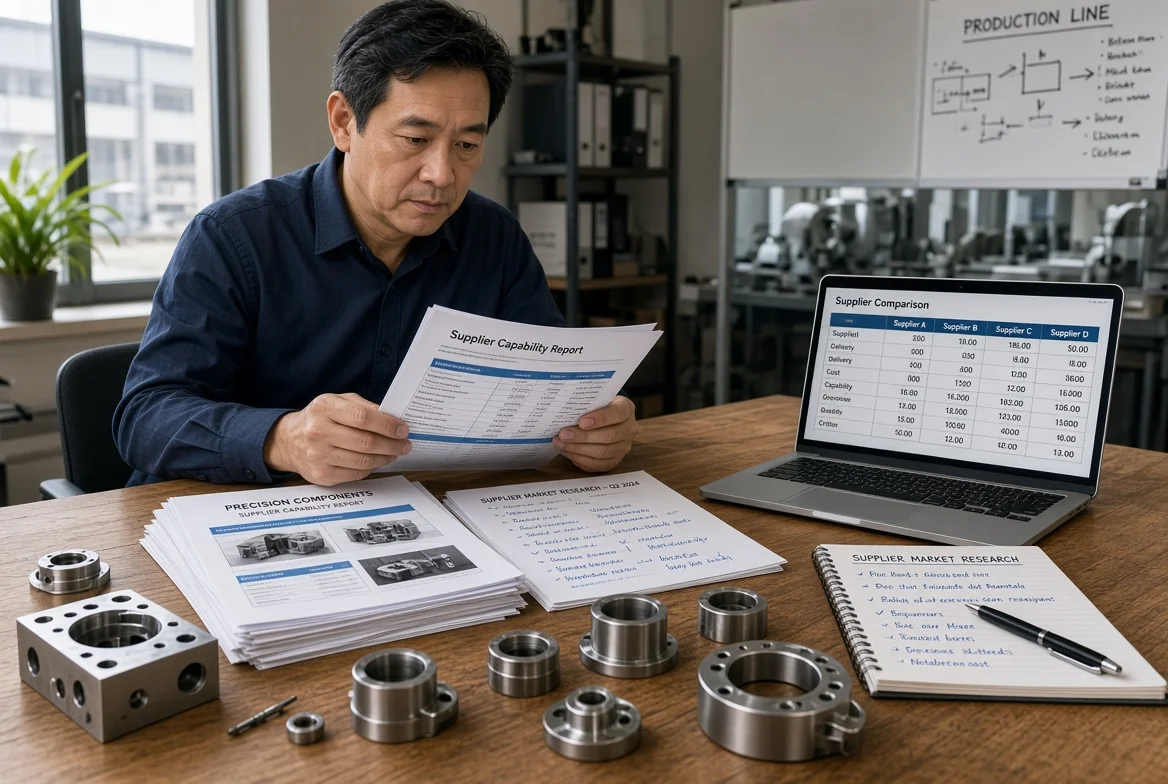
Analyse the current supply market to identify potential suppliers and map their location.
Buyers need to know the realistic supply sources: direct manufacturers, contract manufacturers, OEM/ODM manufacturers, specialized service providers and regional manufacturers. The idea is to compile a list of those who are able to fulfill the requirement, not the longest list possible.
It is useful to capture the supplier type, location, core capabilities, probable capacity range and application experience at this stage as a starting map for future screening.
Search by Capability, Process and Application Experience
When you type in just a product name, you are likely to get general and poor quality responses. In the technical categories, the following filters are better: manufacturing process, material expertise, certifications, equipment lists, test capability, or end-market experience.
More specific searches might be “precision CNC machining supplier for aluminum housings”, “Custom cable assembly manufacturer with overmolding” or “Food-contact flexible packaging supplier with clean-room conversion. These are the criteria to eliminate companies that just seem like they might be a good fit.
Re-think the Obvious Supply Region
If the category is one that makes the comparison worthwhile, the buyer should compare domestic, regional and foreign alternatives on more than just the factory price. Freight, tariffs, lead time, stocks, inspection access, communication quality, currency exposure and continuity of supply all have an impact on the commercial result.
There is no one “best” area. The selection of the right choice will depend on the volume of the product, lead-time requirements, quality risk and the overall total landed cost profile.
Build a Competitive Supplier Longlist and Shortlist
The first step should be to compile a longlist of potentially relevant suppliers and then to rigorously screen this to generate a shortlist for further investigation. This way, you can make sure that you don't commit too early to the first company that responds and that the process remains competitive and based on facts.
A good shortlist is not three suppliers all with the same qualities—low cost, high quality, close to them, special technology, flexible capacity, or development support—but it is three suppliers each with meaningfully different attributes.
Take advantage of multiple supplier discovery channels.
Discovery involves industry specific searches, B2B platforms, trade shows, trade associations, professional referrals, import data, and existing supply-chain contacts. The channel should be in line with the category and the necessary supplier profile.
Rankings in platforms or levels of membership do not demonstrate competency. Discovery is just one step to finding candidates; screening and verification are the steps to deciding who moves forward.
Determine Screening Suppliers Before Investing in RFQs and Samples
Early screening includes supplier identity, supplier business model, supplier experience with the relevant product, supplier manufacturing processes, supplier capacity indications, typical supplier MOQ, supplier export or domestic experience, supplier key certifications, quality of supplier communication and supplier willingness to provide evidence.
Red flags: When a company is unable to provide details about where their products are made; when quotes are done without the specifications being reviewed; when a company refuses to answer technical questions; when answers to questions are vague; or when the company does not have documentation to back up their claimed capabilities.
Compare and shortlist suppliers with varying competitive strengths.
The short list of three almost similar suppliers with cost is not providing any strategic information. A better short list may consist of a cost leader, a technical/quality leader, a flexible regional option and a supplier with greater capacity buffers or risk controls. All shortlisted suppliers will have to satisfy the buyer's key criteria before secondary strengths are compared.
Evaluate Suppliers on Total Value, Not Quoted Price
Strategic supplier sourcing is a determination of whether a supplier will deliver the best overall business result over time. Unit price is just one piece of info. The assessment should include Quality Systems, manufacturing capability, capacity, delivery performance, flexibility, communication, compliance, financial stability, innovation potential, and supply risk.
A practical comparison framework is provided that allows teams to organize evidence as follows:
Evaluation Dimension | What to Examine | Why It Matters |
|---|---|---|
Total Cost of Ownership | Price, tooling, freight, duties, inspection, defects, inventory, admin | Reveals true commercial impact beyond unit price |
Quality Systems | Process control, inspection methods, records, certifications | Prevents quality escapes and rework costs |
Manufacturing Capability | Equipment, process flow, technical staff, experience | Confirms the supplier can actually make the product |
Capacity & Flexibility | Utilization, planning, scale-up ability, backup equipment | Protects delivery when demand or material changes |
Delivery Reliability | Historical on-time performance, lead-time stability | Avoids production stoppages and expediting costs |
Communication & Problem-Solving | Clarity of answers, transparency on limits, corrective-action quality | Reduces hidden risk and speeds issue resolution |
Supply Risk | Financial stability, single-source exposure, geographic concentration | Supports continuity and contingency planning |
Compare Total Cost of Ownership
Total cost of ownership is the purchase price plus tooling cost, sample cost, freight, duty, packaging, incoming inspection, defect rates, rework, warranty claims, inventory carrying cost, impact of late delivery, payment terms and administration effort. It's not about everyone having to make their way through a complicated spreadsheet. It is to prevent continuing to view the unit price as the whole commercial picture.
An overseas supplier could quote a lower factory price, but longer transit times and increased safety-stock levels, inspection fees and quality fluctuations could cancel out apparent savings. Even a qualitative comparison of these factors yields better decisions in most of the mid-sized companies.
Verify Quality and Manufacturing Capability
Buyers must be able to obtain evidence of the supplier's ability to meet the quantity and quality of product required. Production equipment lists, descriptions of production processes, test methods, inspection records, material control practices, technical personnel, maintenance discipline and previous experience of similar projects are all useful evidence.
Full capability is not demonstrated by a certificate, a polished sample or factory photographs. The extent of verification should be commensurate with the product complexity and business risk.
Evaluate Delivery, Capacity and Flexibility.
Competitive suppliers deliver material as planned, and they respond to planned change or material constraints. Capacity utilization, production planning methods, backup equipment, historical lead time performance, sourcing of materials and ability to demonstrate scaling are important considerations for buyers.
A supplier that has spare capacity today can be a danger if not able to define how they would support a meaningful volume increase or a firm launch date. Hands-on planning skills are more important than promised monthly yields.
Assess Communication, Transparency and Problem-Solving
The ability to communicate with suppliers is an operational capability. Suppliers should be noted on their approach to dealing with technical queries, assumptions of the quotes, quality issues, engineering changes, delivery status updates, and corrective actions.
Vendors who explicitly provide limitations and substantiate claims with supporting information generally pose less risk than those that make a lot of promises but generally lack specific commitments for performance.

Identify Which Suppliers Should Become Strategic Partners
Not all able suppliers are equal; some suppliers are more worthy of a relationship investment than others. Strategic suppliers are those that have products/services, technology, capacity or relationship that have a significant impact upon the buyer's operations, customer value or competitive position.
Segmentation is typically based on business impact and supply risk and not just spend volume.
Determine the segmenting of suppliers based on Business Impact and Supply Risk.
Two questions a practical approach will inquire are: What would be the impact to the business if the supplier failed, and how easy would it be for the business to qualify an alternative? Answers will help to distinguish routine suppliers from bottleneck, leverage and true strategic suppliers.
The final classification should be determined by category context, the technical complexity, customer commitments and real supplier-market conditions. The matrix is a thinking tool, not a formula.
Go beyond Supply Continuity for Strategic Value.
Some suppliers do more than just deliver. They can assist in cost reduction by improving the processes, product redesign for more efficient manufacturing, material performance, packaging efficiency, cycle times, and specialized technical knowledge.
A small price reduction on the supplied item, combined with a supplier that can help reduce the amount of material used or ease of assembly, can provide more value than just a small price reduction alone.
Cultivate Relationships Appropriate To The Importance Of The Supplier
Strategic suppliers generally need to be structured; joint business reviews, shared forecasts, capacity planning, quality-improvement projects, escalation paths, and metrics. Standard purchasers need standard purchasers' controls and the regular review of price/performance.
There is little benefit in calling a supplier a “strategic” supplier without adopting a strategic approach to the relationship. There is a need for increased communication, contingency planning and performance review discipline on critical suppliers.
Use RFQs, Negotiation, and Supplier Development Strategically
Finding great candidates is the first step. Whether the business actually achieves the value a supplier can provide is dependent on the RFQ design, negotiation approach, commercial terms and post-selection development.
Negotiation involves bringing together all the commercial terms and operational commitments, quality expectations and risk controls with the overall sourcing intent.
Identify and Craft RFQs that Identify Meaningful Supplier differences
A well-designed RFQ will include such information as allows for a true comparison such as technical approach, materials, production process, price breakdown, tooling, test methods, lead time, MOQ, capacity, packaging, delivery terms, payment terms, and quality documentation.
The same basic information and the same opportunity to ask technical questions should be given to all active suppliers. If there are changes in material requirements, then these changes must be communicated consistently.
Negotiate for value, capacity and risk protection
MOQ, leadtime, payment terms, price-breaks, tooling ownership, warranty, stock/stores, capacity booking, change notification, quality remedies, service levels can all be negotiated, not just unit price. The relative importance of each point will be based on the category risk and supplier importance.
There may be a greater value in documented capacity commitments and access to tools for a critical part than a small unit-price cut. With common items that have numerous options, price and terms are typically more significant.
Replace Automatic Supplier Replacement with Capable Suppliers Development
When the supplier possesses good technical fit and requires improvement in quality consistency, delivery performance, documentation or communication, supplier development may be more valuable than immediate replacement. Development can consist of corrective action plans, process review, collaborative improvement efforts, greater performance expectations, or specific training.
Development is not necessarily the solution. Alternatives are generally qualified if they repeatedly fail to meet critical requirements, refuse transparency, and/or have fundamental capability gaps.
Protect Competitive Advantage With Supplier Performance Management
Competitive ability of suppliers needs to be demonstrated in actual production. If volume orders start coming in, a supplier can win an RFQ and then fail to deliver, if quality or delivery or capacity or communication suffer.
Unfortunately, a feedback loop with real performance data is needed for sourcing decisions. This enables companies to keep good suppliers, groom good suppliers, and get ahead of bad suppliers.
Keep an eye on the Metrics That Matter for the Category.
Typical KPIs can be on-time delivery, defect rates, corrective-action closure time, adherence to lead-time, price stability, responsiveness, documentation accuracy, and participation in improvement projects. The set should remain focused and related to the actual job of the supplier.
For a smaller business, it might begin with delivery, quality and response-time tracking. Formal scorecards and quarterly business reviews can be added at larger organizations. Too much reporting leads to an administrative burden but does not help decision making.
Make Better Future Sourcing Decisions with Supplier Reviews
Future RFQs, category strategy, supplier segmentation, contract renewals, and contingency plans should all be based on performance reviews. Actual results will be more indicative than the assumptions made in the selection process.
A supplier scorecard is not an administrative report; it's a tool for improvement and decision making.
Be competitive with bad suppliers without harming good suppliers.
Businesses can sustain the knowledge of the marketplace and qualified alternatives without having to rebid each and every relationship. Periodically reviewing markets, supplier performance and contingency planning can be more effective for strategic suppliers than putting them under pressure on price from time to time.
Too much switching can impact quality and inhibit a supplier's willingness to invest. Complacency can lead to the erosion of costs, services, and/or risk without anyone realizing. The balance is based on the type and supplier's proven track record.
Common Mistakes in Strategic Supplier Sourcing
There are some common mistakes that companies make in their selection of truly competitive suppliers.
A common mistake that is made is thinking that the lowest quote is the best supplier.
The lowest quotation may not include realistic delivery commitments, quality controls, testing, tooling or packaging. The choice of it without normalizing scope and total cost usually results in the higher overall cost and greater operational risk.
Before giving final recommendation, scope alignment and total-cost comparison should be done.
The use of Supplier Directories as a Proof of Capability.
Discovery is with the help of B2B platforms, certificates, factory images, catalogs, and online reviews. They are not a substitute for technical checks. The buyer should ask to see the evidence that is most relevant to the project and verify the claims that are of greatest risk.
The first perspective is that of handling all suppliers as transactional.
Short-term buying is a good strategy for many categories of products that are bought on price. Doing the same with critical or complex relationships can lead to the supplier's reluctance to make capacity reservations, engineering changes, process enhancements, or provide early warning. Segmentation makes it possible to focus relationship building effort where it is necessary to safeguard continuity or to measure added value.
Failure to follow up with Suppliers after Award.
The sourcing project is not complete upon issuance of the purchase order. Buyers need to keep an eye on initial production orders, to monitor actual production against promises, to insist on agreed conditions, and to act on warning signals before any serious issues arise, such as the cost of defects, late deliveries or production capacity.
The best supplier isn't necessarily the one who made the best impression; it's the one who consistently works under real conditions.
Final Takeaway: The business is more robust than just because of cost; it's because of competitive suppliers.
Strategic supplier sourcing can assist a company in identifying suppliers that can provide sustainable value, with the right balance of cost, capability, quality, delivery reliability, innovation potential, and risk control. It starts with a clear understanding of the categories, moves on to disciplined market research and evidence-based evaluation, and then on to negotiations, development and continuous performance management.
Choose one key category to begin with. Identify real cost drivers, supplier market mapping, develop a long list of suppliers, assess them on total value and not just on the unit price and, set up simple supplier performance measures. Those suppliers that make it through this process are much more likely to enhance the business in the long run.
Here are some common questions and answers regarding strategic supplier sourcing.
What is the difference between strategic supplier sourcing and normal supplier search?
Strategic supplier sourcing is more than just a price comparison exercise; it's about assessing suppliers based on total business impact – cost, quality, capacity, risk, and long-term value.
How do you determine if the supplier is really competitive?
Competitiveness is defined as the ability to consistently satisfy the purchaser's needs in terms of total cost, quality performance, delivery reliability, technical capability, flexibility and supply continuity. Each factor's weightage varies according to the category.
What are the reasons why TCO is of importance in strategic sourcing?
Unit price doesn't consider what it costs to tool, freight, inspect, defects, keep inventory, late delivery and the administrative effort. Comparing total cost ensures that buyers won't choose a low quote that ends up being costly.
Is all suppliers a strategic supplier?
No. Companies can use business impact and supply risk to prioritize deeper relationships with a small number of supplies that can have a significant impact on business, while more effectively managing other routine suppliers.
When is it appropriate to have a dual sourcing strategy?
Dual sourcing is useful if there is a high supply risk, long qualification times or limited alternate capacity. It helps to decrease reliance on one factory and yet retain concentration of volume with the more successful factory.
What is the difference between supplier development and changing supplier?
Development is aimed at enhancing an existing supplier with good technical fit, but with poor quality consistency, delivery or documentation. Switching should be used where there are essential skill deficits or recurring critical errors that cannot be addressed.
What is supplier performance management once the suppliers have been selected?
Continuous measurement of on-time delivery, quality results, responsiveness and effectiveness of the corrective-action correspond to the initial selection decision and safeguards the supplier's competitive advantage.