
Structured supplier evaluation process provides procurement a repeatable process to not only minimize risk but also to compare suppliers on equal terms and to make better sourcing decisions prior to approval or award. The seven steps encompass the entire lifecycle from requirements up to final approval and continuous monitoring, making it a disciplined process that is suitable to the complexity of a product, the amount of money involved and the impact it will have on the business.
However, there are still too many buyers who treat evaluation as a form and/or a brief factory tour. It's a continuous process that combines RFQ work, capability assessment, risk review and performance monitoring to ensure that the low tender or the nice sample does not hide the lack of capacity, quality or commercial surprise.
Step 1 – Define Requirements and Evaluation Criteria
The assessment process does not start when a supplier is contacted. The various suppositions are blocked if the requirement is satisfied and the foundations for a fair comparison are prepared later.
Explain the need for Product, Quality and Volume Requirements.
Record technical specifications, drawings, materials, tolerances, testing procedures, inspection standards, annual quantities and ordering frequency. When a buyer asks for a custom metal part, he/she may be agreeing to a particular grade of metal, surface finish, dimensional tolerance and testing standard. Print quality, material compliance and compression performance are other steps if it is a package. If the supplier doesn't provide this information, there are various interpretations to quote against and then the end-of-the-day comparison is not valid.
Set up commercial and logistics and compliance guidelines
All the payment terms, Incoterms, target cost model, packaging and labeling, export documents and legislative or market access conditions should be in one document. If some markets demand ISO certification, or product testing procedures, or previous experience in exporting to that market, inform potential buyers right away that it is a requirement and exclude any non-ISO certified, product tested or unexported products.
Change requirements to evaluation criteria.
Convert the requirements into criteria, which can be scored or assessed; technical capability, quality systems, capacity, delivery reliability, cost, commercial terms, compliance, financial stability, logistics readiness and communication. Add weight to the criteria, according to risk and importance. Typically a critical custom part is more interested in technical capability and quality than price, whereas a standard catalog item may be more interested in delivery reliability and cost stability than capability and quality.

Step 2 – Identify and Screen Potential Suppliers
Once requirements have been established the next step is to create an accurate long list, then narrow it down to the candidates that will be worked on.
The task of determining where supplies are coming from and who is supplying each one.
Sources of potential suppliers are in the databases, referrals, industry contacts, trade shows, direct research and targeted outreach. Go all-out and really make it a race. For most critical component projects, the number of candidates can start at 10 people.
Initial screening questions and red flags.
Screening is used to filter suppliers that are clearly not fit in category, volume, technical, region, communication or compliance. At the early stages of answering a few questions about the products range, what they already produce and export experience, along with relevant certifications, mismatches are eliminated at a high rate. If at this juncture, the supplier is unable to produce the required quantity or does not have the export capability or has not actually produced the type of product, then it is removed.
Develop a Shortlist for Deeper Evaluation
Document the purpose of screening for clarity of decision making. The short list is then used for the detailed questionnaires, RFQs and capability reviews.
Step 3 - Collecting information and documentation from suppliers.
Shortlisted suppliers get a set of information requests that gives them a comparable, structured set of information.
Supplier Questionnaires and Company Profiles.
The structure of a questionnaire consists of the following sections: legal, production capability, quality systems, capacity, key customers, financial overview, compliance and sustainability measures. Adjust depth as per product risk. Typically a form will request information on equipment, process flow, inspection and experience with similar product for custom manufacturing.
Compliance documents and Test Reports, as well as certifications.
Request current certificates, test results and product specific qualifications from reputable organizations. When available, always look for authenticity; a certificate will not suffice.
Capacity Information, Lead Time Information and Export Capability Information
Collect the correct data on production capacity, current workload, standard lead times, main markets, logistics experience. It's possible for a supplier to say it has a lot of capacity and then find that the majority of it is being used for long-term customers.

Step 4 – Evaluate Technical Capability and Quality Systems
This is typically the most critical step in the process for custom, technical or regulated products.
Assessment of the technical skill and equipment.Evaluation of skills and gear.
Make sure that the supplier has all the equipment and tooling, engineering support and process flow. Check equipment lists, process charts and sample of production record. The buyer of a precision component will confirm that the proper CNC machines and/or molds or testing equipment is available on site.
A review of Quality Management and Process Control.
Please do not look at the certificate. Discuss the following: Incoming material control/inspection, In process control inspection, Final inspection, Calibration, Traceability, Nonconforming product control, Corrective-action systems. A certificate is good, but doesn't necessarily mean anything on the floor.
Samples are assessed and First-Air Validation carried out.
Samples or first-article inspections prove in representative conditions. Ensure the same materials, tools and processes are used during volume production. A common and costly surprise is a well-finished prototype which is not mass producible.
Step 5 - Assessment of capacity, delivery and commercial terms
A technically competent supplier is a non supplier if he cannot supply the required quantity on reasonable time, reasonable commercial terms.
Capacity, Scalability, Production Flexibility
Take a stocktaking of the machines, labour capacity, bottlenecks, order backlog, shift pattern, raw material access and changeover ability. It is good to have the right equipment, but only as long as it can be used within the buyer's capacity window.
The delivery of logistics and reliability of delivery.Logistics and delivery reliability.
Reliable delivery means order preparation, goods packaging and arranging for goods delivery, documents to be prepared for export and communication in case of problems. A supplier that provides acceptable parts, but frequently delays containers or a supplier that ships customers portions of documentation is quality problems in operation.
The group reviews Cost Structure and Commercial Terms.
Compare unit price, MOQ, payment terms and conditions, tooling, price validity, material changes, packaging, warranties and Incoterms. One quote might be lower, however it doesn't consist of a item examination, product customization, paperwork of certifications or last inspection.

Step 6: Perform Risk Assessment and Due Diligence
Product and commercial fit is required but not enough. There is still a risk of residual risk.
Financial and business continuity and stability.
If you're a strategic or sole-source supplier, examine financial statements, credit data, ownership issues and continuity plans. A common scenario is a business heavily depends on one supplier for a critical part of its operations, leaving it exposed to the risk of that supplier.
Compliance, Regulatory & Ethical Risk
Conduct product compliance, safety, environmental, labelling and market access checks. The certificates and declarations are only a first step; reports of test results, documents on materials, and relevant experience with the product is a more valuable source of evidence.
Geographic, Logistics, and Supply-Chain Exposure
Consider the risk of regional disruption, logistics corridors and port dependency. Prior to finalizing an arrangement if it is to be made overseas, or only from one source, think about backup capacity and/or alternative pathways.
Step 7: Make Approval Decisions and Schedule Ongoing Monitoring.
The final step is to compile all of the evidence and develop a sound decision and monitoring plan.
Approval/Conditional Approval/Rejection.
The possibilities are either full approval, conditional approval, trial-order approval, backup status or rejection. Normally, conditional approval is issued with some corrective actions, paperwork, sample approval or even the successful initial production run.
Documenting decisions and communicating with suppliers.
Record the “why?” and what was done and follow-up activities. Make clear to the supplier the decision and expectations. Consistency and future re-evaluations are supported by documentation.
The planning of ongoing performance monitoring.Planning Continuous Performance Monitoring.
Evaluation is not over once the approval is received. The scorecards, quality records, delivery information and periodic reviews serve as the feedback mechanism to the supplier confirming or triggering re-sourcing. Strategic suppliers will normally be reviewed quarterly, lower risk suppliers will normally be reviewed annually.
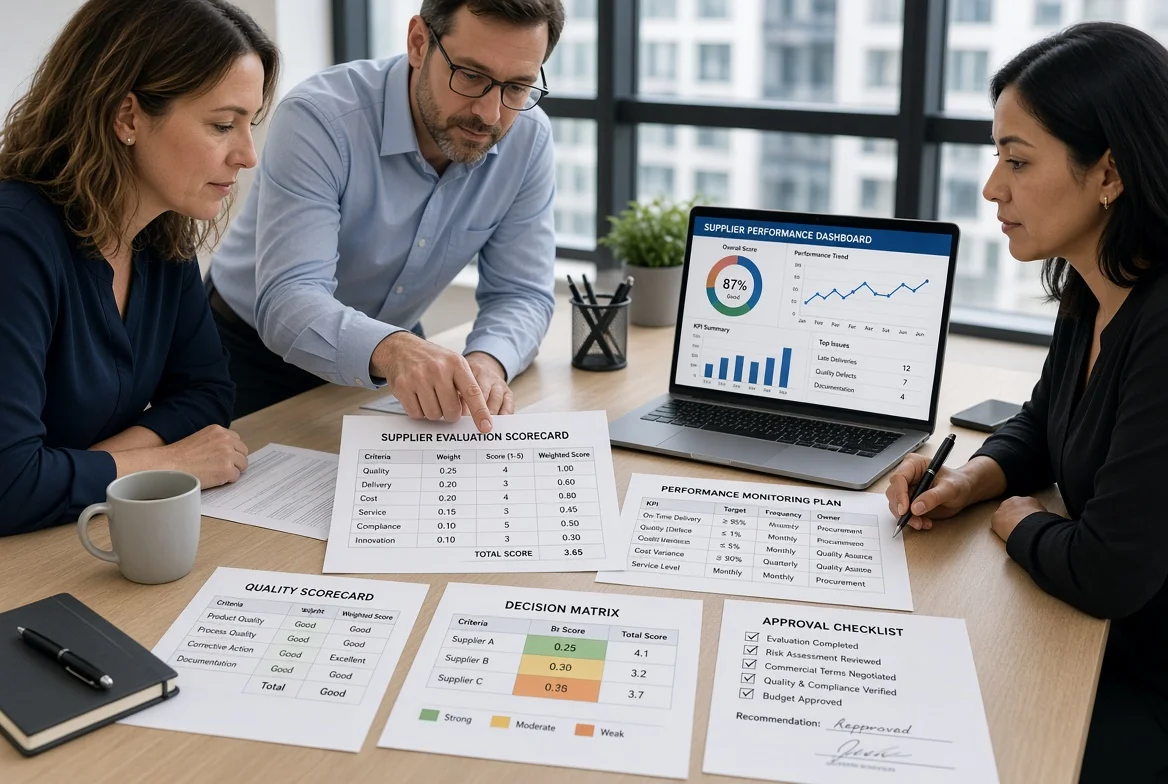
Final Takeaway: A Structured Process Turns Supplier Evaluation into a Strategic Capability
The disciplined supplier evaluation process helps to minimise risk, to have a level playing field and to inform more effective sourcing decisions. The seven steps are employed by professional buyers to evaluate capability, quality, capacity, delivery, cost, compliance and residual risk before making any substantial commitment. The same approach is used for ongoing performance management – approval is not the end, it is a start of a managed relationship.
If you're looking for more in-depth practical tools, follow up with the following B2B Source Desk guides: Supplier Evaluation Criteria, Supplier Evaluation Checklists, Qualification Processes, Selection Methods, Factory Audits and Supplier Performance Reviews.