
Step-by-Step Supplier Evaluation Procedure for Professional Buyers
A formal supplier evaluation process allows professional buyers to minimize risk, fairly evaluate suppliers, and clarify their sourcing decisions before approval, trial orders, and contract awards. It transforms the evaluation process into a repeatable process that begins with clearly established requirements and concludes with documented approval and continuing monitoring.
Evaluation is still often regarded as a one-off checklist or a check at the end. It's actually a procedure that lives—and it must evolve with the complexity of the product, its purchase cost, risk from the suppliers, and business impact. Breaking in steps or rushing through the sequence can result in gaps in abilities, quality, or delivery that only show up during post-production.
Step 1 – Define Requirements and Evaluation Criteria
The initial stage of any supplier evaluation protocol is to secure the buyer's needs prior to reaching out to suppliers. If there are no requirements, then all subsequent comparisons are subjective and any quotation is given on a different set of assumptions.
Outline Product, Quality and Volume Requirements
Do record technical specifications, drawings, materials, tolerances, testing methods, inspection levels, annual volume and order frequency. The metal material grade, surface finish, dimensional tolerance and test standard may be different for the custom metal part. Packaging may require specific print quality, material conformance and compression properties. In the absence of these specifics, suppliers incorrectly fill the void and the assessment becomes unsound.
Assign Commercial, Logistics and Compliance Expectations
Include payment terms, Incoterms, desired price range or cost model, packaging and labeling requirements, export documentation and regulatory/market access requirements. If you have to have ISO, specific product test reports or proven export experience for certain markets, say this at the beginning so it can be part of the evaluation criteria and not an after-thought.
Convert Requirements to Evaluation Criteria
Turn the requirements into criteria which can be scored or assessed - technical capability, quality systems, capacity, delivery reliability, cost, commercial terms, compliance, financial stability, logistics readiness and communication. Give greater weight to the criteria based on risk and importance. The technical capability and quality systems are typically more important for a critical custom component than the price. In the case of a standard item, reliability and stability of delivery might be more important. Record weighting, so the team can apply it uniformly to candidates.

Step 2 – Identify and Screen Potential Suppliers
When requirements and criteria are defined, identify and screen candidates to determine if any suppliers are viable then advance them to further evaluation.
The identification of sourcing channels for the supplier.
Existing databases, referrals, industry contacts, trade shows, direct research and targeted outreach are all potential supplier sources. Make sure the net is wide enough to establish real competition. If a critical component, a buyer may begin with 10 candidates and begin screening.
Initial Screening Questions and Red Flags
Utilize brief product category fit, capacity range, export experience, certifications, and willingness to meet stated requirements screening questions. Eliminate suppliers who are obviously not able to provide the quantity, don't have the manufacturing process or don't have the export capability to the destination country. Screening saves time and money because it avoids in-depth analysis of apparent incongruities.
Creating a Shortlist for Deeper Evaluation
The result of screening is a short list of suppliers that seem to possess appropriate capabilities to warrant questionnaires, RFQs and capability reviews. If the shortlist is challenged, document the reasons for the inclusion/exclusion as this will become clear.
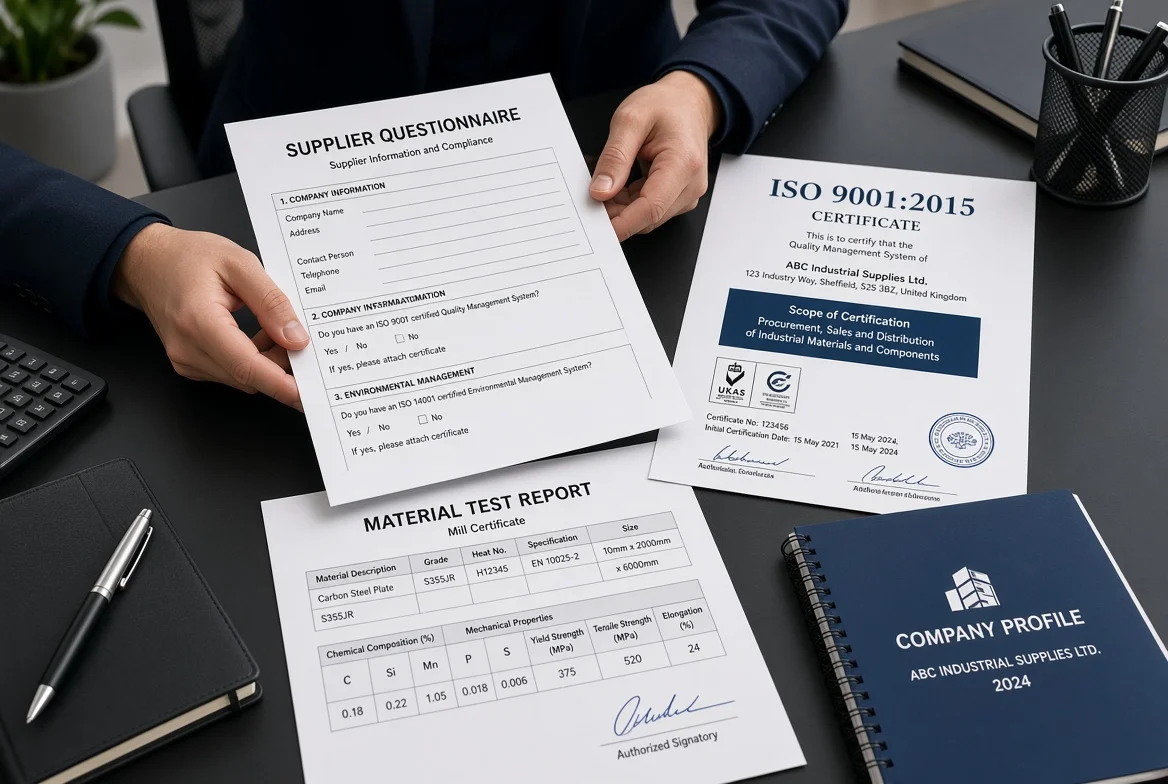
Step 3 – Gathering Supplier Information and Documentation.
The shortlisted suppliers provide the evidence for later technical, commercial and risk assessments.
Supplier Questionnaires, Company Profiles.
It is a standardized questionnaire which gathers consistent information regarding legal status, production capacity, quality systems, capacity, key customers, financial data, compliance and sustainability. Match the questions with the product category and risk level. When looking for custom manufacturing, inquire about equipment lists, descriptions of the manufacturing process, methods of inspection and experience with similar products.
Certifications, Test Reports, and Compliance Documents.
Ask for latest product and material test reports and regulatory documents from reputable organisations. Although a certificate will be helpful evidence, it will not be conclusive proof. Check authenticity and relevance as much as possible.
Preserving the details of your capacity, lead time, and export capability.
Gather information on production capacity, existing workload, average lead times, export markets and logistic capability. This step at times brings to light that the capacity claimed by a supplier is already in the long-term supply chain of their customers, thus altering the viability for assessment before any factory visit.
Step 4 – Evaluate Technical Capability and Quality Systems
This is frequently the most critical step for custom, technical or regulated products. It is not enough to have certificates and questionnaires to determine whether the supplier can actually provide the necessary product in the desired quality.
This assessment is for technical ability and equipment.
Check equipment lists, process flow, engineering drawings and sample production records to ensure that the supplier has the correct equipment and the process knowledge. Specific CNC machines, molds, testing equipment or assembly lines may be checked for the component by a buyer.
This document represents a Quality Management and Process Control Review.
Discuss the supplier's approach to quality in practice including incoming materials inspection, in-process inspection, final inspection, calibration, traceability, nonconforming product handling, corrective action and training. A quality certificate is supporting evidence and is not a substitute for the knowledge of the actual process controls.
Complete testing and first article validation
Samples or first article tests determine if the supplier can perform to specification under realistic conditions. Verify that all samples were made with the same materials, tools, and processes that were planned for production. One of the most common and expensive design problems is a prototype that is not neatly completed and cannot repeat the design at volume production.
Step 5 - Assess Capacities, Delivery, and Commercial Terms
You need to have the technical ability but it's not enough. The supplier is required to meet sustainable volume, lead time and commercial expectations.
The capability to carry out a capacity greater than the demand.
Evaluate machine availability, labour capability, constraints, backlog, shift arrangements, raw material supply and changeover. A supplier might have sufficient capacity to own the necessary equipment, but may not have the available capacity during the buyer's production window.
Adheres to the delivery reliability and logistics readiness.
Delivering the products in time is not enough to guarantee reliability. Discuss order planning, stock management, packaging quality, booking of shipments, export documentation, communication control, and experience with the market. Even with the right paperwork, the wrong packaging, missed bookings or poor communication, acceptable product quality can be lost.
Cost Structure and Commercial Terms Review
Compare unit price, MOQ, payment terms, tooling charges, price validity, material-cost adjustment clauses, packaging, warranties, Incoterms and exclusions. One quotation might be lower just because tests, custom packaging, certification or final inspection are not included.

Step 6 – Conduct Risk Assessment and Due Diligence
In addition to product and commercial risk, consider all other risk factors that may disrupt supply or cause compliance issues.
Providing financial stability and business continuity.
If you are a strategic or sole-source supplier, check finances, credit, ownership and continuity plans. If any supplier relies on a single critical supplier, that constitutes a single point of failure, which could only be revealed during this phase.
Ensuring that operations are compliant, regulatory, and ethical.
Check product safety, ecological, labelling and market access prerequisites particularly for controlled products or sending to stringent markets. The certificate and the declaration does not automatically prove, cross-check test reports, material documentation and relevant product experience.
Exposures to geographic, logistics and supply chain.
Take into account the geographic risk, the vulnerability of the logistics routes, the political or natural disaster risk, and dependence on certain ports or transport corridors. If overseas or single-source suppliers, determine if there are backup capacity or alternative routes before committing.
Step 6 – Making decisions to approve and planning for continued monitoring.
The final step will be the clear decision and plan for post-approval activities.
Approval, Conditional Approval or Rejection
The outcome is full approval, conditional approval, approval for trial orders only, retention as a backup source or rejection. Typically, corrective action, further documentation and/or sample re-approval, audit closure, or successful first production runs are necessities for conditional approval.
Making decisions in writing and communicating with suppliers.
Document decision, reasoning, if applicable and next steps. Ensure clear communication of status and expectations with suppliers. Documentation helps ensure consistency, auditability and re-evaluation.
Planning Ongoing Performance Monitoring
The supplier evaluation process doesn't stop once a supplier is approved. Establish scorecard, quality records, delivery information and review schedules to measure performance. Quarterly reviews may be required for strategic suppliers, annual reviews maybe adequate for lower risk suppliers. It is this feedback loop which can enable continuous improvement or re-sourcing on time.

Final Takeaway: A Structured Procedure Turns Supplier Evaluation into a Strategic Capability
A seven-step supplier evaluation process is a disciplined approach that provides professional buyers with a consistent method for evaluating capability, quality, capacity, delivery, cost, compliance and risk of suppliers before forming a supplier relationship. Evaluation becomes a function of an organization's capability over time when the procedure is followed and documented.
Users requiring supporting tools can follow up on the other B2B Source Desk resources on Supplier Evaluation Criteria, checklists, Qualification, Selection, Factory Audits and supplier performance review.