
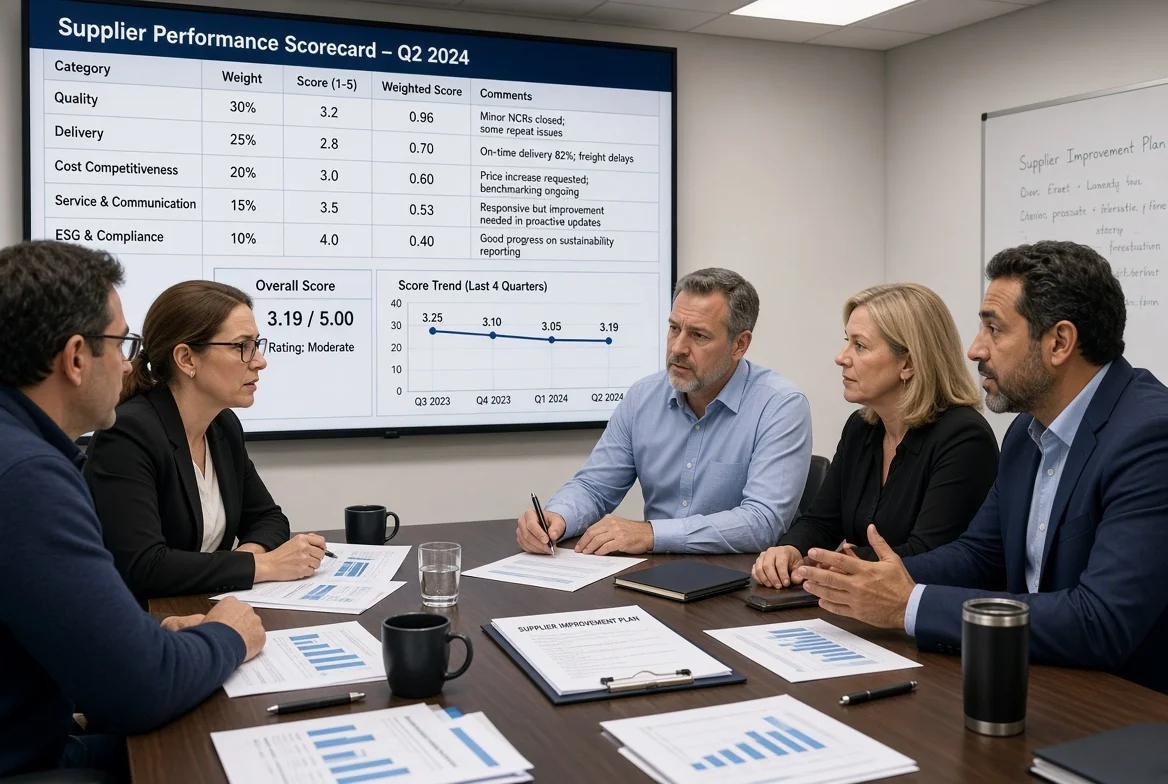
Choosing supplier evaluation criteria is more than just a matter of comparing unit prices or verifying a few quality certificates. Professional buyers evaluate technical skill and ability, capacity, delivery reliability, commercial terms, compliance, financial strength, communication, risk exposure and continuous improvement potential before deciding to go into business with a supplier. These 10 criteria provide a practical tool for procurement teams to give them a comprehensive decision-making tool with a risk context as opposed to incomplete signals.
Evaluation is still viewed as a cost-plus-certificate activity, by many teams. This is not the best way to find out about these because they are not apparent at the time. They might be the main problem, namely capacity shortages, ineffective process controls, export delays, or the reliance on a single source. The criteria listed below are directly related to real-world activities: RFQ reviews, sample validation, factory discussions, and approval decisions.
Criterion 1 – Technical Capability and Product Fit
The basic groundwork is technical ability. If the supplier is unable to make the product and/or provide the required service to specification, all other considerations fade away.
Equipments, Tooling and Process capability
Evidence of the right machines, tooling, and processes will be required by the buyers for the product. Perform a review of equipment lists, process flow charts, engineering drawings and records of past similar work. If the part is a precision machined part, actually verify that the supplier is using the correct machines, has the necessary fixtures and maintains the required tolerances during production – not on a one off sample.
Engineering Support Technical Expertise
Engineering resources are important for custom and complex products. Determine if the supplier is able to provide feedback for design for manufacture, manage drawing changes and resolve technical problems in the early stages of new product introduction. Sometimes a supplier will simply take drawings and do nothing constructive, leading to problems later.
Sample Quality and First-Article Validation
Tangible proof in the form of samples and first articles. Trace and investigate if they were produced under representative conditions using the same materials, tools and processes to be used for volume production. It can be a costly and common pitfall to use a carefully-prototyped product that cannot be scaled up.

Criterion 2 – Quality Management and Process Control
Quality must be managed across the entire process, not only at final inspection. Buyers should understand how the supplier actually controls variation day to day.
Quality Systems and Certifications
Review the quality management system, manuals, procedures, and audit history. ISO 9001 or similar certificates are useful signals but never automatic proof that the supplier can meet your specific requirements. Focus on how the system works in practice for the products you need.
Incoming Material Control and Traceability
Consistent quality starts with incoming materials. Assess procedures for inspection of purchased materials, supplier quality verification, material identification, and batch traceability through production. Weak control here often leads to downstream defects that are hard to root-cause.
In-Process Controls and Final Inspection
Evaluate inspection points, testing methods, acceptance criteria, and handling of nonconforming products. Look for in-process checks at critical steps and a disciplined final inspection before shipment. A supplier that relies only on end-of-line inspection is at higher risk.
Criterion 3 – Capacity, Scalability, and Production Flexibility
Capacity evaluation reveals whether the supplier can support current volumes and possible growth without chronic delays.
Current Capacity and Available Capacity
Examine machine availability, labor capacity, bottlenecks, order backlog, shift patterns, and current utilization. A supplier may have the right equipment yet have little free capacity in the window you need. Confirm realistic open capacity rather than theoretical totals.
Scalability and Growth Capability
Assess expansion plans, willingness to invest in new equipment, hiring ability, and proven ability to ramp production. For strategic suppliers, ask whether they can meaningfully increase output within a defined period if demand rises.
Production Flexibility and Changeover Capability
Flexible suppliers handle product mix changes, urgent orders, and design updates with less disruption. Shorter changeover times, multi-skilled operators, and adaptable lines reduce risk for buyers with variable demand.

Criterion 4 – Delivery Reliability and Logistics Readiness
Most buyers will not allow late and missing deliveries. Experience in the past and discipline in planning are good indicators.
On-Time Delivery Performance – Historical Delivery Performance
Ask for historical on-time delivery data and trends, and why it hasn't been delivered on time in the past. Generally, a supplier with good on-time performance for the last 12 months will be less risky than a supplier who continually has excuses.
Production Planning & Scheduling Discipline
Examine production planning, priorities and dealing with changes to the schedule by the supplier. Planning processes are formal, and commitments are realistic, with a lead time that minimizes the risk of surprises.
Logistics, Packaging, and Export Readiness
Packaging quality, booking shipments, accuracy of export documents and freight coordination are important factors for the overseas suppliers. Late and incomplete documents may cause the production to be late.
Criterion 5 – Cost Structure and Commercial Terms
Unit price is only one part of the commercial picture. Evaluate total cost of ownership and the sustainability of the quoted terms.
Unit Price and Cost Competitiveness
Make price comparisons and ask for cost breakdowns if applicable. Know the drivers of material, labour and overhead costs and be able to decide if the low price is realistic and viable.
Payment Terms and Financial Arrangements
Payment terms impact cash flow and risk. In some instances a slightly higher unit price can be compensated for by favorable terms. Explain the amount of deposits, credit required and any financial guarantees.
MOQ, Tooling, and Cost Exclusions
When goods are cheap, the MOQ requirements are high, the tooling fee is high, or the test, document or packaging fee is high. Surface these early so as to have a clear understanding of landed cost before selection.
Criterion 6 – Compliance, Regulatory, and Market Access
Non-compliance risks legal, customer and brand issues. Verification should be more than just certificates and declarations.
Product Compliance and Certifications
Assure compliance with product standards, safety and customer requirements. Examine past test reports, documentation of materials and previous experience with the regulatory process. The certificate is not a valid proof.
Protecting the environment and maintaining ethical standards.
Environmental management systems, limited substance compliance (RoHS, REACH) and ethical labor practices are an imperative for many industries and customers. Evaluate supplier's apparent continued compliance, instead of just paperwork.
Market Access and Export Capability
International buyers require suppliers who have experience with the destination market's labelling, documentation and customs requirements. This is often a reason for clearance delays.

Criterion 7 – Financial Stability and Business Continuity
Even if the technology seems sound now, a financially unanchored supplier has the ability to cause disruption to the supply chain.
Financial Health & Creditworthiness
If you are a strategic or sole-source supplier, check financial statements, credit reports, registration information and ownership structure. The depth of review will be commensurate with the risk and volume.
Business Continuity and Risk Management
Review contingency planning for disruption – including backup capacity, alternative sourcing for critical inputs and documented risk responses. Suppliers that have realistic continuity plans are more reliable sources for critical supplies.
Ownership Structure and Strategic Direction
Know if the supplier is owned by a single party, a group or going through a change of ownership. Long-term strategy aligned with your needs - less surprises ahead.
Criterion 8 – Communication, Responsiveness, and Relationship Fit
Day-to-day working relationships often determine whether problems are solved quickly or escalate.
Quality of Communication/ Language Capability
Effective, timely communication in the language of the buyer minimises misunderstandings. Assess the clarity of responses, preferred modes of communication and the capacity to talk about technical matters without frequent translation problems.
Attitude of responsiveness and problem solving attitude.
Observe the speed of the supplier's response to basic queries and especially when it comes to solving problems. Unusually quick reactions to routine problems and slow answers to questions about problem solving are a common indication.
Cultural Fit and Potential for Partnership
Long-term cooperation is easier due to the shared values, work style, and business approach for both of them, particularly when it comes to peak demand or issues with quality. The "good fit" is hard to measure but can be seen in initial interactions.
Criterion 9 – Risk Management and Supply Chain Exposure
Every supplier relationship carries exposure. Identifying and mitigating it early is part of professional evaluation.
Single Points of Failure (SPOF) and Sub-Supplier Dependencies
Identify key sub-supplier and processes. If you have a single sub-supplier who supplies an important component, then you're running a concentrated risk. Where exposure is high, collaborate with the supplier to determine realistic backup options.
Geographic and Logistics Risk
Take into account political stability, natural disasters, port congestion and the usage of particular transport corridors. In higher-risk areas, consider backup capacity or alternative routes before committing to the volume.
Business Risk & Contingency Planning – Step by Step Approach to Risk Management and Business Continuity Planning
Evaluate supplier's capacity to deal with demand fluctuations, material shortages, or workforce matters. Confidence is gained when there are documented plans in place and experience of handling disruptions.
Criterion 10 – Innovation Capability and Continuous Improvement
In cases of strategic or long-term partnerships, the capacity to improve and innovate is a competitive edge.
Research and development capacity and new product development.
Review engineering resources, experience with co-development, and ability to accommodate design changes/new product introductions. This is important if product changes occur often.
A culture of continuous improvement and track record.
Check for lean efforts, meaningful process improvements, and employee involvement in quality and/or efficiency improvements. A supplier with proven results will be more inclined to continue improving following the initial purchase.
The use of technology and its effects on digital capability.
Implementation of modern manufacturing technologies, digital process control and automation can bring consistency, efficiency and scalability. Compare the quality of the supplier's technology with your products' complexity and quantity.
Final Takeaway: Comprehensive Criteria Lead to Better Supplier Decisions
The ten key supplier evaluation criteria above give buyers a structured way to assess capability, risk, quality, delivery, and commercial fit before making sourcing decisions. Professional procurement teams do not rely on price or certificates alone. They examine the full set of factors that determine whether a supplier can perform reliably over time.
Use these criteria during RFQ comparisons, sample reviews, factory discussions, and approval meetings. Adjust emphasis according to product criticality and supply-chain risk, then document the assessment so decisions remain transparent and defensible. For related practical guidance, continue with B2B Source Desk resources on supplier evaluation processes, qualification checklists, factory audits, and ongoing performance reviews.