
A professional RFQ process is the way to get a buying team from a sourcing need to comparable supplier quotations. You state the requirement, you find the manufacturers that can actually make that part, you send one controlled RFQ, you deal with the questions, and you look at the quotes against a same scope. Supplier prices only make sense when all factories have the same drawing revision, quantity, quality level, packaging and delivery terms.
The work does not begin with an e-mail message request for a price. It begins before others- earlier, when engineering, quality and purchasing agree on what they're purchasing and which plants are able to make it. The final part of the question is not the cheapest number. An RFQ process that is complete demonstrates capability, assumptions in the quotation, production risk, and commercial conditions before its ever given to anyone for award.
What Is the RFQ Process in Procurement?
The RFQ process is a structured procurement process that is employed to solicit, clarify, and assess supplier quotes for a clearly defined product, service, component, assembly, or manufacturing project. Where the need is explicit enough, having multiple manufacturers offer the same scope is helpful. Its use is by buyers for new product sourcing, OEM work, custom component purchases, repeat purchases, alternative-supplier qualification, cost benchmarking and production expansion.
RFQ Process vs a Simple Supplier Inquiry
Basic research can be done with a simple inquiry. It will not provide you with the control that you need to ensure a reliable quotation comparison. The structured process for request for quotes involves setting the specifications, quantities, quality, delivery terms, instructions for returning the quotes and a procedure for clarifications.
If you ask a number of factories for the price of “custom printed packaging”, you might get varying prices for three different products. One person mentions a board grade and another doesn't mention anything about finishing, and the third is assuming that you didn't mention the amount of cartons. When you make sure all suppliers have the same dimensions, material structure, print colors, finishing, quantity, carton packing, delivery location, order frequency and more, the numbers really begin to add up.
When Buyers Should Use an RFQ Process
Apply RFQ process, if the need is well enough specified that suppliers can respond with price. Representative products are custom manufactured parts, cable assemblies, contract manufacturing, private label products, packaging, fabricated products, spare parts, and recurring supply programs.
Common triggers are: When a new sourcing project comes along, when the suppliers are diversified, when a cost-reduction review is conducted, when supply risk is mitigated, when a product is launched, when an annual purchasing plan is done, when the product is redesigned by the customer, or when the capacity is increased.
When an RFI or RFP May Come Before an RFQ
Don't always start with an RFQ. If you need to learn more about supplier capabilities, materials, production processes, or technical options, begin by obtaining an RFI or having a technical discussion. An RFP is better for situations when suppliers are required to offer a more comprehensive solution, project plan, engineering design or service model. Once the scope is sufficiently stable to be consistent, the manufacturing RFQ process is appropriate.
Step 1: Define the Sourcing Requirement Internally
Internal requirement definition is the first step of the RFQ process. Prior to reaching out to manufacturers, coordinate input from engineering, product development, quality, operations, logistics, finance and management.
Any uncertainty should be resolved internally before asking someone for a quote. When the drawing revision, material, quantity, quality standard, packaging or delivery model is still open, suppliers will want to fill those gaps with their own interpretation. Those assumptions result in delays, quotes changing and arguments.
Define Product Scope and Project Objective
State the source(s) and the purpose. The goal could be prototype development, sample approval, a first production order, repeat production, cost reduction, replacement sourcing, alternate-supplier qualification, or emergency supply continuity.
Changes in project stage update the quotation. A variety of factors vary between prototype, low volume, pilot, and mass production quotes, including tooling, set-up, material procurement, labour efficiency, testing, capacity planning, risk coverage, and the volume.
Gather Technical, Quality, and Commercial Inputs
Gather drawings, CAD, BOMs, material specifications, samples, quality criteria, testing requirements, packaging requirements, quantity expectations, delivery requirements, payment preferences and target timing prior to the construction of the RFQ package.
Indicate essential requirements and those which are subject to other solutions. That will enable a good supplier to be able to provide a compliant solution and still highlight a better material, process, lead time or MOQ.
Establish Document Revision Control
All drawings, specifications, BOM, package artwork, sample reference and product requirement should be assigned a version or revision number. Suppliers should be aware of exactly what documents they are quoting.
You can't sensibly compare the price or lead time of one factory if they've a previous release of the same machined component but at a different material grade or tolerance, and another factory quotes the latest one.

Step 2: Identify and Pre-Qualify Suitable Suppliers
Prior to release of an RFQ, identify manufacturers that are likely to fulfill the project's technical, quality, capacity, and commercial needs. Utilizing the Internet to send files to all suppliers adds to the workload and may provide a plant with product secrets that they can not perform.
A good quote is from a supplier that has relevant capability. The price is not very meaningful if the factory is not capable of providing consistent production, delivery, quality or capacity.
Match Supplier Capability to Product Requirements
Inspect production systems, equipment, materials experience, engineering support, inspection capability, testing resources and quality systems against the actual product.
A supplier who is only good at plastic injection molding is not going to be good at making molded components that have high tolerances and require good looks. A cable assembly manufacturing facility can create a standard cable harness, but may not have the testing, tracing, sourcing of connectors, shielding, or certification to make a custom cable.
Review Supplier Experience, Capacity, and Scale Fit
Verify previous experience with similar products, supporting the quantity of orders and lead time fit, and a commercial scale. Even if a plant is technically able to meet your requirements, it might still not be the right choice if it doesn't offer the same order size or production model you need.
Consider prototype and low volume custom jobs as the first kind of supplier profile, and medium volume recurring production jobs and large volume manufacturing jobs as second and third kinds of supplier profile.
Assess Communication and Documentation Quality
Inquiries that happen early on with respect to drawings, material grades, tolerances, quantity, quality, tooling and delivery will involve technical engagement. Communication quality cannot be a substitute for factory evaluation or sample validation. It's one helpful indicator when you're looking for a supplier who can manage your controlled documents, engineering changes, quality records and international communication.
Step 3: Prepare the RFQ Package
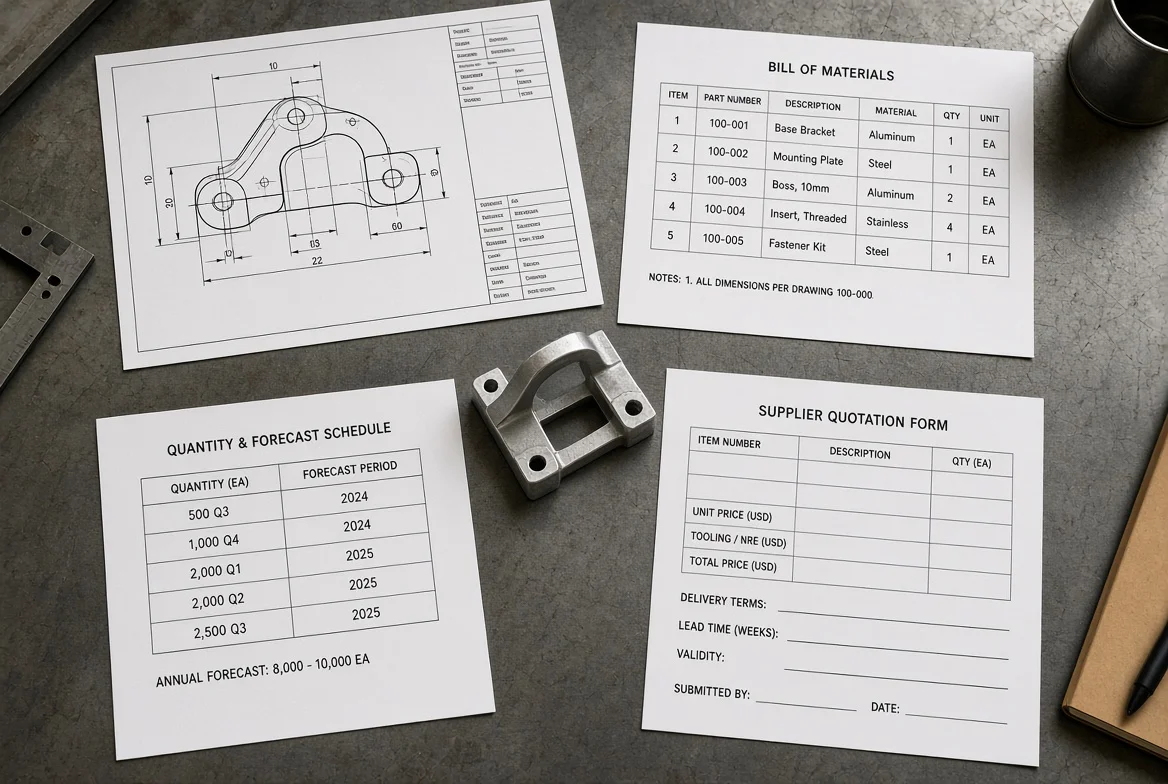
The RFQ package should provide suppliers with a clear picture of what they are to quote. Combine product requirements, quantity information, quality expectations, packaging/ delivery requirements, and quotation-response instructions.
Ensure that the package is maintained and kept uniform. If multiple suppliers are being compared, they should be given the same relevant documents, revision, and quantity assumptions, and commercial requirements. If you are building a structure once and never again, check out Manufacturing RFQ Template: Essential Information Buyers Should Include for a template you can use for a one-time structure.
Include Product, Drawing, and Specification Information
The supplier might require a product description, buyer part number, drawings, CAD files, BOM, material requirements, dimensions, tolerances, finish, colour, approved parts and components, assembly instructions, sample references and performance criteria.
Custom manufacturing is often not adequately described by the product images or one-line descriptions. The factory should know not just the look of the product, but also the materials used, the manufacturing process and the quality control and the function.
Include Quantity, Forecast, and Production Information
Record any order quantities requested, price break quantities, quantity expected per year, frequency of orders, quantities for pilot runs, and forecast ranges as appropriate. This is used by suppliers to calculate material buying, setup, labour, tool setup amortization, capacity, and MOQ.
Distinguish between confirmed order quantity and a forecast. Be clear about the order you are requesting, whether it be one-off orders or trial orders, or pricing for a longer production programme.
Include Quality, Testing, Packaging, and Delivery Requirements
The required state quality standards, inspection requirements, tests, documentation, packaging, labeling, delivery location, requested lead time and Incoterms as applicable.
While being quoted a basic parts price, you might be expecting test reports, export carton labels, individual packaging and a specific shipping date from a supplier. These items should all be included in the RFQ prior to comparing quotations.
Define the Required Quotation Format
Explain to suppliers what is included in the price, quantity break, MOQ, sample cost, setup cost, production lead time, payment terms, price validity, packaging, freight treatment, exclusions, commercial assumptions, unit price, and total price.
A format for suppliers' responses that is structured minimizes the chances of comparing incomplete offers. Also indicates which suppliers missed a key commercial or technical query.
Step 4: Issue the RFQ and Manage Supplier Communication
The RFQ is the beginning of supplier engagement, it is not the end of the buyer's job. Monitor receipt of, respond to, control revisions of, communicate timelines for, and ensure that all competing suppliers have received relevant clarifications.
Questions from the suppliers enhance the RFQ. Inquiries on material, tooling, testing, packaging, delivery or volume can highlight missing requirements that could be addressed prior to final quotation. This is the nuts and bolts of RFQ (Request For Quote) Management.
Send a Clear RFQ Cover Email or Letter
Identify project, list attached files, state quotation deadline, name buyer contact, request confirmation, explain how questions are to be asked, and state how quotations will be returned. Avoid creating a template – keep the message short and to the point.
Manage Supplier Questions Fairly
Record questions and consistently answer when such answers do impact the scope of a quotation. If one supplier makes a request for clarification on a material grade, tolerance, packaging requirement, or quantity assumption, it may need to be directed to the other invited suppliers.
Fairness doesn't imply sharing a supplier's proprietary idea. This translates to each factory bidding the same buyer requirement.
Control RFQ Revisions and Deadline Changes
It is necessary to issue changes to drawings, materials, quantities, quality, packaging, delivery and commercial conditions as controlled revisions. Inform suppliers of changes and if so, if they need to adjust their quotation.
Allow realistic deadlines. There's more scope for review time when it comes to custom tooling, multiple parts, specialty materials, certification, detailed testing or international logistics than there is with a simple repeat purchase.

Step 5: Receive and Check Supplier Quotations
Don't rank quotes as they come in! First, determine if each supplier responded fully and if the quotation is consistent with the technical and commercial requirements of the RFQ.
It is very common to encounter incomplete quotes. A supplier can leave out the information about tools, sample charges, test needs, export packaging, payment terms, validity of a quotation and delivery conditions or exclude something. The headline unit price gives false impression.
Check That Each Quote Covers the Same Scope
Check product revisions, materials, amounts, quality, tests, packaging, tooling, delivery terms, lead time and payment terms before comparing suppliers.
Supplier A might seem more affordable since they are not including functional testing, custom packaging or tooling in their quote. Those items are optional for supplier B. Do not determine which is the better offer until both scopes are synchronized.
Identify Assumptions, Exclusions, and Missing Data
Read the notes. Common terms are: subject to final drawing approval, material substitution, price based on annual volume, tooling not included, freight not included, lead time starts after sample approval.
It's helpful to have clear assumptions. They indicate open decision areas. Clear up or resolve them before you price shop or make a purchase order.
Confirm Quote Validity and Commercial Conditions
Ensure validity of prices, particularly when the price is subject to fluctuations in material costs, electronic component prices, exchange rates, seasonal capacity and freight. Examine conditions for change of price, lead-time commitments, conditions causing a price change, deposits and warranty language (if applicable). The latter have an impact on the risks and the overall commercial value.
Step 6: Compare Quotes Beyond Unit Price
Not all orders with the lowest unit price are necessarily the best sourcing opportunity. Compare total commercial value, product compliance, quality requirements, treatment of tools, lead times, payment terms, supplier capability, quality of communication, capacity and sourcing risk.
Maintain the same comparisons. Deeper methods are reserved for specialist quote analysis work; at this point in the supplier quoting process it is time to not consider unequal offers as equal.
Normalize Supplier Quotes Before Comparison
Make changes or add notes to citations to show differences. One supplier may have a price for the unit and another supplier may have a price for the unit plus a price for the tooling. One says FOB, the other says ex-works.One says FOB, the other says ex-works. One prices 1,000 units; another assumes 10,000.
Normalization does not mean changing the supplier’s numbers. It means making scope differences apparent so you can get a fair comparison.
Compare Cost, Quality, Lead Time, and Risk Together
Consider the unit price, cost, tooling, setup, MOQ, lead time, payment terms, quote validity, quality controls, testing, packaging, delivery responsibility, capacity, and operational risk.
A lower unit price is less desirable when the supplier has a long lead time, poor documentation, uncertain material sourcing, no backup capacity, and/or exclusions that increase the total cost later on in the project. If you're looking for an assessment, consider reading: Why the Lowest Supplier Quote Is Not Always the Best Choice, Unit Price vs Total Cost: How to Evaluate Supplier Offers Correctly and Hidden Costs in Supplier Quotations: What Buyers Need to Check Before Ordering.
Request Clarification Before Making a Supplier Decision
Before choosing a supplier, request a quotation, a breakdown of costs, confirmation of materials, a sample plan, a delivery date, a commitment to delivery, or capability evidence.
The last price tag is not necessarily the last purchase choice. There are still a lot of manufacturing projects that require sample approval, factory assessment, technical review, an audit, a contract review or a pilot run before a purchase order for production.
RFQ Process Stage | Buyer Action | Common Risk to Prevent |
|---|---|---|
Define Requirements | Confirm product, technical, quality, and commercial scope | Suppliers quote incomplete or conflicting requirements |
Select Suppliers | Screen capability, capacity, and relevant experience | RFQs sent to unsuitable manufacturers |
Prepare RFQ Package | Issue controlled documents and response instructions | Suppliers price different revisions or assumptions |
Manage Clarifications | Share relevant answers and revisions consistently | Quotes become impossible to compare |
Review Quotations | Check scope, exclusions, and missing information | Lowest price hides omitted costs or requirements |
Compare and Decide | Evaluate total value, capability, and risk | Supplier selected on price alone |
Step 7: Move from Final Quotation to Supplier Decision
The RFQ process (seeking suppliers, selecting supplier and quoting) must result in a documented buyer decision and not a single quote. Determine and document the reasons for choosing and discarding suppliers, and for keeping others for future assignments.
Quotes may require technical confirmation, sample approval, commercial negotiations, contract review, quality approval, or purchase-order verification prior to the start of production.
Confirm Final Scope Before Awarding Business
All product revision, material, quality, quantity, pricing, tooling treatment, delivery commitment, payment terms, packaging, documentation and exclusions confirmed prior to award.
Any un-resolved assumption should be closed with a written document. Never accept a verbal quotation, order confirmation or purchase order when production scope needs to be defined.
Document the Supplier Selection Decision
When there are multiple stakeholders, use a short record. Take note of prices, technical compliance, quality capability, lead time, tooling, payment terms, capacity, supplier risk, and why it is being selected.
This doesn't need to be a burdensome red tape. A simple comparison sheet or decision note will help to create a record of what was agreed and why to prevent future confusion.
Prepare for the Next Sourcing Stage
After the RFQ, you may move to sample development, tooling approval, supplier onboarding, contract review, purchase-order issuance, production planning, inspection planning, or supplier relationship management.
An RFQ is one stage of a broader sourcing process. Strong RFQ discipline makes the handoff cleaner because both sides already understand the quoted scope.
Common RFQ Process Mistakes Buyers Should Avoid
Most unreliable quotations come from process failures, not from “bad factories.” The problems below are the ones that most often produce mismatched prices or a supplier chosen on incomplete information.
Starting with an Unclear Requirement
Buyers often start before the product, quantity, quality standard, packaging, delivery, or commercial expectation is defined. Suppliers then make different assumptions, and the clarification cycle never ends.
Sourcing a metal enclosure without stating material thickness, coating, cutout tolerances, assembly requirements, or expected volume is a typical example.
Sending RFQs to Suppliers Without Relevant Capability
Inviting plants that lack the process, equipment, quality controls, engineering support, or scale wastes time. Those suppliers may submit low but unrealistic quotes, delay their response, or outsource the work without telling you.
Screen capability before sharing detailed RFQ files, especially when the project includes confidential design information or critical quality requirements.
Allowing Uncontrolled Changes During Quotation
Uncontrolled drawing changes, revised quantities, updated packaging, or informal clarifications cause each supplier to quote a different scope. Use revision control and share relevant updates consistently.
This problem often appears later as an unexplained price gap, a sample mismatch, or a dispute over what the supplier was originally asked to quote.
Choosing a Supplier Based Only on the Lowest Quote
The cheapest quote can be of different quality, tooling, testing, packaging, freight, payment and lead-time than other quotes. Don't assume that a low price is indeed a cost saving, until you have seen the scope of the commercial and the capability of the supplier.
Summary Guidance — Build an RFQ Process That Produces Comparable Supplier Quotes
The RFQ process is a buyer controlled workflow. It assists procurement teams in establishing requirements, identifying relevant suppliers, creating consistent documentation, clarifying requirements, and comparing quotations on a more level playing field.
Think of process improvement as a continuous process. Looking back, examine the times when things went wrong because of previous quotation cycles, price changes, failure to meet requirements, supplier delays, or quality issues. Now make templates, checklists, what you accept from suppliers, and how you compare quotes more restrictive for the next round for offers that you can really compare.