
A practical RFQ checklist for buyers covers four things before any factory is contacted: a defined product scope, current technical and quality information, realistic quantity and delivery assumptions, and a short list of suppliers who can actually make the item. A photo and a target price are not enough. Manufacturers need enough detail to judge process, materials, tooling, capacity, inspection, packaging, and commercial conditions.
Sending the same incomplete request to many unqualified factories rarely improves the result. Prices become hard to compare, suppliers fill gaps with silent assumptions, and the buying team spends weeks clarifying what should have been decided first. Use this checklist to test whether the project is ready for a formal request, what is still open, and which factories are worth approaching.
What Does an RFQ Checklist for Buyers Mean by “RFQ-Ready”?
A project is RFQ-ready when a supplier can understand what must be made, how much is required, what quality level applies, where and when it must be delivered, and how the quotation should be presented. That does not mean every detail is locked. Some items may stay open for a supplier recommendation. Those uncertainties must be labeled. Leaving them blank forces the factory to guess, and those guesses rarely match across bidders.
The Difference Between an RFQ-Ready Project and an Early Idea
An early idea may be a photo, a sketch, a target function, or a rough volume. An RFQ-ready package usually includes controlled specifications, key materials, quantity assumptions, quality expectations, and delivery requirements.
A buyer who wants a custom molded enclosure but has not decided resin, wall thickness, surface finish, annual volume, or tooling approach is not ready for a production quote. That project needs a feasibility discussion first. A cable-assembly request with connector part numbers, length, test method, and first-order quantity is much closer to quote-ready. The difference is not polish. It is whether a factory can price a defined scope instead of inventing one.
What Can Remain Open Before Contacting Suppliers?
Buyers can leave items open if they name them clearly. Useful labels include:
- To Be Confirmed
- Supplier to Recommend
- Optional Quote
- Buyer Approval Required
- Open for Alternative Proposal
Typical open items include alternative materials, packaging options, tooling approach, production location, or a supplier-recommended process. A packaging buyer might ask for a quoted structure plus an optional lighter board. A machining buyer might allow an equivalent alloy if the mill certificate and hardness still meet the drawing. The supplier then prices the base case and the option instead of substituting in silence.
When to Use an RFI or Technical Discussion First
Use an RFI, a capability inquiry, or a technical discussion when the manufacturing process, material family, or supplier type is still unclear. Asking for firm production pricing before that definition exists produces numbers that look precise and are not. A buyer who does not know whether a housing should be machined, die-cast, or molded should ask for process advice first, then issue a production RFQ against the chosen route.

Checklist 1 — Confirm the Product Scope
Suppliers should not have to guess the level of completion. State whether the quote covers material supply, manufacturing only, assembly, testing, labeling, packaging, tooling, documentation, or a finished product delivered to a warehouse. Two factories quoting different scopes will never give comparable unit prices.
Product Name, Part Number, and Description
Prepare:
- Product or part name
- Buyer part number
- Product category
- Short functional description
- Application or end use, where it affects design or compliance
- Drawing or specification number
- Current revision
Clear identity stops a quote from attaching to the wrong version when similar parts are under discussion. A “bracket, Rev C” is usable. “Metal bracket for the new machine” is not.
Scope of Supplier Responsibility
Define who sources raw materials and components, who fabricates, who assembles, who tests, who labels, who packs, who owns tooling, and who delivers.
A cable-assembly house may need to buy connectors, cut and terminate, electrically test, apply labels, and carton-pack. A machine shop may need to buy bar stock, machine, heat-treat, finish, inspect, and issue certificates. A packaging plant may print, convert, glue, and palletize — or only convert a supplied print file. Write the boundary in the request so each bidder prices the same work.
Product Sample and Reference Product
Physical samples, photos, approved references, or current products help when appearance, construction, or assembly is hard to describe. Samples do not replace specifications. Label each sample, record its revision, and state whether it is for reference or for approval. If the sample and the drawing disagree, name the controlling document. Otherwise one supplier will follow the part in hand and another will follow the PDF.
Checklist 2 — Prepare Technical Documents and Specifications
Technical information is the foundation of a manufacturing quotation. Before contact, confirm which files exist, that they are current, readable, and consistent with each other. A 3D model that shows shape but not material, tolerance, finish, or inspection still leaves the factory guessing.
Drawings, CAD Files, and Product Specifications
Typical attachments:
- Current 2D drawings
- 3D CAD files
- Product specifications
- Assembly instructions
- Process requirements
- Packaging drawings
- Artwork or labeling files
- Test procedures
- Approved sample references
Check that revision letters match across files. A Rev B drawing paired with a Rev A BOM is a common source of wrong material and wrong price.
Materials, Components, and Approved Alternatives
List grades, thickness, hardness, finish, coating, plating, resin, paper structure, cable construction, approved brands, and component part numbers where they matter. “Steel,” “plastic,” “aluminum,” “rubber,” “paper,” or “cable” will produce different quotations. State whether equivalents are allowed and how they will be approved. A buyer who accepts 6061 or 6082 should say so. A buyer who must keep a specified connector brand should say that too.
Dimensions, Tolerances, and Critical Features
Mark critical dimensions, fit, surface roughness, flatness, concentricity, hole positions, electrical values, and cosmetic zones. Tight features can force special equipment, extra inspection, slower cycle time, higher tooling cost, or a more capable shop. If a bore is a press fit and a logo area is only visual, say which is which.
Functional and Performance Requirements
Describe what the product must do, not only how it should look. Depending on the part, that may be load, pressure, temperature, electrical performance, durability, signal integrity, water resistance, chemical resistance, or dimensional stability. Replace “heavy-duty,” “premium,” or “long-lasting” with a measurable target, a test method, an operating condition, or a named reference standard.

Checklist 3 — Verify Quantity, Volume, and Production Timing
Volume changes material purchasing, setup allocation, labor, tooling amortization, MOQ, capacity, and unit cost. Separate the first order, quantity breaks, annual forecast, production schedule, and any confirmed commitment.
Initial Order Quantity
State the quantity for the first order or the first quoted lot. If it is uncertain, give a realistic range or several levels. A supplier cannot price one sample, a 200-piece pilot, and a 20,000-piece run as if they were the same job.
Quantity Breaks and Annual Forecast
Prepare breaks such as prototype, first order, recurring order, and higher-volume levels. If annual demand is known, label it as confirmed volume, estimate, forecast range, or non-binding projection. Asking for 500, 2,000, and 10,000 units often shows how setup and material lots move the economics. Do not present a hopeful forecast as a purchase commitment.
MOQ and Order Frequency
Note expected order frequency and ask suppliers for MOQ and standard batch size. If cash flow, market testing, or inventory risk limits the first buy, state a preferred maximum initial quantity. MOQ is usually driven by raw-material lots, setup, packaging, testing, or line capacity, not by an arbitrary preference.
Required Production and Delivery Timing
Give a measurable target: sample date, production completion, ready-to-ship date, and warehouse arrival if that is what matters. Avoid “urgent” and “as soon as possible.” Factories need a date to check capacity and material lead time. A packaging job that must arrive before a retail reset is not the same as a spare-part run with a 12-week window.
Checklist 4 — Define Quality and Testing Requirements
“High quality” is not a requirement. Quality expectations change process controls, inspection labor, test equipment, documents, lead time, and which factories can bid. Write measurable criteria, an approved sample, a performance test, or an inspection method.
Acceptance Criteria and Approved Samples
Cover dimensions, material compliance, appearance, color, performance, defect limits, approved samples, customer standards, and product-specific criteria. Machined parts need dimensional limits. Cable assemblies need electrical tests. Consumer goods need cosmetic standards. Printed packaging needs registration, color, and board-structure rules.
Inspection and Testing Requirements
Decide whether the job needs incoming checks, in-process inspection, final inspection, first-article inspection, sample approval, 100% testing, batch sampling, or third-party inspection. Match the level to product risk, customer rules, critical features, and internal quality procedures. Adding 100% testing after quotes arrive will usually break the comparison.
Required Quality Records and Certificates
List what must ship with the goods or with the first article:
- Material certificates
- Dimensional inspection reports
- Test reports
- Certificate of conformity
- Traceability records
- First-article documentation
- Reliability or validation records
- Production photos
- Customer-specific quality forms
State format and frequency when those details change workload.
Compliance and Certification Requirements
Identify legal, customer, product-specific, or preferred requirements before contact. Do not treat every certification as universal. If a claim is technical or legal, confirm it with a qualified source inside the company or with the relevant specialist. A food-contact claim, an electrical safety mark, and a buyer-preferred ISO certificate are different kinds of request.

Checklist 5 — Prepare Packaging, Labeling, and Delivery Details
Packaging and delivery change materials, labor, protection, cube, handling, labels, and total cost. Define not only the destination but the condition in which the goods must arrive.
Product and Export Packaging
Prepare:
- Unit packaging
- Protective materials
- Moisture protection
- Anti-static protection
- Carton quantity
- Carton dimensions
- Maximum carton weight
- Palletization
- Mixed-SKU packing
- Retail packaging
- Export packaging
Electronics often need ESD bags. Cables need controlled winding and labels. Fragile parts need inserts. Printed cartons need protection from moisture and compression.
Labels, Barcodes, and Carton Marks
Prepare product labels, barcode formats, carton marks, warning labels, country-of-origin text, customer-specific labels, and language requirements. Unclear labeling creates relabeling cost, shipment delay, warehouse errors, customer rejection, or customs problems.
Delivery Address and Required Dates
Include:
- Full delivery address or port
- Required ready-to-ship date
- Required arrival date
- Preferred transport mode
- Partial shipment rules
- Consolidation requirements
- Warehouse or DC constraints
A factory cannot judge freight or schedule against “USA warehouse” with no city, no Incoterm, and no date.
Incoterms, Freight, and Import Responsibilities
International buyers should state the requested Incoterm, freight responsibility, insurance expectation, and known export-document needs. Confirm Incoterms and import duties with qualified logistics or trade staff. The RFQ should record the chosen basis so every supplier prices the same delivery point.
Checklist 6 — Prepare Commercial Requirements Before Contacting Suppliers
Without commercial instructions, suppliers use different pricing bases, payment terms, delivery assumptions, and exclusions. The goal is not to dictate every factory condition. It is to make buyer expectations visible and force exceptions into the open.
Currency, Price Format, and Quantity Pricing
Request:
- Preferred currency
- Unit price
- Total price
- Quantity breaks
- Price basis
- Separate variants
- Cost-breakdown format, if needed
Every supplier should price the same quantities and the same scope. Different volume assumptions make the spreadsheet useless.
Tooling, Setup, Sample, and Engineering Costs
Ask for one-time costs as separate lines: tooling, molds, fixtures, programming, samples, engineering, test setup, certifications, artwork, or packaging development. Where relevant, ask who owns the tool, who maintains it, where it is stored, and under what conditions it can be transferred or replaced.
Payment Terms and Quote Validity
Cover deposit, balance timing, credit or milestone terms, quote-validity period, material-price adjustment rules, and currency assumptions. Two similar unit prices can have very different commercial value once payment and validity are included.
Exclusions, Assumptions, and Supplier Deviations
Require suppliers to list exclusions, assumptions, substitutions, deviations, and extra charges. A factory may omit testing, packaging, freight, tooling, certificates, inspection, or engineering unless the request asks for a complete response. Those omissions are the usual reason one quote looks cheaper.
Checklist 7 — Pre-Qualify Suppliers Before Sending Sensitive RFQ Files
Readiness is not only documents. Confirm that each factory is technically and commercially relevant. Sending detailed drawings to every company found online wastes time and increases confidentiality risk. A short, qualified list usually produces better replies than a long list of unsuitable plants.
Confirm Relevant Manufacturing Capability
Check processes, material experience, equipment, tooling, testing, quality controls, certifications, and product history. A standard cable plant may not support custom overmolding or specified electrical tests. A general machine shop may not hold tight-tolerance production. A carton supplier may lack the required print process or board structure.
Review Capacity and Production Scale
A factory can make the part and still be the wrong size. Review prototype ability, low-volume flexibility, recurring production, peak-season capacity, and backup arrangements. A 50-person shop that quotes a 200,000-piece annual run may be optimistic. A high-volume plant may refuse a 300-piece launch.
Check Communication and Document Capability
Suppliers should be able to read drawings, answer technical questions, quote in a usable format, manage revisions, and issue the required quality files. Fast email is not proof of capability. Look for replies that show they understood the scope.
Protect Confidential Information
Classify drawings, CAD, BOMs, customer names, forecasts, and pricing before distribution. Use confidentiality agreements, controlled sharing, watermarks, access limits, and revision labels where they help. An NDA is not a complete safeguard. Share only what is needed to evaluate and quote.
Checklist 8 — Confirm Internal Approval and RFQ Ownership
Align internally before the request leaves the company. Know who owns technical questions, commercial decisions, quality approval, logistics, and final selection. Suppliers should not receive conflicting answers from different departments.
Engineering and Product Approval
Engineering or product development should confirm drawings, specifications, materials, performance, and approved alternatives. Document open technical questions instead of hiding them in the supplier pack.
Quality and Inspection Approval
Quality should review acceptance, testing, inspection, documentation, traceability, and certificates. Those items change price and lead time. Adding detailed inspection reports after bids are in can invalidate the comparison.
Logistics and Commercial Approval
Logistics and finance should review destination, packaging, Incoterms, freight, payment, currency, and validity. Do not ask factories to quote commercial conditions the company has not considered.
Assign One RFQ Owner and Contact Person
One person should own the process and coordinate internal answers. Suppliers need one primary contact even when engineering, quality, logistics, and finance work in the background. That speeds replies and keeps a clean record of questions and answers.
Final Pre-RFQ Checklist for Buyers
Use this list immediately before contact. If an item is unknown, mark it as open rather than omitting it.
Product and Technical Readiness
- Product scope is clearly defined
- Product name, part number, and revision are confirmed
- Current drawings and CAD files are attached
- BOM and approved components are verified
- Materials, finishes, tolerances, and critical features are defined
- Functional and performance requirements are measurable
- Samples are labeled and their status is clear
- Technical attachments are consistent
Quantity, Quality, and Delivery Readiness
- Initial order quantity is defined
- Quantity breaks are identified
- Annual forecast is labeled as binding or non-binding
- MOQ and batch-size expectations are understood
- Quality and acceptance criteria are defined
- Testing and inspection requirements are listed
- Required quality documents are identified
- Packaging and labeling requirements are ready
- Delivery location and timing are clear
- Incoterm and logistics scope are prepared
Commercial and Supplier Readiness
- Currency and quotation format are defined
- Tooling and setup charges are requested separately
- Payment terms and quote validity are identified
- Exclusions and assumptions must be disclosed
- Suitable suppliers have been pre-qualified
- Confidentiality requirements are ready
- RFQ deadline and contact person are assigned
- Internal stakeholders have approved the RFQ
- Supplier response format is prepared
- Clarification and revision procedures are defined
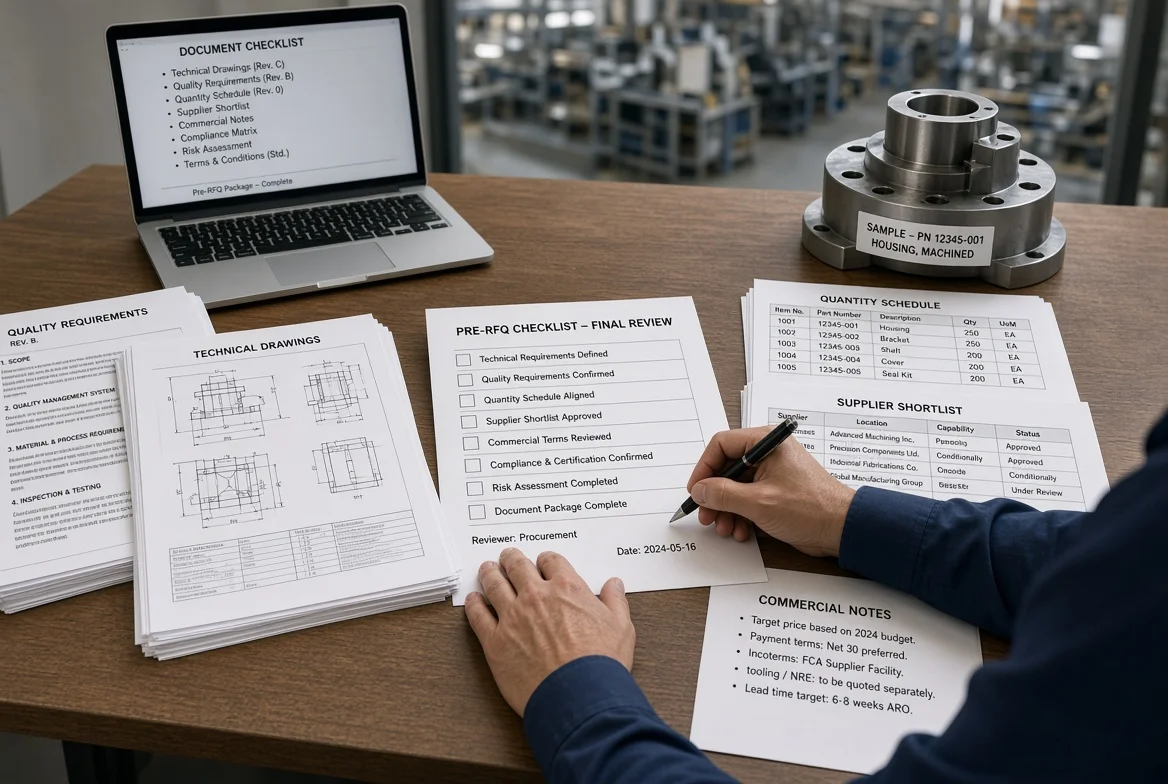
Summary Guidance — Do Not Send an RFQ Until the Scope Is Ready
Contact manufacturers when the buying team can explain the product scope, attach current technical information, state realistic quantities, define quality and delivery expectations, and name suitable factories. Treat the list as a readiness tool, not a rigid form. If something is unknown, mark it and ask for a recommendation or an optional quote. Visible uncertainty is manageable. Hidden gaps produce delayed replies, weak quotations, and prices that cannot be compared.