
A handy manufacturing RFQ template is designed to manage the information that suppliers will require to quote the equivalent product scope – buyer details, project details, product specifications, product drawings, materials, quantity, quality requirements, packaging, delivery, commercial terms, and instructions for response. It is a starting framework and not a form that you copy and paste. Keep the core structure the same and adapt the details to different technical fields for a machined component, cable assembly, molded part, printed package and private-label product.
An RFQ is often considered to be a product name, quantity and unit price. The factors that influence manufacturing quotes include materials, tolerances, tooling, quantity, testing, packaging, delivery terms and conditions, and assumptions made by each manufacturer. This template minimises the amount of information missing and simplifies comparing quotations. Before sending it, you do need to check that drawings, quality requirements, and commercial conditions are complete.
What Makes a Manufacturing RFQ Template Useful?
There are two practical uses of the manufacturing RFQ template. It assists you to clearly articulate your requirements, every time, and it assists suppliers to reply in a format you can compare. It should reduce the number of clarification cycles but not force all products into a one-size-fits-all field list.
Most procurement RFQs are limited to description, quantity and price. A manufacturing RFQ form must include material, process, tooling, labor, quality control, and capacity. In this case, the suppliers use their own suppositions to fill in the blanks and the quotes aren't comparable.
A Template Should Define the Same Scope for Every Supplier
If applicable, provide the same technical data, drawings, samples, quantities of assumptions, quality criteria and delivery specifications to all suppliers.
Even if the same RFQ Template is used for the Manufacturers, one factory may be sent a revised drawing and a detailed packaging note, the other, a revised drawing and last month's revised packaging note - quotations are therefore not comparable. Consider the RFQ package as a controlled package: one revision, one attachment list, one quantity basis.
A Template Should Separate Required Fields from Optional Fields
There are some fields that are common to nearly all production RFQs. Still others rely on the process.
Typically included: pricing format, delivery basis, quality acceptance, materials, drawings or other specification, quantity, and product identity.
May be available or not available: Tooling ownership, certification, reliability testing, retail packaging, installation, after-sales support.
Fill in the fields with Required, Optional, Supplier Recommendation or Not Applicable. Alone without a label is not flexibility. It is ambiguity.
A Template Should Request Supplier Assumptions and Exclusions
Provide suppliers with a section where they can quote assumptions, exclusions, substitutions, lead time conditions and cost items not included in the quotation.
The assumptions are made transparent, which indicates what has yet to be discussed. A template which only requires a unit price will mask differences in tooling, testing, packaging, freight, quality documentation and production volumes. Those gaps will appear later as change orders and unforeseen line items.
Manufacturing RFQ Template Overview
The following is an RFQ template that is supplier ready. Fill in the buyer information, add controlled documents and leave supplier-response information for the factory.
- Crafted with consideration for the needs of the client.Designed with client in mind.
- Objective of the project - sourcing overview
- Product and scope of supply:
- Electronic specification and attachments
- The number and amount of goods and products.
- The standards for quality and testing.Quality and testing standards.
- Packaging, Labeling and Delivery
- Commercial quotation requirements
- Supplier response instructions
- Deviations and assumptions made by the supplier
- Requirements for evaluation and follow-up.
Copy the field blocks to Word, Excel or your sourcing portal. Remove paragraphs not pertinent to the material. Don't include fields to make the document look complete.
How to Adapt the Template to Different Manufacturing Categories
Modify the template for the product. Short examples:
- Machined parts: Material Grade, tolerances, surface finish, heat treat, inspection reports.
- Cable Assemblies: Cable Construction, Connector Part Number, Pin-out, Shielding, Electrical Testing, Labeling.
- Injection-molded Products: Resin Quality, Mold Requirement, Surface Finish, Color, Shrinkage, Tooling Ownership.
- Packaging: substrate, size, print colors, finishing, board structure, packing configuration etc.
- OEM/ODM goods: product specification, branding, packaging, compliance, sample, forecast volume, change-control rules.
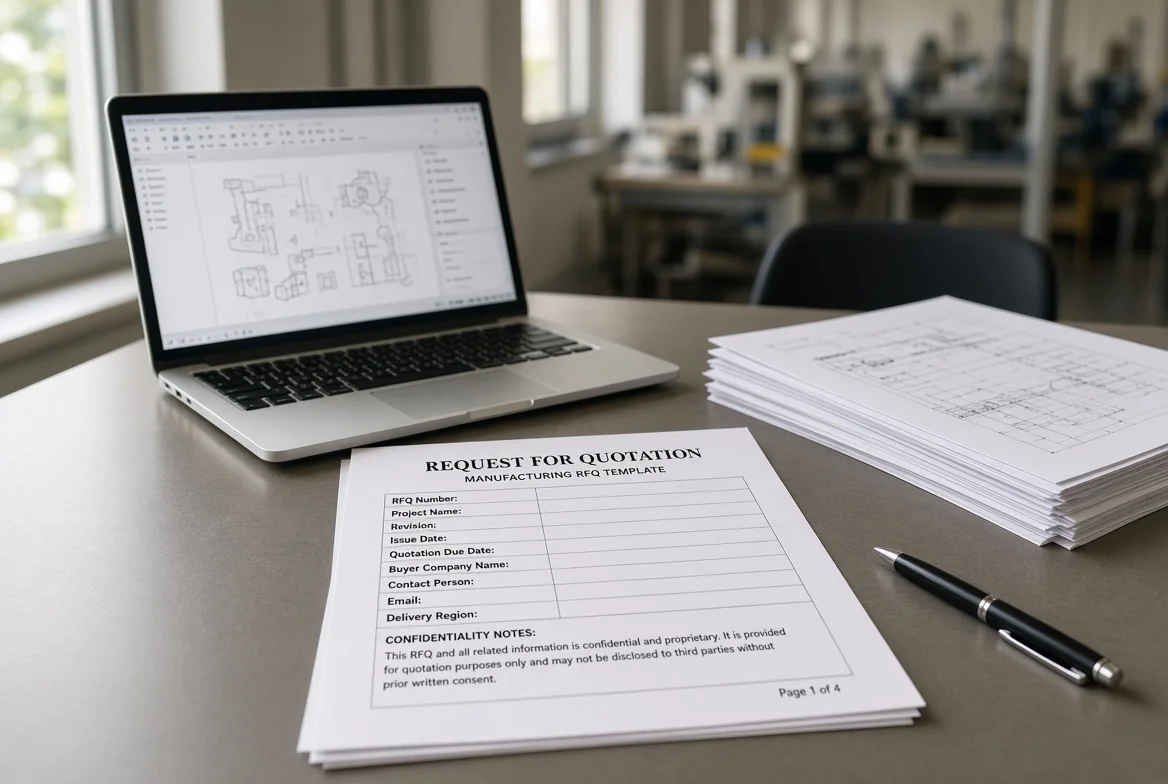
Section 1 — RFQ Identification and Buyer Information
This section specifies what the request is for, allowing the supplier to submit the request appropriately. It is important if you are sending several projects, revisions, or product lines to the same factory. Keep it short. The aim is traceability.
RFQ Number, Project Name, and Issue Date
Field | What to enter | Why the supplier needs it |
|---|---|---|
RFQ Number | [RFQ-0001] | Unique tracking ID for quotes, emails, and revisions |
Project Name | [Project or Product Name] | Human-readable label on the supplier side |
Issue Date | [Month Day, Year] | Confirms which version was issued |
Quotation Due Date | [Month Day, Year / Time Zone] | Sets the response clock |
RFQ Revision | [Rev. A / 00] | Prevents quotes against an old package |
Note for Buyer: When drawings, quantities or commercial terms change, the revision number should be changed. Edit the same RFQ number without using a "silent edit.
Buyer Company and Contact Details
- Buyer Company and Contact Details
- Name of the company: [Buyer Company Name]
- Contact Person: [Name and Job Title]
- Email: [Email Address]
- Phone/Messaging Contact: [Contact Details]
- Note: If the company has a website, include it in the company website.
- Delivery Country/Region: [Destination]
Using the destination, suppliers make logistical and export-related decisions as well as make package decisions and decide if freight should be quoted.
Confidentiality and Document-Control Instructions
- Signed / Required Before Drawing Release / Not Required: NDA Status
- Confidential Information: Customer Name, Other, drawings, BOM, forecast
- File-Sharing Method: (Named portal / Encrypted email / Controlled link):
- Document Handling: May keep for quotation only / return or destroy after quotation / do not give to subcontractors without permission.
Drawings, product concepts or volume forecasts are frequently part of a RFQ. Explain to students what information may be kept confidential and what information the supplier may keep.
Section 2 — Project Overview and Sourcing Objective
If you wish to communicate general application, production stage or intended market to assist supplier to understand quality, packaging, compliance and/or performance expectations. Keep it factual.
Product or Project Background
Project Background:
[Briefly describe the product, its application, and the reason for requesting this quotation.]
You may mention the general application, production stage, or intended market if it helps the supplier understand quality, packaging, compliance, or performance expectations. Keep it factual.
Sourcing Objective
Choose and/or edit one or more:
- Ideation or testing of prototypes and samples.
- Pilot production
- Initial production order
- Recurring production
- Alternate supplier qualification
- Cost benchmarking
- Capacity expansion
- Replacement sourcing
- OEM / ODM development.
The cost of these stages varies between suppliers. The processes of tooling, set-up, engineering, material purchasing and quality control, as well as the manufacturing planning are not identical for one-off prototype and production program.
Supplier Input and Design Feedback
State if they should be quoted precisely to the specification, highlight any manufacturability issues, suggest alternatives, and/or put forward any cost reduction ideas.
This field is used to distinguish a fixed-scope RFQ from the one for engineering or design input.
Section 3 — Product Description and Scope of Supply
Be clear about what the supplier will be quoted on and which activities are included. This section prevents suppliers from quoting a variety of completion levels.
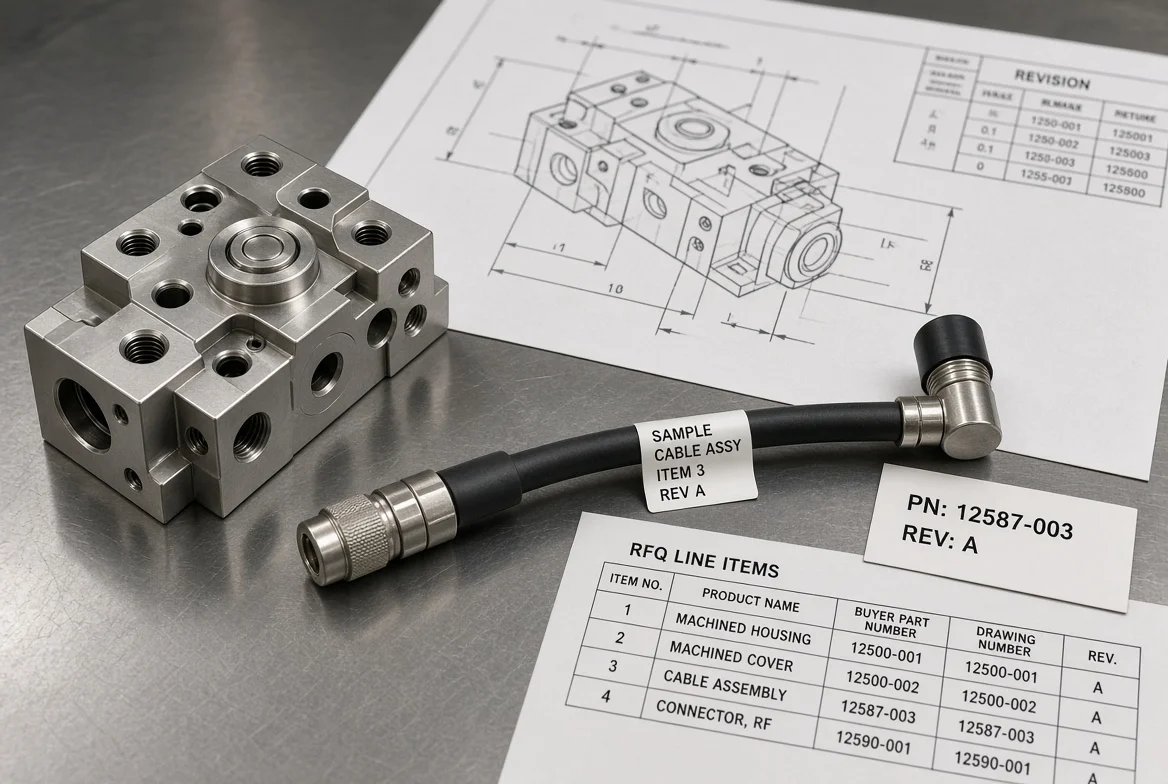
Product Identity and Line-Item Information
Field | Example entry |
|---|---|
Item Number | [Line 01] |
Product Name | [Product or Part Name] |
Buyer Part Number | [Part Number] |
Drawing or Specification Number | [Document Number] |
Revision | [Revision] |
Description | [Short Product Description] |
Every line item should be traceable to the relevant drawing, BOM, sample, or specification.
Scope of Supplier Responsibility
Scope of Supply:
Determine if supplier will supply materials, components, manufacturing, assembly, testing, labeling, packaging, documentation, tooling and delivery.
Practical examples:
Cable assembly scope can range from connectors, cable, cutting, crimping, overmolding, electrical testing, labels, and package.
May include material procurement, machine, heat treatment, coating, inspection, certificates, for a machined part.
Bringing the two together for comparison with the new product.Comparing the two for the new product.
Reference Samples and Existing Products
- Sample Reference Number = [Sample ID]
- Sample Status: [Reference / Approval / Reverse Engineering / Existing Production Sample]
- SRR: [Yes / No]
- Priority if Sample and Drawing Differ: Drawing / Sample / Buyer Confirmation Required
Physical samples are used to aid understanding, but should not be used in place of controlled specifications. State the information you are not finding in the sample but are finding in the document.
Section 4 — Technical Specifications and Required Attachments
This is the most product-specific section of the template. Give sufficient detail for supplier to assess materials and method, tooling and equipment, production time, inspection requirements and feasibility. Eliminate data that's not relevant and include process-specific data as necessary.
Drawings, CAD Files, and Technical Documents
Attached list (replace with actual file names and revisions):
- This is the 2D Drawing app.This is the 2D Drawing App (File Name / Revision).
- The 3D CAD Model is the name of the file / the format / the revision.
- Data Source: Bill of Materials (File Name / Revision):
- The instructions for Assembly are included under [File Name / Revision].
- Product Specification: [File Name / Revision]
- Packaging Artwork or Drawing: [File Name / Revision]
- Test Procedure: [File Name / Revision]
- Approved Sample: [Sample ID]
Attachments must be clearly named and correspond to the revision mentioned in the RFQ. It's hard to find a CAD file without material properties, tolerances or notes that are critical for a production quotation.
Materials, Components, and Approved Alternatives
- Grade: [Grade Specification]
- The thickness or size of a product.Thickness, or size of a product: [Value]
- Finish/Coating/Treatment: [Requirement]
- Manufacturer [If known]:
- Allow Equivalent Materials: [Yes / No / Approval Required]
- Describe the process for approving substitutions.
The word “steel,” for instance, or “plastic,” or “cable” are typically not sufficient. Establish desired grade or performance; express whether alternative(s) will be accepted.
Dimensions, Tolerances, and Critical Features
Critical-to-Quality Features:
Identify dimensions, tolerances, fits, performance characteristics, or appearance characteristics that are important and need to be controlled.
Identify the critical requirements and differentiate from general dimensions. Special finishes or tight tolerances impact on tooling, equipment, inspection, labor, cycle time, risk of scrap and supplier capability.
Functional and Performance Requirements
- The product needs to provide the following function:
- Operating Conditions: [Temperature, Load, Pressure, Environment, or Other Conditions]
- Performance Targets: [Measurable Requirement]
- Test Method: (Required Method or Standard)
- Acceptance Limit: [Pass/Fail Criteria]
Do not use words like “durable”, “heavy duty” or “high performance” without accompanying criteria or a recognized reference standard.
Section 5 — Quantity, Forecast, and Production Requirements
Provide suppliers with a definite quantity basis for pricing. The manufacturing cost is determined by the volume of production, the frequency of the setups, purchasing of raw materials, the efficiency of the labor, the allocation of tooling, packaging, and capacity planning. Understand the differences between actual buying volumes, demand projections and forecasts.
Initial Order Quantity and Quantity Breaks
Quantity Level | Required Quantity | Supplier Unit Price | Total Price |
|---|---|---|---|
Prototype or Sample | [Quantity] | [Supplier to Complete] | [Supplier to Complete] |
Initial Order | [Quantity] | [Supplier to Complete] | [Supplier to Complete] |
Higher Volume | [Quantity] | [Supplier to Complete] | [Supplier to Complete] |
Ask for discounts if ordering in bulk. Each quantity quoted by the supplier must have the same technical and quality requirements, unless otherwise indicated in the RFQ.
Annual Demand and Reorder Pattern
- Estimated Annual Volume: [Quantity or Range]
- Expected Order Frequency: [Monthly / Quarterly / Project-Based / Unknown]
- Forecast Status: [Binding / Non-Binding / Preliminary]
- Seasonal Demand: [Details, if Applicable]
- Expected Program Duration: [Months or Years, if Known]
These details help suppliers evaluate capacity and pricing. Do not present them as guaranteed commitments unless you are prepared to honor them.
MOQ, Batch Size, and Partial Shipment Requirements
- Estimated AV: [Quantity or Range]
- Exp. Order Freq. (Monthly / Quarterly / Project Based / unknown):
- Binding / Non-Binding / Preliminary:
- Seasonal Demand: (If applicable)
- Expected Program Duration (in Months or Years: if Known):
The information aids suppliers assessing capacity and pricing. Don't make any promises that you're not willing to keep.
Section 6 — Quality, Inspection, and Testing Requirements
The quality section tells suppliers what must be controlled and what evidence you need before approving production or accepting delivery. Avoid generic wording such as “good quality.” Ask for measurable requirements, approved samples, inspection expectations, testing, traceability, and documentation.
Quality Standards and Acceptance Criteria
- Applicable Product Standard: [Standard or Specification]
- Approved Reference Sample: [Sample ID]
- Critical Defects: [Define]
- Major Defects: [Define]
- Minor Defects: [Define, if Applicable]
- Cosmetic Requirements: [Details]
- Functional Acceptance Criteria: [Details]
Use the standards and acceptance criteria appropriate to the product, customer, market, and your internal quality system. Do not invent a universal defect classification.
Inspection Requirements
- Inspection Stage: [Incoming / In-Process / Final / Pre-Shipment]
- Inspection Coverage: [100% / Sampling / First Article / Batch-Based]
- Dimensional Report Required: [Yes / No]
- Inspection Photos Required: [Yes / No]
- Third-Party Inspection: [Yes / No / If Required]
Inspection scope affects supplier labor, equipment, lead time, and documentation. Define the requirement before the quotation is issued.
Testing and Quality Documentation
- Functional Testing: [Required Test]
- Reliability Testing: [Required Test]
- Material Certificates: [Required / Not Required]
- Certificate of Conformity: [Required / Not Required]
- Traceability: [Lot / Batch / Serial / Not Required]
- Test Report Format: [Buyer Template / Supplier Format / Other]
Supplier quotations should state whether testing and documentation are included, separately charged, or excluded.

Section 7 — Packaging, Labeling, and Delivery Requirements
Packaging and logistics belong inside a manufacturing RFQ because they affect materials, labor, product protection, shipping volume, handling, and total landed cost. Define both how products are packed and where, when, and under what delivery basis they must arrive.
Product and Carton Packaging
- Unit Packaging: [Details]
- Protective Materials: [Details]
- Units per Carton: [Quantity]
- Carton Dimensions or Maximum Weight: [Requirement]
- Palletization: [Requirement]
- Moisture or Anti-Static Protection: [Requirement, if Applicable]
- Mixed-SKU Packing: [Allowed / Not Allowed]
Packaging requirements vary by product. Fragile components, electronics, cable assemblies, consumer goods, and printed packaging each need different protection.
Labels, Barcodes, and Shipping Marks
- Product Label: [Required Information]
- Barcode or QR Code: [Format and Placement]
- Carton Marking: [Required Information]
- Country-of-Origin Marking: [If Applicable]
- Customer Labeling: [Details]
- Language Requirements: [Language]
Labeling errors cause relabeling, shipment delays, inventory problems, or customer rejection. Attach or describe requirements clearly.
Delivery Location and Required Schedule
- Delivery Location: [Full Address or Port]
- Required Ready-to-Ship Date: [Date]
- Required Arrival Date: [Date]
- Sample Lead Time: [Supplier to State]
- Production Lead Time: [Supplier to State]
- Partial Shipment: [Allowed / Not Allowed]
Distinguish production completion from final delivery. Suppliers control manufacturing lead time but not international freight or customs clearance unless the quotation scope includes those responsibilities.
Incoterms, Freight, and Logistics Responsibility
- Requested Incoterm: [EXW / FOB / CIF / DDP / Other]
- Freight Included: [Yes / No / Supplier to Quote Separately]
- Insurance: [Requirement]
- Duties and Taxes: [Responsibility]
- Export Documentation: [Requirement]
Confirm trade terms and import responsibilities with qualified logistics or trade professionals where necessary. This template does not provide legal or customs advice.
Section 8 — Commercial Quotation Requirements
Tell suppliers exactly how to present pricing and commercial conditions. A single unexplained unit price is rarely enough when tooling, setup, samples, testing, packaging, freight, payment, and quote validity affect total cost.
Required Price Format
Item | Quantity | Unit Price | Total Price | Currency | Notes |
|---|---|---|---|---|---|
[Product / Part] | [Qty] | [Supplier to Complete] | [Supplier to Complete] | [Currency] | [Supplier Notes] |
Request separate prices for different quantity levels, product variations, packaging options, or approved material alternatives where relevant.
Tooling, Setup, Sample, and Engineering Charges
- Tooling or Mold Cost: [Supplier to State]
- Fixture or Jig Cost: [Supplier to State]
- Setup Fee: [Supplier to State]
- Sample Cost: [Supplier to State]
- Engineering or DFM Fee: [Supplier to State]
- Testing or Certification Fee: [Supplier to State]
- Tooling Ownership: [Buyer / Supplier / To Be Agreed]
Request one-time charges separately from recurring unit prices. Ask who owns the tooling, where it will be stored, how it will be maintained, and whether future replacement or repair costs apply.
Payment Terms, Quote Validity, and Warranty
- Payment Terms Requested: [Details]
- Deposit Requirement: [Percentage or Amount]
- Balance Payment: [Milestone or Timing]
- Quote Validity: [Number of Days]
- Warranty or Remedy Terms: [Requirement, if Applicable]
- Price Adjustment Conditions: [Material, Currency, or Other Conditions]
Commercial terms affect supplier pricing and risk. Ask suppliers to identify conditions that could change the quotation after approval.
Exclusions and Supplier Assumptions
Supplier Assumptions and Exclusions:
[Supplier must list all assumptions, exclusions, substitutions, additional charges, and conditions attached to this quotation.]
This field is essential for preventing hidden costs. It should not be optional when you are comparing several suppliers.
Section 9 — Supplier Response and Submission Instructions
Specify how the supplier must respond. Clear submission instructions make incomplete quotations easier to spot and reduce unnecessary email exchanges.
Quotation Deadline and Submission Method
- Quotation Due Date: [Date and Time]
- Time Zone: [Time Zone]
- Submission Method: [Email / Portal / Procurement System]
- Required File Format: [PDF / Excel / Other]
- Buyer Contact: [Name and Email]
Complex manufacturing RFQs may require longer response time because suppliers need engineering review, material costing, capacity confirmation, tooling assessment, and quality evaluation.
Required Supplier Documents
Checklist (request only what you will actually use):
- Completed quotation form
- Technical compliance statement
- List of deviations or exceptions
- Production lead-time statement
- Tooling and setup quotation
- Quality and testing proposal
- Supplier capability profile
- Relevant certifications, if required
- Sample plan, if applicable
- Packaging proposal, if applicable
Do not burden suppliers with documents that will not influence the sourcing decision.
Supplier Questions and Clarification Process
- Question Deadline: [Date]
- Question Contact: [Name / Email]
- Clarification Method: [Email / Shared Log / Portal]
- Revision Notification Method: [Details]
Record important clarification answers and share scope-changing information consistently with every supplier in the same comparison.
Section 10 — Supplier Compliance, Deviations, and Alternatives
Suppliers may not meet every requirement exactly. Give them a controlled way to disclose deviations, recommend alternatives, or identify requirements that need clarification. This is better than forcing a “compliant” mark when a material, process, quantity assumption, or delivery condition has been changed silently.
Technical Compliance Statement
Technical Compliance:
[Compliant / Partially Compliant / Not Compliant]
Details of Deviations:
[Supplier must identify any requirement it cannot meet or proposes to modify.]
Review deviations before comparing prices. A lower quote may reflect a non-compliant material, tolerance, test method, packaging standard, or delivery schedule.
Approved Alternatives and Cost Options
Supplier Alternatives or Cost-Reduction Options:
[Supplier may list alternative materials, processes, components, packaging, or production methods that meet the stated performance requirements.]
Alternatives should be priced separately and clearly labeled. Suppliers should not substitute materials or processes silently.
Open Technical Questions
Open Questions or Information Required from Buyer:
[Supplier must list any missing information required to finalize the quotation.]
A supplier that raises a relevant technical question may be protecting both parties from a later manufacturing problem.
Section 11 — RFQ Evaluation and Follow-Up Requirements
High level evaluation criteria and post submission requirements may be included. This will help suppliers to realize that unit price is not the only factor. Do not give one set of universal scores. The criteria should be in relation to the level of risk, technical challenges, quality standards, delivery timelines, and commercial significance of the product.
Supplier Evaluation Criteria
Possible categories:
- Technical compliance
- The quality of products and testing capacity
- Relevant manufacturing experience
- Production capacity
- Lead time
- Unit and total cost
- 25% of the cost of each tooling set and non-recurring charge.
- The payment and commercial terms.
- Packaging and delivery capability
- Communication and responsiveness
- The risk and continuity of the supplier.
Only use criteria that are relevant to the sourcing decision; compare quotations to criteria provided in the RFQ.
Sample, Pilot Run, and Validation Requirements
- Sample Required (Yes / No):
- Sample Quantity: [Quantity]
- Sample Approval Criteria: [Details]
- Is pilot run required? [Yes / No]
- Validation Documents: [Requirements]
- Production Approval Trigger: [Details]
A quote from the supplier does not indicate that the supplier will be able to manufacture satisfactory parts. Samples, pilot runs, first-article approval, or process validation may be required prior to production approval.
Buyer Decision Timeline and Next Steps
- Clarification period is anticipated to be: [Dates]
- Sample Date of Decision: [Date]
- Check out the Supplier Selection Target (SET): [Date]
- The Expected Purchase Order Date is [Date].
- Contract/NDA requirement: [Details]
- Supplier timelines should be realistic and not
Supplier timelines should be realistic and not a purchasing commitment that can be guaranteed, unless you are prepared to go through with the purchase.

How Buyers Should Use the Manufacturing RFQ Template
Use the template to the product, delete irrelevant parts and complete the known information in the document, clearly mark the unknown information, attach controlled documents before sending it. A template helps to communicate. It is not intended to supersede buyer's judgement or technical review.
Complete the Buyer-Side Fields Before Sending
Complete all known project, product, quantity and quality, delivery and commercial fields. Add a blank column to the right, and fill in with “supplier to state,” “not applicable,” “to be confirmed,” or “open for recommendation.” This will inform the supplier of what you don't have and what you have forgotten.
Attach and Verify All Supporting Documents
Ensure drawings, CAD, BOMs, specifications, samples, packaging artwork, test procedures and quality documentation are up-to-date and properly referenced. Ensure attachments are opened properly, follow a consistent revision number and are not in conflict with each other or the RFQ wording.
Send the Same Applicable RFQ Package to Qualified Suppliers
The applicable version of the RFQ, the technical elements of the RFQ, the quantity assumptions and the commercial requirements should be the same for all suppliers being compared. Consistently communicate scope changing clarifications to all participants. This will ensure that the quote is comparable.
Review Supplier Responses for Completeness
Review suppliers' responses to determine if they filled in the relevant sections, identified exclusions, included assumptions, verified the appropriate revision, and revealed deviations. If answers are not complete, they should be clarified or discarded before they are given a ranking.
Common Mistakes When Using a Manufacturing RFQ Template
The use of a template does not ensure that the RFQ is a good one. Even when buyers complete the form correctly, leave it partially blank, provide conflicting information, rely on old attachments or request a variety of quoted scope, poor results can be achieved.
Treating the Template as a Generic Form
Manufacturing RFQ template needs to be customized for the product and process. A generic form might not contain the necessary information for a cable assembly, molded product, machined part, industrial part, packaging job or an OEM product. Eliminate unnecessary requirements rather than keep them in the document.
Leaving Important Fields Blank Without Explanation
Blank fields have different meanings for suppliers. If it is blank, this could indicate that the buyer is open to suggestions, didn't think to ask for it or assumed it was a standard part of the project. Mark open fields distinctly with “supplier to recommend,” “to be confirmed,” “not applicable” or “buyer approval required.”
Failing to Control Revisions
If attachments and revisions of the template are uncontrolled, it is not useful. Even if the RFQ form is fully completed, an old drawing, outdated BOM or previous packaging artwork will lead to inaccurate quotations. Document all attachments and revisions; formally update requirements as they change.
Asking for Price Without Asking for Assumptions
A template that only requires unit price information leaves room for vendors to obscure or neglect the important commercial conditions. Ask suppliers to specify MOQ, tooling, setup fees, validity of quote, lead time, exclusions, substitutions, payment terms, testing, packaging and delivery basis.
Summary Guidance — A Good RFQ Template Creates Better Supplier Alignment
The manufacturing RFQ template should be used to clearly outline the product, the requirements, ensure all suppliers provide the same response and reveal assumptions prior to sourcing. Refine the template as time goes on, according to actual enquiries by suppliers, gaps in quotations, changes in production, issues arising with the quality, and unforeseen charges. Use it as a "living" internal procurement asset and not a static document copied from project to project.