
Writing a good RFQ is not about increasing the number of pages, it's about providing manufacturers with a quote that they'll be able to respond to. The clearer, complete, comparable and easy-to-answer the RFQ is, the better the responses that will be received from the suppliers. Outline the terms of the product scope, include existing drawings and specifications, specify quantities and quality demands, and explain the delivery and commercial goals, and explain precisely how suppliers should format their quotations.
Incomplete and/or ambiguous requests are left unaddressed, postponed, or inadequately answered. A factory could be the wrong revision, miss out the tooling or simply not get the RFQ as it takes more time to clarify it than the opportunity warrants. The longer a document is, the better it is not. Clear, specific, relevant instructions make more useful quotations.
What Makes an RFQ Effective for Manufacturers?
An effective manufacturing RFQ will address a short list of practical questions from the supplier's point of view: What do they need to produce? How much do they need to produce? What quality is appropriate? When do they need it produced? What should be included in the quotation? How will the supplier know if they have successfully won the business?
There are two aspects to response quality. The Response Likelihood is if the qualified factory even makes a response. The usefulness of the response is whether or not the quotation is technically relevant, commercially complete and is comparable to other offers. If you can't determine which revision, quantity, test scope or packaging basis was used, a fast one-line unit price is not a helpful answer.
Clear Enough to Understand the Product Scope
Assign a product, component, assembly or service a part name, part number, revision and scope of supply. You should never leave the factory wondering if you are being quoted for material only, machining, assembly, testing, packaging and labeling, tooling or delivered goods.
In a cable assembly RFQ, connectors, cable construction, length, pinout, testing and packaging should be identified. Machined part RFQ should include material, drawing revision, tolerances, finish, quantity, inspection, and delivery. If the scope is incomplete, the suppliers will fill in the missing items and they will not be the same in all factories.
Complete Enough to Price the Manufacturing Work
Materials and dimensions, tolerances, finishes, quantity, tooling, testing, packaging, delivery, quality documentation are priced by manufacturers. Quotes are estimates based on assumptions if any of those cost drivers is missing.
Identify items that can be repaired from those that can be quoted as an option. When the material is not final, request suppliers to identify the assumed grade or to quote alternatives. Avoid letting each factory choose a Resin, Plating or Connector brand without a discussion.
Structured Enough to Compare Supplier Responses
Request all the same basic information from all suppliers: Unit price, Total price, Quantity basis, MOQ, Tooling, Set up, Lead time, Payment terms, Quote validity, Exclusions, Assumptions.
Standardization elucidates the reasons for differences in quotes. It does not imply that all factories have to cram a true exception into a rigid format. Allow for comments and deviations. The supplier who tells you what he is limited on is far more useful than the one with a low price who tries to hide it.
Prepare the RFQ Internally Before Writing It
Improved supply chain behaviours begin before the first sentence is written. Collect feedback from engineering, product development, quality, operations, logistics, finance and management. You can't solve your inner conflicts for a supplier.
In the event that the drawing and quantity, quality standard, packaging requirement and delivery date are inconsistent, factories will adopt different assumptions. The quotes returned will appear to be from different projects.
Confirm the Product, Project Stage, and Sourcing Objective
Indicate whether the RFQ is for a prototype, sample, pilot run, first production order, recurring order, alternate source, cost benchmark or long-term OEM program.
The staff, pricing, and staffing of those requests vary from supplier to supplier. Sometimes engineering time and sample development may be required for a prototype. These include recurring production needs capacity, material purchase, tooling amortization, quality documentation and production schedule. If the objective is not clear, a factory may offer a sample shop rate for a production work or a production MOQ for a development work.
Separate Mandatory Requirements from Preferences
Determine expectations of the supplier and those which may be recommended. Performance, safety, material, dimensional, certification and customer-approval conditions may be mandatory. Packaging style, brand of the part, where it is made or some other process.
Use the required, preferred, optional, supplier recommendation, and to be confirmed labels. That labeling prevents a nice-to-have carton design from becoming a cost driver or a requirement that a factory does not see as being important.
Resolve Internal Contradictions Before Sending the RFQ
Common misconceptions are readily overlooked and costly misjudgements that can be made. The drawing does specify one material, the BOM does a different. There are 1,000 units planned and 10,000 units asked for by procurement. The RFQ states only that it will be subject to "standard inspection", whereas Quality requires 100% testing.
Do not ask suppliers to make wagers on the winning paper. Update the package, find controlling revision and send one aligned request.

Write a Clear RFQ Introduction and Project Summary
The first section should include who you are, what you are buying, why you are sending out the RFQ, and what type of response you are seeking. Keep it short. A factory uses context in order to determine if the request is relevant.
Identify the Buyer, Project, and RFQ Reference
Add company name, contact person, RFQ number, project or product name, issue date, quotation deadline, how to reply, and any confidentiality instructions that are relevant.
These details provide traceability in the event you need to send revised RFQs, multiple products or several projects to the same supplier. If there is no reference, it is not until prices don't match that you will know.
Explain the Sourcing Objective Briefly
Put simply, what you need: a production pricing, sample development, tooling quotation, capacity confirmation, an alternate-source proposal, a cost-reduction option or even full OEM/ODM support.
You will not have to reveal the target prices or names of customers unless required to quote correctly. Provide sufficient background to enable the factory to select the appropriate process and commercial basis.
State the Expected Supplier Response
Explain to suppliers what a complete answer should include: pricing schedule, lead time, MOQ, tooling, quality proposal, deviations, assumptions, packaging, delivery terms and commercial conditions.
If you don't mention this in the beginning, you will only be given a one price without knowing what it covers. The factory should be aware of what “complete” means before they begin to charge for the job.
Provide Technical Information Suppliers Can Actually Quote
The most important factor for determining the quality of the quotation, when it comes to custom manufacturing, is technical clarity. Suppliers must assess the suitability for cost and feasibility before they can make their own cost and feasibility decision; they must have information such as dimensions, materials, process requirements, performance, tolerances, components, and critical features.
A photo or a conversation is not a substitute for controlled documents. The factory must look at the drawings, verify the materials, calculate the process time, assess the processing equipment and judge the quality product.
Include Drawings, CAD Files, and Current Revisions
Post the most recent 2D drawings, 3D CAD models, BOMs, specifications and assembly instructions. Name each file clearly, revise them and provide reference within the RFQ.
3D modelling of geometry. Does not automatically display material, tolerance, finish, testing, or inspection. Don't take it for granted that a CAD file is sufficient basis for a production quotation.
Define Materials, Finishes, and Approved Components
Consistent quotes are not provided for words such as steel, plastic, rubber, aluminum, paper or cable. State the grade, thickness, hardness, coating, plating, resin, cable construction or performance as appropriate.
If equivalents are permitted: State the performance requirement and the approval process. State that there are no substitutions if there are none. One of the easiest method to make quotations appear similar when they aren't is to make use of silent substitution.
Identify Tolerances and Critical-to-Quality Features
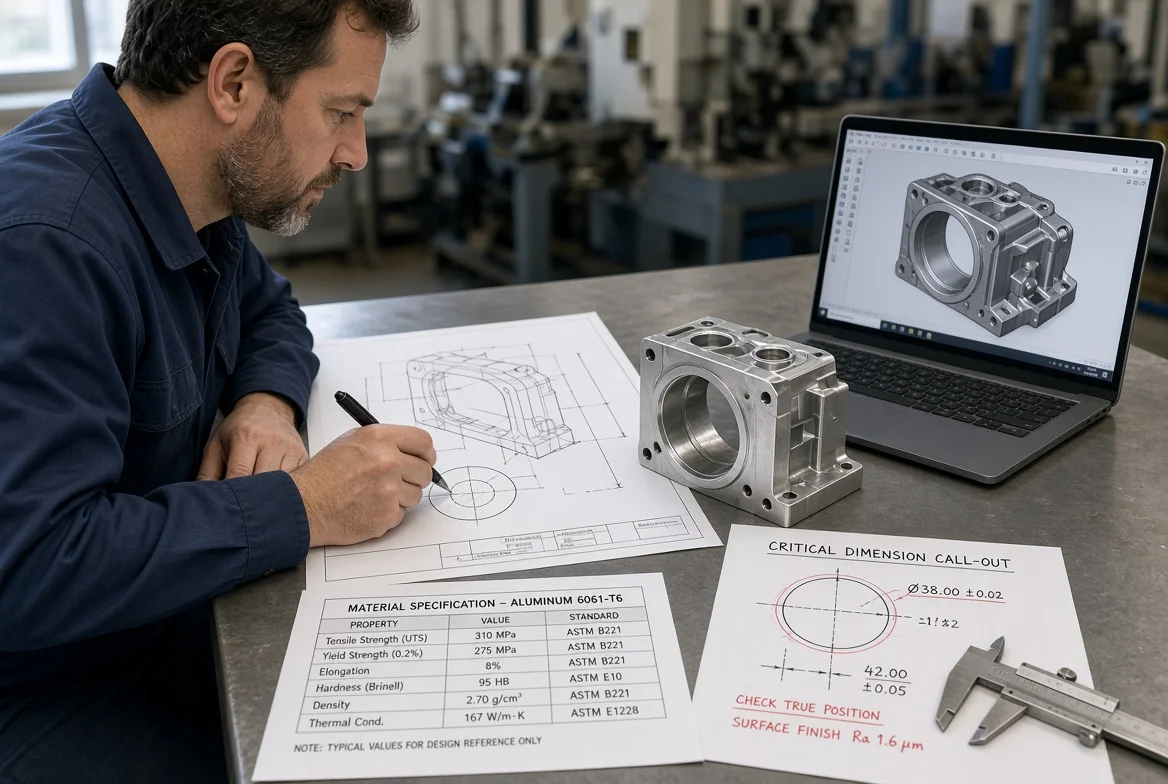
Record dimensions and features that influence fit, function, safety, appearance or performance. Suppliers must understand the tolerances that will be critical to the process and those that will be within normal process capacity.
If all dimensions are tight, some factories will under quote by employing the standard procedure. Others will over quote by estimating special fixtures, additional inspection or slower machining speeds on features that don't require them.
Describe Functional Requirements and Test Conditions
State the functionality of the product and NOT how it looks. When applicable, include operating temperature, load, pressure, electrical performance, mechanical strength, environmental exposure or other measurable conditions.
Do not use the words high quality, heavy duty, or long-lasting without specifying the test method, target, acceptance limit or reference standard. You can't put a price on a slogan.
Make Quantity and Volume Assumptions Clear
Suppliers consider quantity when determining material purchase, set up allocation, efficiency, labor, tooling amortization, capacity and MOQ. Many factories have several reasons for returning different prices or not committing to a lead-time and one of them is ambiguous volume.
Keep an order and a forecast apart. Make sure you label each figure, so that the quotation basis is visible.
State the Immediate Order Quantity
Give the quantity for the initial order or quotation. When multiple quantities are being considered, request individual price points.
For instance, if you ask for prices at 500 units, 2,000 units and 10,000 units, you will get a sense of how price changes as volume changes, and you won't have to guess at comparing volume economics.
Provide Forecast Volume Without Overpromising
A factory can use annual demand, reorder frequency or a seasonal range to evaluate its capacity and material planning. State whether the forecast is a binding forecast, non-binding forecast, preliminary forecast, or a subject to customer forecast.
If the quantities are overstated in order to sell them at a lower price, the problems present themselves upon actual purchase. The subsequent RFQ from the same buyer will be taken more seriously.
Ask Suppliers to State MOQ and Production Assumptions
Inquire about minimum order quantities, batch sizes, any assumptions, and if they will ship partial orders. If the price is only available at an unrealistic quantity, it's a waste of everyone's time.
Once you can see the desired scale, you are more likely to get a response from qualified suppliers and you can determine which factories won't be able to process your order sequence.
Give Suppliers Clear Quality and Acceptance Requirements
In the absence of acceptance criteria, a factory may list the standard factory inspection - you may want a little more testing, documentation, or defect control at the site. Quality criteria should be realistic, measurable and commensurate with product risk.
Replace “High Quality” with Measurable Requirements
A statement such as “Premium quality”, “Best quality” or “Zero defects” does not give a manufacturer any indication of what to review. Utilize dimension, approved sample, functional targets, cosmetic standard, defect limits, or test criteria.
It is not necessary to specify all possible variables. Consider characteristics of importance for acceptance, safety, customer approval, performance or compliance.
State Inspection, Testing, and Documentation Needs
Define inspection stage, frequency, methods and acceptance limits, inspection report, material certificate, traceability, first-article requirements and third-party inspection (if applicable).
Reports, 100% tests, special fixtures and retained records cost and take time. If they are listed after the quotation, the price was not final.
Explain Packaging and Delivery Quality Expectations
Quality includes the condition of the goods on arrival. Explain the following packaging aspects: unit packing, export packing, labelling, palletising, moisture protection, anti-static protection, carton marks and delivery location in the context of acceptance.
Machined parts that are fragile, electronic components, cable assemblies, and printed packaging materials break while being transported, even if the product itself was manufactured properly.Even though a product is manufactured correctly, fragile parts, electronics, cable assemblies and printed packaging materials break in transit. Where packaging is not specified, each factory will take the level of protection that it assumes.

Request a Structured Supplier Quotation Format
With a clear response format, suppliers can be more easily able to provide a complete response and you can easily compare offers. Make the form simple yet specific enough to demonstrate the differences in cost and scope.
Request Recurring and Non-Recurring costs, Quantity levels, Lead time, MOQ, Payment, Quotation Life, Exclusions and Assumptions separately.
Ask for Unit Price and Total Price by Quantity
Use unit price and total price for each quantity requested. Each line should be a separate line if you have product variations, materials, packaging options or quantity breaks.
Avoid taking one blended price, which may assume quantities or may have differences in the products.
Separate Tooling, Setup, Sample, and Engineering Costs
Request suppliers to separate out molds, dies, fixtures, set-up, programming, samples, engineering, test set-up, certification, packaging-development costs from the unit price.
Regarding tooling, ask who owns the tool, who services it and what happens if the tool requires repair. The answers have the same impact as the first unit price on long-term cost.
Request Lead Time, Payment, and Quote Validity
Be sure to request sample lead time, production lead time, payment terms, deposit, quote validity, material-price assumptions, capacity assumptions and the clock's "when" moment.
The “30-day lead time” may start from the deposit, Approval, Tooling completion or Material confirmation. If the starting date is not defined, then the date is not comparable.
Require Assumptions, Exclusions, and Deviations
Make it compulsory to include Assumptions, Exclusions, Deviations, Substitutions and Open Questions. Provide the factory with a secure location to recognize uncertainty rather than deny it or sneakily alter the scope.
A supplier who tells you about a limitation will likely be able to give you a usable quotation compared to the one that will be able to give you a lower quotation and not tell you about the limitation.
Response Field | What the Supplier Should Provide | Buyer Benefit |
|---|---|---|
Quoted product revision | Drawing, BOM, or specification revision used | Confirms the current scope was priced |
Unit and total price | Price by quantity level and total order value | Supports direct comparison |
MOQ and volume basis | Minimum order and pricing assumptions | Reveals volume constraints |
Tooling and setup | Separate one-time charges | Prevents hidden costs |
Lead time | Sample and production timing with starting condition | Supports realistic planning |
Quality and testing | Included inspections, tests, and records | Confirms quality scope |
Exclusions and assumptions | Items not included or still open | Makes quote differences visible |
Quote validity and payment | Commercial validity and payment conditions | Helps evaluate commercial risk |
Make the RFQ Easy for Suppliers to Read and Complete
The usability of the document has an impact on the quality of the response. Disorganized, repetitive, difficult-to-open or irrelevant pages in an RFQ will add more work and incomplete answers.
Use Clear Sections, Headings and numbered Requirements
Use Clear Sections, Headings, and Numbered Requirements
Divide the RFQ into product scope, technical requirements, quantity, quality, packaging, delivery, commercial terms, and response instructions.
Number important requirements so suppliers can confirm compliance item by item. This is especially useful on assemblies with many technical and commercial conditions.
Use a Response Template or Pricing Schedule
A buyer-provided pricing schedule reduces omissions and simplifies comparison. Typical fields include product line, quantity, unit price, total price, tooling, sample cost, lead time, MOQ, payment, quote validity, exclusions, and notes.
Do not make the form so complicated that factories cannot add a necessary qualification. The template should capture the quote, not trap it.
Keep the RFQ Focused and Remove Irrelevant Content
Include information that affects quotation, feasibility, quality, delivery, or commercial evaluation. Company history, marketing copy, duplicated requirements, and unrelated legal text slow the review.
Clarity comes from relevance and organization, not from extra pages.
Set a Realistic Deadline and Manage Supplier Questions
A complex manufacturing RFQ may require engineering review, material costing, tooling evaluation, capacity confirmation, and internal approval. The deadline has to allow that work.
Supplier questions are part of the process. Repeated questions about basic scope items, however, usually mean the RFQ still needs work.
Set a Deadline Suppliers Can Actually Meet
Match the timeline to complexity. A repeat-product quote may need less time than a custom assembly, multi-part BOM, tooling project, or certification package.
There is no universal number of days. If the project is technically demanding or strategically important, ask qualified suppliers whether the date is realistic before you lock it.
Identify One Buyer-Side Contact Person
Name one main contact for questions, even if technical issues are routed internally to engineering or quality. Conflicting answers from different people produce conflicting quotes.
Fast, consistent replies also affect how much engineering time a factory is willing to invest in the quotation.
Control Clarifications and Document Revisions
Record questions that change scope and share the same answer with every supplier in the comparison. Revised drawings, quantities, specifications, or quality requirements need a revision identifier.
If one factory receives an important clarification and the others keep quoting the old requirement, the prices are no longer comparable.

Common RFQ Writing Mistakes That Produce Weak Supplier Responses
Most weak quotations start with a weak request. The problems below are the ones that most often cause delay, decline, partial answers, or mismatched scope.
Asking for a “Best Price” Without Defining the Scope
“Please send your best price” does not tell a factory which configuration, quantity, quality level, packaging, delivery basis, or commercial terms to use.
Replace it with specific quotation instructions and quantity levels. Ask suppliers to state assumptions instead of letting each one invent the scope.
Providing a Product Photo Without Technical Requirements
A photo can show appearance. It usually does not show material, tolerances, internal construction, performance, or test criteria. Two factories can quote two different processes from the same image.
Attach drawings, CAD files, BOMs, samples, and measurable acceptance requirements when the product is custom.
Leaving Quantity, Forecast, or Delivery Information Unclear
Immediate quantity, expected volume, order pattern, delivery location, and requested timing drive production and logistics assumptions. Different volume assumptions produce different unit prices, MOQs, lead times, and tooling allocations.
Label forecasts as binding or non-binding so the quotation basis is honest.
Mixing Mandatory Requirements with Preferences
If every preference is written as a must-have, some factories will overquote or decline. If a critical requirement is not labeled, others will ignore it.
Use Required, Preferred, Optional, Supplier Recommendation, and To Be Confirmed.
Failing to Ask for Exclusions and Assumptions
Tooling, testing, packaging, freight, documentation, and engineering work disappear from a quote when they are not requested. The low price then looks attractive only because the scope is smaller.
Require a separate assumptions and exclusions section in every response.
Sending a Complicated RFQ to the Wrong Suppliers
Response quality also depends on supplier fit. A factory without the process, capacity, quality capability, or product experience may send a vague answer or none at all.
Pre-qualify the list. Send a detailed manufacturing RFQ to suppliers who can actually do the work.
How to Improve Supplier Response Quality After the RFQ Is Sent
Follow-up should remove real obstacles without pushing factories into premature prices. Keep the comparison fair.
Confirm Supplier Receipt and Interest
Ask suppliers to confirm they received the package and can review it within the timeline. That quickly shows attachment problems, capacity issues, or a lack of fit.
Do not chase factories that have shown no technical or commercial interest. Silence is information.
Respond to Important Questions Promptly
Prioritize questions that affect material, function, quantity, quality, tooling, lead time, or quotation scope. Delayed answers produce incomplete or heavily qualified quotes.
Document the answers and identify any revised files so the final quotation can be traced to the correct information.
Request Revised Quotes When Scope Changes
If you change a technical requirement, quantity, packaging condition, delivery location, or test requirement, ask for revised quotations.
Do not compare an updated quote from one supplier with an original quote from another unless the scope difference is documented and intentional.
Final RFQ Writing Checklist for Better Supplier Responses
As a pre-send review read this. The test is straightforward: can a competent manufacturer fill out the quotation without taking any guesses about the essentials?
Product and Technical Clarity
- Drawings, CAD, BOM and readable attachments.
- Materials, dimensions, tolerances, finish and critical features
- What the performance requires and what the approved components are.
- Samples or reference standards as appropriate
- Consistency in all technical documents.
- The goal is to achieve clarity and transparency in commercial terms and deliveries.
Commercial and Delivery Clarity
- A forecast that is binding or non-binding.Forecast that is binding or non-binding.
- MOQ, Tooling, Samples, and Set-up Fees are requested separately.
- Quality, testing, packaging, labeling and delivery location
- All the above, except quote validity, are part of the lead time starting condition.The lead time starting condition includes all of the above with the exception of the quote validity.
- Excludes/assumes in the response.
Supplier Response and Communication Clarity
- Realistic quotation deadline
- How the response will be processed or the cost of the response
- A process for clarifying and contacting with a single question.
- Revision-control method
- The documents that are required from suppliers and the evaluation criteria.
- Confidentiality instructions (as applicable)
Summary Guidance — Write RFQs That Make the Right Supplier Response Easier
An effective RFQ isn't a one-size-fits-all solution – it won't make all factories say the same thing. It provides a qualified supplier with enough detail to allow him to price the appropriate scope, note assumptions, highlight any limitations, and provide alternatives where they can assist him.
Review your questions after sourcing and the fields that suppliers have left blank. When multiple factories ask the same question or leave the same question blank, update the RFQ prior to the next project. Best practices for writing RFQ's are gained from the quotes that return with fragments, and not by adding additional pages to an already confusing RFQ.