
For buyers who must decipher beyond the unit-price line of a supplier's quote, you should begin with the entire quote. A quotation is a suggested method of manufacturing, inspecting, packing and delivering a product. Prior to comparing two numbers, make sure that technical compliance, quality, lead time, capacity, MOQ, packaging, payment terms, total cost, and execution risk are checked. The key question isn't “Who offers the lowest price?” It is “Who can deliver the required scope for a total cost and risk that is acceptable?”
A low unit price might exclude testing, tooling, export packaging or freight. A higher cost may involve 100% inspection, more thorough documentation or a realistic schedule. It is not about not considering price when evaluating. Check the scope, compare the commercial, then assess if the supplier can actually deliver.
What Does It Mean to Evaluate a Supplier Quote Beyond Price?
Beyond price quote evaluation is an evaluation of the entire offer from the supplier: product scope, quality, delivery, capability, commercial terms, risk, total cost of the offer. The quote is a pledge on the process of manufacturing, inspection, packing and shipping the part. You are not responsible for whether one line on the spreadsheet looks good, you are responsible for whether those conditions meet the business requirement or not.
Unit Price vs Total Commercial Value
Unit price is the cost of a single good, based on given considerations. Total commercial value is the cost of utilizing that offer in real operations. That may be tooling, set-up, testing, packaging, freight, inventory, incoming inspection, payment timing, quality risk and the time that your team has for managing the supplier.
A real-life scenario: Supplier A offers a lower UOP, but he doesn't include the electrical testing, and he has a high MOQ. Supplier B offers a higher unit price, 100% testing, smaller batch sizes, and material certificates and first article documentation. Paper A is cheaper (on paper). With inspection at your site, additional inventory and a possible rejected lot, B could be a better commercial offer.
Quote Evaluation vs Supplier Qualification
Simply looking at a quote does not constitute a qualification of a supplier. This quotation provides you with an idea of how the supplier intends to meet this request. Work may be awarded after samples, factory visit or audit, checks on the quality system, financial conditions, customer references and contract terms.
Apply the quote and determine any gaps that require due diligence. If the supplier can't explain process capability, there are hidden subcontracting issues, or the testing is left undefined, this is a qualification issue, not something you can correct after the purchase order is issued.
The purchase risk is a reflection of the evaluation crit
Why the Evaluation Criteria Should Match Purchase Risk
The purchase risk is a reflection of the evaluation criteria.Evaluation criteria should be reflective of purchase risk.
Don't use the same scoring method for all purchases. Different failure costs come with those failure modes: A safety-critical machined housing, a long-lead custom cable assembly, a high-value mold, and a low-risk carton are all different. The weightage should be given not only to the product but also to the commitment of the customer and the risk of the supply, not to a scorecard which is a copy from another project.

Step 1 — Confirm the Supplier Quoted the Correct Scope
If the supplier's quotation is incorrect on a revision, material, quality level, or delivery basis then the rest of the evaluation is not valid. Scope comes first. Price second.
Check Product and Document Revision
Check the product name, part number, drawing revision, BOM, approved sample, specification, packaging artwork and referenced standards. It's not a bargain if they are giving you a low quote based on an older drawing or a lower specification resin. It's a different product.
Check Material, Components, and Technical Compliance
Check grades, thickness, finishes, parts, tolerances, performance and approved substitute parts. If the supplier suggests an alternative option, the quotation should indicate the name of the supplier's alternative product or service and how it will be approved. No substitute that is not approved will be considered a comparable offer.
Check Quality, Testing, and Documentation
The quote should identify the following: inspection, functional testing, first-article approval, certifications, traceability, material certificates, and reports. In the case of cable assemblies, it could be as much as 100% electrical testing. Dimensional report for machined parts. Print and structural checks for packaging. If they are not present, they are not being compared at the same quality.
Check Packaging and Delivery Scope
Verify unit packing, export packing, label, palletization, delivery point, Incoterms, freight and dates required. Quotes from one supplier could present lower costs due to the factory packing and ex works, whereas another supplier may have offered export cartons, labels and a named delivery point.
Scope Area | Buyer Should Confirm | Risk if Not Confirmed |
|---|---|---|
Product revision | Correct drawing, BOM, and specification | Supplier quotes the wrong version |
Materials | Correct grade, thickness, and components | Performance or approval failure |
Quality | Inspection, testing, and records included | Added costs or rejected goods |
Tooling | Tooling and setup treatment | Unexpected project charges |
Packaging | Required protection and labeling | Damage or relabeling |
Delivery | Location, date, Incoterm, and freight | Misleading total cost |
Commercial terms | Currency, payment, validity, exclusions | Unclear or unstable offer |
Step 2 — Evaluate Product Quality and Supplier Quality Capability
Quality is on two levels: in this quote, the product quality, and the system which is supposed to repeat itself. A statement that the quote appears to be of good quality is not sufficient if there are no acceptance criteria, inspection methods, nor process control.
Review Product Acceptance Criteria
Verify measurements, materials, performance, cosmetic constraints, defect criteria, approved sample(s) and customer-specific standard. The word "high quality" is not a quotation condition. Criteria that can be measured are.
Review Inspection and Testing Capability
Inquire about equipment, methods, inspection phases and records that the supplier will be using. Examples of typical evidence to be collected are dimensional inspection, electrical testing, pressure testing, material verification, reliability testing, first-article inspection and third-party inspection when warranted by risk.
Review Quality-System Evidence
Certifications, quality manuals, inspection records, corrective-action examples and process controls etc. may be inspected and references may be reviewed. Passage of this product does not guarantee a certificate. Determine the feasibility of the system for the specific process and risk.
Consider the Cost of Quality Failure
Low quality can result in sorting, reworking, replacement, customer rejection, line stoppages, return freight, warranties, and additional supplier management time. Don't make up failure rates. Determine the level of product criticality and impact on the customer and let that drive the quality level for this buy.

Step 3 — Evaluate Lead Time and Delivery Reliability
While a short quoted lead time may seem valuable when it is based on unconfirmed material, unrealistic capacity, or without shipping, it is not.
Clarify What the Lead Time Includes
Inquire if the clock includes tooling, sample approval, material procurement, production, inspection, packing and shipping. Then, ask, what triggers the clock: Deposit, PO, Drawing approval, Tooling completion, or material confirmation?
Compare Sample, Production, and Delivery Timing
Distinguish prototype or sample lead time from production lead time and inbound transit. A supplier may be able to provide a fast production window following long tooling or material-buy stage. These are other guarantees.
Evaluate Lead-Time Reliability, Not Just the Estimate
Where you have history, review on-time delivery, promise-date accuracy, delay communication, capacity planning, and backup arrangements. For a new supplier, ask how the date was built and what happens if a key material slips.
Assess the Cost of Delay
Late delivery can miss a customer date, stop a line, force air freight, or leave you holding excess stock later. A slightly higher quote can be the better offer when delivery reliability protects a committed schedule.
Step 4 — Evaluate Manufacturing Capability and Capacity
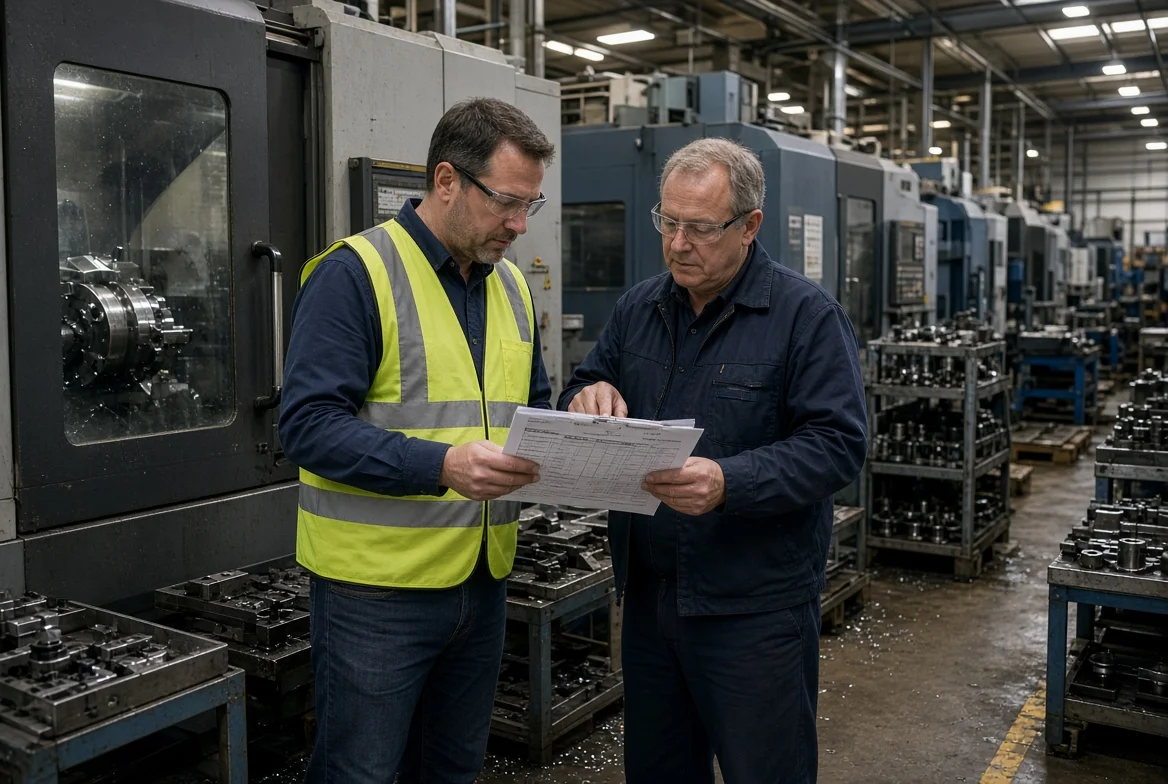
An attractive quote is still a problem if the supplier lacks the equipment, skills, testing, capacity, or process stability to deliver it.
Confirm Relevant Manufacturing Experience
Look for comparable products, materials, tolerances, processes, quality levels, and customer requirements. Experience in precision machining, custom cable assemblies, injection molding, packaging, electronics, industrial equipment, or OEM development is not interchangeable. Ask for similar work, not a general claim that the factory “can make anything.”
Review Equipment, Process, and Tooling Capability
Confirm who owns or controls the machinery, tooling, fixtures, and test equipment. Unapproved outsourcing is a process-control and confidentiality risk, especially for critical operations or customer-owned designs.
Evaluate Current and Future Capacity
Match capacity to the first order, recurring demand, forecast growth, seasonal peaks, and required dates. A shop can be right for a prototype and wrong for volume. Another may have the volume but need a higher MOQ or longer tooling lead time.
Review Scalability and Continuity
Ask how output would increase, how demand swings are handled, and what happens if a key machine, operator, or subcontractor is unavailable. Larger plants are not automatically safer. Judge the capacity, process control, and continuity measures that apply to this project.
Step 5 — Evaluate MOQ, Volume Flexibility, and Inventory Impact
MOQ and order flexibility change the real value of the quote. A low unit price that forces a large buy can raise inventory, cash-flow pressure, storage, and obsolescence risk.
Check MOQ and Minimum Efficient Batch
Identify the MOQ and what drives it: material buy, setup, packaging, testing, machine utilization, or scheduling. Ask about a smaller first lot, mixed production, partial delivery, or phased releases when the demand does not justify a full batch.
Compare Price Breaks with Actual Demand
Do not choose the lowest price at a quantity you will not use. A 50,000-piece break is not helpful if you expect to consume 10,000 pieces in the near term. Price the quantity you will actually buy and hold.
Consider Inventory and Obsolescence Risk
Larger lots create storage cost, working-capital exposure, damage risk, and design-change risk. For changing designs, electronic components, seasonal goods, or customer-specific configurations, flexibility often matters more than a small unit-price saving.
Step 6 — Review Total Cost and Commercial Conditions
Look at the full commercial impact: recurring and one-time costs, logistics, payment, quality exposure, inventory, and possible changes after award.
Review Tooling, Setup, Samples, and Engineering Charges
Separate unit price from molds, fixtures, setup, programming, samples, DFM, engineering, certification, and testing charges. Ask who owns the tooling, who maintains it, whether it can be transferred, and how future access is handled.
Review Packaging, Freight, and Landed-Cost Factors
Clarify product packaging, export packaging, labeling, freight, insurance, duties, taxes, customs support, and local delivery. There is no single landed-cost formula. The relevant elements depend on destination, Incoterm, shipment size, product value, and how you move the goods.
Review Payment Terms and Cash-Flow Requirements
Deposits, milestones, credit terms, currency, and payment timing affect working capital and supplier risk. A slightly higher unit price with workable terms can be a better commercial fit than a cheap quote that requires a large deposit and short validity.
Review Quote Validity and Price-Adjustment Conditions
Confirm how long the price holds and what can change it: raw materials, exchange rates, freight, component availability, or design changes. Document any adjustment mechanism before you select the supplier.
Step 7 — Evaluate Communication, Responsiveness, and Problem-Solving
For custom products, engineering changes, quality issues, and international work, responsiveness is part of the offer. The RFQ process itself shows how the supplier handles questions, documents, uncertainty, and technical responsibility.
Assess RFQ Response Completeness
Note whether the supplier answered the required fields, named exclusions, used the correct revision, explained assumptions, and raised useful technical questions. A complete response is more useful than a fast, vague price.
Evaluate Technical Communication
The supplier should be able to discuss materials, process feasibility, tolerances, testing, tooling, packaging, and production risks in plain terms. A good question from the factory—about a draft angle, a tolerance stack, or a test method—often reveals a real issue the RFQ did not catch.
Review Issue-Resolution and Corrective-Action Capability
Record whether the supplier has filled in the required areas, provided names of exclusions, explained assumptions, etc., and whether they asked any helpful technical questions. Instead of a quick and vague price, a full answer is more helpful.
Consider Cultural, Language, and Documentation Fit
The supplier should be able to talk about materials, process feasibility, tolerances, testing, tooling, packaging and production risks in layman's terms. The best question that you can ask in the factory is often a question about the draft angle, a tolerance stack or a test method that uncovers a real problem that the RFQ did not detect.
Step 8 — Evaluate Supplier Risk and Business Continuity
However, a quote should also be evaluated on risks which may disrupt supply, cause damage to quality, or open up financial exposure: financial strain, reliance on one source of materials, geographic concentration, reliance on subcontractors, lack of continuity planning, regulatory risk, or over-dependence on one customer or process.
Review Financial and Commercial Stability
On critical suppliers, evaluate if the company is able to continue purchasing materials, operating equipment, investing in quality and remaining in the business. Financial review is one due diligence measure that is in step with the significance of the supplier. Don't ask for private numbers without permission.
Review Supply-Chain and Material Dependence
Recognize single sourcing, single part, single subcontractor, single machine or single shipping. Typical weak points include constrained electronic parts, specialty resins and single-source tooling, as well as outsourced surface treatment.
Review Geographic and Logistics Exposure
Alternate routes, infrastructure, regulatory exposure, customs, freight and lead time are all impacted by location. Don't assume that one area is inherently safer. Exposure should be measured using this product and this delivery system.
Review Business Continuity and Backup Capability
Inquire about backup equipment, back-up facilities, disaster recovery, back-up suppliers, inventory buffers, data protection, and emergency contact. The level of that review should be commensurate with the part's significance.
Build a Beyond-Price Supplier Quote Evaluation Matrix
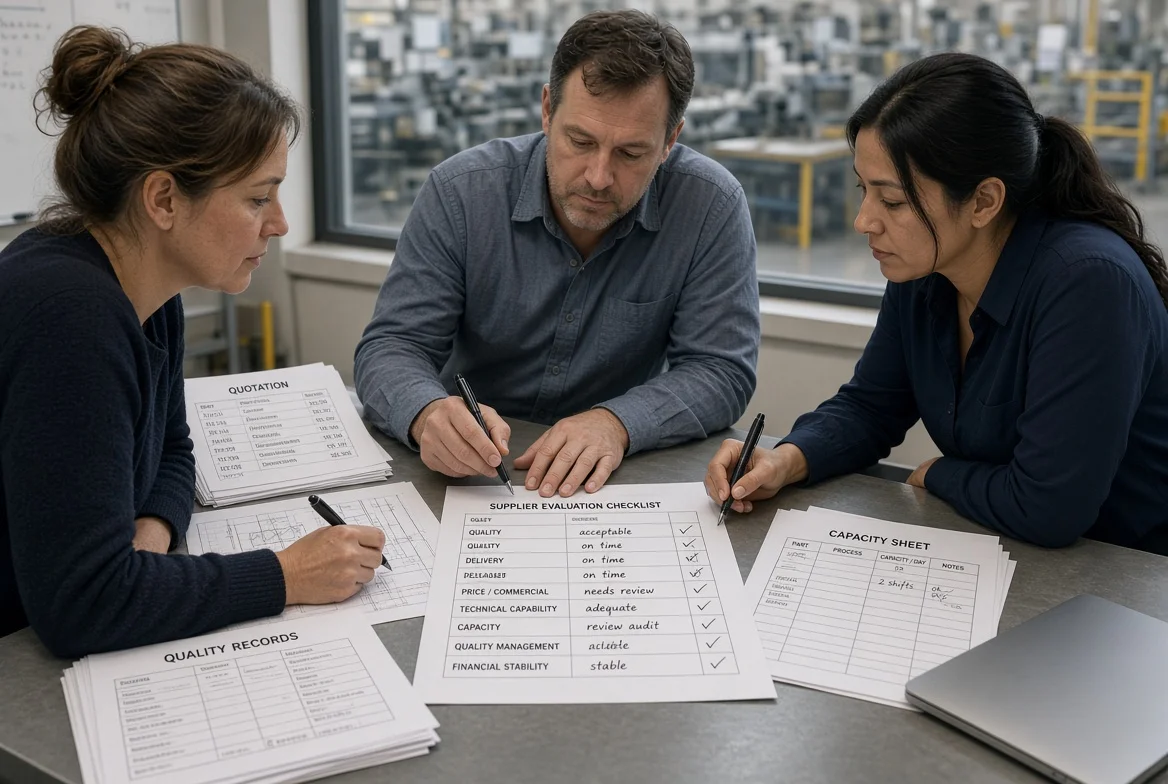
A matrix that is structured to evaluate offers in the same way and document the rationale for selection is helpful for a team. It should not make a difficult choice into random points. Check the mandatory requirements for the screen first. Use weighted criteria on quotes that already satisfy the criterion.
Define the Evaluation Criteria
These factors include technical compliance, quality capability, product testing, lead-time reliability, capacity, MOQ and flexibility, total and unit cost, engineering support, tooling and set-up, packaging and logistics, payment terms, communication, supplier risk. Select the set that is appropriate for this project.
Separate Mandatory Requirements from Weighted Factors
If a supplier fails on one of the following critical material, safety, certification, tolerance or testing requirements, he or she should not win based on lowest price. Two stages: compliance screening, then weighted evaluation.
Assign Weights Based on Business Consequences
There may be a high-risk component that requires greater consideration of quality and delivery. For a low-risk commodity, price and availability could be more significant considerations. Never replicate the percentages from a fixed buy. Record explanations for why each criterion is important here.
Document the Final Supplier Recommendation
The recommendation should include the chosen supplier, the basis for the evaluation, the price and total-cost position, the quality and delivery points, any unresolved risks, any necessary samples and next steps. The record should provide an explanation for why the more expensive winner is more valuable or less risky, if it is not the cheapest winner.
Evaluation Area | Questions to Ask | Evidence to Review |
|---|---|---|
Technical compliance | Does the quote meet the exact requirement? | Drawing review, compliance statement, samples |
Quality | Can the supplier produce consistently? | Inspection plan, records, certifications |
Delivery | Can the supplier meet and hold the schedule? | Lead-time plan, performance history, capacity |
Capacity | Can output scale with demand? | Equipment, workforce, production plan |
MOQ and flexibility | Does the order model fit actual demand? | MOQ, batch size, release options |
Total cost | What will the offer cost to use and manage? | Tooling, freight, quality, inventory, payment |
Communication | Can issues be resolved effectively? | RFQ response, technical questions, response history |
Risk | What could interrupt supply or raise exposure? | Continuity plan, material sources, financial review |
Common Mistakes When Evaluating Supplier Quotes Beyond Price
Buyers can still make a weak decision after they accept that price is not everything.
Replacing Price-Only Thinking with Vague “Value” Language
“Best value” is not a criterion. Define quality, delivery, risk, total cost, and technical requirements in terms you can check.
Choosing a Supplier Based on Claims Instead of Evidence
Claims about quality, capacity, certifications, or delivery need documents, samples, performance data, audits, references, or a technical discussion.
Using the Same Weighting for Every Purchase
Criteria should change with product risk, customer requirements, volume, lead time, and how critical the supply is.
Ignoring Price Accuracy and Future Cost Changes
Review validity, material-price conditions, invoice accuracy, change-order exposure, and possible expedite costs. A cheap quote that moves after award is not a cheap quote.
Failing to Record Why the Supplier Was Selected
The criteria should vary according to product risk, customer requirements, volume and lead time, and criticality of the supply.
Final Supplier Quote Evaluation Checklist
Check validity, material price conditions, checking the invoice, change order exposure, and expedite cost considerations. If that cheap quote moves after award, it is not a cheap quote.
Technical and Quality Checks
- Check quotes from suppliers with this supplier quotation evaluation checklist before making an offer.
- Technical and Quality Checks
- RFQ & Document revision correct
- Product scope and technical requirements are in line.
- Materials, components, tolerances and performance are checked.
- Testing, Inspection, Certificate and Traceability understood
Delivery, Capacity, and Commercial Checks
- Samples and/or validation steps are specified.Samples and/or validation steps are specified.
- Deliveries, capacity and commercial checks.
- Sample & Production lead times are reasonable
- Lead time starting conditions are known
- Capacity equal to demand now and in the future
- MOQ and order flexibility is as per actual requirement.
- Separate Tooling, Setup, Sample, Engineering and Testing Charges
- Recognize the understanding of freight/delivery, Incoterms and landed-cost factors
- The terms of payment and also the validity of the quotes are acceptable.
Risk and Decision Checks
- Evidence to support capability.
- There is an acceptable level of communication and ability to resolve issues.
- The material and subcontractor relationships are known
- The risk for financial and continuity grows according to the purchase.
- Cost and risk of operation have been taken into account.
- Evaluation criteria and weights are recorded
- Final recommendation & Unresolved risks are documented
Summary Guidance — Choose the Offer You Can Reliably Execute
But considering a supplier quote is not just about the price – it's about the full package: technical specification, quality, delivery, capacity, flexibility, total costs, communication and risk. Do not make assumptions, use evidence. When the supplier is capable of supplying the required unit at the lowest unit price, then the lowest unit price is the right one to choose. When it results in lower quality, delivery, inventory or continuity risk, a higher priced supplier may be the better option.
You are not selecting an integer. You're opting for a supplier's suggested approach to getting the desired outcome.