
Manufacturing quotations will be more favourable for buyers if they provide suppliers with the following information: a detailed product scope, full technical details, quantity requirements, quality specifications, delivery requirements and commercial quotation instructions. Learning to write an RFQ for manufacturers isn't more about the length of the email. It's all about both specifying what needs to be fabricated and what the quote should contain, so a factory can quote a custom part or assembly or OEM product without having to guess.
The pricing of two suppliers are usually not the same, not because one is necessarily overpriced, but because the assumptions made to arrive at the price vary. One quotation can cover Tooling, testing, packaging and freight preparation. Another can be different in that it does not include those items or meet the same material or quantity or quality standard. For initial exploration, a product photograph, web link or brief request for a “best quotation” is helpful. It isn't sufficient to produce a reliable production quote.
What Is a Manufacturing RFQ?
An RFQ (Request for Quotation) is a formal request sent by buyers to a limited number of suppliers in order to obtain a quotation and commercial terms for a specific product, part, assembly or manufacturing project. It works when the buyer is able to describe the item required and the delivery requirement sufficiently for the factories to quote the same requirement. This common scope is essential for making later price comparisons.
RFQ vs a Basic Price Inquiry
If you're just determining if a factory produces a similar product, a message like: “Please quote this item” is sufficient. Most custom manufacturing needs it; it is not enough. A well-defined RFQ states to the supplier what is being requested, the technical specifications that need to be addressed, quantities required, and what commercial fields need to be included in the quotation.
Use an individual cable. The supplier quoted for a “custom cable” request may be willing to quote a generic connector on an unshielded assembly, or the supplier may add shielding on the assembly and provide 100% electrical testing, or the supplier may assume a different length or conductor size. Cable length, conductor size, insulation, shielding, connector type, pinout, testing, packaging and expected volume are all factors that should be identified in the same RFQ. If they are not specified, they can't be compared.
When Buyers Should Use an RFQ
A RFQ will be used if the need is understood sufficiently to obtain a formal production or sample quote. These are usually customized parts, OEM products, private label products, industrial assemblies, packaging, fabricated parts, replacement parts and repeat production orders.
Real-world examples range from the introduction of a new product, qualification of an alternate supplier, price comparisons of competing products, the transition from prototype to production, and the procurement of a backup manufacturer for a critical part. Use an RFQ when the buyer already has a clear idea of the item(s) to be produced and how it should be shipped.
When an RFQ Is Not Ready to Send
If the design is still changing or the material, dimensions, performance requirements, production quantity, or quality requirements are in flux, don't send out an RFQ. Suppliers can provide approximate estimates, but they can not provide accurate production quotations if the scope is changing.
Collect technical feedback before you begin to write. Call for comments on design for manufacture, prepare drawings or specifications, verify samples, or resort to an RFI or RFP when you are looking for suppliers to come to you with a solution, not a specified requirement. Quotes issued prior to stabilization of the scope, tend to come with dates that expire the moment the requirement is modified during engineering or for quality.
Prepare Your Requirements Before Contacting Manufacturers
There is no such thing as a weak RFQ, it begins within the purchasing company. Gather the following information first before contacting any factory: engineering, product development, quality, logistics, finance, sales and management. The different internal instructions cause supplier confusion. When the procurement requires one quantity, but later the engineer changes the drawing, and quality introduces a new test, the initial quotation is not a match with the actual project.
Define the Product Scope and Sourcing Objective
Identify needs and justify their need. The RFQ should specify if it is prototype development, sample approval, pilot production, a first order for mass production, repeat production, cost reduction, alternate-supplier qualification or a longer-term sourcing program.
The quote is altered by that objective. The set-up, material cost, tooling, labor efficiency, test, and capacity planning differ between a 50-run trial and a 10,000 piece repeat run. The factory is not informed about which situation it is pricing, thus it will use its own assumption.
Gather Current Drawings, Specifications, and Samples
Obtain the most up-to-date controlled documents prior to the issuing of RFQ. That can be 2D drawings, 3D CAD files, product specifications, bills of material, wiring diagrams, material requirements, approved samples, test procedures, color references, assembly instructions and even packages information.
Revision control matters. Suppliers must be aware which version of a file, drawing or sample to quote. If the material grade, connector type, tolerance, surface treatment and dimension change, production cost, tooling, inspection work and lead time will change. An older attachment is another quickest means to obtain the outdated estimate that will no longer correspond to the product that you are purchasing.
Separate Required Specifications from Optional Preferences
Define the requirements that must be met and those that can be negotiated with the suppliers. This division allows a factory to quote a compliant version and, if necessary, make suggestions to help you improve manufacturability, lower cost, shorten leadtime, or decrease MOQ.
A buyer could specify a strength, electrical, safety or performance standard, but if the supplier can demonstrate that the same end standard is being achieved through alternate packaging materials, component brand or production process, they may be permitted. If all are marked mandatory, the factories either refuse to give a quote or they use conservative estimates of costs.

A manufacturing RFQ is a document created from technical and commercial information, controlled with the goal of fulfilling the needs of the user.
Include Complete Product and Technical Information
Manufacturers should have sufficient technical information to determine if they are capable of producing the product, the materials and processes that are needed, if tooling is required, how much inspection is needed and which production risks should be included in the quotation. It's not a requirement of the buyer to write the engineering textbook. They do require them to provide information on cost changes, viability, quality assurance and lead time.
Product Description, Part Number, and Scope of Supply
Suppliers might require dimensions, material grades, thickness, hardness, finish, color, plating, coating, tolerances, thread details, electrical specifications, functional performance and environmental conditions. Tolerances that are tight increase cost due to the ability of machines, precision tooling, cycle time, inspection, etc. that may be required as well as tighter material control and scrap prevention.
Describe important characteristics. Avoid over-specifying surfaces that are not required by the function. The inclusion of all dimensions in a drawing is often more expensive and takes longer to arrive at the quote than really necessary for the product.
Drawings, Dimensions, Materials, and Tolerances
A bill of materials or approved component list may be required for a variety of types of assemblies, cable products, electronics, machinery and OEM goods. Brands and model numbers, source of materials, and if equivalent parts are permitted.
If substitutions are allowed, state what the approval process is. If they are not allowed due to certification, compatibility, customer approval or performance, state in the RFQ. Two factories may include different component costs in the same assembly due to the silent substitution rules.
Bill of Materials and Approved Components
Assemblies, cable products, electronics, machinery, and OEM goods often need a bill of materials or approved-component list. State required materials, component brands, model numbers, approved sources, and whether equivalent parts are allowed.
If substitutions are permitted, define the approval process. If they are not permitted because of certification, compatibility, customer approval, or performance, say so in the RFQ. Silent substitution rules are a common reason two factories quote different component costs for what looks like the same assembly.
Product Samples and Reference Materials
Assemblies, cable products, electronics, machinery, and OEM goods often need a bill of materials or approved-component list. State required materials, component brands, model numbers, approved sources, and whether equivalent parts are allowed.
If substitutions are permitted, define the approval process. If they are not permitted because of certification, compatibility, customer approval, or performance, say so in the RFQ. Silent substitution rules are a common reason two factories quote different component costs for what looks like the same assembly.
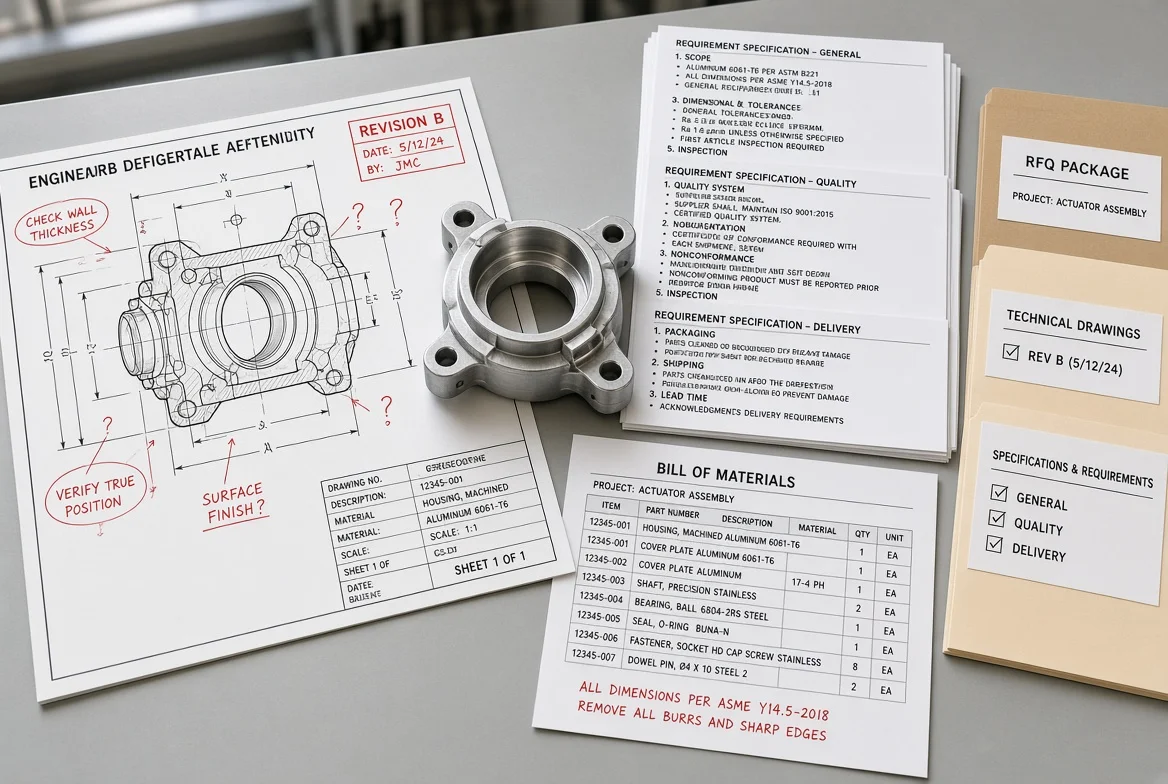
Complete product definition – drawing, sample, BOM, controlled document versions – is the key to accurate supplier quotations.
Specify Quantity, MOQ, and Expected Production Volume
One of the major quotation variables in manufacturing is quantity. It is important for suppliers to understand what they are selling, a prototype, a small trial, an initial batch, repeat orders, or estimated annual volume. Cost/unit varies significantly based on product quantity due to the variable costs of materials, machine set up, labor, packaging, testing, tooling amortization, and production efficiency.
State the Immediate Order Quantity Clearly
Provide precise quantity for the current quotation. If multiple volumes are being considered, request pricing for every quantity step. An enquiry for 500, 2,000 and 10,000 copies of the book reveals the supplier with a greater commercial structure than a single generalised quotation and demonstrates the relationship between volume and the unit cost.
Share Forecasts Without Misrepresenting Commitments
The opportunity can be determined by an estimation of annual demand, reorder frequency, seasonal needs, and/or forecast ranges. If you're not ready to commit then mark those figures ‘N.B.'. Simply over-estimating future volume to get a lower price is creating further issues later on. In cases where the actual demand is significantly lower than assumed in the quote, the suppliers may increase the price, impose MOQ or even deny maintaining the original terms.
Ask Suppliers to Explain MOQ and Batch-Size Assumptions
Inquire from each provider regarding minimum order amount and why. MOQ can be obtained from material procurement, production preparation, machine operation time, packaging amount, test, parts suppliers, factory arrangements, etc. Then ask if there are alternatives like standard materials, combined orders, simpler custom packaging, or a different delivery time frame that would allow a smaller purchase to be commercially viable.
Define Quality, Testing, Packaging, and Delivery Requirements
The RFQ should specify the quality of the product that is acceptable as well as the manner in which the finished product should be delivered. Quality, testing, packaging, labeling and delivery requirements make supplier cost change. They will typically be missing if a factory provides only basic production conditions, and will only become apparent after you start to do some comparison shopping or order.
State Quality Standards and Acceptance Criteria
Express quality standards numerically. These may include dimensions, material compliance, cosmetic standards, approved samples, performance, defect limits, inspection criteria, traceability and documentation, depending on the product. “high quality,” “premium quality,” or “same quality as our existing supplier” is not a clue to a new factory as to what to control.
Specify Testing and Inspection Requirements
Determine necessary testing and inspection: dimensional checking, functional testing, electrical testing, material verification, pressure testing, pull testing, reliability testing, first-article inspection, pre-shipment inspection and/or third-party inspection. Testing and reporting costs and time is an addition. Unless the RFQ requires the supplier to provide 100% testing, inspection reports, certificates, photographs, traceability records, or customer specific documents, a supplier can quote basic in-process checks.
Include Packaging and Labeling Requirements
Packaging comes into the supplier's scope particularly with export products, fragile products, consumer products, traceable components, electronics, cables and retail-ready products. Common information that is given includes unit packaging, polybag, protective inserts, moisture protection, carton size, carton requirements, pallet requirements, barcode labeling, carton marks, warning labels, maximum carton weight, mixed-SKU rules, and customer-specific labeling. When packaging isn't specified, one quote may cover exportable cartons vs another may only cover bulk bags.
Clarify Delivery Location, Lead Time, and Incoterms
Specify the place, timing, and trade terms (ex-works, FOB, CIF, DDP, or others) for the deliveries of the products. Ensure customs clearance, customs duty, insurance, tax and import compliance with qualified logistics or trade experts. This is not a substitute for that advice given in the RFQ. It does require some delivery detail that does not leave someone's mind to let freight and risk slip away from one quote to the next.

Quality, Inspection and Packaging should be included in the RFQ. They are not requirements that are to be settled once the price is decided.
Tell Suppliers Exactly What to Include in Their Quotation
Always ensure that every quote is in the same format when multiple suppliers are being compared. Let them know which commercial fields they need to supply so they can present you with differences in pricing, prerequisites, lead time risk, tooling costs and capacity assumptions. It's not about additional paperwork. It's to prevent an incomplete quotation from appearing as the lowest price.
Request Unit Price, Total Price, and Quantity Breaks
Request unit price and total price for each quantity requested. Multiple volume levels should be quoted individually, not as a range. The annual cost of 50 000 units is not comparable to the cost of a single order for 2 000 units.
Request Tooling, Setup, Sample, and Non-Recurring Charges Separately
There may be separate charges for custom manufacturing tooling, molds, dies, fixtures, programming, sample development, engineering support, testing setup, artwork, packaging development, and/or production set up. Determine who owns the tooling, is it going to be for the buyer, can it be used on other customers, is maintenance included, and will the tool get replaced in the future and if so, at what cost.
Request Lead Time, Payment Terms, and Quote Validity
Suppliers shall designate the following: Sample lead time, Production lead time, Delivery readiness, Payment conditions, deposit requirements, Credit terms, quotation validity, Material-price assumptions. A lower price with a long validity period and good payment plans is not the same commercial offer as a lower price with a shorter term and less transparency in terms of payment.
Require Suppliers to List Exclusions and Assumptions
Inquire with suppliers about what is not included. Typical exclusions are freight, duties, taxes, testing, certifications, packaging, tooling, installation, inspection, spare parts, engineering changes, or customer supplied materials. Useful to have clear assumptions. They illustrate areas that still require a determination. The risk is an unconditional assumption that is only shown after the issuance of the purchase order.
Commercial Information Buyers Should Request in a Manufacturing RFQ
Commercial Item | What Suppliers Should State | Why It Matters |
|---|---|---|
Unit Price | Price per unit at each requested quantity | Enables like-for-like supplier comparison |
Total Price | Total cost for each quantity level | Shows real order cost, not only unit cost |
MOQ | Minimum order quantity and the reason for it | Reveals production and material constraints |
Tooling Cost | Mold, fixture, setup, or engineering charges | Prevents unexpected one-time costs |
Lead Time | Sample and mass-production lead time | Supports production planning |
Payment Terms | Deposit, balance payment, or credit terms | Affects cash flow and commercial risk |
Quote Validity | Date until pricing remains valid | Helps manage material-price volatility |
Exclusions | Items not included in the quotation | Prevents misleading price comparisons |
Choose Suitable Manufacturers Before Sending the RFQ
Send out RFQs to suppliers who will most likely possess the process, experience, capacity, quality controls, and commercial fit. Sending the same request to a long list of unfit factories is only going to cause extra work, while not necessarily making the decision better. The process of supplier selection begins prior to quotation comparison. It does not compensate for a lack of technical expertise, poor quality control, small capacity, weak communication skills, or production model feasibility.
Check Manufacturing Capability and Relevant Experience
Determine if the supplier has experience in the process, materials, complexity of the product, tolerances, testing, certifications, and quality expectations. A stamping factory that produces basic stamped parts might not be suitable for high precision stamping. Your RFQ might call for connectors, shielding, testing, traceability, and/or compliance that is not available at a cable manufacturer's standard products.
Review Capacity, Lead Time, and Communication Quality
Think about the ability to provide the required volume, target lead times, and clear communication, documentation, and product changes, and the ability to answer technical questions. Don't assume that a quick quote equals production ability. Consider whether the supplier really understood the RFQ and had any questions regarding the production, quality or commercial aspects.
Protect Sensitive Product and Commercial Information
Confidential drawings, specifications, customer requirements and pricing information are common parts of RFQs. Determine what needs to be kept confidential and implement practical controls before sending sensitive information: confidentiality agreements as needed, watermarked documents, controls on the sharing of documents, revision labels, restricted supplier list, and limited disclosure in initial screening.
Send the RFQ and Manage Supplier Clarifications
This is a process that starts with the initial e-mail and then continues through the RFQ process. Monitor receipt confirmations, handle technical queries, manage document revisions, provide your deadline update and ensure all relevant suppliers are supplied with the same update. It is often helpful to ask supplier questions. Materials, tolerances, packing, testing, quantity, tooling, and delivery are typically missing details to be closed prior to finalizing quotes.
Use a Clear RFQ Email or Cover Letter
The cover message should contain the project identification, attached documents, the date for the quotation, the name of the person to contact, information on where to send questions, and the preferred format of quotation. Keep the e-mail organized. Attach requirements in detail. To see a document-level listing of what those attachments should include see Manufacturing RFQ Template: Essential Information Buyers should include.
Control Supplier Questions and Clarifications
Record queries from suppliers and provide uniform responses to any change in response that alters the scope of the product or quotation. Any supplier who is given an updated material requirement, a revised quantity or clarified test method should be given the same relevant update by the other participating suppliers. Simple clarification log of the question, answer, issue date, document revision, and affected suppliers to eliminate factories from quoting different assumptions.
Manage RFQ Revisions Before Suppliers Submit Final Quotes
Drawings, BOMs and quantity, quality, packaging, delivery terms or commercial conditions should all be sent out as a controlled revision in case of any major changes. Indicate the changes that have occurred and request that suppliers confirm that their quotations are updated. When suppliers are quoting different revisions it creates an artificial comparison to rank them by price.

Once the RFQ has been issued, document control and answers from all suppliers ensure that everyone is quoting the same current scope.
Review Supplier Quotes Before Comparing Prices
Look at quotations for completeness, scope, assumptions, exclusions, and technical aspects before prioritizing suppliers based on the unit price. Verify that all factories reported the same quality level, quantity, product, delivery basis and commercial conditions. Quotes can vary based on a number of assumptions including material, processes, tooling, testing, lead time, and volume. The differences must be determined prior to the purchase.
Check Scope Compliance Before Reviewing Unit Price
Consult product revision, material, quantity, quality requirements, packaging, tooling, testing, lead time, delivery basis first. The low price is not significant if a necessary process was not performed or another material or quantity was used. Supplier A may appear to be cheaper as the 100% functional test and export packaging are not included. Both are allowed in Supplier B. To understand which offer will be more commercially valuable it is necessary to normalize the quotes.
Identify Supplier Assumptions and Missing Information
Watch for terms like “subject to drawing approval,” “material equivalent allowed,” “tooling not included,” “freight excluded,” “price based on annual volume,” “testing not included” and “lead time begins after deposit and technical approval.” Clarify those points. It's also useful to have a discussion about a disclosed assumption. After the purchase order an assumption that not been reviewed can convert to a cost increase or quality issue.
Compare Total Commercial Value, Not Only Price
Take a unit price and Total Order Cost along with tooling, set up, sample, payment terms, quote validity, quality scope, delivery reliability, packaging and logistics responsibility, capacity and supplier capability into account. To get the detailed review method, see How to Analyze Supplier Quotations: A Practical Guide for Procurement Teams and How to Compare Manufacturing Quotes from Different Suppliers.
Common RFQ Mistakes Buyers Should Avoid
The majority of RFQ issues are avoidable. Delays, hidden costs, quality, and unreliable comparisons are the result of incomplete documents, uneven information, and price-only decisions.
Sending Incomplete Specifications
When a specification is missing for material grade, tolerance, finish, product revision, test requirements, packaging or quantity, suppliers must make an assumption. Those guesses are then become price changes, delay or quality arguments. A metal part with an unspecified surface finish or an unconfirmed part number for a connector on a cable assembly or an unconfirmed moisture-protection requirement for a cable assembly's export packaging can push cost and lead time more than buyers are willing.
Sending Different Information to Different Suppliers
The package of controlled technical and commercial should be the same for all suppliers when the quotations are to be compared directly. If you give one factory a new drawing, a better forecast, a sample, or a clarification and do not give the same to the others, it is meaningless to make a comparison. When there are multiple parts or engineering changes or internal stakeholders, use revision numbers and a supplier distribution record.
Selecting the Lowest Quote Without Checking Scope
Tooling, testing, packaging, quality documentation or freight preparation may not be available for the lowest quotation. It could also be based on a lower material grade, different quantity, unrealistic lead time or temporary pricing. For a more detailed account of that risk, please read the articles: Why the Lowest Supplier Quote Is Not Always the Best Choice and Unit Price vs Total Cost: How to Evaluate Supplier Offers Correctly.
Forgetting Tooling, MOQ, Setup Fees, and Hidden Costs
Request non-recurring and conditional charges on paper. Total sourcing cost can be as much as unit price, depending on the tooling, mold/casting, fixtures, engineering, samples, setup, testing, certifying, packaging development, inspection, logistics, and material surcharges. Readers might also be interested in reading: Tooling Costs, Setup Fees, and Hidden Charges in Supplier Quotes, Hidden Costs in Supplier Quotations: What Buyers Need to Check Before Ordering, and How MOQ Affects Supplier Pricing and Manufacturing Quotations.
Practical RFQ Checklist Before Sending to Manufacturers
This is an ultimate control point before the request reaches the buying team. Does not repeat each of the previous sections. It is a survey of the choices that need to be endorsed.
Product and Technical Checklist
Verify product name, part number, drawing revision, dimensions, materials, tolerances, finish, BOM, approved components, sample reference, performance requirements, testing and inspection, packaging and labeling, technical attachments. Any documents should be up to date, legible, appropriately labeled and harmonious.
Quantity and Commercial Checklist
Verify quantity, quantity break, expected annual usage, MOQ questions, tooling requirements, sample requirements, quotation currency, unit price, total price, payment terms, valid period of quotation, lead time, delivery location, Incoterms, scope of freight, and the requirements for the exclusion of freight. This is the way buyers can prevent quotes that are not comparable because each supplier assumed a different commercial.
Supplier Communication Checklist
Verify the short list of suppliers, the capability review, the confidentiality controls, the RFQ deadline, contact person, question process, the clarification process, revision procedure, quotation response format, and evaluation criteria. If you need a list of items to put together before requesting a quote from suppliers, read on for RFQ Checklist for Buyers:
Summary Guidance — Create RFQs That Help Suppliers Quote the Right Scope
A good manufacturing RFQ provides the information needed for suppliers to be able to quote the correct scope of work and provides a level of certainty for the buyer to be able to compare the price, lead time, quality and commercial conditions of each supplier. Use the RFQ as a sourcing-control tool, rather than as an administrative form. Better requests avoid unnecessary assumptions in the factory, predict production risks early in the process, increase the potential for comparable quotes, and enable an informed buying decision prior to tooling, sampling or production.