
The first task if buyers have to learn how to compare the manufacturing quotes is not to rank the prices. Check that each supplier had the same product and revision. Then compare specifications and quantities, standardize commercial scope, check quality and lead time, add up the costs and evaluate supplier risk. Sometimes it's the cheapest number on the page that's not really comparable.
A factory might appear to cost less, due to the following reasons: they may have ordered a smaller quantity, a different alloy, a lower quality scope, no tooling, no export packaging or used EXW pricing rather than FOB. The offers have identical technical specification, quantity basis, quality level, delivery scope, and commercial assumptions for the manufacturing procurement. As long as those match, sorting prices from low to high is merely ranking different jobs.
Why Manufacturing Quotes Are Difficult to Compare
There are no universal quotes or cost structures for manufacturers. One factory could provide a line item breakdown for materials, process, tooling, testing, and packaging. Another might send one unit price in an email, with the assumptions included in a note or an attachment. Those disparities may stem from a variety of reasons, such as scope, volume, process, quality, efficiency, logistics, risk, and even the way the supplier delivers the offer.
You're not comparing suppliers until you can see the difference. You are making comparisons between partially read stories.
Suppliers May Quote Different Technical Interpretations
In a thin or vague RFQ, factories fill in the blanks. There are two suppliers that can quote the same enclosure, but different grades of aluminum. There are various different cable assembly houses that may take on different connectors, jackets, or strain relief configurations. Paperboard structure and finishing specifications may be different from those approved by your brand team at the packaging plant.
Those substitutions affect performance and cost. Treat them as if they are a different product until you approve an alternative in writing.
Suppliers May Use Different Quantity and Volume Assumptions
The unit price varies according to quantity, batch size, annual volume, setup allocation, material purchase and machine utilization. If both factories are being honest, a 10,000-unit quotation from a supplier will appear to be a better deal than a 1,000-unit quotation. Determine if the quoted amount is an order, a price-break level, an annual forecast or a minimum production batch. However, if these bases are not equal, the prices are not comparable yet.
Suppliers May Include Different Commercial Scope
Tooling, testing, packaging, freight, inspection, labelling and delivery can be included within the unit price, on separate lines or not present at all on the quote. The molded part quote may only contain molded part, not the export cartons. Another might require just a repeat order unit cost and wait until later for mold, samples and packaging. When you are trying to determine who's cheaper, you need to know the differences in the scope of the work before you compare costs.
A Low Price May Reflect Higher Risk
Low offers aren't necessarily bad. It is a signal used to confirm scope. There may be a discount offered because of the use of a lower grade material, optimistic lead time, sampling rather than 100% testing, lack of certificate, thin capacity, or commercial terms that you can not accept. Before you consider a number a win, confirm what it was priced at.
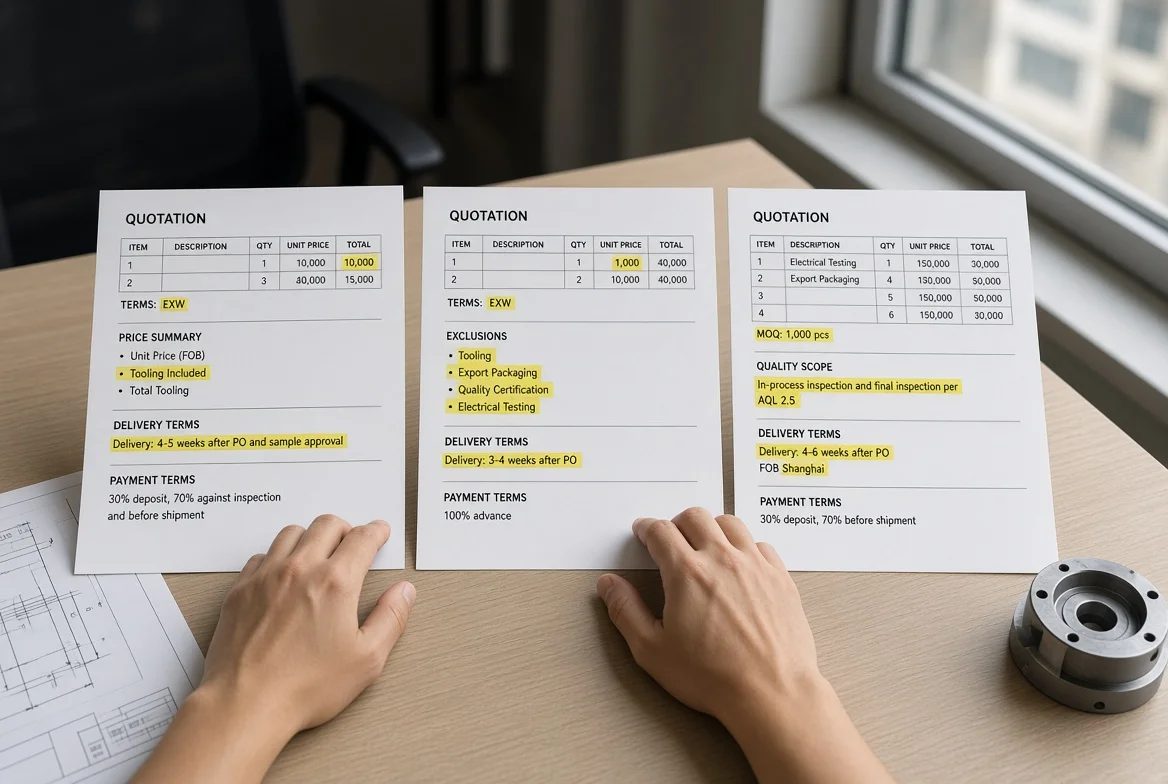
Step 1 — Confirm Every Supplier Quoted the Same Technical scope is before price. Verify that all suppliers received the same RFQ, drawing, BOM, sample, specification and product revision. It is not a comparison of the price of different products, it is a comparison of pricing one defined job in the factory.
Check Product Name, Part Number, and Drawing Revision
Ensure each quote contains the product name, part number, product configuration, drawing number, revision, BOM revision and sample reference. Many suppliers will sell the updated connector with a different price, with a tighter tolerance, a different coating, or a different carton design. If there is a discrepancy in the revision, please ask for a requote on the existing package before ranking.
Compare Materials, Components, and Finishes
Inspect material grade, thickness, hardness, finish, coating, plating, resin, cable construction, paperboard structure, connector model and any specified electronic components. If an alternative alloy, resin or brand is available, document this separately. Do NOT use that quote until engineered or quality has approved the substitution.
The common pitfall is that one machine shop has the customer specify aluminum 6061, while another specifies a cheaper alloy that will machine faster. The second is a pretty good deal until you perform a test of corrosion, strength, or anodizing.
Verify Dimensions, Tolerances, and Performance
Compare critical dimensions, tolerances, fit, surface finish, strength, load, pressure, electrical performance and environmental conditions. A relaxed tolerance, a softer material or lower spec component can reduce process time and scrap and so reduce the quote. It may also affect if the part is usable in the assembly or not.
Confirm Quality, Inspection, and Testing Scope
Check inspection/ testing records, quality records, certificates, traceability, first-article inspection and any other third-party inspection. Some cable-assembly manufacturers provide 100% electrical testing. Another could be a regular batch sampling. These are not the same quality scopes. Never compare unit prices until the test coverage is suitable to your requirement, or until the difference is accepted as a defined risk.
Technical Scope Checks for Manufacturing Quote Comparison | ||
|---|---|---|
Comparison area | What to verify | Why it matters |
Product revision | Drawing, BOM, specification, and sample version | Prevents comparison of different products |
Materials | Grade, thickness, finish, and approved alternatives | Affects cost and performance |
Critical features | Tolerances, fit, surface finish, and function | Affects process capability and quality |
Components | Part numbers, brands, and substitution rules | Prevents unapproved substitutions |
Testing | Test method, coverage, and reporting | Affects cost, lead time, and acceptance |
Packaging | Unit, export, retail, and pallet requirements | Affects protection and delivery cost |
Step 2 — Standardize Quantity, MOQ, and Price Breaks
Make price comparisons based on the same quantity. Quantity changes material buying, allocation of setup, labor, Amortization of tooling, machine utilisation, packaging and capacity loading. What you assume about the volume is not a reflection of different supplier prices. They are two different production plans.
Align the Initial Order Quantity
Ensure that all suppliers replying to the same first order. A small trial batch could be sold at one factory. The other can take on a full production process. If their quantities are different, ask for a re-quote on your first order quantity if it is different.
Compare Price Breaks at the Same Volume Levels
If you must check the production economics, make sure you ask for the price in the same quantity. The typical categories for custom parts could be prototype, first production, mid-volume, and annual volume. Since you will be working with a specific project, use values that correspond with that project (e.g., 500, 2,000 & 10,000 rather than whatever each factory selected).
Review MOQ and Batch-Size Requirements
The lower the price the higher the MOQ or the more the production batch. Consider the inventory, cash, storage requirements, uncertainty and obsolescence against that benefit. Check if it can be delivered in smaller quantities, shipped in parts, produced in smaller batches or delivered in stages. The lower the price of the piece, the longer the time for the stock to be held is not necessarily the best commercial trade.
Separate Confirmed Orders from Forecast Volume
Write whether price is fixed on an order or estimated annual volume or non-binding forecast. A supplier may agree a lower unit price if a higher volume is anticipated in the future. Note that this is not a fixed price to be guaranteed since actual demand can be less than the forecast level.
Step 3 — Normalize Commercial Terms and Delivery Scope
Without the means of currency, types of measure, payment terms, Incoterms, freight, taxes, packing and responsibilities for delivery, comparisons of manufacturing quotes from various suppliers are not comparable. It's not necessary to push all factories on the same terms the first day. You will need to record the differences first before you can rank the offers.
Align Currency and Unit of Measure
Verify quotation currency, unit of measure, pack quantity, price basis, conversion assumptions and taxes included. Be alert for per-piece pricing, per-set pricing, and different currencies on different exchange-rate days, and per-carton versus per-unit pricing. Compare after you convert to one currency and one unit.
Compare Incoterms and Freight Responsibility
There is a difference in costs and risks involved in EXW, FOB, CIF, DAP, DDP and more terms. Write down what each supplier provides and what needs to be organised. An EXW price may appear lower than a FOB or DAP price for the same part due to the fact that the inland freight and a lot of the export handling and risk of loss are to be borne by you.
Confirm Payment Terms and Cash-Flow Impact
Real attractiveness of an offer varies with the size of the deposit, the timing of deposits, the credit terms, milestone payment options and the currency of the payment options. While a higher unit price for the same material may require a higher deposit, the need to make the balance may be less stressful to the working capital and may be cheaper in the end than a lower quote with a higher initial payment and without tooling or production up front.
Check Packaging, Labeling, and Delivery Conditions
Compare unit packaging, export packaging, labelling, carton marks, palletization, delivery location, partial shipment and required dates. A lower product price may not include basic factory wrap, no retail insert or delivery to a different location than your warehouse. Those gaps manifest as damage, relabeling or additional freight later.

Step 4 — Separate Recurring and One-Time Costs
Separate the "unit price" (recurring cost) from "one time", "conditional" and "project-start" costs. That split is used when looking at the first invoice and the long-run economics of production.
Tooling, Mold, Die, and Fixture Costs
Record tooling separately. Ask about the charge to confirm what it includes: design, manufacture, trials, maintenance/Repair/replacement. Verify rights to ownership, storage, transfer, exclusive use and future production. A mold that the factory owns which it has not transferred rights of to you is a different situation to one that you own and can move.
Setup, Programming, and Engineering Charges
Costs for CNC programming, fixture preparation, engineering review, DFM, process development, or change over may be charged by the supplier. Several charges are payable in one-off. Others use each application. Inquire about the need for a new charge: a new revision, a change of color, gap between orders, or a different machine.
Samples, Testing, and Certification Costs
All costs associated with samples, testing and certification.All costs relating to samples, testing and certification.
Various sample builds, first articles, validation tests, reliability tests, certifications and third-party inspection may be included as separate lines or may remain excluded. Correctly recognize letters and words. Request to see if there will be any sample or cost credits to a producing order.
Compare Initial Investment with Recurring Unit Economics
One supplier may give you a higher tooling price and a lower piece price. The other one can offer virtually nothing up front and a higher production cost. The better structure is dependent on the volume of expected production, the life of the product, cash flow, ownership of tooling and the degree of demand certainty. If it's a short-run custom part, it can be a winner with low initial investment. The lower repeating unit cost may be more important for a multi-year OEM product.
Recurring and One-Time Costs in Manufacturing Quotes | ||
|---|---|---|
Cost type | Examples | Comparison question |
Recurring cost | Unit price, assembly, routine packaging | What will each production unit cost? |
Tooling cost | Mold, die, fixture, jig | Who owns it and what does it include? |
Setup cost | Machine setup, programming, changeover | Is it one-time or charged per batch? |
Sample cost | Prototype, first article, pilot units | Is it refundable or credited later? |
Engineering cost | DFM, process development, revisions | What work is covered? |
Testing cost | Validation, reliability, certification | What tests and reports are included? |
Packaging development | Artwork, retail structure, custom inserts | Is production packaging included afterward? |
Step 5 — Compare Lead Time, Quality, and Supplier Capability
An execution promise is also called a manufacturing quote. Look into supplier claims regarding timings, quality controls, capacity, materials, communication and relevant experience. These points can be more significant than a small unit-price difference for a safety-critical or launch-critical part.
Compare Sample and Production Lead Times
Compare tooling lead time, sample lead time, production lead time, ready to ship date, transit date and date of goods to you. Can the clock begin counting from deposit, drawing approval, material confirmation, tooling completion or your sample sign-off? An aggressive date that begins only after a number of unpaid approvals is not the same as a date that begins after some sort of reasonable, clearly defined trigger.
Compare Quality Controls and Evidence
Do an inspection of inspection systems, test equipment, quality records, certificates, sample results, traceability and industry experience. Just a certificate on the wall is not enough. Request to see proof that demonstrates the same testing, tolerances, and records for this product as the supplier. The more specific a claim is, the more helpful it will be, such as, if a factory already has other cable assemblies or machined parts that are similar that are being tested by the same test method, that is more helpful than a generic claim.
Compare Capacity and Scalability
Check out existing load/equipment availability, peak season limitations, material availability, backup production, and volume increase capability. One shop might be very good at prototyping but not so good at mass production. One could be capable but require a larger MOQ or longer TL. Match the factory to the volume path that you actually need.
Compare Communication and Technical Understanding
The quality of the quotations can often reflect the quality of the RFQ read by the supplier. Identify if they raised technical risks, provided relevant questions, made assumptions, and provided full documents. Quality communication is not the same as qualification. It is one indicator for risk of execution. It's easier to compare an actual fully completed quote that explicitly states what it does and does not cover than it is to compare a low-ball quote without attachments.
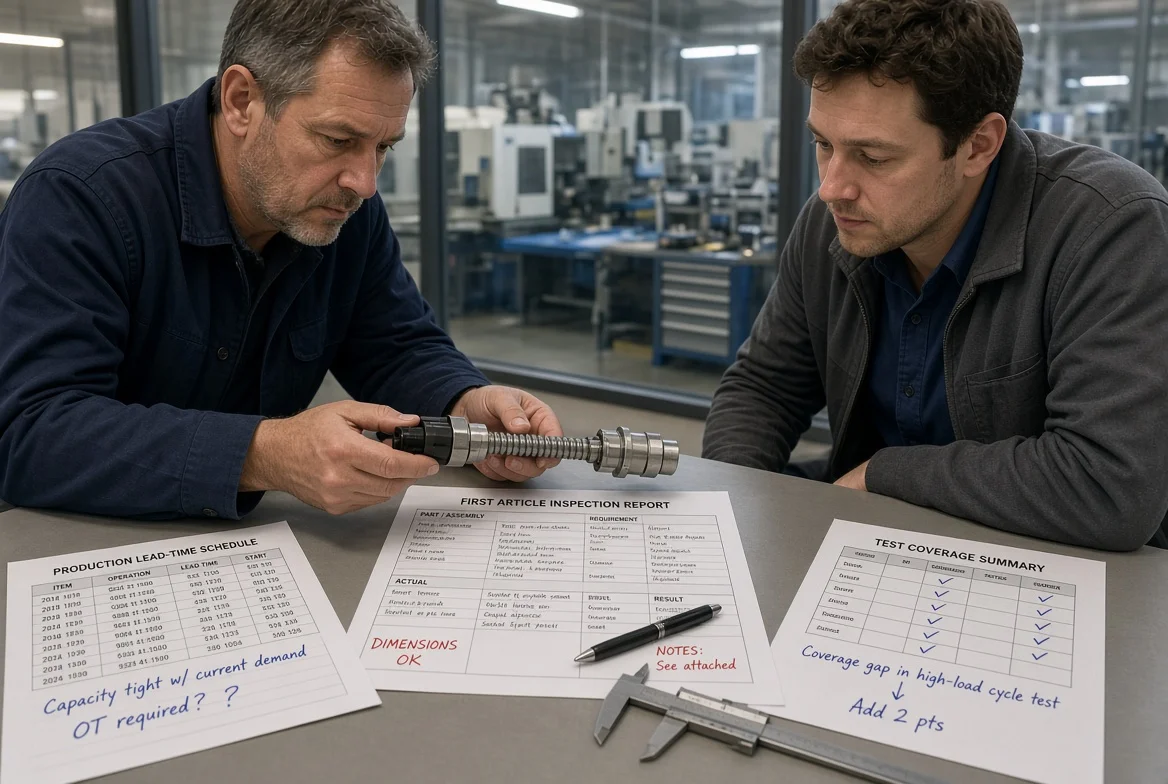
Step 6 — Calculate Total Cost and Commercial Value
When looking at the total commercial value, compare quotes, not just the unit price. The cost elements that go into that view will vary according to the project. Common examples are payment terms, delay risk, inventory, quality exposure, duties and taxes, samples, packaging, and tooling. One size does not fit all when it comes to destinations and business models.
Direct Product and Project Cost
Add recurring unit price, quantity, tooling, set-up, samples, engineering, testing, packaging and any other supplier costs. Compare each supplier on the same product and the same quantity. If one quote doesn't have a line that the other quotes do, again obtain a written confirmation or a new quote before adding it together.
Landed Cost and Logistics Exposure
To calculate landed cost, you might need the cost of freight, insurance, duties and taxes, customs handling, local delivery, packing cube, and shipment frequency. Don't take the supplier's Incoterm for granted as it's your final cost. The EXW and FOB cost to the buyer are different. DAP or DDP quotes may appear more expensive, but when you add in your own shipping and handling costs, it can actually be easier. Join the lane you are in and use your own import set up. NEVER use a blanket uplift.
Quality and Delay Exposure
take into account inspection, rework, rejection, replacement, customer claims, line stoppage and late delivery. Don't assume failure rates. Question if those exposures are reduced or left open due to the supplier's process, test coverage, capacity, and documentation? If you're on a part that can block your customer's line, a little more expensive with some better evidence can be the safe bet for your commercial.
Inventory and Working-Capital Impact
The MOQ, batch size, lead time, deposit and payment conditions affect cash and stock quantity. A lower-priced supplier who needs a big batch and a high deposit may end up being more expensive, since he has to commit big money to the order, while a higher-priced supplier who will take a smaller batch and a lower deposit may be more affordable due to the fact that he has only to commit smaller money to the order. Place the cash effects beside the piece price.
How to Compare Manufacturing Quotes Using a Comparison Matrix
An inconsistent factory response is converted to a side by side review using a comparison matrix. It should be used for identifying missing information, differences in scope, exceptions and decision criteria. The matrix provides support for judgement. It does not take its place. A score is accurate even if it is not complete. A weighted total should not be considered as a definitive answer if significant gaps exist.
Recommended Comparison Fields
If you use a common set of fields, add rows for each product:
- This may be referred to as supplier or quotation reference.
- Product revision
- Technical compliance
- Material and components
- Quantity basis
- The unit price is: $16.00.The unit price is $16.00.
- Min order quantities and price breaks
- Tooling and setup
- Samples and testing
- Quality documentation
- Packaging and labeling
- Lead time
- Incoterm and freight
- Payment terms
- Quote validity
- Exclusions and assumptions
- The capability of the suppliers and risks
You can create rows that are relevant to the part: electrical testing, surface treatment, certifications, installation or after-sales.
Use Compliance Screening Before Scoring
Start by marking those suppliers that do not meet a required criterion, or who require more clarification. Weighted review should be of only compliant or conditionally compliant offers. That prevents the occurrence of a material-test-revision mismatch occurring due to an extremely low price.
Weight Criteria According to Purchase Risk
Weights need to be based on purchase, not on a template. The focus of a safety critical component should be on technical compliance and quality evidence. If it's a commodity with low risk it can invest more in price and delivery. It takes more than a few cents on the piece price to get engineering assistance and tooling clarity for a new product.
Document the Sourcing Recommendation
Document the recommended supplier, the primary reasons, the un-resolved risks, negotiated conditions, required samples, and next steps. If the selected factory is not the lowest unit price, the file should provide evidence of how quality, delivery, total cost, capacity, or risk were the reason for the selection. The record will be required the next time someone asks, "Why was the cheapest number not selected?
Common Mistakes When Comparing Manufacturing Quotes
A lot of mistakes occur once the quotes are received, when teams are trying to make the quickest decision and don't have time to level offers.
Comparing Unit Prices Before Checking Scope
It is not allowed to compare unit price until product revision, material, quantity, quality, testing, packaging and delivery scope are confirmed. A manufacturing price quotation comparison that begins with the price column is already late!
Treating Missing Costs as Included
This does not imply that if a supplier does not mention tooling, testing, freight, packaging or inspection that these are provided. Request a written confirmation. Later invoices tend to be missing lines.
Comparing Different Quantity Bases
It is not possible to compare the prices directly as they are based on different quantities, MOQs, batch size or annual forecasts. In a single, unified volume, bring all suppliers together before discussing who is cheaper!
Ignoring Incoterms and Landed Cost
EXW, FOB, CIF, DAP, DDP and other terms transfer logistics costs and risk from the factory to the buyer. A factory-gate number is different to a delivered number.
Choosing the Lowest Price Without Checking Supplier Risk
The lowest quote may be more of one of these: quality, capacity, lead time, documentation or continuity risk. Price is one input. It is not the choice.
Using a Comparison Score Without Reliable Inputs
The following is a typical example of how a scorecard is misleading when a quotation is incomplete or has different scope. Plug the big holes; then score. When a supplier won't clarify assumptions treat that as a risk and not a blank cell.
Final Manufacturing Quote Comparison Checklist
Make this a checklist to use when you compare supplier quotes before you choose a factory.
Technical and Scope Checks
- Same RFQ, drawing, BOM, sample and revision confirmed.
- Product configuration and scope are the same
- Material, components, finish, tolerances and performance match
- Quality, testing, inspection and documentation are similar
- Supplier deviations and alternatives are discovered
- Packaging and labelling scope is aligned
Quantity and Commercial Checks
- Same initial order quantity is used
- Price breaks are requested at the same volumes.
- The assumptions of MOQ and batch size are understood
- The relationship of currency and unit of measure are aligned
- The cost of tooling, setup, sample and engineering is clearly broken out
- The terms of payment and validity of the quote are compared.
- Incoterms, freight, duties and taxes are discussed.
- Exclusions and assumptions are dealt with
Supplier and Decision Checks
- Sample and lead time for production are confirmed
- The supplier's capacity and experience are acceptable
- Where necessary the quality of evidence and qualifications are checked.
- The overall expense and carrying cost are taken into account.
- There is a Risk Log that records Quality and Delay Risk.
- Supplier clarifications and updated quotes are noted.
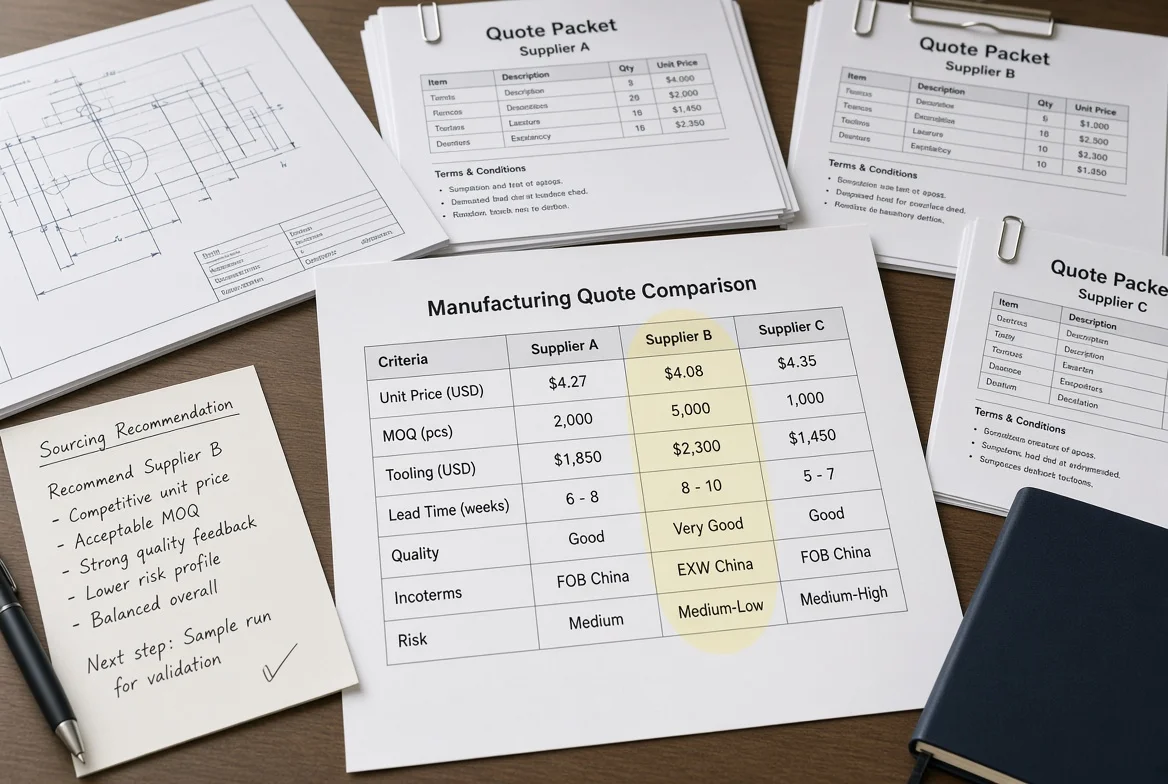
Compare the Offer, Not Just the Number
In Japan, the word "offer" is not merely about the numbers.In Japan, the word for offer is not just the numbers.
Comparing manufacturing quotes fairly requires a common Technical, Manufacturing quantity, Quality, Delivery and Commercial basis. Put the RFQ in standard terms; normalize the bidders' answers; define who the answer is not for; compare total cost; evaluate supplier capabilities; record the decision. The best offer is one that offers an acceptable return with a reasonable likelihood of being achieved. It is NOT the cheapest unit price from the first spreadsheet sort.