
Minimum order quantities aren't simply about the number of items you must buy. MOQ affects the supplier pricing is based on the way factories split up the charges of setup, tools, material, package, manpower, shipping, administration etc into a MOQ. The bigger the order the smaller the unit price. The smaller the MOQ, the higher it is. The buyer should also take into account the price fluctuations due to inventory, storage costs, working capital and demand risk.
MOQ need to be a number, NOT random number. It is generally due to machine change over, raw material minimums, tooling recovery, packaging efficiency, and purchases made from the upstream part of the production chain and by the supplier to meet a requirement for a viable order margin. Buying more of the same units for more of the same money is not always the most advantageous. Excess stock, obsolete parts and cash on hand in stock inventory can result in a loss because the unit price savings are lost.
What Is MOQ in Manufacturing?
Minimum order quantity (MOQ) is the smallest amount that a supplier will order at one time or produce in a production run. That's a commercial threshold, not a textbook formula, in manufacturing.
The meaning of the term you're using in these factories may be different. One Supplier has MOQ for each SKU. One more uses it for each colour, material or set up. Some employ it on a production batch. Others utilize it throughout a delivery, or on a "blended" material purchase. To compare quotes, make sure you know what the supplier is offering.
MOQ vs Minimum Production Batch
Minimum Order Quantity: MOQ is the minimum order quantity for the Beneficiary. Min Production Batch: smallest production batch that the factory would consider efficient for the machine, material, process or line.
The packaging supplier can print 800 cartons. That run might still be economically unfeasible due to the cost of the print plates, die set-up, the cost of paperboard, color change, and waste. The same is true of custom molding, the press can run fewer parts, changeovers of resin and colour, and first piece, approval and mould set up all may mean that the order value will have to be greater and the larger batch will be required.
MOQ vs Price-Break Quantity
MOQ is the minimum order quantity the supplier requires, which is the least amount. The number of items at which the unit price changes is a price-break quantity.
There is a factory that can give the better deal at 2000 or quote again at 10000. The entry ticket is the MOQ. It's not always the lowest cost. Often buyers have the idea that those two numbers are synonymous, which leads them to either paying more per unit or purchasing more in the way of inventory than what's warranted.
MOQ vs Minimum Order Value
When the size, price or configuration of a SKU vary, some suppliers may have a minimum order value instead of a minimum number of items ordered. When a cable-assembly house is receiving an order that incorporates a mixture of part numbers, they will accept orders up to a specific dollar amount. The packaging supplier may require a minimum number of sheets, a by weight minimum or a minimum of print-run.
Do you have to purchase by the minimum quantity, SKU, batch, order value, weight, or material purchase? A seemingly flexible, quantity quotation may actually be inflexible on value.
Why Suppliers Use MOQ
MOQ can recover the fixed cost, reduce the number of setups, buy materials at lower prices, improve the efficiency of production and manage packaging and shipment, and ensure the profitability of orders. All those reasons is not all MOQ reasonable. They do make the point that for a small first order, a complete change over, a material buy and a complete administrative cycle are still required, why?
It is the buyer's job to become familiar with the driver and subsequently decide if the driver's minimum is adequate for the specific requirements.
Why MOQ Affects Supplier Unit Pricing
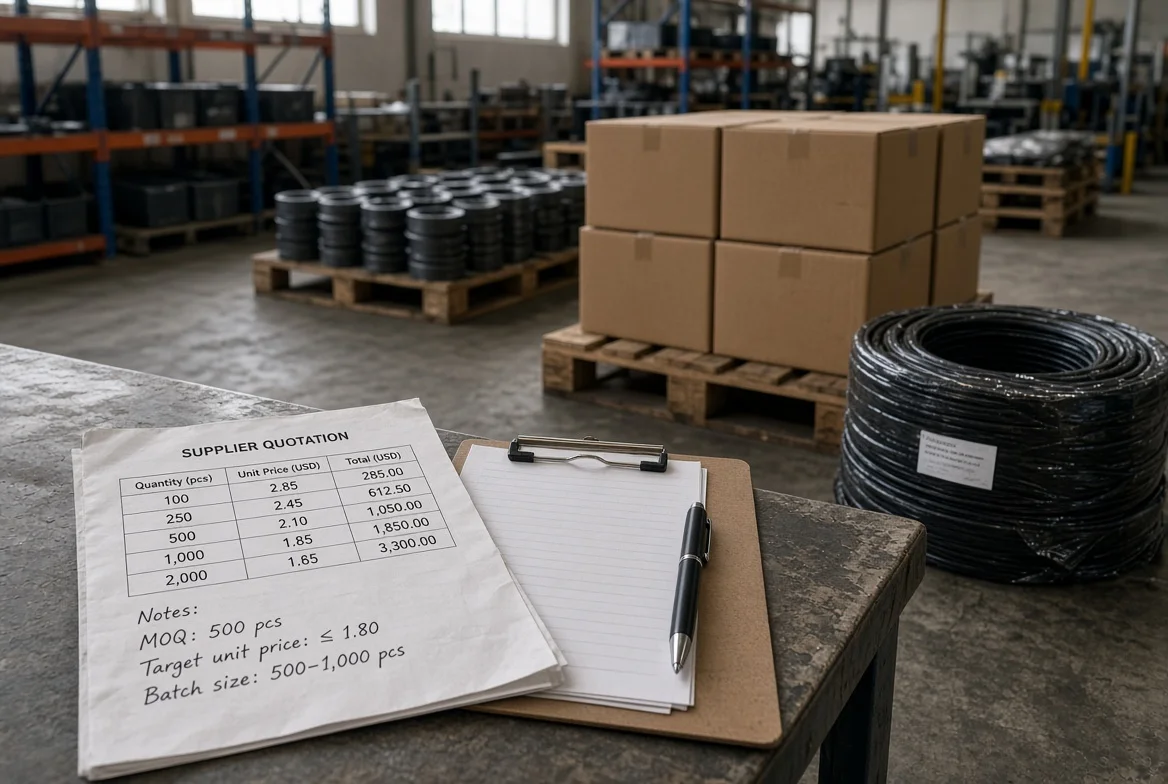
The MOQ affects the unit price as many of the production costs are based on costs per order, batch, setup or run. Those costs don't decrease in a linear relationship with the number of pieces ordered. The same equipment and material purchase and change over is split differently at 100 units, 1000 units and 10,000 units.
That is, the more that unit has, the less its value is.In other words, the more the lower the costs of units, in principle, and the messier in practice. It doesn't necessarily reduce the total cost of ownership for the buyer.
Fixed Setup Costs Spread Across More Units
Setting up a machine, programming it, setting up fixtures, preparing materials, clearing lines, first piece approval and changeovers can be just as costly as to purchase a small batch of the machine from the supplier versus purchasing a larger batch. The more units that are made, the lower that is for each unit; the fixed cost will be distributed over more units.
One such example is a CNC shop that's going to quote a custom bracket. Programming, fixturing, first article inspection and material preparation might be identical at 50 and 500. The unit price of the 50 piece quote is higher than the 500 piece quote because there are fewer pieces to support the unit price.
Material Purchasing and Supplier Minimums
Factories frequently order raw materials, like cable reels, resin lots, sheet stock, paperboard, coatings, and electronic components and printed packaging substrates, in minimums. In this case where the amount ordered by the buyer does not meet the minimum amount of the purchase, the manufacturer may still need to buy the entire lot.
The unused material results in a higher per unit rate, a material surcharge or a material not wanted in inventory. Typically, the items are specialty resins and electronics. Parts used are also an expense of the buyer. The purchaser also may be buying the supplier's forced overhang.
Labor and Production Efficiency
Larger runs can help to decrease the amount of repeated setups, changeovers, handling, inspection and packing per unit. The use of operators is consistent and regular. Consistency of inspection is improved. Constant line stops are not used with cartons.
The larger the volume, the better the efficiency is not guaranteed. The benefit can be lost due to bottlenecks, capacity limits, quality issues and high product variation. Not every mixed-SKU run is going to be efficient and many can remain inefficient even if the number of items goes up.
Tooling and Amortization
Tooling and moulds, dies, engineering and fixtures can be charged separately, or incorporated in the unit price at a specified number. The appearance of a low cost for a molding quote may be deceiving, as the mold expense is spread over a high estimated quantity.
It is important for buyers to verify what will occur if there are fewer actual orders than assumed. When the supplier has incorporated tooling recovery into a unit price for 20,000 tools and the buyer only requires 4,000, this quoted unit price is not the actual price.
Packaging and Shipping Efficiency
Where larger orders are placed, consider using full boxes, full pallets or container loading/consolidated freight to minimize packaging and transportation cost per unit. Low MOQ is a risk factor for the following packing processes: small batch packing, extra packing handling, courier packing and carton packing.
The freight differential should be accounted for in the comparison. These benefits can be sacrificed before the items reach the door if the unit price is low but the items are shipped in a few small lots.
How MOQ Appears in Manufacturing Quotations
MOQ seldom resides in a single cell. It may appear in the price table or in commercial conditions, in notes for packing or in some cases it may be something the supplier assumes, and thus leaves out. Read the price as a set price and not a single price.
MOQ by Product, SKU, Color, or Configuration
MOQ is frequently used separately with each part number, color, size, material, finish, voltage, connector, packaging design or configuration. An OEM or Packaging order can be large quantity but every SKU is below the minimum quantity.
When a customer wants to buy 6,000 cartons for eight artworks, they may need to be a minimum of 8,000 pieces for each artwork. This is the same with the separate component buy of each length/cable type combination in cable assemblies.
MOQ by Production Run or Batch
The supplier might insist on a minimum batch as changing the machines, materials, molds, printing plates, tooling or test settings is expensive. Fifty thousand units not ordered in one run is not 5 X (ten thousand units ordered in one run).
The first one will only be recovered once while setting up. The second includes set-up, approval of first piece and material staging. For quotes assuming one batch, staged releases can impact price, lead time and capacity.
MOQ by Raw Material or Component Supplier
An upstream distributor or mill could have a minimum that the manufacturer has to comply with. Electronic parts, connectors, special resin, cable reels, coatings, paperboard and custom packaging material are some of the common source materials.
The constraint is not being added by the factory. Relays another purchase rule. Identify what the minimums are for items in the bill of material.
MOQ and Customer-Specific Customization
Custom artwork, labels, colors, dimensions, tooling, or private label packaging increases MOQ because the supplier is not able to easily recycle remaining material or setup for another customer. An overmold or unique resin color is not worth recycling.
Typical colors, standard connectors, and existing tooling typically allow for more space for reducing the minimum.
MOQ Notes and Conditional Pricing
If the customer desires the supplier to produce unique artwork, labels, colors, dimensions, tooling or private label packaging, the MOQ will increase since there will be no surplus product or setup for the supplier to use for another customer. The color of the resin, included with carton or special overmold for the Customer has small second-life value.
Typically, it is easier to reduce the minimum size when working with standard colors, connectors, and tooling.
MOQ Notes and Conditional Pricing.
How MOQ Affects Manufacturing Quote Structure
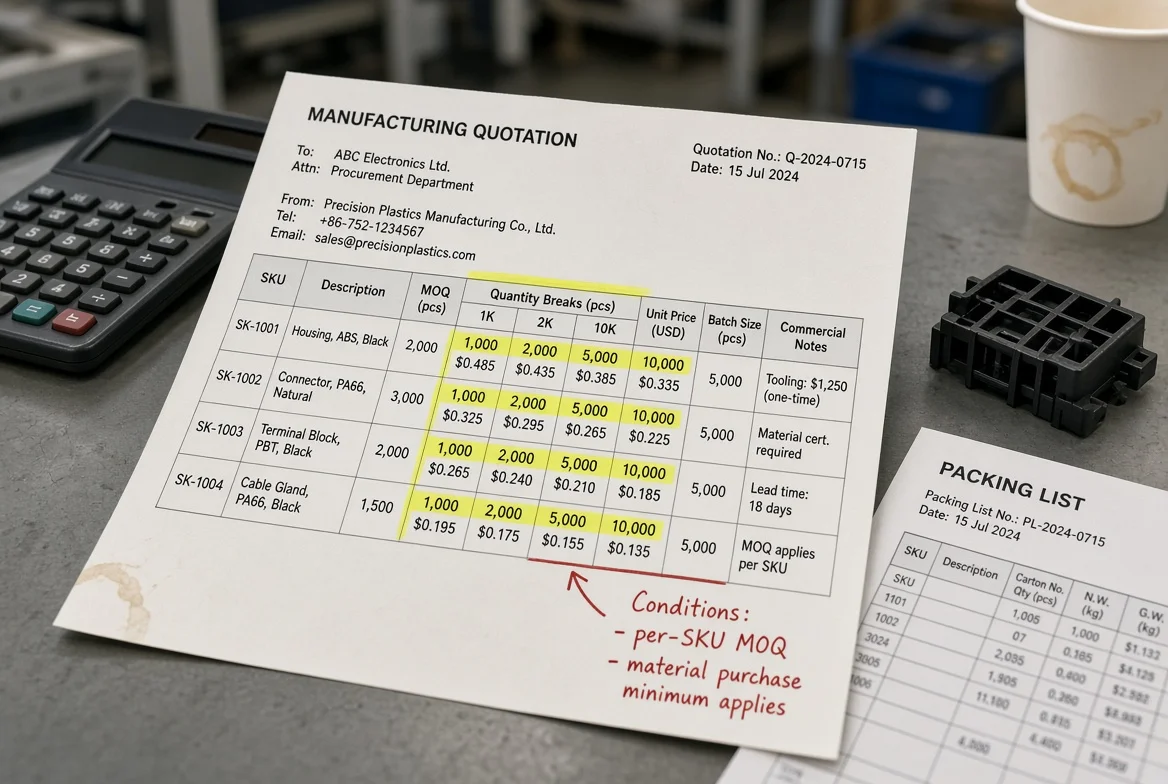
MOQs affect more than just the unit price. It can impact on tooling amortization, setup fees, sample pricing, packaging, lead time, payments, production scheduling, freight and the supplier's desire for the project.
Unit Price and Total Order Value
It is important to have clarity on words such as “MOQ applies per SKU”, “material purchase minimum”, “standard pack quantity” or “minimum order value,” before comparing quotes. Conditional language is for two identical unit price suppliers that are a lot different when committed.
Ask the supplier for the number of pieces, SKU, batch, value, what if the customer's actual need is less.
Tooling and Setup Treatment
A supplier can charge a low MOQ but then spread the cost of the tool over the next few units or even bury it in the unit price – but only at high volumes. Ask for transparent pricing of the tools, set-up and production costs for each quantity.
If set up is only included at a certain volume, then the lower launch order can be used to bring those charges back.
Sample and Pilot-Run Pricing
Depending on the product, their sample or pilot quantities may be lower than their normal MOQ. Sample pricing is typically quoted higher and sometimes as a fixed cost by the supplier since setup, engineering and material costs are taken by the supplier over a relatively low number of units.
A sample quote is NOT a production quote. Assume it is a development cost, unless the supplier has indicated that the same cost will be used for the first production.
Lead Time and Production Scheduling
An order that is placed for a low volume might be held for a position in the schedule. In the event that materials and/or capacity must be reserved larger orders could receive a dedicated window, which may then take longer. For each quantity that you are thinking about, ask how it affects sample timing, the start of production, and delivery.
A factory can produce 300 parts next week and 8,000 parts in six weeks is giving you a fact, not a tactic to negotiate with.
Payment and Deposit Requirements
The higher the MOQ, the higher the deposit and the balance due. It can also alter the timing of payments, the requirements for letters of credit, and financing exposures. Compare between payment terms and unit price and total order value. A small unit price improvement, with a doubling of cash at order placement is a different commercial arrangement.
MOQ, Inventory, and Buyer Financial Risk
MOQ is a requirement from the supplier. The financial ramifications are borne by the purchaser. A lower price will lead to higher inventory and cash-flow risk.
Excess Inventory
If there is an excess of orders over demand there are storage, handling, financing, insurance, damage, shrinkage and obsolescence cost. Seasonal products, electronics, custom-made packaging, slowly moving parts in industries and products that are subject to frequent changes are at greater risk.
An artfully distributed brand of cartons that are exposed after an artwork change is not a value. It's dead stock with a printing bill!
Working Capital and Cash Flow
The higher the MOQ, the greater the amount of money that the buyer must invest before they can resell or use the products. Examine deposits, payment conditions, forecasted inventory period and cash conversion based on your own finance assumptions. Don't just take the carrying cost percentage from another product or industry.
This is the right question to ask rather than the unit price appearing good on a quote.
Demand Uncertainty and Forecast Risk
Distinguish between confirmed and forecast demand. A supplier may be able to provide a better price based on an annual volume. That price is only relevant if the buyer is able to make that commitment.
Don't change the name of the non-binding forecast to something else. Don't plan on a quote that is either a blanket order or a take-or-pay volume as an estimate, but as a contract risk.
Storage and Handling Capacity
Large batches require space, warehouse staff, inventory management, packaging quality, and possibly climate control and/or special racking. Even in a factory-efficient pallet quantity, the buyer may still have to deal with a warehouse issue due to limited floor space or mixed-SKU storage constraints.
Obsolescence and Product Changes
Electronics, branded packaging, custom labels, seasonal products, customer-specific products, and parts that are subject to change after an engineering change are particularly risky using too much inventory. The next 20 per cent of a big MOQ is usually the most expensive, as these items are the ones that don't meet the next design or the next customer's requirements.
How MOQ Affects the Buyer Beyond Unit Price
MOQ effect | Potential benefit | Potential buyer risk |
|---|---|---|
Lower unit price | Fixed costs spread over more units | More cash tied up |
Larger production batch | Fewer setup events | Excess inventory |
Bulk material purchase | Better material pricing | Unused or obsolete material |
Full-carton or pallet shipment | Lower logistics cost per unit | Higher storage requirement |
Longer production run | Better supplier efficiency | Less flexibility for changes |
Higher forecast commitment | Access to volume pricing | Future MOQ or pricing dispute |
Fewer order cycles | Lower administrative effort | Larger replenishment gap |
How MOQ Differs by Manufacturing Process
MOQ is process-specific. Why a molder wants a larger batch is very different from the molder's minimum.The molder's reason for setting a minimum is very different from that of a machine shop, a cable assembler, a printer, or an electronics contractor.
Injection Molding and Custom Tooling
Molding MOQ can represent mold investments, machine set-up, color/resin changeover, cycle economics, material procurement, cavity design, and anticipated mold utilization. A low unit price typically will be based on sufficient volume to justify the tooling and will maintain an efficient run of the press.
Cable Assemblies and Component Purchasing
Cable-assembly MOQ is frequently driven by cable reels, connector purchases, terminal quantities, crimping setup, test fixtures, overmolding, labels, and packaging. A special connector brand or an uncommon cable length can impose a component minimum the assembler cannot split.
If the reel or the connector tray is larger than the buyer’s need, the leftover becomes part of the quote whether it is visible or not.
Printed Packaging and Custom Artwork
Packaging MOQ is a result of printing setup, plates, dies, purchasing substrate, color change, finishing, waste and minimum print runs. All of these, or overage, shortages, artwork changes and storage of customer specific cartons are part of the decision.
It is rare that a unit price will be sufficient to recover a new print plate for a short promotional run.
CNC Machining and Fabricated Parts
Low MOQ for machining/fabrication compared to molding is possible due to smaller investment of dedicated tooling. Until a certain quantity, unit price also increases with lower quantities of programming, setups, material purchasing, inspection and machine time being distributed over lower quantity.
The shop could take 25 items. The 250-piece price is less because the setup and programming cost is no longer the major expense in each part.
Electronics and Upstream Component Minimums
Many electronic assemblies will carry minimum purchase requirements from the distributors or manufacturers of the components. Differentiate between assembler imposed MOQ and the component MOQ. Until an IC or connector is inserted into the board, a build of a board can be considered flexible.
OEM/ODM and Private-Label Products
If you want to customize, brand, package, comply, make a new tool or develop it, MOQ goes up. Explain the distinctions between minimum and complete product, minimum by color, minimum by SKU, minimum by packaging version, and minimum by production location.
One private label order can encompass multiple minimums in a single Purchase Order if it is a combination of three colors and two box designs.
MOQ vs Price Breaks and Production Volume
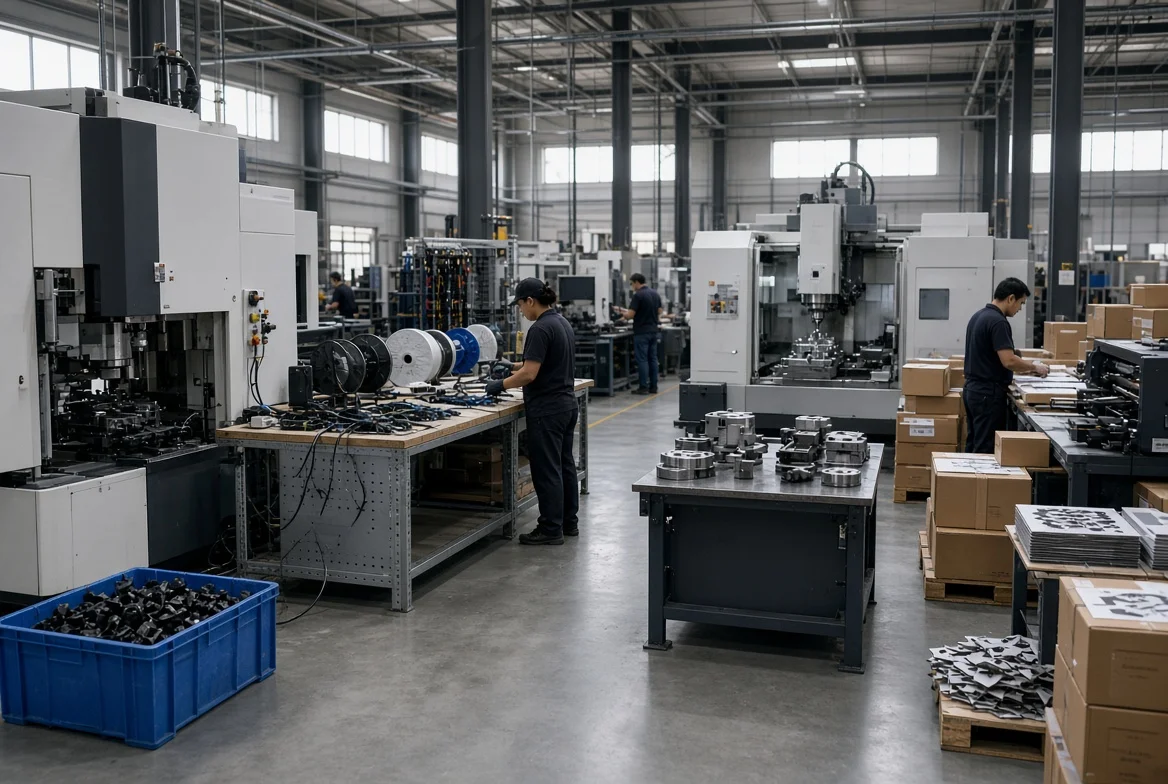
MOQ is not cost break, it is a volume of production. All three are necessary for a thorough quotation review.
MOQ Is the Minimum Accepted Quantity
MOQ refers to the minimum quantity that the supplier is willing to accept under the given terms and conditions. Can be the most expensive price per unit on the sheet. The acceptance of the MOQ only indicates that the order is commercially valid. Does not indicate that the price is optimized.
Price Breaks Are Quantity-Based Discounts
Changes in the unit price at certain quantities are called price breaks. Make sure to ask multiple suppliers for the same break points to ensure an apples-to-apples comparison. One factory is saying 500 / 2,000 / 10,000, another is saying only 1,000 – you are not yet comparing the same buying decision.
Annual Volume May Not Equal Order Quantity
Suppliers may price against annual volume even when the buyer places several smaller orders. Confirm whether the quoted price requires one production batch, an annual commitment, a blanket order, or scheduled releases.
A price based on 50,000 pieces a year is not the same as a price for a single 50,000-piece run.
Production Volume and Capacity Constraints
More volume may lead to less cost, but more capacity, materials, tooling and lead time. If production is scheduled within a clearly defined period, some factories will only have a lower price. A volume price will often be apparent because of capacity, not because of generosity.
How to Request a Quantity-Based Quote
As applicable, request quotes from suppliers:
- Sample quantity
- Initial order quantity
- Medium-volume quantity
- Higher-volume quantity
- Annual-volume scenario
- Stated MOQ
- Price-break levels
- Tails and setups on separate lines
- Lead time for each of the quantities involved.
The objective is a pricing map, not just a number that covers up its volume assumption.
How Buyers Can Negotiate or Manage MOQ
It should not require the supplier to drop the MOQ but not decrease the cost reason. The trick is to vary the variable that caused the minimum.
Ask Why the MOQ Exists
Determine if the minimum is a result of material acquisition, set-up, tooling, packaging, testing, machine utilization, subcontractors, shipping, order administration, or some other factors. The answer gives you an idea of what to negotiate.
Requesting a reduced price will not solve the material-reel issue. A set up fee may be used to address a set up problem.
Request a Lower MOQ at a Higher Unit Price
A smaller order, but with a higher unit price or separate setup fee will be accepted by many suppliers. This feature works well for market tests, prototypes, launches and volatile demand.
You're purchasing choice. Make it a request for flexibility, not a discount.
Use Standard Materials or Components
The standard materials, the standard color, the existing tooling, the common connectors, or the standard packaging can help to reduce MOQ because of leftover materials and tooling can be used in other manufacturing areas. Ensure that the replacement still performs, is of quality and is a brand.
The entire problem is often a short run of a unique Pantone.
Consolidate Orders or Combine SKUs
The use of shared materials, colors, components, tooling or processes can lighten the workload of the factory. The suppliers may have MOQ's per SKU and/or configuration, so double check before thinking that a combined order will solve that problem.
Use Blanket Orders or Scheduled Releases
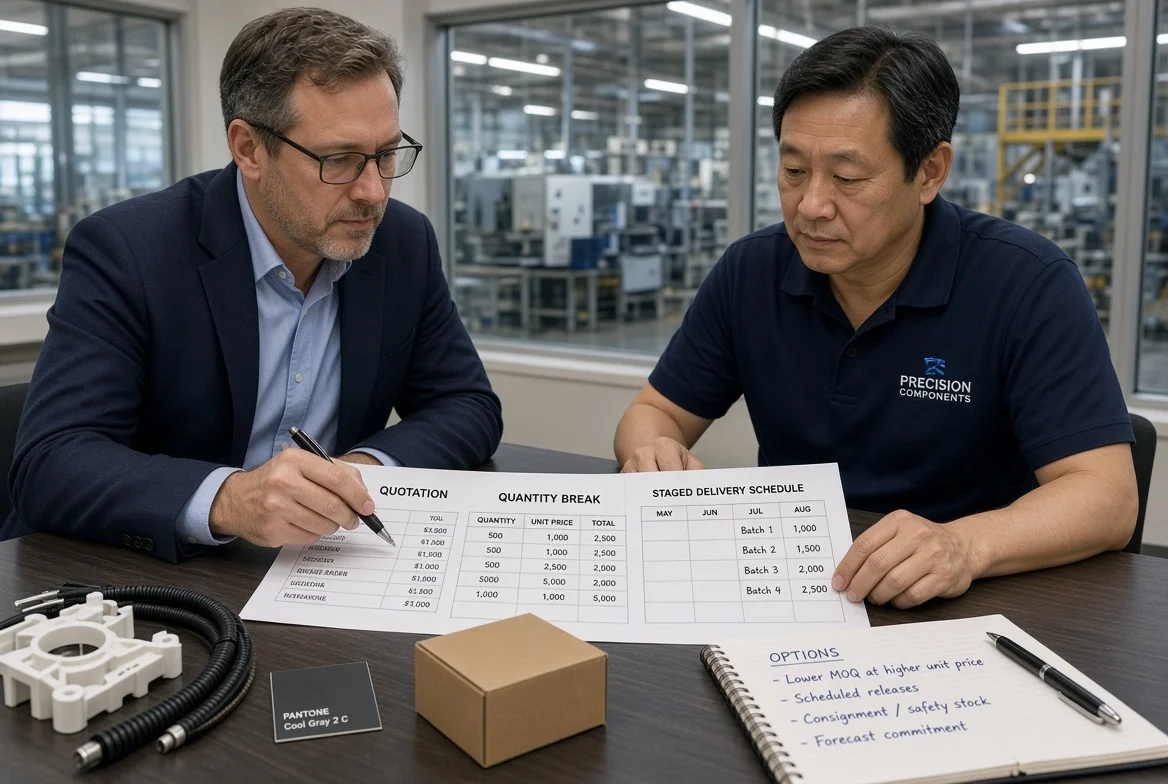
A buyer may specify a quantity to be committed and may ask for staged production/delivery. That makes it easier for the supplier to plan materials and less burden for the buyer to store the materials. Clearly communicate payments, ownership, storage, expiration, quality hold, and release prior to making the blanket a "fait accompli.
Negotiate Tooling or Setup Separately
If the tooling and set up are distinct from the unit price, then the supplier can take on a lower volume of production without having to place all of the fixed costs in the unit price. The first order is more easy to understand. Subsequent reorders are more easily compared.
Work with a Trading or Consolidation Model Carefully
It is possible for a consolidator or a distributor to aggregate demand and reduce the apparent MOQ. That model can introduce “noise,” additional levels of communication, quality control, and delivery complexity. Look at total costs and total responsibility, not just minimum quantity.
How to Evaluate MOQ in the Total-Cost Context
Take into consideration MOQ along with unit price, order value, inventory, storage, working capital, freight, demand risk, and supplier flexibility. That's just one line of the lowest unit price.
Compare Total Order Cost
Increased MOQ will result in decreased unit price and increased cash order cost. Write both numbers on the same piece of paper.Write both numbers on one piece of paper. The comparison is not complete until the cash difference is seen if the cheaper unit price involves four times the inventory.
Compare Inventory Duration
Make realistic estimates on the duration of the MOQ in the store, with a realistic demand, not an optimistic prediction. A 12 week cover might be ok for a stable industrial product and not acceptable for a branded seasonal product.
Compare Logistics and Storage Efficiency
A larger quantity might result in lower freight per unit but higher storage and handling costs. A smaller order will be more expensive to ship and have less inventory risk. Do not assume that full containers are always cheaper and use your actual freight mode and warehouse constraint.
Compare Supplier Flexibility
A supplier who will take smaller releases, split shipments, or some material alternative can be more valuable than a marginally less expensive piece price. Flexibility is a business word. Request in a written format.
Compare Demand and Obsolescence Risk
Such as custom packaging, electronics or branded products, engineering sensitive parts are riskier in the event that demand or specification changes. The MOQ that's suitable for a customer label is not always the one that's suitable for a catalog metal bracket.
Common Buyer Mistakes When Reviewing MOQ and Pricing
Typically, MOQ issues begin with the buyer not examining the order model they are buying.
Choosing the Lowest Unit Price Automatically
The lowest might be the most onerous in terms of MOQ, large deposit, long storage or volume commitment that the demand plan cannot be met.
Assuming MOQ Applies to the Whole Order
MOQ can be applied per SKU, Color, Size, Material, Configuration, Artwork and Packaging version. There is a possibility that a large mixed order can skip all the individual minimums.
Treating Annual Forecast as a Guaranteed Commitment
Do not commit to annual volumes which you cannot keep if you have to accept a lower price. Once the supplier invoices or reallocates the forecast, it's now a burden.
Ignoring Upstream Component MOQ
The minimum purchase for materials and components from vendors, particularly for electronics, connectors, specialty cable, packaging substrates and custom materials. Before award, the item that is driving the order should be identified if one reel or one tray is driving the order.
Ignoring Inventory Carrying and Obsolescence Cost
Expiry, damage and engineering changes are not included on the quote line, neither are they considered for warehouse space.
Negotiating MOQ Without Understanding the Cost Driver
Before you suggest a solution, ask whether it is to do with setup, material, tooling, packaging, shipping or capacity. The incorrect lever costs time and decreases the willingness of the supplier to adjust the correct lever.
Accepting a Lower MOQ Without Reviewing Unit Price and Quality
A lower MOQ may lead to higher unit price, lower supplier priority, or fewer material choices, or to altered production and quality conditions. Rising the job to a slower line or to a different material will not be the same product.
Final MOQ and Supplier-Pricing Checklist
Before accepting an MOQ or comparing MOQ-based quotations, use this checklist.
Supplier and Production Checks
- On the MOQ basis, it is clear that it is based on unit, SKU, color, configuration, order value, batch, material.
- The supplier has given the reasoning for the MOQ.
- Minimum production batch is different from buyer order quantity.
- The material and component minimums are identified.
- Knowing of the costs of tooling, set-up, and changeover.
- The production volume and the price-break levels are specified.
- MOQ lead times and capacity are known.
Buyer Demand and Inventory Checks
- The initial order quantity is the realistic quantity order.
- Forecasts are declared as a binding or non-binding.
- Estimated inventory periods.
- Consideration is given to storage, handling, financing and insurance.
- Obsolescence and Product Change Risk is discussed.
- Cash deposit and balance is welcome.
Commercial and Negotiation Checks
- The total value of the order is compared with the price of each unit.
- Low and high MOQ requested.
- Tooling and set up is charged separately, as applicable.
- The possibilities of using standard-material and standard-packaging are discussed.
- Staged-release or consolidation options are considered.
- Packaging, freight and delivery impact is known.
- MOQ changes do not affect the quality or supplier priority.
- Final MOQs and price conditions are recorded in writing.
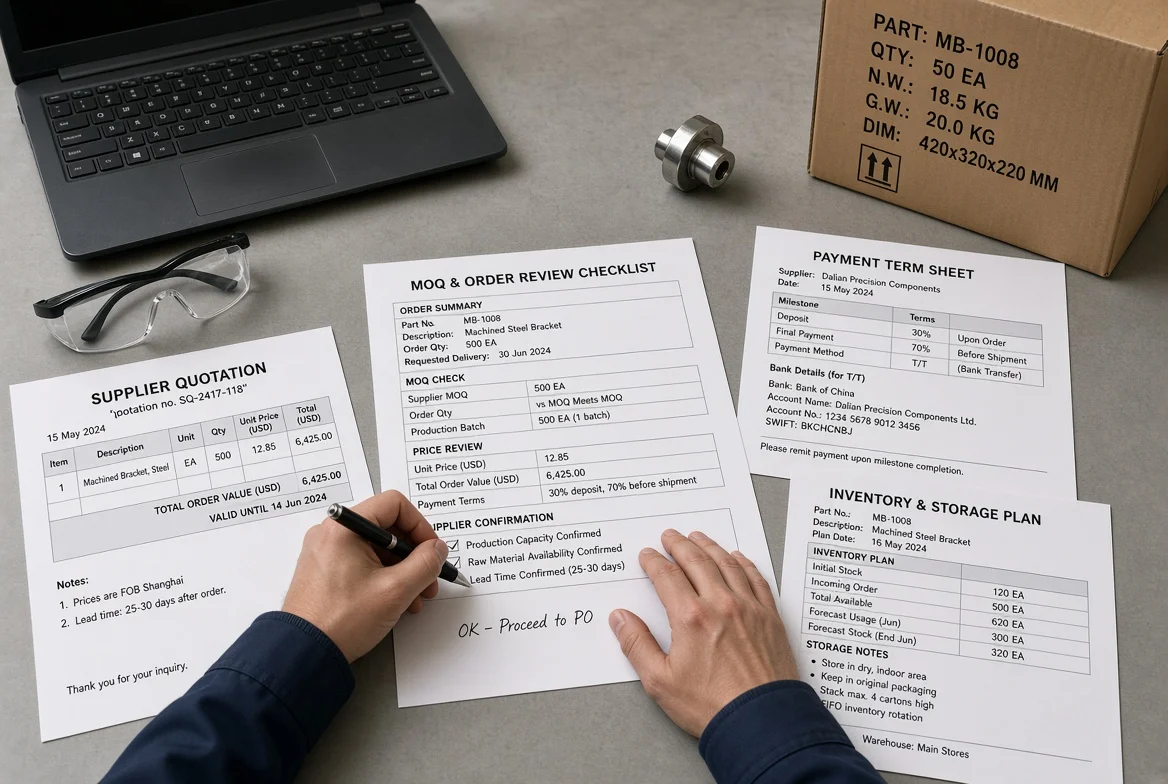
Summary Guidance — The Right MOQ Balances Supplier Economics and Buyer Risk
MOQ is not just a supplier hurdle. It represents the economics of product, materials, set-up, tooling, packaging, shipping and capacity. A lower minimum will enable a lower unit price. It can also burden the buyer with stock, cash-flow issues and the risk of obsolescence.
The comparison of lowest piece price versus highest piece price isn't particularly useful. It's whether the order quantity brings into a sustainable harmony between factory efficiency, and buyer risk. Question the “why” of the minimum, compare and find out the price of the alternative and only accept the MOQ if the unit price and total order cost, demand, inventories, lead time, quality and supplier flexibility are all still logical.