
Procurement strategy relates to a long-term plan for a business to purchase goods and services, select suppliers, manage the purchasing risk and contribute to business commercial objectives. It's not about finding the lowest bid. If the lead time slips, the quality is off, the freight increases, the payment terms can be a cash-flow problem, or the shipment is late, a manufacturer can take a low unit price and still lose money.
Whereas price negotiation is still relevant. A complete strategy also determines how the suppliers are screened, the importance of the categories, the quality and delivery requirements, and the monitoring of performance after the order.
What is Procurement Strategy?
A procurement strategy is a long-term plan that provides an organization with direction on how to procure products/materials, equipment and services within its scope of work in consideration to its cost, quality, delivery, risk, compliance, and growth objectives. It establishes decision rules prior to the next RFQ, avoiding that teams have to “make it up” as they receive new RFQs and suppliers miss dates.
If those principles are in place, then the same applies to recurring purchases. The company already has established a list of items requiring multiple sources of supply, a list of approved suppliers, and a list of quality documents to be provided before first production runs.
A Procurement Strategy provides the purpose, or the reason for the procurement.
This is to provide the business with a uniform way to control external suppliers and purchasing costs. The strategy is then tailored to each category with the question answered—what is important to you?—lowest total cost, reliability of supply, technical capability, speed, compliance, or product quality.
Let's get convenient and fast office stationery. Where a casting or electronic component is critical to the production a different problem. In that area, the few cents on the unit price are often outweighed by the value of the capacity, process control, traceability and on time delivery. Packaging for an export SKU falls somewhere in between: cost is important, but print accuracy, drop-test capability and seasonality volume-holding are also crucial.
Procurement Strategy Goes beyond Purchasing.
The everyday business of purchasing is the requisition, purchase order, delivery follow up, receipt and invoice matching. Procurement strategy is above that work. It determines the selection of suppliers, its commercial and risk controls, and the writing of its requirements.
Purchasing action: issuing a purchase order. Single sourcing versus dual sourcing is a strategic purchasing decision for a production critical component. And is competitive bidding versus a long-term capacity agreement, or first-article inspection before any volume order, the right choice.

Why Procurement Strategy Matters to Businesses
The buying process manifests itself in margins, stock, delivery times of customers, the quality of products, suppliers and cash flow. Problems start over again—other people select other suppliers for an identical part, emergency purchases become regular, and quality requirements shift from order to order, while one factory is most likely the only place to obtain a part that can shut down the plant.
This noise is mitigated through a usable strategy. It doesn't solve all the scarcity and price hikes. It makes the following decision quicker and more consistent.
Controlling Total Procurement Cost
The unit price is a single line. Additional costs include freight charges, customs charges, inspection, packaging, rework, scrap, warranty exposure, inventory carrying cost, payment terms and downtime when the material is late.
They are a common occurrence: Supplier A prices 8% lower than B. The first few lots are inspected on arrival and out-of-tolerance holes are discovered. The “saving” is lost because of rework, additional freight for replacement, and two days of assembly downtime. When purchasing custom-made parts, imported products, or when your business is production critical, buyers should look for the total cost of ownership (TCO), which is the total cost of the unit itself, including all shipping, storage, usage and replacement expenses.
Improving Supply Reliability
Late delivery, capacity limitations, materials, transport disruption, and sudden changes of supplier are operational issues and not merely purchasing inconveniences. Practical controls are lists of approved suppliers, capacity checks before the busy season, safety stock of long lead items, dual sourcing if necessary to ensure availability, and a named backup supplier, and communicating the realistic forecast with the factory.
All purchases do not require the same level of protection. Focus on items that can prevent production, delay a customer, present safety problems, or result in a significant monetary loss. Normal consumables can remain on a more streamlined purchasing journey.
Ensuring Quality and Compliance
Requirements for quality documentations must be documented prior to supplier selection, not after the first lot rejected. This is where drawings and tolerances, material call-outs, sample and first article rules, inspection criteria, certificates, traceability, change-control notice and where the risk is high, a quality agreement or supplier audit would apply.
The lack of clarity means that there are disputes. A Buyer states that the surface finish is not acceptable, and the Supplier states that it complies with the last verbal order given. The engineering, quality, operations and procurement should agree on the specification, packaging and inspection procedure before the RFQ is sent out.
Supporting Business Growth
When SKUs, order volume, or even export destinations increase it starts to fall apart for a few suppliers and a few weekly orders. When a buyer is not around, informal knowledge residing with one buyer turns into a risk.
A more robust approach enables the company to scale up factory capacity, to standardize the way that similar purchases are made, to look at costs by category, and to minimize reliance on human memory. New product introductions, too, require greater involvement from the suppliers, or they might find themselves faced with the unpleasant prospect of having to buy in tooling, samples, and capacity at the last minute.
Key Components of a Procurement Strategy
A practical strategy is a connected system: business objectives, priorities of spend, approach to suppliers, risk controls, roles, processes and measures. When one of those pieces is omitted, business find themselves with a “strategy” document that the purchasing team does not use.
Business goals and objectives, and procurement objectives.
Procurement objectives should align with the company's current objectives, whether margin protection, no line stoppages, improvement in supplier quality, reduction in emergency air freight, supply resilience or a new product.
No one can manage "reduce costs". A usable goal is more like: decrease total landed cost for a defined packaging category for 12 months, with agreed upon defect and on time delivery rates. That version can be quantified and debated in terms of finance and operations.
Include spend analysis and category management.
Work from the company's own purchasing patterns: How much it spends, who it is spending it with, how often and where the most risk or opportunity is. Category management is used to group similar purchases together so that the same strategy is not used for all purchases.
Examples of typical groups are direct materials, electronic parts, packaging, MRO supplies, logistics, capital equipment, and professional services. The reviews performed by the supplier do not need to be as extensive as those performed for a high-value, long-lead production part as they are for a low-value stationery part.
Supplier Selection and Supplier Segmentation
Typically, evaluations include price, quality, technical ability, capacity, lead time, location, certifications, communication, financial or operational stability, and support of future volume.
Not all suppliers are regulated in the same ways. Different review frequency, contract depth and management time is required with strategic partners, approved suppliers, preferred vendors, backup sources and transactional vendors. Relying on a one-off packaging printer as an OEM partner is a waste of effort and relying on a critical tooling supplier as a catalog vendor is a risk.
Sourcing Model and Supplier Relationship Approach
The strategy should specify at what point the company will be employing single sourcing, dual sourcing, multiple suppliers, competitive bidding, long-term partnerships, framework agreements, and supplier development.
Common types of fasteners, which can be sourced in many different qualified locations, can be put to competitive bidding. Establishing a longer relationship, change-control discipline, tooling ownership terms and a plan for that factory that is not able to ship, generally requires a custom OEM housing with unique tooling. The sourcing model should be aligned to the level of risk and complexity of the item, not just a company-wide slogan.
These are the elements of a cost structure and the considerations relating to commercial terms.
Quotations should be made on the same term: Specification, quantity, MOQ, tooling, payment, freight, Incoterms, lead time, flexibility, warranty, price adjustment clause.
International manufacturing quotes can be very misleading. An FOB unit price is NOT a delivered cost (DDP). Once the ocean freight, duties, inspection, and additional packaging is factored in, a lower factory price can be lost. The actual number is also affected by volume commitments and tooling amortization.
Risk Management & Business Continuity
Potential sources of exposure include supplier concentration, geographic clustering, capacity constraints, long lead times, material availability, compliance issues, quality fluctuations, and reliance on special tooling or a single manufacturing process.
Alternate suppliers, audits, safety stock, contingency plans, approved substitutions, escalation paths, and regular reviews should be used for controls to match the impact of failure. Qualifying a backup source for a special medical grade part may take months. That should be in the strategy, not a panic after a fire in the factory!
The measurement of performance and governance.
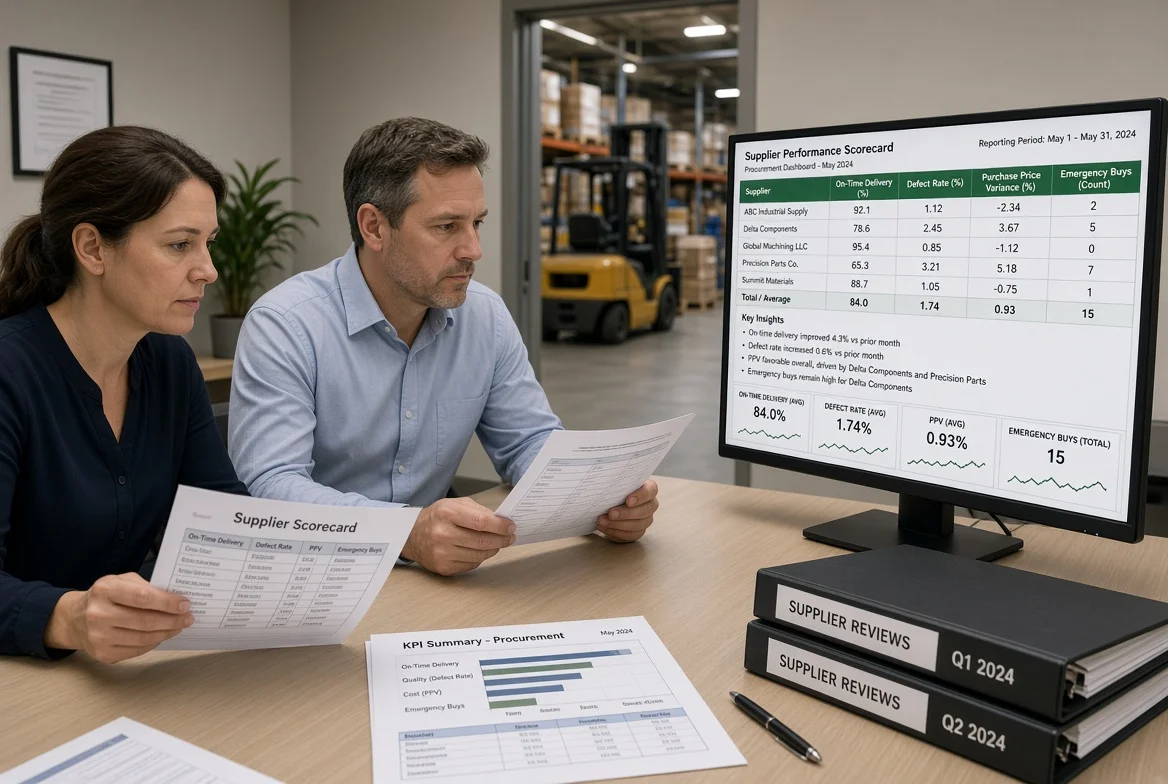
Some helpful metrics are on time delivery, defect rate, purchase price variance, total cost, compliance with contract, frequency of emergency buys, supplier responsiveness, cycle time and spend under management.
Governance is the team that can approve a new supplier, a specification change, a price increase or an exception to the list of approved suppliers. Otherwise it can be left out of the plan. This can be done by small companies using a spreadsheet and a form for approval. Larger ones will typically require ERP rules or e-procurements, for which the same restrictions will apply if the regular buyer is not in the office.

How to Develop a Procurement Strategy Step by Step
Any business should not be undertaking a re-design of all purchases all at once. Use the most important categories first (those that would impact cost, quality, or production continuity) and then make analysis a short list of actions with owners and review dates.
Step 1 - Define the Requirements of the Business
Discuss the outcome of the purchase with the people with whom it will be shared. Engineering might require a close toleranced material spec. A consistent weekly decline in production may be required. May require inspection records to show quality. Finance might desire less stock. You may have a promise that you make to your customers that can't be delayed when it comes to sales.
Specs, quantity profile, lead-time window, quality docs, packaging and commercial constraints are all procurement's responsibility in converting those needs into purchasing requirements. If they remain aural, the quotations will not be comparable.
Step 2- Looking at current spend and supplier performance.
Review past purchases, supplier lists, contract coverage, quotation files, quality complaints, late deliveries, emergency orders, and reoccurring price discussions.
The red flags are obvious: uncontrolled purchasing; excessive suppliers for the same part; no approved vendor list; repeated rush orders; ambiguous part specifications; same part quoted at three different prices; constant shortages; and no backup factory. Those patterns inform you where the initial strategy work must be plotted.
Step 3 - Supply Market and Procurement Risks are analyzed
Determine how many qualified suppliers are available, the competitive market, typical leadtimes, availability of materials, factory capability, geographical concentration, and the difficulty of qualifying an alternative supplier.
Many printers can be obtained for a commodity carton at a competitive price. If using a specialised coating or a custom mould, this requires planning at an earlier stage, supplier development, reserved capacity and/or a second source previously qualified. It should be the approach that changes and not the price target.
Step 4: Prioritize and select sourcing strategies
Choose a few priorities among the following: cost, quality, continuity, speed, working capital, supplier consolidation, or supporting a new product. Trade-offs are real. Decrease in inventory means cash increases and shortages risk increases. Levage and dependency can be both increased and strengthened by fewer suppliers. The cheapest bid may reduce the unit cost and result in quality or delivery issues.
Provide the chosen approach for each priority category to prevent the buyers from guessing.
The goal of this step is to establish policies, responsibilities, and approval rules.The objective of this step is to set up policies, responsibilities, and approval rules.
Identify which party can request, peer review, approve, negotiate and manage purchases. Confirm approved supplier lists, if applicable, thresholds for approval, ownership of the specification, supplier onboarding process and how exceptions will be managed.
This can be used by a 20 person importer on a shared file and a basic approval form. In a multi-site manufacturer, the systems' workflow typically prohibit a plant from having a source for a critical part without its approval.
The resource development phase includes implementing, measuring, and improving the resource.
Implementation can involve such things as RFQs, negotiating, auditing, contract updates, scorecards, quality actions, demand consolidation and training. Every program requires a baseline, an owner, a date and a review.
Revise the plan when there are changes in the supplier performance, product design, market conditions, customer demand, regulations, or logistics. If a strategy has been written and put away, it's already out of date.
Procurement Strategy vs Related Procurement Terms
In the real world, there is a lot of overlap between these terms. The differences below prevent planning, sourcing, procurement and process design from being considered the same process.
There are two types of procurement strategy, and they are quite distinct: Procurement Strategy and Strategic Procurement.
Procurement strategy refers to the documented way that the organization will oversee the purchasing and suppliers. Strategic procurement is the more comprehensive management strategy in which procurement is seen not only as a process for placing purchase orders but also as a means to cost, risk, quality, supplier development and business decisions.
There is a significant difference in the scope of the scope of work between a procurement strategy and strategic sourcing.
A major procurement activity is strategic sourcing, which involves the analysis of the supply market, assessment of suppliers, decision on sourcing model and negotiation of commercial value. Procurement strategy is more broadly conceived. It also encompasses governance, performance measurement, risk controls, implementation and subsequent supplier management following the award.
Procurement Strategy is a new strategy in procurement, while Purchasing Strategy is a purchasing strategy that has existed.
In smaller businesses the two terms are used interchangeably. Typically, procurement strategy will address supplier, risk, quality, governance, and long term value considerations. More often, buying strategy is used to indicate the organization of buying: channels, volume of orders, framework agreements and commercial execution.
Procurement Strategy is different from Procurement Process.
Strategies set direction and priorities. Process are the steps that can be repeated from request to payment. The strategy could involve having to look for approved suppliers and two comparable quotes for the category. The process describes what needs to happen from the time of the requisition until the order is approved to be a purchase order, how the goods are received, and how the invoice is matched.
Procurement terms at a glance
Term | Main focus | Typical question | Example |
|---|---|---|---|
Procurement strategy | Long-term purchasing direction and business priorities | How should the business manage buying and supplier decisions? | Build a dual-source plan for a critical component |
Strategic procurement | Value-focused procurement management | How can procurement contribute to business performance? | Combine cost, risk, quality, supplier development, and governance |
Strategic sourcing | Supplier-market analysis and supplier selection | Which suppliers and sourcing model fit this category? | Run an RFQ and evaluate qualified suppliers |
Purchasing strategy | Buying methods and commercial execution | How should the company organize and control purchases? | Use framework agreements and approved purchasing channels |
Procurement process | Repeatable steps from request to payment | What steps must be followed to complete a purchase? | Requisition, approval, quote, PO, receipt, invoice |
Procurement Strategy Examples for Different Industries
The concepts remain the same. Supplier risk, customer requirements and product complexity dictate the emphasis.
Manufacturing Procurement Strategy
Typical manufacturing procurement focus areas include direct materials, parts, packaging, MRO, capacity, supplier quality, lead time, BOM cost, MOQ, specifications, and line continuity.
The buyer should expect to be provided with capability verification, sample or first article approval, quality documentation, confirmed capacity, delivery plan (schedules) to match production, and realistic alternative-source path for a production critical component. If the quote is too low, it is not a viable one, unless it can be used to produce a lot of product per week.
OEM and ODM procurement strategy.
OEM/ODM work may involve the supplier in development, tooling, materials, engineering changes, testing, packaging, and ramp-up. Issues that a catalog buy can never bring up that that closer relationship does raise: IP protection, ownership of tools, control of specification, prototype approval, change notification, production sample, quality agreements, reserved capacity.
An undocumented material change that occurs late can cancel the whole launch. Change control should be part of the commercial agreement, not an afterthought in an e-mail.
Global Sourcing & Import Procurement Strategy
Purchase across the border introduces supplier verification, communication delay, product compliance, Incoterms, currency, freight, customs, inspection, payment risk, longer lead times and disruption exposure.
The figure to compare is landed cost: factory price plus freight, insurance, duties, brokerage, inspection, and additional packaging or storing that may be needed to deliver the goods to their intended destination. It's not a decision until those items are on the same sheet, with an attractive ex-works unit price.
The strategy reflects an online retailer and consumer products procurement strategy.
The primary concerns of retail and ecommerce teams are their forecasts of demand, seasonal production windows, MOQ, product quality, packaging, compliance, inventory turns, landed cost, and the cost of an overstock or stockout.
The item below is a seasonal product, with a production lead time of 90 days and ocean shipment lead time of 90 days, thus the product has only one realistic booking window. Pass that deadline, and the commercial season is over, no matter how attractive the unit price was in May.
This guide has been designed to help you apply the Service and Indirect Procurement Strategy.
There are a number of companies that purchase a small quantity of actual supplies, but spend on software, logistics, facilities, consulting, marketing, maintenance and office services. The next phase involves service levels, contract terms, contract renewal dates, vendor consolidation, approval discipline and budget visibility.
A common source of hidden cost is unwatched auto-renewals, as well as multiple vendors. The same principles of a discipline of using direct materials apply: define the requirements clearly, make offers comparable and have a named owner for the contract.
How to Measure Procurement Strategy Performance
Compare with goals established at beginning. Success shouldn't be declared just because of a drop in unit prices for a company that demands continuity of supplies. It is important to note that there still has to be a quality and delivery level for any company that's chasing cost, otherwise, the cost saving is not going to be real.
Create cost and savings metrics.
Examples are purchase price variance, negotiated savings, cost avoidance, total cost reduction, spend under contract, improvement of payment terms and landed-cost performance.
Savings require a yardstick. A lower quote is not a saving if the specification was lowered, freight was not included or if later quality created rework. Before the savings number is reported, procurement and finance should agree on the method for calculating the savings.
The quality and delivery metrics of the suppliers.Supplier quality and delivery metrics.
Monitor On-time Delivery, Defect Rate, Rejection Rate, Corrective-Action Response, Order Accuracy, Lead-Time Reliability and Responsiveness.
If the supplier is one that ships on the agreed upon date and still has a 6 percent reject rate, it is not a good supplier. Quality and delivery must be considered together, particularly on components that are direct route to the line.
The processing of data and the evaluation of risks.
Monitor cycle time, emergency purchases, maverick spend, concentration of suppliers, qualified number of suppliers for critical items, contract coverage, stock outs and disruption incidents.
If there have been repeated emergency purchases, there must be a reason – for example if the forecasts were poor, the suppliers were not reliable, there was no safety stock, or the approvals were slow. The metric only means something if there is someone to rectify the root cause.
Common Procurement Strategy Mistakes to Avoid
The vast majority of these issues stem from unclear requirements, inadequate cross-functional handoffs, inadequate supplier data or the pressure to accept the lower price. They can be resolved after they are named.
Ontly on the LSP.
Low Quotation may conceal additional freight, quality cost, communication delay, limited technical support or unstable capacity. As you are doing this, ensure that both the supplier and the customer are the same specification, quality capability, capacity, delivery record, payment terms and support, and then consider the total cost.
If two quotes cannot be compared because of the different Incoterms, the comparison is not completed.
Not defining what is needed prior to sourcing.
If the drawing is incomplete, there's no tolerance, no packaging specification, unclear inspection requirements or an impossible delivery date, the quotation can't be fulfilled. Disputes follow.
Prior to an RFQ, procurement should be in collaboration with engineering, quality, production and finance long enough to nail down what constitutes “acceptable”. That meeting would be less expensive than a first lot rejection.
All Suppliers and Categories are treated alike.
A strategic component, a routine consumable, a logistics contract, and a piece of capital equipment do not require a similar level of detail in an RFQ, a long contract term, or a long review schedule. Put time where a failure is going to hurt with category priority and supplier segmentation.
Being overly dependent on a single supplier.
Single sourcing may be the appropriate decision in cases where a factory has unique capability. Without a continuity plan, it's still an exposure. Capacity loss, price increase, quality deterioration, ownership, material scarcity or a logistics shock may occur simultaneously.
Determine the need for a backup source, safety stock, approved substitute, capacity agreement or written contingency plan for critical buys – while the current supplier is working.
A strategy that nobody uses.A Strategy That No One Uses.
If individuals continue to purchase offlist, without specifying, without respecting the limits of approval and without recording the performance of the supplier, the document becomes useless.
Implementation is not glamorous: named owners, simple workflows, a short training, scheduled supplier reviews and some measures management is asking about. It's what makes a plan a purchase.
Building a Procurement Strategy That Creates Long-Term Value
Procurement Strategy is a practical approach to determining the company's supplier, cost, quality, delivery, risk and internal needs management. It helps if it changes the following RFQ, the following supplier approval, and the following exception request.
Small is a workable start. Know the categories of purchases that can destroy the operation or that can have the greatest cost impact. Check and discuss the ongoing performance of suppliers and any recurring issues. Establish some reasonable goals. Select a small number of actions such as dual sourcing one part, reporting on specification changes before the next RFQ, locking specifications before the next RFQ, etc. or landed cost as opposed to factory price, and relegate those to owners. When a procurement strategy becomes one that teams use, instead of one that's filed, that's when it becomes one that businesses use.