
Many buying teams use procurement strategy as synonymous with procurement process, but they actually address different questions. Strategies are used to set direction; what the business should focus on, the model of supplier to be used, the amount of risk to be taken, and how purchasing should contribute to cost, quality, delivery and continuity. The procurement process is the sequential step that is repeated when purchasing, which is the sequence of buying—requiring, evaluating, approving, issuing a purchase order, receiving, invoice matching, and follow-up on performance.
As a strategy, a manufacturer might choose to dual-source a part that is critical to the manufacturing process and set a high quality standard for it. The process then demonstrates how the team validates specification, sends out RFQs, qualifies suppliers, receives approvals, orders, inspects incoming goods, and logs the performance of incoming goods. These are not two different iterations of the same! The decision framework is strategy. Process is the way of doing things. They are essential to a business. An efficient process can buy the wrong thing due to weak strategy. A good strategy may be lacking enforcement if it's a weak process.
What Is Procurement Strategy?
Procurement strategy is a long-term plan for how a business acquires goods and services in line with cost, quality, delivery, supply continuity, compliance, growth, and risk objectives. It is not a purchase-order procedure. It is the set of priorities and decision rules that tell the buying function what “good” looks like before anyone sends an RFQ.
Strategy decides how the company treats categories, suppliers, contracts, sourcing methods, risk controls, and performance management. Once those rules exist, later process steps—supplier selection, quotation analysis, approval thresholds, inspection, and review—have something to follow besides habit or the lowest unit price.
Questions Procurement Strategy Should Answer
A usable strategy answers practical questions, not slogan-level goals:
- What should we buy, make, or standardize?
- Which categories deserve the most attention because of spend, risk, or production impact?
- Should this category be single-sourced, dual-sourced, or multi-sourced?
- What quality level is required, and what evidence will we accept?
- What total cost is acceptable once freight, duty, tooling, inventory, and failure cost are included?
- Which supply risks must be reduced, and which can be tolerated?
Take a production-critical component. The lowest quotation may look attractive until the team considers supplier capacity, first-article quality, tooling ownership, technical support, and lead time. Strategy is what tells the buyer that those factors can outweigh a small unit-price gap.
Typical Elements of Procurement Strategy
Most working strategies cover a similar set of elements, used as direction rather than as a second framework document:
- Business objectives the buying function must support
- Spend analysis and category prioritization
- Supplier segmentation and sourcing approach
- Commercial terms and total-cost rules
- Risk management and procurement governance
- Supplier performance and continuous improvement
These elements influence later process steps. If the strategy requires approved suppliers and documented quality requirements, the RFQ process, supplier qualification, and purchase-order controls have to carry those rules into daily work.

What Is a Procurement Process?
The organized progress that is followed to satisfy a procurement need is called a procurement process. In other words, it's the actual way the company purchases.
A typical process would be: need identification, requirement definition, supply approval, sourcing or supplier selection, quotation requesting, quotation evaluation, supplier term confirmation, purchase order, goods receipt, and invoice matching and purchase order closing/review. The steps in a procurement process vary depending on the value, risk, category, company policy and regulatory need of the purchase. A low value consumable must not be followed by a custom OEM part.
“purchasing process” is also used as the execution layer. The procurement process in the supply chain is wider because it encompasses the handoffs to warehouse, quality, logistics and accounts payable. The essence of the job is the same: finish the purchase in control and with a record trail.
The goal of a procurement process.
The process has been designed to achieve consistency, control, traceability and accountability. It is what decreases unauthorized buying, missed approvals, incomplete specs, supplier issues, duplicate orders, invoice errors and unrecorded commitments.
Examples are ordinary. It is necessary to get quality to sign off before buying a custom component. The Purchase order should be identical to the quoted document and the supplier will not be able to ship until the order is in effect. Inspection and quantity must be verified by receiving before accounts payable can pay for it. Those steps are not tactics. They are the mechanisms through which strategy is implemented on a transaction level.
Procurement Process Is the Execution Layer
Process converts strategic decisions into repeatable actions. When the strategy involves an approved supplier list, competitive quotations, documented quality requirements and delivery monitoring, then the process shall include the documented steps and records that make the requirements real.
It can be stored in forms, approval workflows, checklists, in an ERP system, in a shared spreadsheet, supplier records, and in rules associated with purchase-orders. The tool is secondary, the tool serves for a purpose. However, what is important is that the action needs to occur in the same way, the owner needs to be known and there needs to be an auditable result.

Procurement Strategy vs Procurement Process: Key Differences
When thinking about procurement strategy and process, it is easiest to remember one sentence: strategy sets direction and priorities; process sets steps for conducting purchasing activity. They belong together. They do not represent alternatives.
Difference in Purpose
The purpose of the procurement strategy is to establish a long-term approach to build value in the business and to define the sourcing direction. The procurement process is intended to make purchases in an orderly, repeatable manner.
The goal of strategy could be to lower the risk associated with a critical material's supply. Then the process needs to be supplemented by supplier qualification and approval, order confirmation, incoming inspection and delivery monitoring to realize the aim for every order.
Difference in Time Horizon
Typically, strategy is based on a longer time scale: an annual category plan, a product lifecycle, supplier relationship or growth period. Process executes on a one purchase/one project/one order/one cycle basis.
Strategy includes a dual-source program and a three-year supply agreement. The purchase order for this month is processed to that agreement.
Difference in Main Questions
Strategy asks what we should prioritize and why. The process asks what steps we must follow and who is responsible.
Strategy questions include:
- Which supplier model fits this category?
- What level of quality, cost, and supply risk is acceptable?
Process questions include:
- Who approves the requirement?
- Which documents and supplier evaluations are required?
- When should the purchase order be issued, and how will delivery be verified?
That is also the practical line between procurement strategy vs purchasing process: one sets the rules for the category; the other completes the transaction.
Difference in Ownership and Participants
Strategy is usually owned by procurement leadership, with input from senior management, finance, operations, engineering, and quality. Process execution involves requesters, buyers, approvers, suppliers, warehouse staff, quality inspectors, and accounts payable.
In a smaller company the same person may wear both hats. Responsibilities still need to be named, or gaps and duplicated work appear quickly.
Difference in Outputs
Common strategy outputs include category strategies, supplier segmentation, sourcing models, procurement objectives, risk plans, contract policies and KPI frameworks. Typical process outputs are approved requisitions, RFQs, quotation comparisons, supplier approvals, purchase orders, receipts, inspection records, invoices, and supplier-performance records.
The output from those should be connected. The RFQ method should be based on a category strategy. A purchase order must accurately reflect the approved requirements and terms of a commercial contract – not a last minute verbal change.
Difference in Success Measures
These factors are used to measure strategy: total cost, supplier quality, delivery reliability, risk reduction, category performance, contract compliance, contribution to the business. Process is measured by cycle time, accuracy of approval, accuracy of orders, on-time processing, invoice matching, and process compliance.
A quick turnaround on processing does not mean that the business has made wise supplier choices. A team can turn around purchases rapidly with weak suppliers or an inappropriate sourcing model.
Procurement strategy vs procurement process
Dimension | Procurement Strategy | Procurement Process |
|---|---|---|
Primary purpose | Set purchasing direction and create long-term business value | Execute purchases consistently and with control |
Time horizon | Long-term, category-based, or business-planning horizon | Individual purchase, project, order, or transaction cycle |
Main question | What should we buy, from whom, under what priorities, and why? | What steps must we follow to complete the purchase? |
Core activities | Spend analysis, supplier strategy, sourcing model, risk planning, category management | Requirement, approval, RFQ, evaluation, PO, receiving, invoice verification |
Typical outputs | Category plan, supplier model, risk plan, objectives, KPIs | Requisition, quotation comparison, PO, receipt, inspection, invoice record |
Main participants | Procurement leadership, management, finance, operations, engineering, quality | Requester, buyer, approver, supplier, warehouse, quality, accounts payable |
Performance measures | Total cost, quality, delivery, supply risk, supplier value, category results | Cycle time, process compliance, order accuracy, approval time, invoice accuracy |
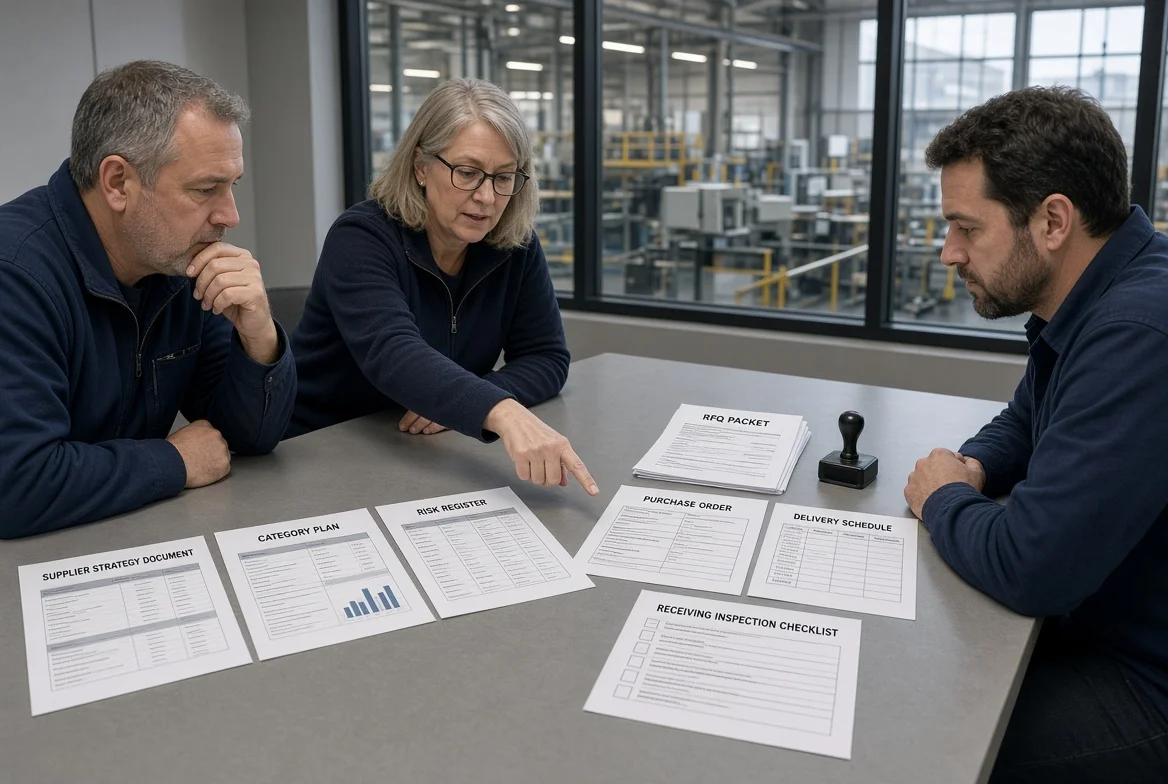
How Procurement Strategy and Process Work Together
A full example is dual sourcing of a critical material. The strategy stipulates that there must be two sources that are qualified. The process requires to identify, technically evaluate, approve and allocate volume, monitor and review alternative suppliers. If they are not listed, then “dual source” is a slide, and not a supply position.
The Rules Are Defined by Strategy
The rules for selecting suppliers, quotation requirements, priorities for categories, quality expectations, risk tolerance, terms of contract, threshold for approval, and measures of performance are defined through strategy.
This can lead to two approved suppliers being provided for a high-risk component. It can be compared on total landed cost instead of analysing on unit price. It can be a quality file prior to the release of any production order. Those are rules for strategy. They inform the process what it can do.
Process Applies the Rules
Those rules are built into the “working processes” of the day: approved supplier list, documented RFQ, technical sign-off, supplier scorecard, purchase-order approval, inspection record, and delivery review. That's how a vision becomes an actionable purchase.
A strategic procurement process is nothing more than a process whose steps reflect the strategy. Beware: When the strategy is quality-led, the workflow shouldn't be able to bypass the first-article approval process simply because someone is pressed for time.
Change is a process of feedback that improves strategy.
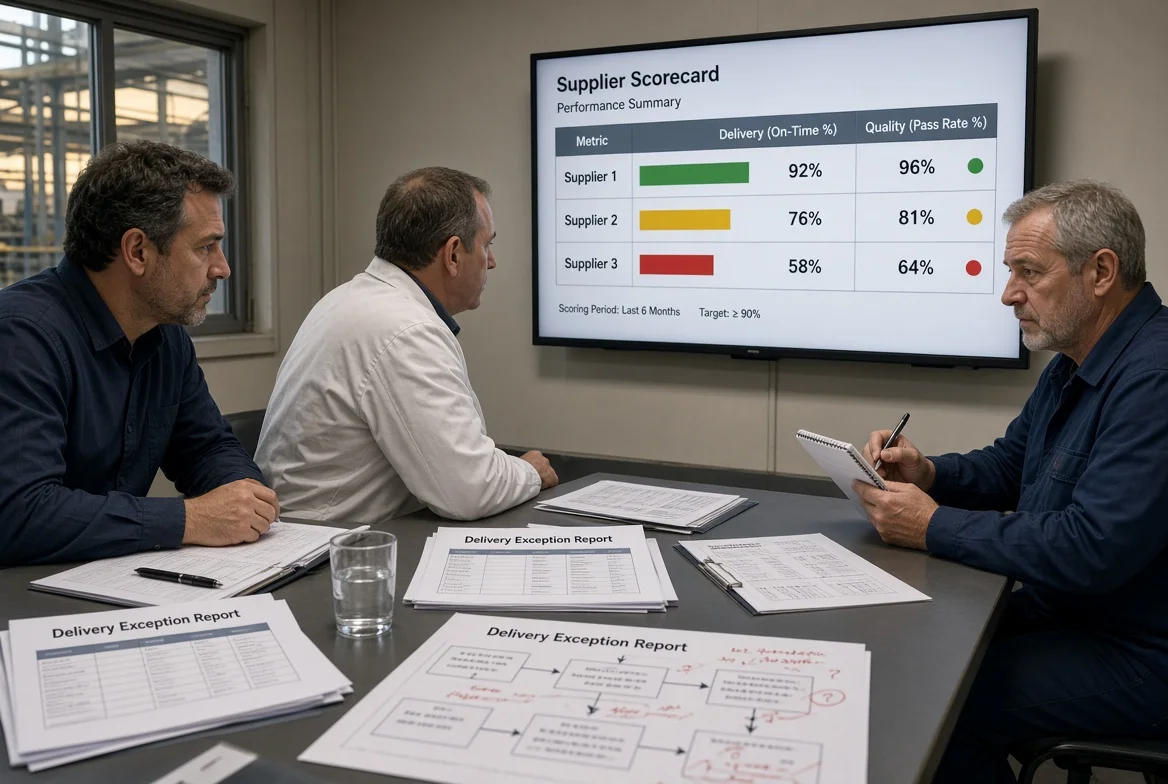
Data from the process should be used to change strategy. Signals include repeated late delivery, frequent changes to specification, emergency order, supplier defect, or invoice dispute. It could be an issue related to the supplier model, to the requirement, to the workflow or all three.
The useful loop is easy: make the purchase, measure the results, determine the root cause, tweak the strategy or process, and wait for the next cycle. The writing of the category document is not the end of the procurement planning.
Practical Example: Sourcing a Production-Critical Component
At the strategy layer, the same purchase is different from the process layer. The following is a common manufacturing environment; a part in which a down stream assembly line can cease operation if it comes late or is out of specification.
The Strategic Procurement Decisions
First, the company makes a decision about the value of the part to the company. If there is quality failure, assembly can be stopped. Qualification takes time. Stable supply is required for customer delivery. When you are choosing a supplier, you have to consider them beyond their price, and the technical support they can offer is a factor.
The strategy that follows can involve "dual sourcing," fixed technical specifications, capacity checks, quality documentation, an extended commercial contract, and periodic supplier performance review. These decisions are taken before asking for a quotation.
The Procurement Process Steps
The process then executes those choices:
- Internal requirement and specification confirmation
- Supplier identification against the approved model
- RFQ issuance with quality and capacity questions, not price alone
- Technical and commercial evaluation
- Sample or first-article approval
- Supplier approval and contract or purchase order
- Production and delivery monitoring
- Incoming inspection, receiving, invoice matching
- Performance recording for the next review
The checklist is not generic. The component’s risk is what adds first-article approval, capacity checks, and dual-source allocation. A stationery order would not need those steps.
What Happens When One Layer Is Missing
Strong process, weak strategy: the team issues clean RFQs and accurate purchase orders, then selects on unit price with no continuity plan. Orders move quickly. The line still stops when that supplier has a quality or capacity problem.
Strong strategy, weak process: leadership agrees to dual-source and require quality approval, then no one finishes qualification, documents the approval, or tracks actual delivery. The strategy exists on paper. Daily buying still behaves like single-source, price-led purchasing.
Both failures are common. One is not better than the other.
Common Procurement Problems Caused by Confusing Strategy and Process
The majority of the confusion occurs as documentation or measurement issues. The labels under each item are diagnostic, not theoretical.
Establishing a Procurement Strategy and using a PP instead of it.
A procedure may outline the process for requesting quotations and approval of an order. This does not determine who or what to prioritize for suppliers, categories or risks. When documentation does not provide any rationale for dual-sourcing or quality evidence, then the team has a process, not a strategy.
The creation of strategy without operational ownership.
There is no one who owns supplier reviews, risk controls, category plans, quality requirements and performance measures, a strategy that fails. Include an owner, a date for the objective to be completed, an approval authority and a review date for each objective. Unowned strategy is converted to a presentation.
Following a common method when buying.
The intensity of the evaluation doesn't have to be the same for low risk consumables, custom OEM parts, capital equipment and regulated products. A one-size workflow slows down simple workflow and high impact workflow. Risk and value-based tiers ensure control where it's needed.
Business results are the most critical measure, but they are not measured.
The advantage of short RFQ cycles, quick approvals and heavy purchase-order volume is only beneficial if the supplier provides quality, on-time supply and an acceptable total cost. But a quick process of continually selecting suppliers that lead to defects and expedited freight isn't good procurement.
Not updating the process when there is a change in the strategy.
Workflow changes must be matched with a new sourcing strategy. Dual-source, stronger qualification or better traceability makes no sense unless there is a change in the documents, approval steps, and records of the suppliers. Check through the process whenever strategy changes, supplier failures, product launches or expansion.
How to Improve Procurement Strategy and Process Together
Begin at the point of pain. Do not rebuild simultaneously ALL categories.
Conduct a review of Current Purchasing Categories and Risks.
Determine high value, high risk, production critical, technically challenging, or single-source categories. Typical red flags are: long lead times, poor quality, emergency freight, and one supplier-dependence. The first strategic review and tightest process control go to those categories.
Write down the Strategic Objectives.
Form specific goals for the chosen category: lower total cost, increase delivery reliability, qualify a backup supplier, lower defects, or increase the contract coverage. Each objective should have an outcome that can be measured and an owner.
Map the Procurement Workflow and Improve it.
Write the steps not the official diagram. Search for missing information, duplicate approvals, unchecked exceptions and inconsistent supplier records. Next, link the flow to the goal. The quality-led category should be subject to technical approval and inspection requirements prior to a release of the purchase order.
Set up Supplier and Performance Controls
Scorecards, review schedules, corrective-action routes, capacity checks, approved supplier lists, and risk registers are the links between strategy and process. Keep them proportionate. Staff often circumvent controls that are not controls.
Check Results and make adjustments
Leverage existing data: total cost, delivery, quality, cycle time, emergency purchase, inventory, supplier concentration and complaints from stakeholders. Revisit regularly and following failures, market changes, product changes and supplier changes.
Summary Guidance – Strategy Sets Direction and Process Delivers It
Procurement strategy or procurement process is not a dichotomy of planning and paperwork. Strategy provides a long-term direction and priorities for buying. Process is the series of repeatable steps that creates completed and controlled transactions from those priorities. A firm that makes only strategy will not affect the order taking process. Even a company that cuts the time of the work can purchase from the wrong suppliers.
Take some simple action: select one important purchasing category, identify some strategic goals, draw the current purchasing process, identify gaps, assign owners, and determine a few KPIs, and then watch and see if daily purchasing is achieving the desired outcomes. If you need to have a plan to set those goals, then use a procurement strategy framework. If the gap is how planning becomes a working buying cycle, review the procurement planning process.