
Many buying teams make the distinction between procurement strategy and strategic sourcing. Procurement strategy is the overall approach to procurement that covers the areas of cost, quality, delivery, supplier relations, risk and compliance. Strategic sourcing is a structured process that goes over the following steps: examining the category, researching the supply market, evaluating suppliers, and selecting a sourcing model and negotiating the overall sourcing result.
A manufacturer can establish a policy on continuity of supply, control of quality, total-cost management and minimised single-source risk. Then a strategic-sourcing project is implemented to source one component family, qualify factories, send an RFQ, confirm capacity, and even establish dual sourcing. One key element of the strategy is sourcing. It is not meant to replace governance, performance reviews, contract control or day to day purchasing discipline.
What is Procurement Strategy?
A procurement strategy is a long-term plan to acquire goods and services that is designed to address the business' cost, quality, delivery, supplier, risk, compliance, and growth objectives. It is located above individual RFQs. It can address the entire purchasing process, multiple spend categories, supplier relationships, purchasing processes, and the measurement of performance.
When you are dependent on the machines, the packaging, and imported electronics to your factory, the approach is not “get 3 quotes.” It's a choice on which elements of the procurement should be protected: production uptime, acceptable quality, working capital, approved supplier lists, and the amount of supplier concentration the business can endure.
The Scope of Procurement Strategy
Business objectives, spend priorities, category management, supplier segmentation, sourcing models, quality controls, risk management, procurement governance, supplier performance and procurement KPIs are all elements of procurement strategy.
In practice that often spans:
- Direct materials and custom OEM parts
- Packaging and printed components
- Logistics and inbound freight
- MRO, tools, and spare parts
- Services such as plating, coating, or contract assembly
- Capital equipment and tooling ownership
A company that treats packaging as a commodity and a production-critical seal as a risk item will not manage those two categories the same way. The strategy is what tells buyers which rules apply.
Questions Procurement Strategy Should Answer
A usable procurement strategy answers questions that sit above any one supplier:
- What should procurement prioritize this year?
- Which categories create the most value or the most risk?
- How should suppliers be grouped and managed?
- What level of cost, quality, delivery reliability, and supply risk is acceptable?
- How will procurement performance be measured?
A mid-volume manufacturer of industrial assemblies often feels this tension in one line item. A cheaper imported housing can look attractive on unit price. If the part is unique, the MOQ is high, and there is no second tool, a late shipment can stop the line. The strategy has to say whether lowest purchase price or supply continuity comes first.

What Is Strategic Sourcing?
Strategic Sourcing is a systematic, data-driven process that involves examining a purchase category and identifying the supplier, sourcing strategy and commercial structure to be used to provide that category. The key elements of strategic sourcing in procurement usually involve spend analysis, requirement review, supply-market research, supplier identification, preparing a request for quotation (RFQ) or a request for proposal (RFP), evaluating suppliers, negotiating, awarding the contract, and implementing.
It is a category work involving a decision point and a start. Not all of the purchasing operating system.
The Main Purpose of Strategic Sourcing
The purpose is to improve the overall result of a particular category or sourcing project. This could be reduced cost of ownership, quality, delivery, supplier capabilities, reduced risk, engineering support, or commercial terms.
It does not necessarily involve a price auction. In a custom OEM bracket, injection-molded enclosure, or imported industrial sensor, the team will often spend more time over the last two cents of unit price as they figure out where to own the tooling, how to get the process to run, how to get the samples approved, how many units to produce, and how to document the quality of the product than they will spend on the last two cents of unit price.
The Typical Strategic Sourcing Process
A typical strategic sourcing process looks like this:
- Define the business requirement and specifications.
- Analyze current spend, volumes, and supplier performance.
- Assess the supply market and available capacity.
- Identify and qualify potential suppliers.
- Issue consistent RFQ or RFP documents.
- Evaluate commercial and technical responses.
- Negotiate or select suppliers.
- Award the business.
- Implement the change.
- Measure post-award results.
Take an imported stamped metal part used on a production line. The quotation stage can be finished in a few weeks. Supplier qualification, first-article approval, packaging tests, and a safe production transition can take months. If the team treats the RFQ as the finish line, the factory often discovers capacity or quality gaps after the first live order.

Procurement Strategy vs Strategic Sourcing: Key Differences
The main difference between procurement strategy and strategic sourcing is that of altitude. Procurement strategy is a procedure in how the business will be run in relation to purchasing and suppliers. Strategic sourcing is a targeted approach to a single category and/or a single supplier decision.
The two overlap. Both include spend analysis, supplier evaluation and total-cost work. They're still not in the same position.
Difference in Scope
Procurement strategy may be for the entire procurement function or for several categories. Typically, strategic sourcing is targeted at a single category, spend pocket, project, or supplier decision.
It may also be determined at company strategy level that no production critical item is to be single sourced without a documented backup. Then, a sourcing project can use that rule in the corrugated packaging project, or in a project for a machined shaft, by mapping the market, qualifying two plants, and splitting volume.
Difference in Time Horizon
Typically, procurement strategy is conducted on an annual timeframe, multi-year timeframe, or based on the product life cycle. Often strategic sourcing is structured as a project: initiation and evaluation, award, implementation, and review. The relationship with the supplier thereafter can be of several years' duration. It's not “short and long.” It is because a lot of sourcing work is typically geared around a specific event or category.
Difference in Main Objective
Procurement strategy is aligned with business objectives: Resilience, Compliance, Working capital control, Supplier development, Quality stability. A sourcing project aims at finding the best solution for the market of a sourcing need: either qualified suppliers or a dual-source model, or lower total landed cost or better commercial terms for that category.
Difference in Core Activities
Procurement strategy cover governance, policies, supplier segmentation, performance management, supplier risk monitoring, category priorities and improvement planning. Strategic sourcing focuses on spend analysis, market research, RFQs, supplier evaluation & negotiation, supplier selection & implementation.
More than half of the overlap exists. Both require objective cost evaluation and a thorough understanding of the supplier's capacity. The boundaries are set by strategy. Does the category fit within the confines?
Difference in Deliverables
The procurement strategy can result in a roadmap, a category list, a supplier-management model, a risk framework, KPIs and governance rules. Results of strategic sourcing can include a category analysis, an RFQ package, shortlist of suppliers, evaluation matrix, negotiation plan, award recommendation, contract, and implementation plan.
The sourcing results should be aligned with the strategy. The approach should communicate with the sourcing team what is required and what is not required.
Difference in Ownership and Participants
Typically, procurement strategy is determined by procurement leadership, executives, finance, operations, engineering, quality and supply-chain leaders. The number of people included in strategic sourcing more frequently includes category managers, buyers, technical stakeholders, quality, finance, legal, logistics, and short listed suppliers.
If the drawing and material spec is an OEM plastic housing, then the engineering owns it. Incoming inspection and PPAP-type evidence belong to the Quality. The change over window is owned by the production. The commercial structure belongs to the procurement. Those individuals, if not in the same room, look like a clean award on paper and do not perform on the line.
A measurement that reveals the distinction between different performances.
The metrics of Procurement Strategy include total procurement value, supply resilience, supplier performance, category results, risk reduction, contract compliance, and contribution to the business. The metrics used to measure Strategic Sourcing are: Total Cost Improvement, Award Implementation, Delivery After Go Live, Supplier Qualification Quality, and Category Results.
Avoid awarding a sourcing project solely on negotiated unit price. If they agree to pay less and you would have to keep paying freight, scrap, extra inventory or the capacity is not stable, then it is not a saving.
Dimension | Procurement Strategy | Strategic Sourcing |
|---|---|---|
Scope | Broad direction for procurement and supplier management | Focused approach for a category, spend area, or sourcing project |
Main purpose | Align procurement with business goals and manage long-term value | Select the best suppliers and sourcing model for a defined requirement |
Time horizon | Annual, multi-year, or product-lifecycle planning | Defined sourcing project plus post-award supplier management |
Core activities | Governance, risk, supplier management, KPIs, category priorities, process improvement | Spend analysis, market research, RFQ, supplier evaluation, negotiation, award |
Typical outputs | Procurement roadmap, policies, supplier model, risk plan, KPI framework | Supplier shortlist, evaluation matrix, negotiation plan, award, contract |
Main question | How should the business manage procurement overall? | Which suppliers and commercial model best fit this category? |
Success measures | Total value, resilience, performance, compliance, business alignment | Total-cost improvement, qualified suppliers, award quality, implementation results |
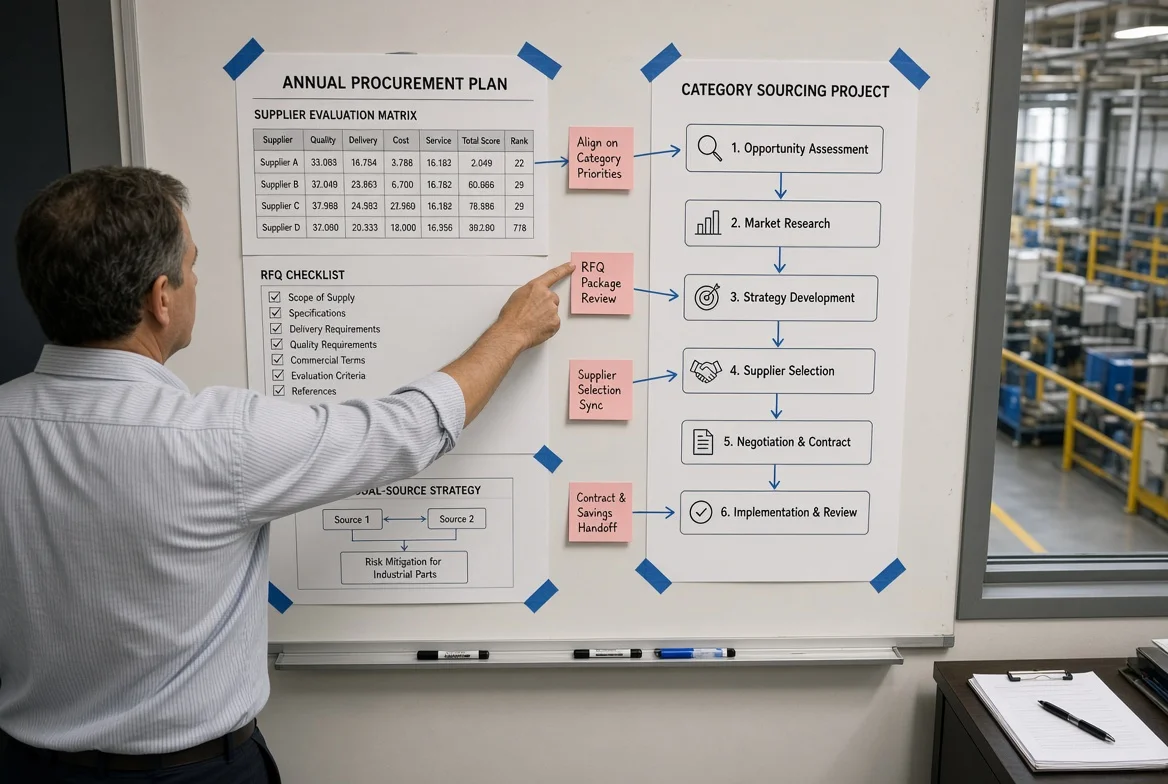
How Procurement Strategy and Strategic Sourcing Work Together
Procurement strategy and strategic sourcing go in tandem and not against one another. The strategy establishes context, priorities and constraints. Those priorities translate into supplier-market decisions and category actions with strategic sourcing.
A practical pattern: continuity and quality are highlighted as company names. The sourcing team then incorporates those priorities into the requirement, the RFQ, the scoring model, the dual-source decision and supplier-performance clauses.
Defining priorities for procurement is achieved by using Procurement Strategy.
The strategy determines which categories are prioritized and what “good” means. Typically, they will become important if they are high spend, supply risk, weak quality, long lead times, thin competition, or have a direct impact on production.
Otherwise, a team may waste weeks on a lower value office-supply contract while a single-source electronic module waits for a backup manufacturing plant.
The Strategic Sourcing makes decisions about the category level.
Strategic sourcing is used for one category and is based on the general guidelines. The work involves market research, supplier qualification, development of RFQ, cost analysis, technical review, negotiation, supplier selection and implementation.
If it is a custom part made of aluminum, that's more than a price sheet. The team needs to consider tooling, material grades, machine capacity, sample approval, quality records, and realistic delivery windows. It is not a fit even if the supplier can only maintain tolerance at the unit.
Increase the effectiveness of the Procurement Strategy by sourcing Results.
Strategy inputs include quotations, capacity comments, lead-time information, cost breakdowns, and actual supplier performance. They need to revise their category plans, segmentation of suppliers, risk lists, and the next generation of sourcing criteria.
The benefit cycle is straightforward: establish direction, run sourcing, make supplier choice, monitor live performance, and then make adjustments to the plan.

Strategic Sourcing Example for a Manufacturing Category
The following is a generalised example of a customised corrugated box for finished goods exiting a plant. No company name. No assumed savings figure. This is true for electronic components, machined parts or contract manufacturing.
The Category Direction is established in the Procurement Strategy.
The overall approach can be: minimize overall landed cost, defend shipment dates, improve packaging, minimize single source exposure, and provide better visibility of supplier capacity.
Until they fail, packages appear to be normal. Delays to customer deliveries can result from a weak board grade, late cartons or an MOQ that results in being stocked with more than is needed. When the owner of one converter is also the owner of the die and print plates, it's a business issue, not a purchasing inconvenience if there's a fire, a quality hold, or a capacity crunch.
The Strategic Sourcing Analyzes the Category.
The sourcing team analyses the following parameters at present spend: Specifications, demand by SKU, on-time performance, claims, inbound logistics, print and die capability, MOQ, lead time, and market capacity.
The analysis makes the decision on who is invited. If a converter does not have the appropriate board grades and/or print registration, he should not be given the same RFQ as a qualified plant. The RFQ should contain the board specs, tooling ownership, sample lead time, capacity per month, quality process and landed cost elements, rather than just a unit price.
Selecting and implementing suppliers.
The price, total cost, quality history, capacity, delivery, technical support, communication and risk are all compared between suppliers. Sample cartons are tested. The team goes to the plant, if necessary. The terms of the contract include change control, ownership of tools and recovery in the event of a ship failure.
This is not a completed project at award. The new converter needs to be onboarded, artwork and dies to be transferred, or remade, first production lots to be checked, and purchase orders to be moved without emptying the warehouse. Once live, the supplier is checked on the same strategy that initially selected him/her: cost, continuity and quality.
When a Business Needs Procurement Strategy, Strategic Sourcing, or Both
The appropriate course of action is different for each problem. Some firms don't have a purchasing-way. There are some that are obviously directed and have a missing category. Many have both.
There are times when procurement strategy is the priority.
A wider strategy review is required if there are no agreed objectives, no supplier governance, no category ranking, no risk rules, no measures of performance, and no cross functional alignment when purchasing.
Common symptoms include: out-of-control growth, all purchases through contacts, too many similar suppliers, frequent shortages, lack of spend visibility or lack of an approved-supplier management structure.
Strategic Sourcing Is the Priority
When spend is already high, supplier performance is low, there is a lack of competition, stale pricing, too much risk, or a need for new capacity, the better first step is a sourcing project.
Common scenarios: re-sourcing packaging materials, securing a second electronics supplier, consolidating freight vendors or shifting a component off of one tool.
In the event that both are necessary.
They are both required when a category problem produces a greater gap. A team begins by stating that this part is too expensive and then identifies varying drawings, no supplier scorecard, a single source, and no one with ownership of the quality spec.
If so, then an RFQ by itself will not participate. However the company has yet to establish rules for the people who can purchase, how suppliers are evaluated and what follows when they are awarded.
Common Mistakes When Confusing Procurement Strategy and Strategic Sourcing
It's not just a language issue when you combine the two terms. It results in the incorrect work.
When purchasing parts for their products, businesses are required to follow a strategy.
The price negotiation and running of RFQs do not include purchasing governance, risk monitoring, process control or purchasing improvement after the award. Once the business is selected, it must have a contract, need to be reviewed, corrective action taken, and a plan for next sourcing cycle.
The absence of a broad strategy in the face of an existing and active category level action
A plan that remains on a slide deck does not alter a supplier. Convert priorities into a short list of category projects with an owner, a date, an expected outcome, and a review point.
Making suppliers selection based solely on negotiated price
It can result in late delivery, low quality, low capacity, additional freight, or an unstable supplier. Analyse total cost, technical capability, quality, delivery, supply risk, commercial terms and work required to implement the change.
Ignoring Implementation After Supplier Award
Selection/decision making is a compromise. There are still the normal activities of onboarding, quality approval, contract execution, order transition, tooling or sample sign-off, and live monitoring. A supplier can get the win and then be unable to supply for the first production week due to lack of capacity or specification information.
Instead of using Sourcing Results as strategic data.
Quotes, market feedback, capacity notes, lead times, cost breakdowns and performance data should not live in your email folder, they should be the next strategy. Reflect market realities in category plans, supplier segments, risk registers and negotiation assumptions.
How to Improve Procurement Strategy Through Strategic Sourcing
If well selected and closed, sourcing projects can help to narrow down the wider function.
Identify High-Impact Categories
Organize categories by spend, risk, business criticality, supplier concentration, quality issues, delivery quality, or achievable improvement. Begin at the point at which a better supplier choice will impact cost, continuity, product quality or customer commitments.
Outline the desired outcome and a business case.
State the problem before contacting a supplier. Potential results include: reduced total expenses, improved delivery, enhanced qualified capacity, reduced defects, cleaner specification or contingency source. “Find a better supplier” is NOT a brief.
Develop a Regular Evaluation System for Suppliers.
Establish technical, quality, commercial, delivery, capacity, compliance and risk criteria prior to the receipt of responses. Weighted scores are helpful but a high score must not outweigh a significant capability or continuity deficit.
Put the Sourcing Decision into effect and review it.
Utilize a contract, a purchase order transition plan, supplier onboarding, sample approval, incoming quality checks, delivery tracking, and scheduled performance reviews. Value is only added by strategic sourcing if the supplier awarded is actually used in operations.
Summary Guidance – Procurement Strategy Sets Direction, Strategic Sourcing Delivers Category Results
The main advantage of understanding procurement strategy versus strategic sourcing is to think of one as direction and the other as as category execution. A procurement strategy is the high level policy for the creation of business value through purchasing. Strategic sourcing is the process used to research the category, assess suppliers, leverage value and establish a sourcing arrangement.
Discuss the real problem. If there are no priorities, no governance, no performance system, then begin with strategy. If one is expensive, risky or under-served, then conduct a sourcing project. If they both apply, don't assume that an RFQ can solve the operating problem. First establish the direction and then source for a defined category result.