
Procurement planning is the systematic approach a business takes to determining its needs, defining the requirements, estimating quantities and timings, assigning budget, determining the sourcing method, coordinating suppliers and managing risk prior to the release of an order. It's not a shopping list. It's what transforms demand, specifications, cash constraints, and supplier reality into a plan you can buy, before you've had a chance to compare.
An excuse to wait until the very last minute to remember to order a long-lead custom part is usually quadruple the price of the part, plus expedited freight, not having to pay overtime and late day hire to workers, and having to pick up the part and store it in a customer's warehouse. Planning makes those decisions in advance, before capacity is secured and alternatives remain.
What Is the Procurement Planning Process?
The procurement planning process is a series of activities that is carried out to identify the required procurement item, its timing, how to source it, which supplier(s) it can be obtained from, budget and purchasing controls, and the method of monitoring the performance of the purchasing process.
Planning needs to occur prior to the need for urgent purchasing. It can be one project, new product release, production run, annual purchase cycle, or a whole product line of goods or services. The level of detail should be commensurate with the value, complexity, and risk of the buy, not a template used for all requisitions.
Procurement Planning vs Procurement Strategy
Procurement strategy establishes long term direction: category priorities, make or buy principles, preferred supplier models, dual sourcing rules and risk appetite. Procurement planning is the process of turning that direction into specific items, quantities, dates, owners, budgets and actions.
A strategy can involve both sourcing from two different suppliers for one critical component. The plan specifies the part, approved suppliers, qualification window, split of volume, delivery dates, and cash required to make dual sourcing a reality. If that translation is not available, the strategy remains a slide.
Procurement Planning Process vs Procurement Purchasing Process
The procurement planning precedes and surrounds the procurement execution. The purchasing process is the journey of a purchase through purchase requisition, request for quotation, purchase order, receiving, invoice match, and payment.
Planning determines how much is needed, when, how to approach the suppliers and how much it will cost. Buys and then sends an approved order and completes the loop. It's a typical cause of late purchases to mix the two together. The teams prepare RFQs before the specification is finalized, or make purchase orders before the lead time, inspection and cash timing are verified.
Why Procurement Planning Matters to Business Operations
Poor planning is evident on the shop floor and on the cash statement simultaneously. Emergency buys, premium freight, disputed quality, excess stock, obsolete material, downtime and missed launch dates are typically planning failures and not “supplier problems” by itself.
Preventing stock outs and production delays
If the supplier ships the item, then it is not useful. It is helpful when it has passed inspection, documentation and warehouse release and is ready for the next production stage. This includes supplier lead time, processing, inspection, transportation, customs and production calendar.
When the transit or factory loading of the imported resin, custom machined housing or printed packaging with a new artwork cycle is not guaranteed, buffers are required. If a supplier promises 8 weeks, and customs and incoming inspection require an additional 10 days, it means that if you order at week 8, by that time you're already going to be late.
Capacity to manage inventory and cash flow.
The same weak plan can lead to shortages and to a collection of unused stock. There are many reasons for over-order, including an inaccurate forecast, a minimum order quantity that is too high, a fear of an impending shortage, or a lack of communication between procurement and production.
Useful planning questions are practical: What did we really eat? What is on hand and allocated? What are the existing open purchase orders or in-transit orders? What amount of safety stock is warranted? What is the reorder point of the system? What is the supplier minimum order quantity and shelf-life? What changes will be happening to the product? What is the additional inventory cost of holding this extra inventory?
Improving Supplier Coordination
By having a clear plan, suppliers are able to see volumes, delivery window, technical requirements, and production priorities. That enables them to free up capacity, make their own materials, and identify risk early on.
Typical tools include forecast sharing, blanket orders, scheduled releases, capacity confirmation, and milestone tracking. A forecast is not an actual sales order until the commercial terms state so. If you consider the forecast a firm order and the supplier a wish, the question of cancellation, storage, and remaining material will be discussed later.
Supporting Cross-Functional Decision-Making
The sell is frequently influenced by facts that production, engineering, quality, finances, logistics, sales, and management may have in their possession and that differ from the facts that the sales person has. There could be a cash-flow constraint in Finance. A drawing can be modified by engineering. There may be additional testing if the quality is required. The sequence of builds may be changed in the production process.
If these facts come after the purchase order is issued, you pay in change orders, scrap and delay. Those inputs come together in the plan before anyone sends an order.

Key Inputs Required for Procurement Planning
The inputs determine how to make a procurement plan. The absence of information, or outdated information, results in a pretty schedule which breaks on the first contact with the factory.
The following is not a ‘no-fail' universal checklist. A low risk MRO part requires less depth than a custom OEM part that requires tools, certifications, and a long import path.
Use known demand: production volumes, milestones, customer orders, seasonality, and consumption data. Changing the plan should be based on demand confidence.
Firm customer orders enable firmer commitments from suppliers and a narrower delivery window. Uncertain market forecasts call for later order points, more flexible contracts, smaller initial releases or high safety stocks only when stockout is costly. Record the assumption. If the weather changes, the amount and time should change.
We also provide product specifications and quality requirements.
Plans should include an easily understood description: drawings, specification of material grades, dimensions and tolerances, performance requirements, packaging standards, inspection criteria, certifications, and acceptance conditions.
Quotation spreads can't be compared when there is an incomplete specification for a custom part, an electronic component or OEM packaging. One supplier uses a different grade, another doesn't test, another supplier charges different carton spec. You then choose a price, and not a product.
Current Stock, Open Orders and Lead Times
Check stock on hand, allocated inventory, open purchase orders, in-transit, in-transit time, expected consumption, inventory inspection time, and logistics time before placing another order.
Without having consideration of what is already purchased or stored in the warehouse, orders that are placed from forecast only result in duplicate orders and cash locked in inventory. This often happens when reports of shortage are inaccurate or where two or more buyers have a requisition for the same SKU.
The budget, commercial constraints and approval requirements should be taken into account.
Planning should take into account available budget, payment terms, cash timing, purchase authority, duty exposure and capital versus operating rules, if applicable.
While it may be tempting to choose a lower price at a higher MOQ, the cost of the cash commitment and storage needs must be taken into account. The “saving,” if there is any, from the extra volume may be less than the carrying cost and the obsolescence risk.
The circumstances of the supplier's ability.
The plan includes capacity, production loading, availability of raw material, MOQ (Minimum Order Quantity), tooling, certifications, location and current market conditions. The historical lead time from last year's quotation might not be applicable when dealing with equipment downtime, holiday, peak season or material shortage. Confirm current capability. Don't create plans from a PDF that is more than a year old.
Steps in the Procurement Planning Process
These steps in the procurement planning process can be followed annually, on a product launch or for a single production requirement. For every step there is a job, a list of inputs, a list of people who need to be included and a mistake to avoid.
STEP 1: Identifying and validating the requirement.
Verify the business needs: quantity, timing, specification, quality, application, package and documents. Never purchase from a complete internal request.
If the drawing is changed, or the old supplier has been replaced or the end use has changed, then the material used previously is not a specification. Check with the user, engineering, and quality before working with suppliers.
Step 2: is the most fundamental part of the exercise.
Determine quantity based on forecast / production plan, stock on hand, open orders, safety stock, scrap / yield, MOQ and expected demand change. Distinguish between firm and uncertain forecast demand.
Document the assumptions. The plan should be able to shift without scrambling if yields improve, a customer order is missed or a design change reduces the quantity use.
STEP 3: Decide on the Procurement Method.
Match the approach to the value, risk, complexity, urgency and nature of the supplier market. This can be achieved by way of a competitive RFQ, negotiated order with approved supplier, a framework/blanket order with scheduled release, direct award or emergency purchase with written justification.
There is no one-size-fits-all solution to competitive bidding. If a product is customized, and requires process development and sample approval, then supplier collaboration and qualification is needed and not a price-only shoot-out.
STEP 4: Research and Evaluate Potential Suppliers
Complete and thorough evaluation of capability, capacity, quality, delivery, pricing, compliance, communication, and operational stability that matches the risk.
Practical work comprises samples, factory information, certification, reference, equipment list, quality record, trial order, audit, and RFQ responses. A low-risk catalog item does not have to undergo the same review process as a production-critical custom part.
STEP 5: RFQ is created and quotations are compared.
An effective RFQ provides all suppliers with the same information regarding specifications, quantities, delivery terms, quality standards, packaging, inspection terms, payment due date, etc., as well as with a quotation life period.
Make comparisons, comparing like with like. Check if a price contains tooling, packaging, freight, taxes, inspection, samples and other costs before picking any one. A first article inspection-free, cheap unit price is not cheaper.
STEP 6: Create the Procurement Schedule and Budget
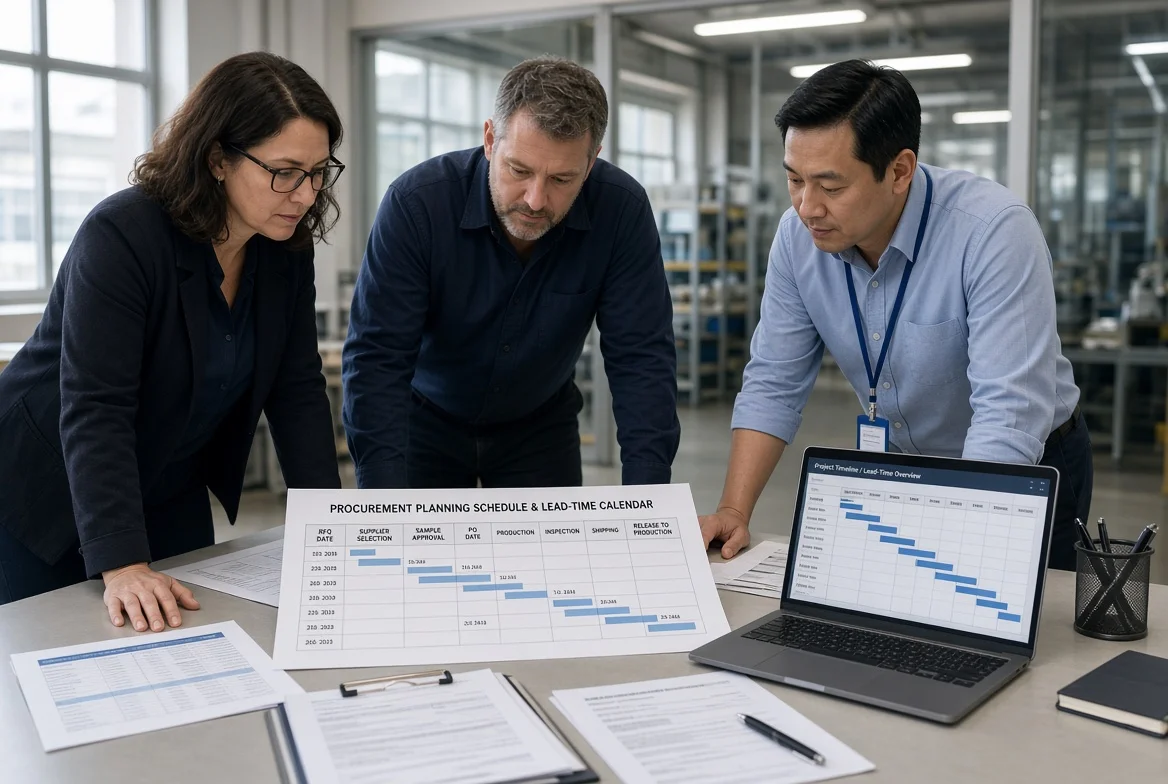
Work backwards from the date that it must be available to use. Requirements, RFQ, supplier selection date, sample/approval gate, purchase order date, production lead time, inspection, shipping, customs, receiving, and release-to-production should be listed on the schedule.
The budget should reflect the anticipated cost of the purchase plus freight/duties, tooling, testing, inspection, storage, and contingencies. A visible schedule is a delay that you see.
STEP 7: Approve the Plan and Assign Responsibilities
Review and approval must be proportionate to value and risk. The owner can be in any of the following positions: procurement, finance, engineering, quality, production, logistics, operations, and senior management.
Identify the owner of the plan, decision timelines, thresholds, supplier requirements, internal dependencies and escalation processes. If something is “everyone's job” then it is nobody's job.
Step 8: Make Purchases and Monitor Delivery.
Send out the purchase order or contract, verify suppliers' acceptance, monitor manufacturing, arrange inspections, arrange shipping and compare delivery with the requirement.
Some indicators are late order confirmation, delayed sample approval, raw material shortages at the supplier, changed production slot, missing documents or missing shipment milestones. The signals have value only when someone is there to see them.
STEP 9: Review Results and Update the Plan
Planning is not complete when it is received. Check actual cost, delivery, quality, quantity, supplier communication, inventory impact and planning accuracy.
Next time, please record the real lead time, quality problems, freight variance, forecast accuracy, impact of MOQ and the size of safety stock. If a plan is not updated then it is not a plan, it is a snapshot.
Procurement Planning in Manufacturing and Global Sourcing
In manufacturing, procurement planning needs to be based on the bill of material, production calendar, supplier capacity, technical approvals, inspection, logistics, and material availability. The idea is not to write a complete manufacturing strategy. The idea is that you don't want to buy something after it has been needed.
Matching Production Schedules With Procurement Plans
Count backwards from the desired production date. Add supplier production time, sample approval time, raw material preparation time at the factory, inspection, shipping, customs, receiving and factory internal release.
A common type of trap is a molded housing. In front of “production lead time” are “tooling” and “first-article approval” and “pre-shipment inspection.” It is not possible to determine the purchase-order date based on the factory cycle time alone.
Determine MOQ, Batch size and material availability.
MOQ and batch rules affect inventory, cash, storage and obsolescence risk. More expensive orders with lower units will lose to smaller orders with higher units, when the additional inventory will likely need to be redesigned or will expire.
This can be done in a number of practical ways such as scheduled releases, blanket orders, supplier-held inventory, consolidating demand across plants or SKUs, shared forecasting or a negotiated reduced MOQ if the volume story is there.
Defining and controlling Engineering changes and Quality Gates
You should include dates on the plan instead of adding them on as: sample approval, first-article inspection, testing, quality documents, engineering-change review.
In OEM work, a supplier can do what he/she wants to change material, process, tooling or package without asking. That change is removed from the customer's product through formal change control. If the plan does not contain a gate, the change is within a shipment.
Including International Logistics and Import Lead Time
Production, export documents, booking, transit, customs clearance, inspection, local delivery and receiving are all to be covered by the global plans. There's time added on because of port congestion, holidays, weather, paperwork and consolidation.
Don't take the supplier's “lead time” as door to door. Verify delivery condition and work out the time it takes before it is available for use.

Common Procurement Planning Mistakes
These failures can be reproduced. Each costs and has a fix.
The planning is done only from the required delivery date.
When ordering materials, the “looks like its needed” approach does not account for any of the following: material production, inspection, shipping, customs, receiving or material approval. If the lead time is not certain, add buffers, working backward from the production or customer date. Determine whether the milestones require active confirmation or hope that the original promise remains valid.
This is a problem that can be addressed by ignoring Existing Inventory and Open Purchase Orders.
If there is no common vision in the warehouse, production, procurement and finance, buyers reorder. If someone works from an old shortage report, a material on the water may be a second buy. Review inventory, commitments, in-transit, open POs and consumption.
To use Incomplete or Inconsistent Specifications
Incompleteness of dimensions, tolerances, grades, packaging, tests and acceptance standards make quotations uncomparable, causing quality disputes after the order. Only use one RFQ package. If an item is custom or critical, obtain technical approval prior to selecting a supplier.
Forecasts as Firm Orders
There is a difference between a forecast, a planned requirement, a purchase commitment and a confirmed order. An oversold soft forecast causes an excess of inventory. Unmet demands result from neglecting a credible forecast. Show forecast confidence, review assumptions and communicate what is reserved and what is produced to suppliers.
It is difficult to confirm the current capacity when selecting suppliers.
Past quotes and the on-time record from last year are no indicator to show this month's capacity. Lead time moves when new customers join, when there is downtime, when there are gaps in labour, when there are material shortages, during the holidays, and when there are changes to product mix. Before locking the plan, please verify current lead time, capacity, MOQ and schedule, and material availability.
The consequences of not including Quality and Inspection Time
When you arrive at the dock, it is not release to production! It takes time to inspect, test, read, sort, rework and approve documents received. Schedule those gates for technical, regulated, custom or line-critical goods.
Utilize procurement planning tools and documents.
The tools are significant because of the information they contain, not because of the software company involved. Spreadsheets are suitable for a small book of purchases. When volume, multi-plant demand and approval chains increase, ERP and procurement platforms come in handy.
Procurement Plan
Typically, a practical plan will include items/services, specification, quantity, requirement date, estimated cost, sourcing method, preferred suppliers, approval status, risk level, owner, and key milestone. Make sure to update it if there are any changes in requirements, capacity, dates, or budget.
A schedule and a lead time calendar are created for procurement.A procurement schedule and a lead time calendar are developed.
Working backwards from the desired date is the calendar: RFQ, Selection, Sample Approval, Order, Production, Inspection, Shipment, Customs, Receiving, Release. But supplier production time is just one part of the road.
Supplier Evaluation Scorecard
The scorecard is consistent across price, quality, technical, capacity, delivery, communication, compliance and risk. Weight the criteria to buy. A production-critical component is not an "office supply" and should not be scored as such.
A Risk Register and Contingency Plan should be prepared.
Write the problem, impact, likelihood, warning signs, owner and mitigation. Common causes are single-source dependence, long lead time, uncertainty of demand, capacity constraints, material shortages, shipping disruptions, quality risks and the lack of regulatory documentation.
The following information should be included in a RFQ package and in the purchase documentation:
All drawings, specs, quantities, delivery terms, quality control, packaging instructions, inspections plans, payment terms and change control rules should be identical for all bidders. You get differing quotes and then conflicts.
Procurement Planning KPIs and Review Methods
Procurement planning is evident in outcomes. A short set of measures that are tracked the same way every cycle is more useful than a long dashboard that no one looks at.
Plan accuracy and schedule performance
Monitor purchase-order timing, planned versus actual delivery, lead-time variance, adherence to schedule, forecast accuracy and percentage of purchase orders that are completed prior to the required date. These figures reflect the delay to the supplier, internal approvals, poor order, poor specification, and also unrealistic plan.
Cost and Budget Performance
Compare the planned purchase cost with the actual purchase cost, landed cost variance, unplanned freight, emergency-buy cost, MOQ-related inventory exposure, and budget adherence. The rest of the spend isn't reflected in the unit price.
Controlling quality and supplier performance.
Monitor defect detection rate, defective inspections, corrective-action response, on-time delivery, order accuracy and document completeness. Apply the findings to alter future allocation, safety stock and keeping suppliers on the plan.
Ensuring continuity of inventory and supply.
Count how often the stock runs out, how much the stock is in excess, how much of the stock is old, how many interruptions occur in production, how many emergencies arise, and how many critical items have a qualified backup. Those results should drive order timing, buffers, dual sourcing, sharing of forecasts and MOQ conversations.

Summary Guidance – Build Procurement Plans Before Problems Become Urgent
The procurement planning process links requirements, quantity, timing, specification, supplier, budget, logistics, quality, risk, owner and review. Strategy sets direction. The plan puts the next purchases into action.
Begin with the purchases that will likely impact production, customer delivery, cash or continuity. Check inventory and open orders. Confirm the requirement. Confirm up-to-date supplier capacity. Create a timeline not just factory cycle time, but inspection and logistics as well. Name an owner. Revise the plan as needed for changes in need, capacity, or design. That's buying strategy planning in the real world: less rush orders, less surprises, a firmer "need to delivery" path.