
A procurement strategy for manufacturing companies is a method by which a manufacturing plant purchases materials, components and services, which will then form the manufactured product, and keeps these purchases synchronized with the plant's production. It is not "Corporate Purchasing"-labelled. It's a hassle to receive a late office order. A late or out of spec production part halts the line, wastes labour and delays customers.
Manufacturing buyers are responsible for dealing with direct materials, supplier capacity, long lead times, MOQ, tooling, engineering changes, incoming quality and supply continuity. Those constraints are not included in a typical purchasing playbook. This guide explores what it is, what it's made of, how to create it and how to manage the cost, quality, delivery and risk without focusing solely on the unit price.
What Makes a Procurement Strategy for Manufacturing Companies Different?
Manufacturing procurement is linked with the bill of materials, manufacturing schedule and manufacturing product quality. When a BOM is generated on a purchase order, that may appear to be a good buy, but can result in a cost increase for the BOM, a work center having insufficient inventory, or a defect being passed to the assembly. The strategy needs to view suppliers as an integral part of the production system – not a list of suppliers.
Qualification cycles are extended. Lock-in is caused by tooling and engineering changes. The planning horizon a weekly MRP run can cover is often too short for lead times. Incoming Quality is NOT a warehouse issue, it's a process control issue which comes out on the line. These facts alter supplier selection, purchasing practices and the metrics used to gauge success.
Direct Materials, or Indirect Procurement?
The materials that are a direct part of the product: raw materials, components, packaging, and subassemblies. Everything else purchased indirectly includes MRO, office supplies, software, facilities and professional services. Both matter. They are not entitled to the same means.
A capacity check, quality documentation, first article approval and a continuity plan are all necessary to complete a capability review for a custom electronic component. A routine MRO product can just be stored on an approved product catalog with a reorder point. Theft by the same team of catalog buying rules comes at an extra cost to the plant because of quality escapes and shortage meetings.
Most of the design effort in a procurement strategy should be for direct materials. It's here that spend risk, quality risk and schedule risk focus. Catalogs, contracts and compliance rules can also be used to tighten indirect spend. It should not be a sole-source machined part by itself.
The link between procurement and production planning.
When procurement is not done in conjunction with MRP, production calendar and customer commitments, then you have two familiar issues to deal with: Run down stock and pallets of unused material between runs. Annual volume discounts sound good until the mix on the floor is different than what was ordered.
A concrete illustration: a purchaser brings a year's worth of fastener and housing demand together and he gets a price break. Then, a different product mix is produced for two months. Two SKUs are kept in stock. Another critical housing is short, the line waits for an expedite to be arranged. The unit price was less. The manufacturing cost was not reduced.
This fix is not “buy less.” It's to link releases to the schedule; forecast sharing, scheduled releases, blanket orders, buffers only on those items that actually halt the line. Both procurement and production planning must be based on the same picture of the demand.
BOM Cost and the Procurement Decision.
The BOM does not have Manufacturing cost on a single PO line. The lower cost item can result in machining, additional inspection, increased scrap or increased safety stock. The quotation is improved. The margin of the product.
Procurement should be on the cost drivers of the BOM, high-impact categories, process-sensitive parts and items that are subjected to a small price move that is overshadowed by quality and/or inventory costs. Even if it's informal, should-cost thinking will help. This isn't the challenge of “who quoted the lowest unit price?” It is “which source will yield the lowest overall manufacturing cost for the desired quality and delivery time?”
The key to BOM cost procurement is to think of the product, not the purchase order, as the unit of analysis.
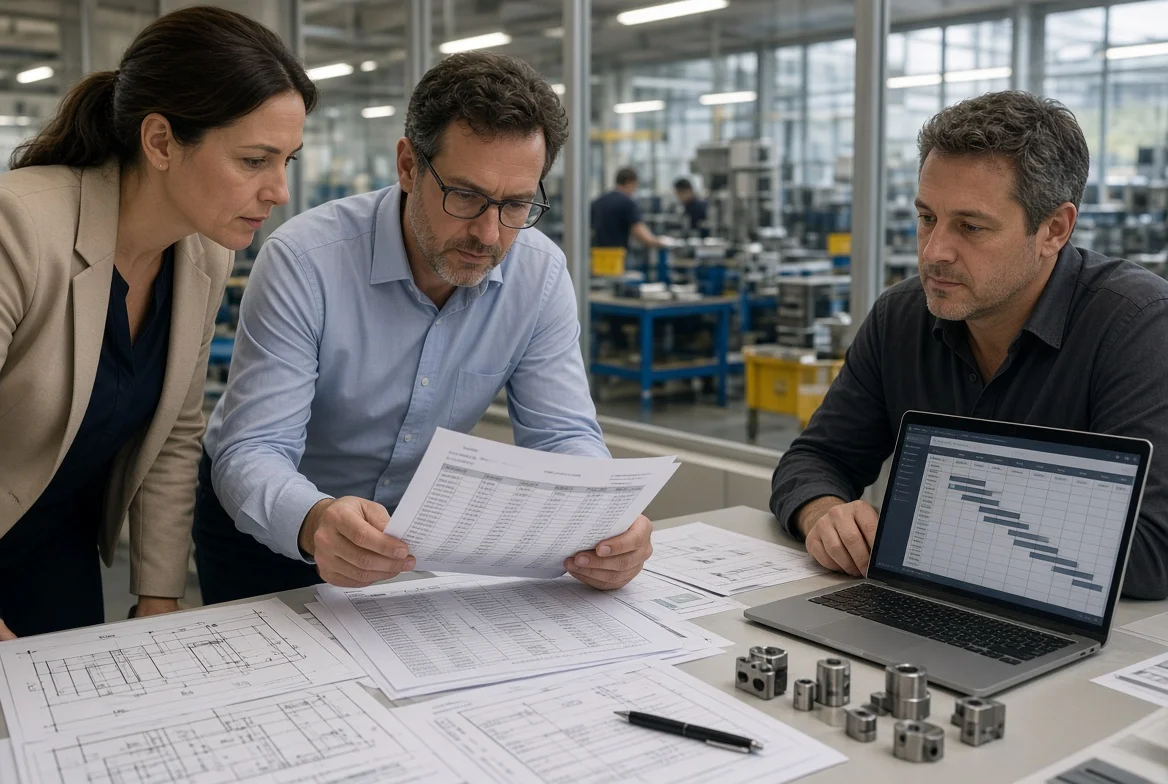
Key Components of a Manufacturing Procurement Strategy
A manufacturing procurement strategy is a collection of controls in place that link the capability of suppliers to the production need. The following components are all there for a reason – when they are not there, the plant risk comes to the fore.
Supplier qualification and technical approval.
Commercial checks are not sufficient, such as price, payment terms, company size etc. A supplier may be able to pass a credit check and not be able to produce because of poor process control, overstated capacity, or because the plant is not able to hold the drawing.
A useful qualification path usually includes:
- Process and equipment capability against the specification
- Capacity and workforce review for the intended volume
- Quality-system evaluation (documented control, not a certificate on the wall)
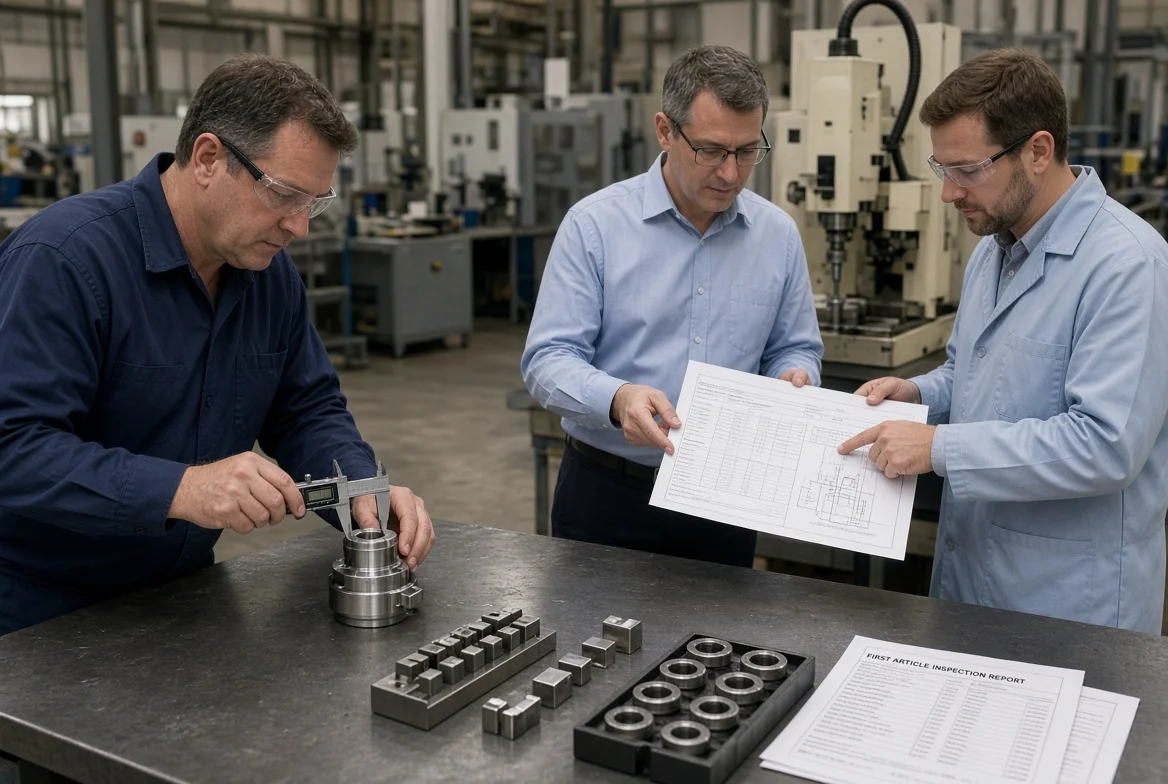
- Sample review and first-article inspection
- Trial production or process capability evidence
- Documentation: material certs, inspection records, change-control practice
- References from similar production work
First-article approval is the point where the drawing, the process, and the actual part are forced to agree. Skipping it to “save time” is how a first production lot becomes a quarantine lot.
Capacity and Production Continuity Planning with Suppliers
If you have a supplier who can produce 500 prototypes, that does not automatically mean that he can produce 20,000 production pieces on your calendar. Capacity reviews should consider equipment, shifts, skilled labour, access to raw materials and the way the supplier currently loads their schedule.
Make forecasts with the things that limit you! Hold inventory for long lead/custom items. Qualify a back-up before the primary source reaches its limit. A common failure mode is a supplier that supports development, and will not ramp. The manufacturer will then not be able to take a customer order since one part cannot be manufactured.
This is relationship language, not capacity management in manufacturing supplier management.
Quality Requirements and Incoming Material Control
Quality requirements should be in the sourcing decision and not after the first bad lot. State the specification, inspection criteria, acceptance standards, test report requirements and certificates of compliance prior to the award of the business. Ensure nonconformance handling and corrective action are incorporated into a supplier quality agreement, instead of creating a response path during a line stop.
Typical plant problem – parts are satisfactory when viewing, but unsatisfactory when measuring or performing function after they are staged for assembly. Production waits. Rework starts. Customer dates move. That doesn't happen by default through incoming inspection, sampling plans, and clear reject authority.
LTMS is the acronym for Lead-Time Management and Inventory Strategy.
Lead time is not just the quoted number of days to produce from the supplier. For an imported item, it contains the production, packing, ocean or air freight, customs, inbound transit, receiving, inspection and release to the floor costs. When any of those steps is not followed, the MRP date is fictional.
Balance order quantity, inventory holding cost and Risks of stock-outs. Utilize reorder points and scheduled releases for stable items. Order buffer items for critical, long-lead and sole-source parts. When there is the relationship plus the visibility of demand, the supplier held-inventory or consignment can be helpful. Avoid having to carry months of each SKU as one short-quarter was painful last time.
Commercial Terms and TOTL Cost
One of the inputs is "unit price. Total landed cost encompasses all costs associated with freight, duties, tooling amortization, packaging, inspection, payment terms, currency exposure, inventory carrying cost and cost of quality failures or downtime.
An overseas source may be more expensive than a domestic source after inventory, expedite risk, and quality recovery costs are included, if it is more expensive per piece, has a longer lead time and freight costs are higher. The opposite is also true of stable, high volume and well-defined products. The comparison should be exhaustive. The same concept, but applied to the total life of the part, including changeovers, tooling and failure cost.
Provide Risk Management and Business Continuity information.
Procurement risk management in manufacturing is concerned with things that could halt the plant from operating; single source parts, geographic concentration, tooling that only one shop can do, material shortages, supplier financial difficulty, and logistics disruption.
Practical controls include dual sourcing if the switching cost is warranted, before a crisis, there should be a qualification backup, safety stock for a few items that block production, approval of alternative materials with engineering, monitoring of suppliers, and a written escalation plan. Continuity planning is not a book! It is a qualified second source, a documented process and has adequate inventory to meet the turnaround time.
The process of engineering change and specification control.
Material substitution, process tweak, dimension shift, and different sub-tier source, or any other uncontrolled supplier change, can result in a quality failure that the buyer never “ordered.” Change-control procedures, controlled specifications, approved supplier lists and first-article re-qualification after a change are the defense.
One channel of communication between procurement, engineering, quality and the supplier. A drawing is a suggestion, not a contract, if the supplier can make the part change without a documented review.
How to Build a Manufacturing Procurement Strategy
Understand how to develop a manufacturing procurement strategy.
Do not attempt to redesign all categories at the same time. Begin with materials or suppliers that stop production or drive up the BOM cost the most. Grow with increasing data, processes and supplier relations.
Step 1: Analyze the Bill of Materials and identify Critical Categories.
Consider BOM, material spend, existing supplier requirements, quality history, delivery history, and stockout history. Improve the ranking of categories by the impact of the production, and not by dollars.
Prioritize:
- Direct materials that go into the product
- Production-critical components
- Long-lead items
- Sole-sourced parts
- High-defect or high-rework categories
- High-spend materials
Regularly-used items can be postponed. The first strategy cycle should target strategies that already lead to meetings.
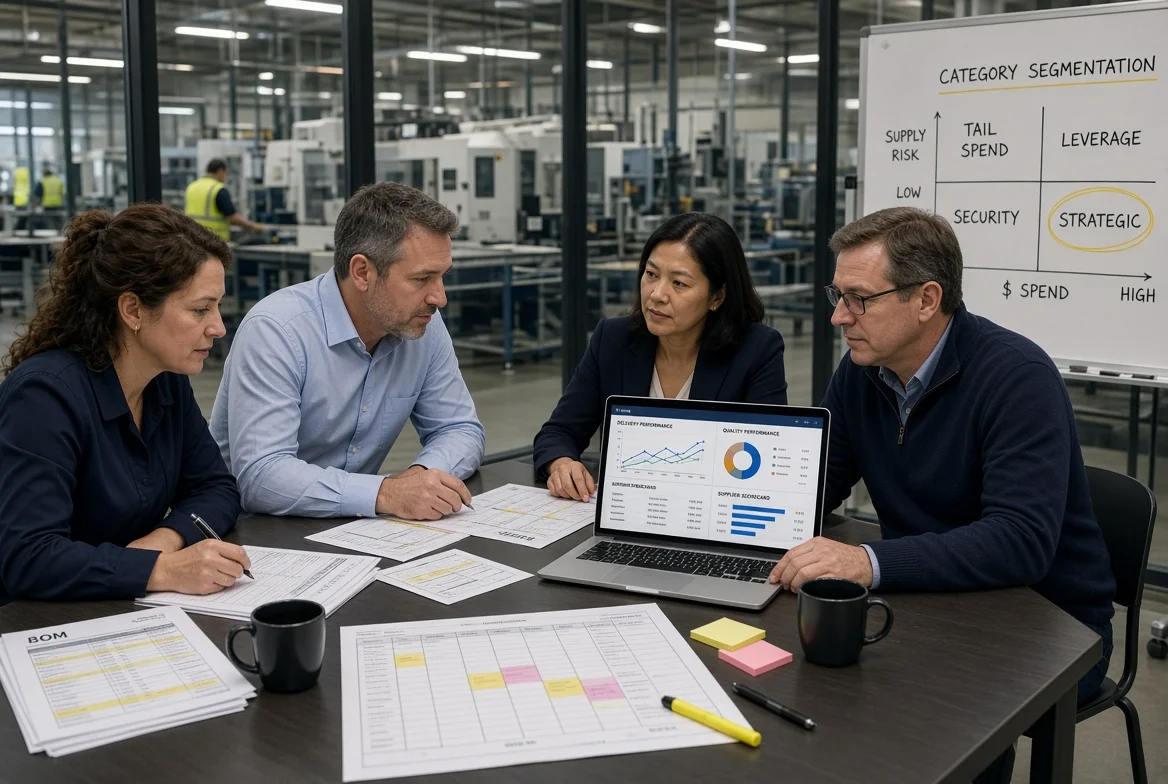
In Step 2, suppliers are prioritized based on their criticality and risk level.
Break down by production impact, spend, technical complexity, switching difficulty, quality history, concentration, and lead time exposure. Capacity reviews, quality agreements and continuity plan are needed for strategic and critical suppliers. Performance monitoring is required for approved suppliers. Transactional suppliers should have a clean catalog process.
The sole-source custom component supplier is not treated like one of five fastener suppliers. A “small” problem becomes a plant-wide problem when treated the same.
Step 3: Identify Supplier Qualification & Quality Requirements
Establish a uniform qualification plan: capability, quality system, samples, first-article, documentation and continuous monitoring. Match the depth of the fixture to its importance. A safety related or line critical part requires greater evidence than a regular consumable.
If the rules for qualification are different for the week buying party, the approved list becomes a wish list.
Step 4: Establish Sourcing Models for Each Category
Choose the model from the category, not from habit:
- Competitive bidding for standardized materials with multiple capable sources
- Strategic partnership for custom or technically critical parts
- Dual sourcing for high-risk sole-source items
- Global sourcing where cost, quality, and lead time still work after landed-cost analysis
- Local or regional sourcing where short lead time and responsiveness matter more than piece price
Evidence should drive the choice: supplier market, risk profile, tooling, and schedule—not a single quotation.
This should be based on evidence: supplier market, risk profile, tooling and schedule—not a single quotation.
Step 5: Synchronise Procurement to Production Planning & MRP
Relate to the schedule when purchasing. Apply MRP outputs, forecasts, reorder points, scheduled releases and blanket orders. Ensure capacity with critical suppliers before accepting a demand spike. Only build buffers where the risk is present.
A non-connected pattern is a procurement that buys to an annual forecast and production that produces a different mix, with some materials building up in inventory, others becoming short. Alignment is not a weekly kickoff meeting.
Step 6: Develop Performance Measurement and Supplier Reviews
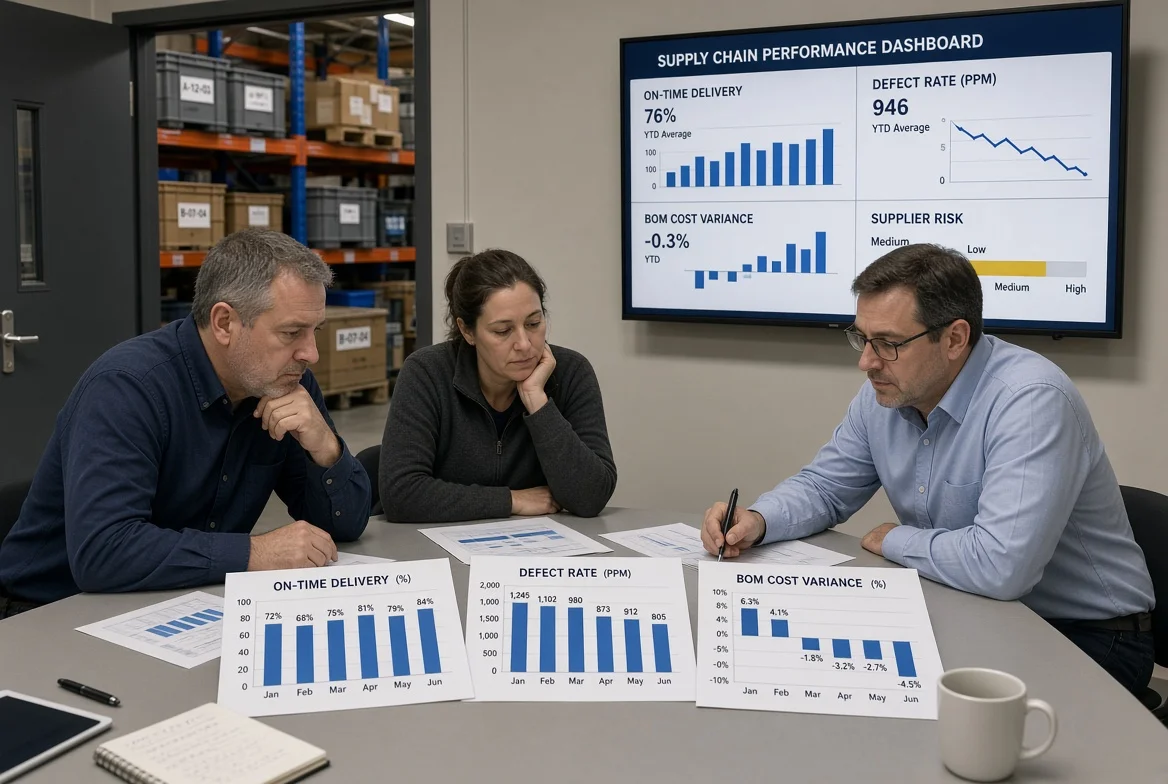
Establish and meet cadence reviews. Some helpful KPIs are on-time delivery, defect rate, lead-time variance, capacity response, corrective-action closure, price variance, and total landed cost. Increase frequency of review on strategic and critical suppliers.
Data can be used to create a new supplier, change sourcing model, or change the sourcing source. If the score card is not being used in a decision, it is not a score card, it's a report card.
Manufacturing Procurement Strategy for Direct Materials
The prime business of manufacturing procurement is to add or subtract value – and that's in Direct Material procurement. There is a different buying logic for each of raw materials, custom parts and packaging.
The procurement of raw materials and standard components
Use spend analysis, price benchmarking, volume consolidation and total cost comparison for standard industrial materials such as metals, plastics, electronic commodities, and fasteners. Monitor price fluctuations, allocation, product quality and supplier capability.
Competition only works when the specification is stable and it is realistic to switch. It breaks down when “standard” is just standard on paper – when the resin grade, steel spec or electronic date code is actually process-sensitive. Verify the specification and then compete!
Custom Parts & Components OEM
Custom molded, machined or assembled parts require tooling, technical approval, sample testing and supplier relationship. Determine who owns the tools & drawings. You don't "need" to protect intellectual property in an email, you need to do it in the contract. Design capacity for ramp up from prototype to production. Maintain the approved part by controlling engineering changes to the production part.
The supplier is usually part of the design support and process development. That is useful. It also makes switching more costly. Great, you now have a lock-in to qualify with, and you will have written it down so that a second source will be possible later.
Packaging Materials
Packaging materials are products used in packaging. It must be capable of being run on the line, must shield the product, must adhere to print and compliance specifications, and must end up in usable quantities. Cost, structural performance, artwork approval, sample testing, MOQ, lead time and warehouse space all play a part in each other.
A savings is only a lower carton cost that will not jam the case packer, or lower film cost that will pass drop tests. Packaging changes also impact on customer visibility and labeling. See artwork, structure, and line trials as part of the qualification process, not an add-on.
Manufacturing Procurement Risks and How to Manage Them
The following risks appear as a stopped line, rejected lot or margin surprise. If a manufacturing supply chain approach doesn't consider them, it's not a plant strategy, it's a purchasing policy.
Production Stoppages – caused by supplier failures.
An idle line may be caused by late delivery, quality rejection, capacity shortfall, or a supplier shutdown. The price is labor, lost customer dates and emergency freight—not the overdue PO.
Mitigation: other sources, safety stock on real constraints, capacity monitoring, escalation contacts that respond, and a contingency plan for the few parts that stop the factory.
Quality Control of Incoming Materials
When incoming material is bad, rework, scrap, delay, customer defect, warranty costs and disputes occur. The working tools are: Specification control, incoming inspection, supplier quality agreements, root cause analysis, and supplier development. One supplier is hurting you – the average defect rate across all of them obscures this fact. Supplier and Part tracking.
The effects of Long Lead Times and Supply Disruption.
Long lead times, port congestion, customs holds, holidays and geopolitical events extend the time that is not covered by a weekly order cycle. Schedule the entire door-to-floor process. Maintain buffer stock of long lead criticals. Always have a different route marked out. Be alert for indicators of slipping promise dates, allocation of raw materials at the supplier, and freight exceptions.
A lack of sole-source dependency and switching difficulty.
Sometimes it is just not possible to avoid sole source: unique tooling, a patented process, or a part designed by the customer. It is still a risk. Qualifying an alternative requires drawings, samples, transfer of drawings and/or drawings and sample of tooling. Begin that activity BEFORE the incumbent has a problem. Once a crisis is over, the calendar isn't there.
Engineering changes and Uncontrolled supplier substitutions.
Failure is looked like “random quality issues” if the substitutions are uncontrolled. Require change notification. Proceed with the approved process until it is frozen. Re-qualify following change in material or process. Ensure that procurement, engineering, quality, production and supplier are on the same change record.
The volatility of costs and pressure on margin.Volatility of costs and pressure on margin.
A negotiated unit-price victory can be wiped out by resin, metal, freight or currency moves. Where there are a lot of parts in the category, use should-cost, use price-adjustment clauses that adjust both ways, volume consolidation, and value engineering with the supplier and your own engineering. Savings that are not visible in the actual BOM cost will not be included.
Manufacturing Procurement KPIs and Performance Measurement
Buyers will be driven to negotiate down to the price and export cost to the buyer will see you negotiate down into quality, inventory, and expedite freight. Utilize a balanced set: cost, quality, delivery, risk, process discipline.
Cost and Margin Metrics
Monitor purchase-price variance, BOM cost variance, total landed cost; real cost avoidance; gaps of should cost; and cost trends with suppliers. Use actual margin, not actual quotation to validate savings with finance.
Supplier Quality Metrics
Monitor incoming defect rate, reject rate, impact on first pass yield, time to close out corrective actions, and frequency of non-conformance, plus audit results. Divide the numbers into suppliers and into components. The average looking appearance can be the result of a persistent subnormal part.
Delivering the right product or service at the right time and place.
Monitor On-time delivery, Lead time variance, Fill rate, Stock-outs, Shortage incidents, Emergency purchase and Capacity response. These numbers should correspond to production attainment and on-time customer deliveries. If the 98% supplier fails to satisfy one of the constraints, it is not a 98% supplier for your plant.
Process Metrics and Risk.
Monitor supplier concentration, sole source count, qualified backups, contract coverage, cycle time, approved-list compliance, and engineering-change compliance. These demonstrate if the controls are in place. If there is no second source making the product then a policy of dual-source is still single source.
Manufacturing Procurement Best Practices
A strategy is only useful if it is followed by daily work. The following are operating behaviors that prevent a manufacturing procurement strategy from residing in a slide deck.
Sync up the procurement, engineering, quality and production teams.
A usable specification, acceptance standard, schedule, and cost target are all necessary to be able to procure well. Hold regular coordination. Discuss drawings and standards of quality. Determine who may approve a source, a deviation and a change. As those groups work on different sets of documents, the supplier ends up with mixed instructions, and the plant gets mixed parts.
Ensure the use of Approved Supplier Lists and Specification Control.
Reduced one-off buying, quality scatter and disputes with suppliers due to an approved supplier list and controlled specifications. Use performance data to update the list, not from the last sales visit. When a buyer can order a production from an unapproved source, the list is a decoration.
Share the forecasts and production plans with key suppliers
In Forecast visibility, a supplier is able to plan capacity and raw material. A forecast is not an actual order. Be clear about what is committed and what is indicative. Scheduled releases and blanket orders convert a forecast into a purchase order the supplier can order up. If you don't make noise and order them to run out of the store then they will just ignore your numbers.
Carry out frequent Supplier Review & Audit.
Utilize scorecards, field audits, and tracking corrective action. The frequency of reviews should be in line with criticality: strategic sources, more often; transactional sources, less often. An audit should examine the process that makes your part, rather than a tour of the showroom.
Record the lessons learned from failed supply chains.
If there is a failure, rejection or shutdown, document the cause, the reason, what was done, and what steps will mitigate the failure. Maintain a Risk Register. Keep it up to date following any major incident. The next buyer shouldn't be forced to "reinvent the wheel" on the same "problem of the one source".
The workhorse of manufacturing procurement best practices: Alignment, Controlled Sources, visible demand, reviewed performance, and memory after failure.
Summary Guidance – Build a Procurement Strategy That Protects Production
A procurement strategy for manufacturing companies is effective when purchasing is integrated with production, engineering and quality; when suppliers are selected for their ability and total cost and not just on their piece price; when supply risk is addressed before the line halts and when performance is measured not on cost only but on cost, quality of the product, delivery and continuity.
Handle manufacturing procurement as a system, that is, supplier qualification, BOM cost management, incoming quality, inventory planning, risk control, engineering change control and supplier performance. Begin with the categories and suppliers that will be most impactful with production. A manufacturing procurement strategy is the best way to protect the schedule, not discuss it.