
Issues with procurement in manufacturing are not usually limited to just one particular area. One late or non-conforming part can stall a production line, require a rush order from supplier, create premium freight, incur a higher inspection/rework cost, and jeopardize a customer delivery deadline. The challenges encompass supplier dependability, material quality, capacity, cost pressure, inventory balance, engineering changes, logistics and cross-functional coordination. They take it seriously since a procurement issue can easily escalate into a production halt, too much scrap, a shortage of cash, or the inability to meet customer deadlines.
Many teams think that it is just a matter of renegotiating prices or incorporating more suppliers. Successful improvement in practice depends on proper requirements, supplier qualification, planning data which are realistic, quality controls, risk prioritisation and collaboration between procurement, engineering, production, quality, finance and logistics.
What Are the Main Procurement Challenges in Manufacturing?
Manufacturing procurement challenges are the perennial issues involved in sourcing and managing materials, components, packaging, MRO items and suppliers to ensure production continues, quality is protected, cost controlled, inventory balanced, and customers' delivery dates are met. The most frequently cited issues are supplier delivery and lead-time instability, incoming quality problems, the rising total costs, the capacity constraints, the single-sourcing dependency, poor planning and inadequate information on the forecast, inventory pressure and MOQ, unclear technical specifications, logistics and customs risk, inadequate internal co-ordination and data control, and supplier performance management problems.
In what ways are manufacturing procurement problems more significant?
When there is a material shortage, a whole line can be idled and so can be the people and machines that rely on that line. If the dimensional defect on a custom component is small, it can render thousands of assemblies unusable or required for 100% sorting. An unplanned engineering change can cause the inherent product to become unusable overnight. One procurement choice thus has reverberations not only within the procurement order itself, but in warehouse space, finance cash flow, quality measures, and customer-service pledges.
Challenges should be prioritised based on the impact of the business.
Not all supplier issues warrant the same level of response. Priority should be based on the actual consequence of failure, switching difficulty, lead time, quality risk, annual spend, and production criticality. Risk-based supplier and category segmentation enables teams to prioritize where to allocate resources for audits, safety stock, backup sources, or supplier development effort over the rest of the items in the category.
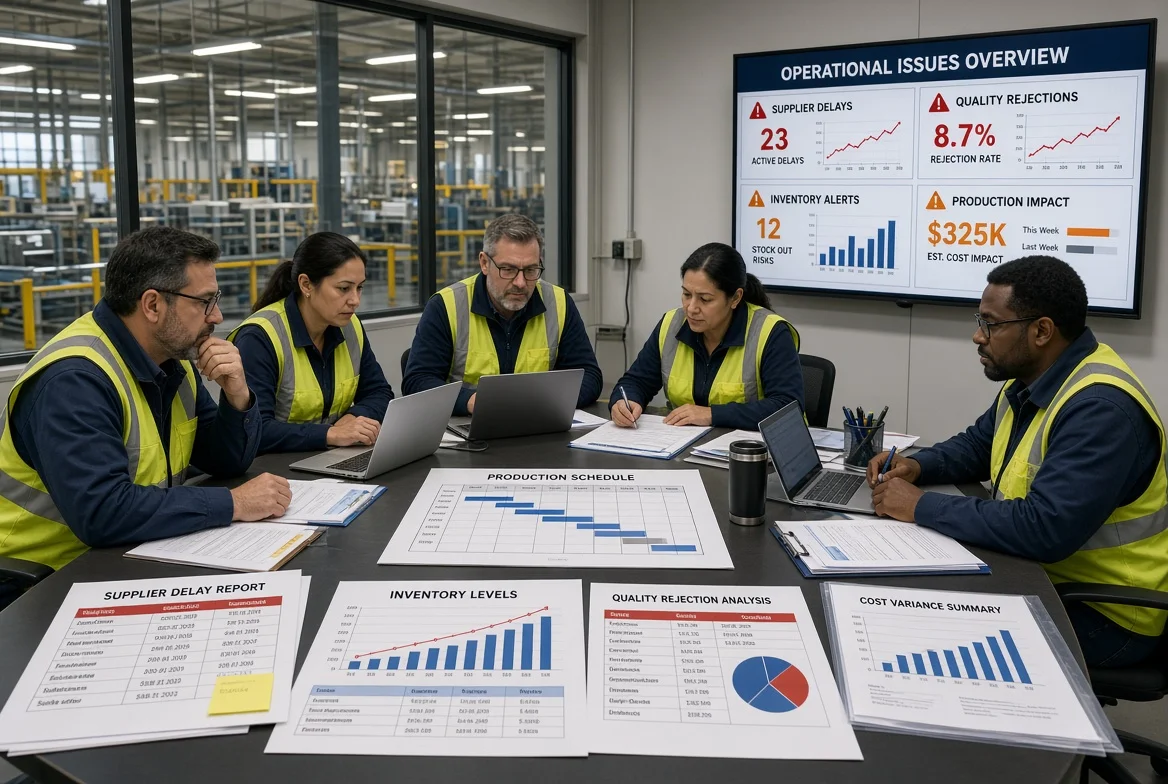
Challenge 1: Unreliable Supplier Delivery and Long Lead Times
Late deliveries and fluctuating lead times cause production delays, lead to high stock buffers, lower equipment utilization, to overtime/laid-off workers and can even generate emergency freight expenses to offset the previous price savings.
The reason why Suppliers' Deliveries become Unreliable.
Each of the following factors come into play: supplier capacity constraints, raw-material shortage at the supplier's own suppliers, production delays, manpower or equipment shortages, subcontracting delays, holiday schedules, logistics disruption. There are also factors on the buyer side: Over-optimistic forecasts, late order placement, uncertain delivery windows, and unrealistic lead-time expectations that were not validated by the actual production capacity.
Delivering and Lead Time problems are solved.
Make sure that you know the exact lead times for the amount you're ordering and the time of production, and not just from the catalogue. Provide realistic forecasts and realistic orders with definite status. Monitor supplier milestones, review capacity routinely, leverage scheduled releases, and establish early warning triggers for potential shortages. Qualify for backup sources; schedule supplier-held stock or consignment as appropriate; have contingency schedules; for long-lead or production critical items.
KPIs to Monitor
On-time delivery, lead-time variance, order-confirmation cycle time, shipment reliability, shortage frequency by production date, emergency freight spend and material availability by required start date. These metrics will help to distinguish between supplier failures and the planning or logistics issues that may be present within the system.
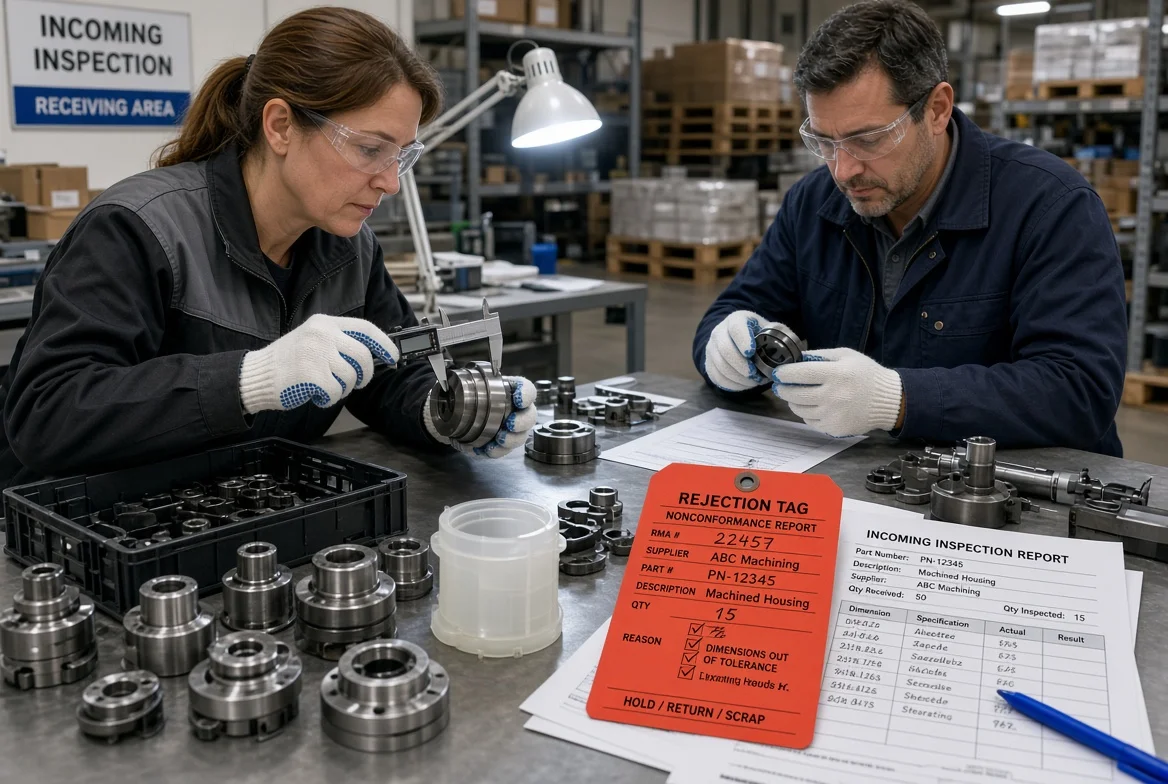
Challenge 2: Supplier Quality Problems and Incoming Defects
Bad materials cause rejections, sorting, reworking, scrap, line jams, customer complaints, warranty issues, and lengthy supplier issues.
Supplier Quality Issues are typically the result of the following:
Ambiguous or incomplete specifications, uncontrolled drawing changes, poor process control at the supplier, insufficient inspection plan, unauthorized material changes, capacity pressure resulting in some steps being skipped, poor change control, and inconsistent sub-tier suppliers. Common examples are out-of-tolerance dimensions, incorrect material specification, non-conforming function tests, surface defects or lack of documentation.
How to troubleshoot problems with suppliers
Establish clear specification and acceptance criteria prior to the RFQ. Qualify suppliers, request samples and first article approval, perform process audits when this is necessary due to risk, discuss inspection plans and certificates, ensure traceability and implement formal corrective-action processes. The expectations for quality should be included in the purchase order or quality agreement, thus both parties have the same baseline.
KPIs to Monitor
Incoming defect rate, rejection rate, first pass acceptance rate, nonconformance frequency, corrective-action closure time, return rate, sorting and rework hours, scrap cost and supplier audit results. Connect these scores to the production and cost effect, do not see them as separate quality numbers.
Challenge 3: Rising Material and Manufacturing Costs
Even with stable unit prices, price pressures arise from raw-material price volatility, raw-materials supplier increases, freight, currency, energy, labor, tooling amortization, quality costs and inventory carrying costs.
Why Unit Price does not reflect the full cost
The TCO and TLA includes the freight, duty, inspection, rework, scrap, inventory holding, tooling, payment terms, exposure of warranty, and production downtime. A low unit supplier can have a high overall cost if there are defects, late delivery, hidden setup costs, etc.
The world's top manufacturers tackle cost pressure—how you can do the same.
Conduct spend analysis, engage in controlled competition, consolidate volumes as feasible, engage in value engineering and specification review with engineering, establish key suppliers, streamline logistic arrangements, question MOQs and negotiate commercial terms. All modifications to material, design or process should be submitted for engineering and quality review and approval.
KPIs to Monitor
Purchase-price variance, BOM cost variance, total landed cost, cost avoidance, quality related cost, emergency freight, supplier price change frequency, and inventory carrying cost. Develop objective baselines in finance to ensure that there is a legitimate and repeatable improvement in the future.
Challenge 4: Supplier Capacity Constraints and Production Scalability
Capacity challenges emerge when demand increases, a new product comes out, a customer order grows, or a competitor supplier takes in more work than he can realistically do.
Basic approach to determining actual supplier capacity
Review equipment and line capacity, labour, raw materials, production delivery dates, subcontracting, quality resources, tooling condition, line utilisation and planned investments. Be aware of the difference between the capacity indicated on the nameplate and the capacity available during the period the buyer is in need of the production.
How to address capacity challenges.
Complete capacity reviews early in volume ramping; communicate capacity forecast; reserve capacity when appropriate; produce capacity in stages; ensure supplier development; qualify second sources; consider volume allocation purposes and maintain realistic customer commitments. A typical example is a supplier who would be able to supply prototypes very quickly, but would not have the ability to scale up to mass production without a long lead time or quality risk.
KPIs to Monitor
Capacity confirmation accuracy, production schedule adherence, lead time variance when producing in volume, order fill rate, supplier responsiveness to capacity requests, shortage frequency, and time required to qualify alternative sources.
Challenge 5: Single-Sourcing and Supply-Chain Dependency
Single sourcing is a commercial and operational risk if the item is production critical, technically challenging to replace or is dependent upon special tooling or certification.
If Single Sourcing is reasonable, it may be used.
If the technology is unique, the tooling is special, the product requires a certification, it's made in low volumes, a joint development or a product is not widely available, it is worth a single source. It should be planned, recorded and be accompanied by recognised risk management procedures and not be a casual consequence of not having developed an alternative.
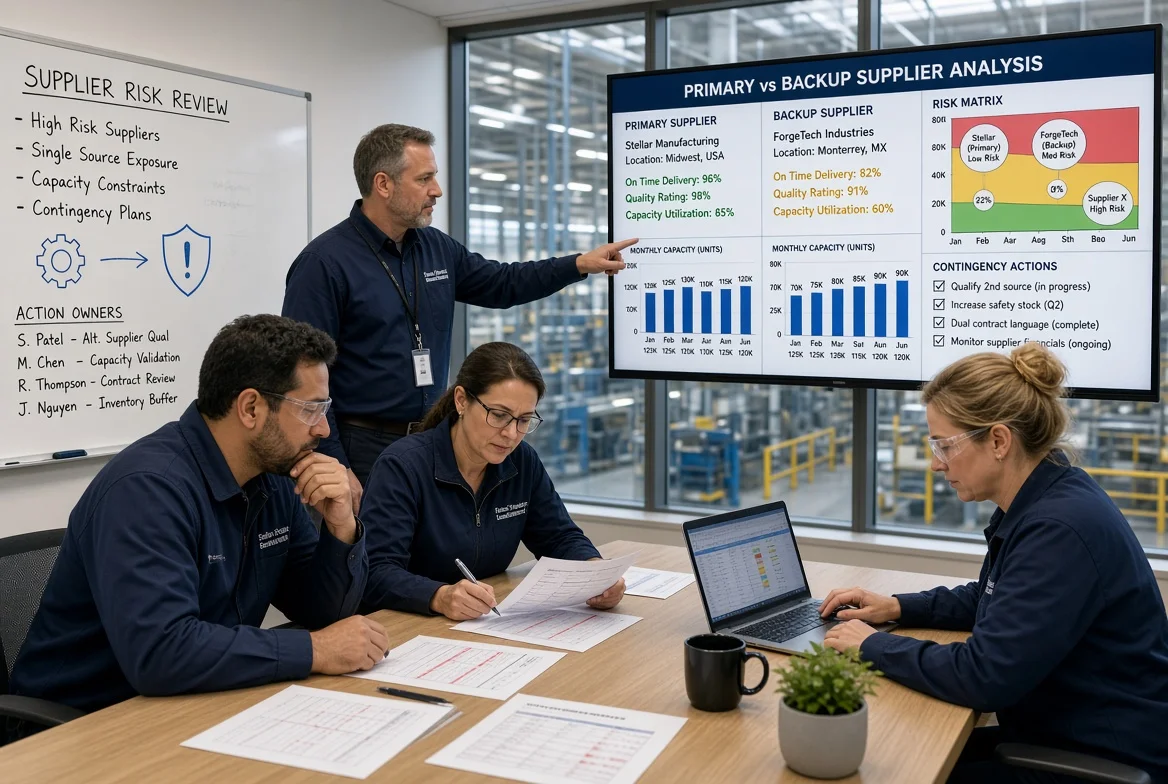
Developing an Understanding of How to Reduce Single-Source Risk
Qualify dual sources or approved alternatives, establish proper safety stocks, ensure ownership or access to tooling, review supplier capacities regularly, develop contingency logistics, and implement communication and contract controls. Unless a back-up is qualified and proven, it is not the actual alternative.
KPIs to Monitor
Percent of critical items qualified with qualified backup sources, percent by spend, percent by impact on production, time to qualify alternatives, percent disruption, percent days of coverage with safety-stock, percent contingency plans completed.
Challenge 6: Poor Procurement Planning and Forecast Accuracy
Shortages and excess inventory and emergency purchases are the result of inaccurate demand signals, old BOMs, late production schedules, unclear priorities and weak communication.
Common Planning Failures
Old MRP data, wrong lead time in item master, missing inventory, open orders not visible, unexpected changes in demand, lack of forecast status, engineering changes not included in planning, and late internal approvals. The common situation is a change in production requirements at the last minute that does not allow procurement to obtain normal lead times or make an acceptable change of alternative.
Tackling Planning Issues
Coordinate procurement processes very closely with the production planning, ensure the BOM and item master data are flawless, distinguish between firm sales and forecasts, review supplier lead times regularly, match inventory and open-order positions, and conduct regular cross-functional planning meetings. Communicate the forecast status clearly to suppliers and give ownership to those who will make updates to changes.
KPIs to Monitor
Accuracy of forecast, number of scheduled changes, availability of materials by production date, number of stock out events, value of excess inventory, number of emergency purchases, lead-time accuracy in the system, and volume of purchase-order changes.
Challenge 7: Excess Inventory, MOQ, and Working-Capital Pressure
Often manufacturers have to carry more stock than the business can use due to high MOQs, incentive for volume discounts, long replenishment lead times, poor forecasting and fear of shortages.
The reasons for excessive manufacturing inventory.The causes of excess manufacturing stock.
The changes of product design, softening demand, supplier batch sizes, long lead times, inaccurate forecasts, minimum purchase quantities exceeding the near-term requirements, and purchasing without taking into consideration stock and open orders. One frequent result is a reduced unit cost that leads to a build of inventory that gets "scrapped" due to an engineering change.
Balancing inventory and supply protection is a complex question.
Use risk-based safety stock levels, negotiate MOQs or scheduled releases, consider supplier-held stock or consignment stock, blanket purchase releases, combine requirements when possible, and diversify suppliers for high MOQs items, and review inventory aging regularly. Reducing inventory is not always a good thing if it increases the risk of being stocked out or production stopped for critical items.
KPIs to Monitor
Inventory Turnover, aging profile, number of stockout days, MOQ exposure value, excess and obsolete inventory, safety-stock performance, working-capital tied up in inventory, and emergency purchase frequency.
Challenge 8: Engineering Changes and Unclear Technical Requirements
Incomplete drawings, missing tolerances and BOM revisions, uncontrolled substitutions, and poor engineering, quality, production, and supplier communication are some of the most common procurement issues.
The impact of technical ambiguity on procurement.
Incomplete or changing requirements leads to non-comparable quotations, incorrect materials or processes, rework, delayed first-article approval, unusable inventory, quality dispute and supplier claim. Common areas of concern are dimensional tolerances, grade of material, surface finish, functional testing, packaging, labeling, and performance criteria.
How to enhance specification and change control
Controlled drawings, approved BOMs, complete technical RFQ packages, engineering sign-off on critical changes, enforce supplier change notification, first article approval, and document all technical communications. Technical substitutions should not be approved by procurement without engineering and quality approval.
KPIs to Monitor
Compliance with engineering changes, wrong revisions, RFQ clarification cycles, first article approval cycle time, nonconformance on specification, and made obsolete inventory due to uncontrolled changes.
Challenge 9: International Logistics, Customs, and Global Sourcing Risk
But international sourcing introduces freight cost and variability, customs and documentation risk, currency and payment exposure, longer transit times, limited visibility and occasional geopolitical disruption.
Typical Global Procurement Issues
Lack of clarity around Incoterms, incomplete or inaccurate shipping documentation, customs delays, port or transport disruption, damaged packaging, long ocean or air transport, payment and currency risk and poor visibility upon production. A common scenario is when a product is complete in the factory but then is delayed for weeks due to missing paperwork or missing delivery.
Putting Global Sourcing Problems to Bed.
Define and explain Incoterms clearly, create complete and accurate documentation, monitor key shipment stages, plan inspections, select transport modes that align to the risk profile, have reliable logistics providers, plan buffer time, and have contingency routes or alternative suppliers. If there are complex customs or regulatory issues, there should be an involvement of qualified logistics or customs specialists.
KPIs to Monitor
Frequency of on time shipment from the origin, on time delivery to the plant, customs delay, document error, freight cost variance, emergency freight, transit-time variance, partial-shipment frequency and landed-cost variance.
Challenge 10: Poor Cross-Functional Coordination and Procurement Data
When procurement, production, engineering, quality, finance, logistics, warehouse and sales are operating with inconsistent versions of quantity, timing, specification, or budget information, procurement performance will be affected.
Manufacturing Risk is caused by Coordination Problems.
Forecasts that differ, engineering changes not authorized, delayed quality decisions, budget surprises, unrecorded supplier commitments, incorrect warehouse records, production schedules that are unmanageable for procurement. An example is that each department has a different requirement for a product and/or its date of delivery.
Determine ways to increase coordination and data visibility.
Conduct joint planning reviews, establish clear ownership and approval criteria, manage item and supplier master data, define common KPIs, connect systems when scale makes sense and record escalation routes. For a smaller operation, a well-managed spreadsheet can do the trick, but larger manufacturers will probably require some sort of ERP, MRP or e-procurement software that maintains data integrity.
KPIs to Monitor
Approval cycle time, data accuracy rates, and percentage of spend with approved suppliers; invoice discrepancy rate, purchase-order accuracy, cross-functional issue closure time, exception frequency; and procurement cycle time.
Challenge 11: Supplier Relationship and Performance Management
Many manufacturing procurement challenges persist because supplier performance is never reviewed systematically after the purchase order is placed.
Why Supplier Relationships Break Down
Unclear expectations, irregular communication, price-only interactions, late escalation of problems, missing or ignored corrective actions, inconsistent forecasts, and absence of performance feedback. Professional supplier management is not informal friendliness; it requires structured communication, data, accountability, and documented actions.
How to Build Better Supplier Management
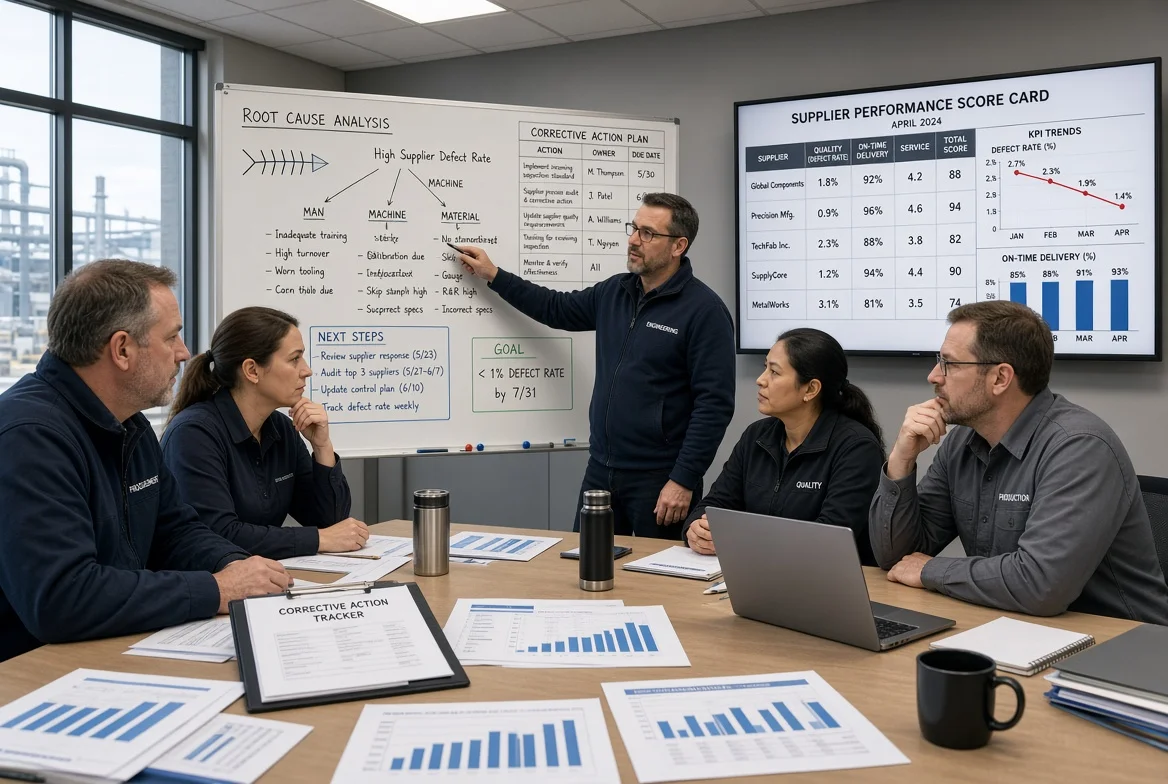
Segment suppliers by criticality, use scorecards, hold regular business reviews, track corrective actions to closure, review capacity and capability, run targeted supplier-development projects, govern contracts, and maintain clear escalation procedures. Strategic suppliers usually need joint planning and improvement work; transactional suppliers need simpler, consistent controls.
KPIs to Monitor
Supplier responsiveness, corrective-action closure rate, on-time delivery, defect rate, capacity support during demand peaks, communication quality, contract compliance, and completion of agreed improvement actions.
How to Create a Manufacturing Procurement Improvement Plan
Solving all the procurement issues at once generally generates superficial change. In practice, focus on the most important issues, look to the root causes, specify who is responsible, define outcomes and normalize good practices.
Step 1: Identify the top procurement issues.
Prioritize Rank issues based on Production Impact, Cost, Quality Exposure, Customer Delivery Risk, Frequency, Supplier Dependency, and Recovery Difficulty. Begin with one or two categories/suppliers where there is disproportionate operational risk.
Step 2: Identify symptoms and root causes.
Recurring delays, stock-outs, or expedites can be signs of lead time inaccuracies, substandard planning information, vague requirements, insufficient capacity, or inadequate approvals. Track the true causes with procurement, production, quality, inventory and supplier data.
Step 3: Identify Corrective Actions and Owners
Record the following: Action, Owner, Deadline, Resources needed, Expected outcome and Escalation point. These can be anything from updating an item's lead time in item-master, qualifying a backup supplier, reformulating an RFQ package, modifying safety-stock settings, to initiating a formal supplier corrective-action plan.
Step 4: Selecting Baselines and KPIs.
Assess performance prior to improvement. Baselines are useful such as delivery performance, quality metrics, total cost, inventory levels, emergency buying frequency, cycle times and supplier concentration. Do not use measures that are not consistently measurable or used in decision making.
Step 5: Review Results & Standardize Improvements
Embed the effective practices within procurement processes, supplier specifications, planning information, contracts, supplier training and supplier evaluation. Be sure to assess whether any new risks were generated by the improvement, such as reduced inventory, increasing stockout risk, or supplier consolidation, increasing dependency.
Summary Guidance – Solve Procurement Challenges at the Root
The challenges faced by manufacturing procurement are interrelated. Common causes for supplier delays include planning errors, quality issues result from incomplete specifications, cost pressure from incomplete total cost visibility and inventory issues are due to MOQ structures and/or forecast assumptions. Sustainable progress is only through addressing root causes and not just the symptoms.
Pick one big challenge, record the symptoms and causes with data, engage the right people, agree on a measurable change with clear ownership, track the change, and scale the change if it works. In the long term, this method increases supplier performance reliability, fewer production downtime and more control of cost and risk throughout the manufacturing supply chain.