
When procurement teams focus on eliminating waste in specifications, demand, process, logistics and the commercial structure rather than press suppliers to deliver a lower price, they can achieve lower costs without compromising on quality. A lower quote doesn't necessarily mean a lower purchase price if the lower quote involves a lower grade of material, less inspection, delayed maintenance, or extended capacity until the cost savings are offset by the cost of rework, warranty claims, late deliveries and defects.
The professional cost project begins with the supplier's actual cost drivers and the buyer's total cost. The work involves removing unnecessary features/poor yield/schedules that are unstable or cannot be met and avoiding unnecessary quality failure, whilst maintaining agreed quality, delivery, compliance and supply continuity.
What Does It Mean to Reduce Supplier Costs Safely?
Supplier Cost Reduction (SCR) is the reduction of supplier product or service costs, without compromising the agreed supplier product or service quality, delivery, performance, compliance or continuity. Optimizing supplier costs does not equate to a single price reduction. There is a relation between quoted price and total cost of the buyer, but not the same. The only way a price reduction creates value is if it does not move up a higher cost into quality, production, logistics, inventory or customer service.
Establish a Supplier Price vs Supplier Process Cost.Set up a Supplier Price vs Supplier Process Cost.
The price on a quotation is a business number. What is behind it are materials, labour, machine time, tooling, set up, testing, packaging, logistics, overhead and margin. A supplier will be able to reduce the price by decreasing the margin. This is sometimes done if the market has changed or the initial quote was not well structured. If the process it is based on is wasteful, it is seldom sustainable.
A longer lasting solution is to lower the supplier process cost. A machined housing, for instance, might have high labor and scrap, due to the lack of stability of the fixture and the length of tool path, and/or the amount of stock remaining after the work is cut from the raw-bar. An optimization on fixturing, nesting or cycle time may be able to decrease costs without changing the functional requirement of the drawing or the agreed inspection plan. The buyer pays a decent percentage premium. Just uses up less material, time and rework.
Supplier Cost Reduction vs Buyer Total-Cost Reduction
The buyer can also cut down the total cost without altering the unit price of the supplier. All of these, order frequency, packaging design, shipment consolidation, incoming inspection effort, inventory policy and component redesign, are all on the buyer side of the ledger. The same carton price, but a better pallet pattern cuts freight and warehouse handling for the same packaging supplier. A custom-part supplier can maintain the same piece price, but with increased first-pass yield, the buyer's sorting/line-stop cost is reduced.
Procurement needs to take both sides into account. A change that benefits the buyer, and yet costs the supplier will come back to haunt them later as a price increase or unavailable capacity or diminished quality.
Quality is a boundary, not a variable to remove.
Quality should be agreed upon in advance of cost discussions. Material grade, tolerance, functional testing, traceability, packaging performance or customer or regulatory requirements are not negotiables. If a requirement truly isn't being used, then it should be deleted from the system by an engineering, quality and compliance owner controlled change. If it is required, cost work must be within that limit.
Not passing drop-testing, not meeting the tolerance, or not being able to assemble because of an inferior resin, not meeting the tolerance, or not surviving the trip because of a lower-cost carton is not considered cost reduction. It's the cost of poor quality delayed.

Why Price-Only Supplier Negotiations Often Fail
When you persist in asking for a reduced price, you may get a temporary discount. Eventually they tend to cause quality, delivery, capacity, communication or stability issues. Business is still business. When commercial condition no longer includes materials, skilled labor, process control and equipment maintenance, something will change in the operation.
In a similar fashion, suppliers may also lower the total amount of hidden process inputs.
With tough pricing pressures, a supplier might turn to a lower cost material lot, decrease the amount of inspections, change a subcontractor, postpone machine maintenance, increase batch size, or shift the work to less experienced operators. This doesn't have to be a falsehood. Economics under which the factory operates change when there is commercial pressure. Only the buyer will see the change when a dimension drifts, a finish fails or a shipment is late.
This doesn't mean that lower price can be higher quality cost.
Defects mean inspection, sorting, rework, scrap, line stoppage, warranty, customer returns and corrective-action cost. When customers win a small plastic unit price cut, they can lose that price cut in one week of incoming rejects. Operators wait, additional inspectors are brought onto the line, and then the supplier has to pay for the replacement parts, with both sides blaming each other. The price quoted was volatile. This is because the cost of poor quality increased more.
Price Pressure Can Weaken Supply Continuity
The supplier may be unwilling or unable to provision capacity; to keep equipment ready; to purchase materials in advance; to install gauges or engineering changes. If the category is critical to the production, supplier stability is as important as the current invoice. The factory that doesn't have the funds for tooling maintenance or employee training will not keep the buyer's schedule.
Negotiation as part of a wider cost strategy.
Negotiation remains in the toolbox! It must be based on spend analysis, market evidence, cost drivers, demand, supplier capability, alternative sources, value engineering, and total cost. When operational waste and unnecessary costs have been identified, negotiation is the process to divide up the value that is left fairly. That is how teams save money with suppliers without destroying the process.
Strategy 1: Improve Specifications Before Negotiating Price
Ambiguous or Specification items are costly for suppliers and difficult to compare quotes. If two suppliers quote the same part number, one is not quoting the same job if he assumes a standard finish and the other assumes a special coating, additional testing and custom packaging.
Remove Unnecessary Specification Complexity
Tight tolerances, overspecified materials, complicated finishes, redundant tests, overpackaging, and custom features that don't provide customer or product value all increase the process time and risk. Changes to specifications should be reviewed by engineering, quality, the customer owner, and compliance prior to any loosening of the specifications. If the cost work is avoided by those owners, it is not a cost reduction for the supplier. It's a design modification that's not controlled.
Outline the processes used in the standardisation of components and materials.
Standardization eliminates the need for setup, tooling, low volume purchasing, inventory diversity, qualification & inspection complexities. Common packaging sizes, fasteners, electronic components, cables, industrial fittings, and subassemblies all usually come to mind. When the market demands different fasteners from a single plant, one approved family of fasteners is easier for the supplier to purchase, store and make use of than 12 similar variants that require 12 sets of drawings and incoming checks.
Improve Design for Manufacturing
Product design influences supplier process time, process yield, labor, tooling, material waste, production risk, assembly, and inspection. A special bracket with deep pockets, thin walls and without standard bend radii can involve additional operations and high scrap. The re-design of a bend sequence, hole position or material thickness can retain function and performance and reduce manufacturing complexity. This is supplier cost reduction in the production of, not its quality.
Be clear about your requirements before sending out an RFQ
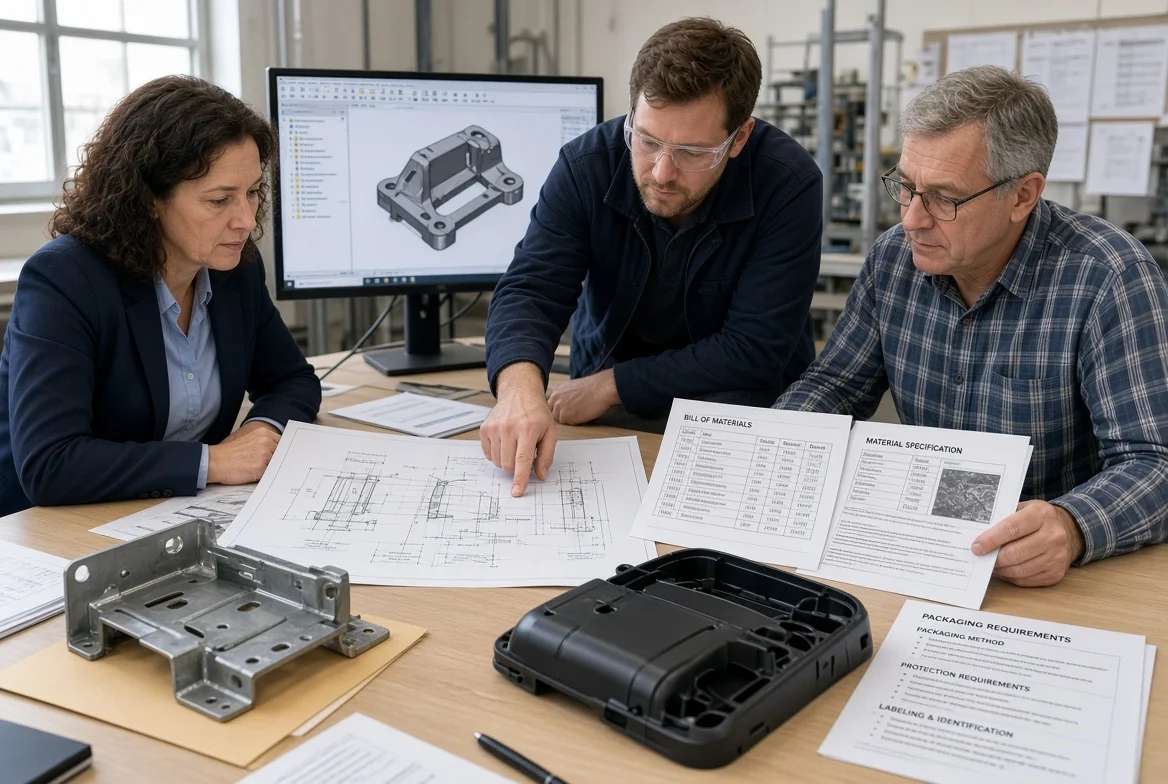
Drawings, material grades, dimensions, tolerances, quantity, packaging, testing and delivery requirements must be complete to be able to quote accurately. A controlled RFQ package (one owner for questions and a written clarification record) ensures that each bidder does not fill in the gaps in the same manner. The first requirement for just competition is similar quotes.
Strategy 2: Use Spend Analysis and Supplier Competition
Buyers establish cost leverage by being visible and accessible in a mutually appropriate way, but in no way a price-only battle. Spend analysis reveals the true level of volume, variation and supplier numbers. If a category can accommodate it, competition is then applied.
Analyze Spend By Category & Supplier
Graph total spend, supplier number, price fluctuations, volume, plant or department purchases, contract coverage, and supplier concentration. One of the popular scenarios is that a number of facilities are purchasing repeat parts from different vendors at different prices without anyone gaining the picture of the company's true commercial situation. While that picture is not there, there's no negotiation.
For Suitable Categories, use Competitive RFQs.
Standardized products that have clearly defined specifications and multiple qualified suppliers fit a competitive bidding, benchmarking, volume aggregation, and supplier comparison. For low bids, supplier evaluation criteria—including technical capability, quality systems, capacity, delivery, MOQ and commercial assumptions—must be confirmed. If the quote is too low, too short of a lead time or if it has no MOQ, it is not a saving.
Consolidate Suppliers Carefully
Combination can minimize management, boost volume leverage, facilitate quality control, and enhance coordination. It also leads to dependency, capacity limitation, less competition, qualification load, and lack of backup coverage. The decision should be made for each type of category. One-off custom mould is a risk other than a standard carton produced in multiple sources.
Enforce competition, without creating instability.
Commercial discipline can be maintained without a constant threat of replacement through market intelligence, periodic benchmarking, reviews of suppliers, and qualification of suppliers from other sources. The objective is a believable option, not a partnership that only exists the following time the price tag increases.
Strategy 3: Use Should-Cost and Total-Cost Analysis
The procurement must have the economics of the suppliers and buyer cost prior to negotiation. Cost analysis and TCO are not a substitute for quotes. They provide the team with a reference point so that they can discuss “this material, this cycle time, this freight assumption don't match up.”
Create a Suppliers Cost Breakdown
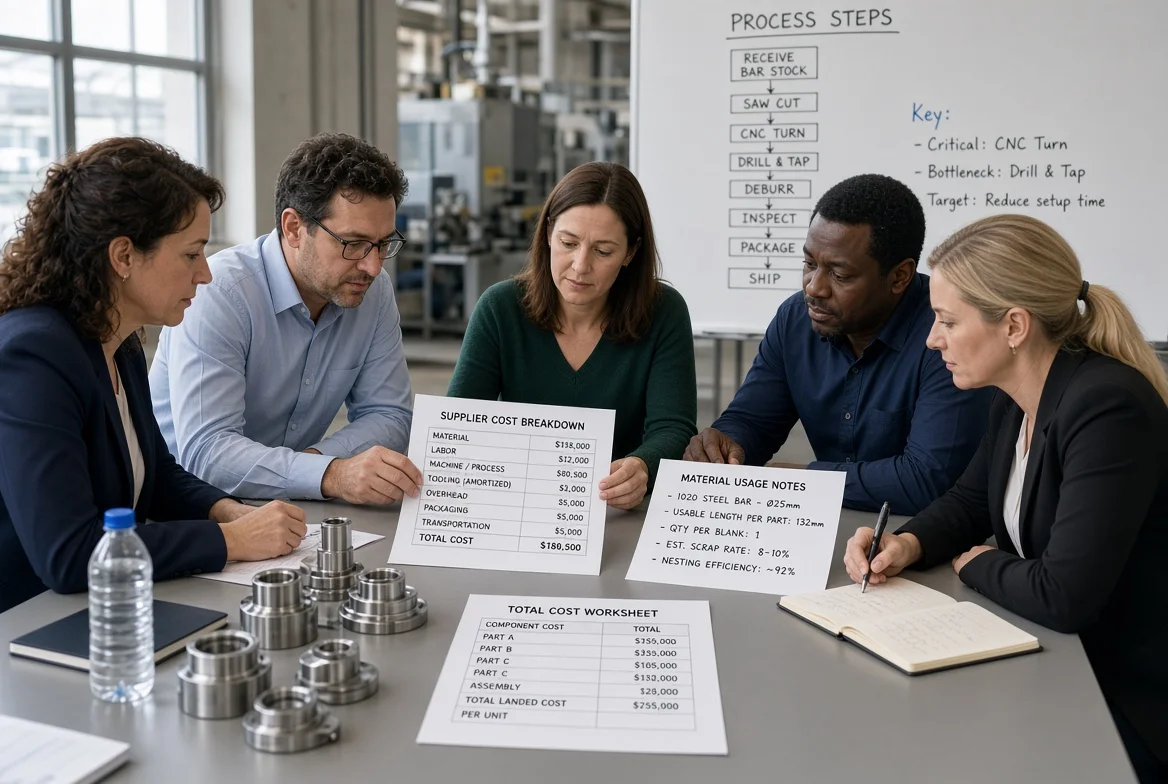
A supplier cost breakdown may include materials, labour, machine time, tooling, set up, testing, packaging, logistics, overhead and margin. The level of transparency will vary based on the relationship, complexity of the product, commercial sensitivity and negotiation process. A few suppliers will provide a detailed build-up. Others will discuss only some of the major drivers. Any breakdown is better than arguing over one unit price.
Use Should-Cost Analysis as a Reference
Should cost analysis helps to determine the potential cost of a product or process based on certain assumptions. It's not a fact of life. Apply it to Market Quotes, Supplier Evidence, Technical Capability, Volume, Quality, and Delivery. If the model is a high volume press and the order is a low volume CNC job the model is incorrect, not the supplier.
Let's compare the Total Cost of Ownership.
Items to consider in the comparison: Freight, duties, tooling, inspection, inventory, quality failure, warranty, downtime, supplier-management effort, payment terms. For example, in the global manufacturing world, a lower factory price from a far away plant is lost once the ocean freight, import duties, longer pipeline inventory and increased likelihood of premium air freight is added up when the shipment slips. The lower unit price is NOT the lower TOTAL LANDING COST!
Determine which are the biggest cost drivers first.
Focus the analysis on key cost factors such as material usage, yield, cycle time, tooling, labour content, packaging, freight, batch size, or quality failure. Not all of the lines in a cost model are open for negotiation or equally significant. Teams that focus on small overhead percentages and are indifferent to scrap and freight tend to miss out on the real opportunity.
Strategy 4: Improve Supplier Productivity and Process Efficiency
Supplier process improvement can help to lower costs without sacrificing the needed quality and delivery. That's the real reason for reducing supplier costs safely - make the work cheaper to do, not cheaper to do not.
Minimize waste and maximize yield!
Benefits for suppliers include yield improvement, improved nesting, decreased scrap, improved material handling, and process control. Examples include sheet-metal nests, runner design for molded parts, stock allowance, cutting yield, assembly waste, packaging waste, and electronic first-pass yield. The quality standard remains. There is less material out and less material that is not working.
Minimize set up/change over expenses
These include Order consolidation, Stable scheduling, Standardization, Batch planning, and Tooling improvement, which decreases setup/chg. cost. There's a compromise. Larger quantities may reduce the cost per unit, but increase the inventory or reduce response. The correct batch size is one that is a compromise between supplier setup and inventory carrying cost and demand confidence for the buyer.
Optimize the production process and maximize production capacity.
Unpredictable forecasts, releases, changing product specifications and poor production planning cause manufacturers to have idle times, overtime, bottlenecks and rush production. The buyer should never assume that they can use the product without any failures, quality holds, or mix changes. An unrealistic load in a factory means that it does not get the next important order.
Minimize rework and inspection requirements by utilizing process control
Stable processes, first article approval, documented work instructions, process capability and corrective action minimize rework and repeated inspections. Supplier quality improvement then reduces supplier cost and finally the buyer's total cost. Inspection remains necessary when there is such a risk that it justifies inspection. The objective is to reduce the number of defects that enter inspection rather to the number of checks applied to an unstable process.
Strategy 5: Use Value Engineering and Supplier Collaboration
Product, process, material, packaging and supply-chain activities help to develop cost improvements in procurement and suppliers. Reducing cost without sacrificing quality requires a controlled review process, rather than an informal, ad hoc “try this is cheaper.”
Consider Material Alternatives Carefully
Alternative materials can have impact on performance, durability, compliance, appearance, supply availability, customer approval, and other factors and may have lower cost. Before adoption, technical testing, engineering review, quality approval and documentation should occur. The “saving” is not complete if a less expensive polymer, coating or unqualified steel grade is used.
Keep a manufacturing process as simple as possible.Make product assembly and manufacturing as easy as possible.
The fewer components, the easier to assemble, the more uniformity in interfaces, or the more changes in process route, the less it costs suppliers in labor and tools. A typical application is a two piece weldment that is used only in OEM work to become a one piece formed part. The Buyer must confirm the product performance and production suitability prior to the change's release.
Enhance the Packaging and Logistics Design
Freight and handling cost depends on dimensions of packages, palletisation, protection, use of containers and frequency of shipment. Reducing carton costs that result in damage to the product or customer complaints or warehouse issues is merely shifting the expense. Packaging should be easy to travel and protect the product.
Institute a Controlled Joint-Improvement Process
The supplier's proposal should be documented, evaluated, tested, approved, implemented and monitored. If a proposal impacts product and supply performance, procurement, engineering, quality, operations, and finance should be considered. Official material swaps enter production via collaboration without change control.
Strategy 6: Optimize MOQ, Orders, and Commercial Terms
Buyers and suppliers costs change due to the buying and commercial decision. MOQ, forecast quality, payment structure and treatment of the tooling are considered part of the supplier's cost reduction measures and not extras when the unit price is determined.
Maintain balance between MOQ and Inventory and Cash flow.
A high MOQ can drive down supplier setup cost, result in excess stock, excess aging inventory, cash exposure, and cash obsolescence. Where the category and relationship allow, the following are possible options: Smaller trial orders, scheduled releases, blanket orders, supplier-held stock, forecast sharing, and demand consolidation. It is NOT a comparison of lower piece price versus higher piece price. It's a combination of piece price, inventory carrying cost and obsolescence risk.
Improve Order Predictability
Accurate predictions of the order, stable order pattern, framework contracts and definite release plans minimize supplier planning cost. A forecast is not a plan or a purchase commitment and a plan is not a purchase commitment. Suppliers either over-order the material or don't prepare the material when they mix them all into one email.
Identify payment and deposit structures with which to negotiate.
Supplier cost, buyer risk are impacted by deposit, milestone payments, credit terms, inspection linked payments, order financing. There is no universal method. This should be based on relationship, customisation, order value, country risk and buyer protection. Late payment may result in the supplier having to procure the materials at a higher price. If the buyer pays without inspection gates, then it can leave them in the lurch.
Explain the concept of clarifying cost of tooling and non-recurring costs.
Where possible, all costs associated with tooling, set-up, samples, testing, engineering and development should be distinguished from recurring unit price. When it comes to OEM jobs with molds, fixtures or prototypes, it is easy to add those expenses into the piece price and difficult to discuss volume changes later. Ownership, maintenance and replacement procedures should be documented.
Strategy 7: Reduce Quality Cost Without Weakening Quality Requirements
Reducing costs should be done in the production of and control of quality, not in the quality standard itself. That's what helps cost reduction without loss of quality remain honest.
It needs to be done before production to prevent defects.
The supplier qualification process includes specification and process reviews, samples, first article approval, testing, and production readiness checks, which eliminate defects as a production issue. This sequence is used for custom components, packaging, electronics, machinery and contract manufacturing. The high cost of quality control is to find the problem on the buyer's line.
Improve First-Pass Acceptance
The key to raising first pass acceptance are accurate requirements, process capability, inspection planning, supplier training and controlled changes. The higher the first pass acceptance, the lower the supplier cost, the buyer cost and the disruption of production. It is one of the purest yardsticks to determine if a process is really under control.
Apply Root Cause Corrective Action
If the process is not stable, sorting/replacing the defective items is insufficient. The source is either continued, developed, or replaced based upon corrective-action evidence, effectiveness checks and supplier accountability. If a commercial change is detected in the presence of repeat defects following a price reduction it is an indicator that the commercial change may have made it to the process.
Measure Cost of Poor Quality
Including rejection, scrap, rework, sorting, downtime, returns, warranty, customer complaints and over inspection. Apply these measures to the assessment of value created by a supplier-cost reduction. In the event of the invoice dropping and the quality ledger increasing, the project failed.

Strategy 8: Improve Delivery and Logistics Cost Together
The cost and delivery of suppliers are linked. Can result in greater freight, inventory, shortage or production cost due to lower factory price. Logistics is also a portion of the same total-cost problem.
Outline the production and shipment milestones.
Reduction of rush cost through earlier forecasts, realistic lead times, supplier milestone tracking, planned inspection, shipment booking and clear delivery requirements. Emergency air freight is frequently a logistics issue that's parading under the guise of a planning or performance challenge.
Use the Transport Based on Total Cost and Risk option.
Ocean, air, courier or multimodal transport should be as urgent as the product, as valuable as the product, as sized as the product, as production impactful as the product, and as available in inventory as the product. When emergency air freight is repeated on the same part, it is a strong indicator that the lead-time, safety-stock, or supplier-capacity assumption is incorrect.
Make regular deliveries without ever being short of stock.
Freight and handling cost can be reduced in consolidation. Delays due to poor timing can lead to inventory increases, or to the delay of material needed for production this week. Ensure match of consolidation with production, safety stocks, supplier lead times and customer commitments.
Recognize the similarities and differences between Incoterms and Delivery Responsibilities.
The Incoterms determine where the responsibilities, costs and risks are to be borne at defined stages. They are not the full landed cost or all contractuals in themselves. Recall: the named place, transport, insurance, export and import duties, documentation, and destination charges before accepting two quotes as equivalent.
How to Measure Supplier-Cost Reduction Without Sacrificing Quality
A project to reduce costs must be able to demonstrate business outcomes and impacts or quality and operational impacts. Cost optimization by the supplier, which only takes into account the new unit price will fail to capture the damage.
Cost and Price Metrics
Utilize supplier price variance, cost-breakdown changes, total landed cost, cost avoidance, contract price, tooling cost, and price-adjustment performance. The baselines should be the same specification, volume, Incoterm and time window. A price drop as a result of a drawing change is not a like-for-like saving.
Quality Metrics
Before and after the cost action, review defect rate and/or rejection, first pass acceptance, corrective action closure, rework, scrap, returns, warranty, and/or customer complaints. When quality deteriorates the commercial outcome is incomplete.
Material delivery and capacity metrics.
Monitor supplier performance metrics, including on-time delivery, lead-time variance, order confirmation, capacity responsiveness, shortage frequency, premium freight and production disruption. The following metrics indicate if the price action had a negative impact on supplier capability.
Supplier Health & Relationship Indicators
Analyze responsiveness, improvement completion, capacity investment, communication, contract compliance, supplier concentration, willingness to accommodate changes. All financial-health claims should remain proportionate and based on evidence. It is better to have a supported review of the risk, with a documented procedure, than to have a statement about accounts that isn't supported.
The entire value and production impact.
Cost of poor quality, Inventory impact, downtime, customer delivery impact, productivity, and working capital. The project, in turn, will be successful only if the overall business value improves.
Common Mistakes When Reducing Supplier Costs
Asking suppliers to lower their prices without knowing their costs
Cost pressure under conditions of no cost analysis leads to unrealistic commitments, instability, quality reduction or delivery issues. Determine the process and product cost drivers first. Then discuss the number that the other process can negotiate.
A situation in which Quality Controls are removed to meet a Target Price.
Lowering the number of inspection, materials, testing or process controls can increase the expense of poor quality higher than the amount of money saved. Keep mandatory requirements. Search for waste in design, process, logistics and commercial structure.
Switching Suppliers Without Transitioning the Change
There's a new source with a new set of related risks: sample, tooling, qualification, inventory, engineering, and customer-approval risk. Employ staged transitions, first article approval, technical documentation and contingency coverage. A lower quote from an inexperienced line is only a lower cost if the line is reliable.
The total demand exceeds the total supply.
Excess stock, cash exposure, storage cost, and obsolescence can result from high MOQ and volume discounts. Before committing, do a comparison of unit-price saving and inventory carrying cost and demand confidence.
Trust without controls is the basis for Supplier Collaboration.Supplier Collaboration assumes trust without controls.
There is still a need for collaboration with specifications, approvals, data, performance measures, change control and commercial clarity. Trust should not be a substitute for a written change and approved sample.
Only the Supplier's Quoted Price – A method used in which the payment is based solely on the price the supplier quotes.
Effectively track all costs, quality, delivery, inventory, logistics, supplier capability and production impact. An invoice is a single line of a bigger account.
Summary Guidance – Reduce Supplier Cost by Removing Waste, Not Quality
By optimizing specifications, analyzing spend, comparing qualified suppliers, understanding supplier economics, raising productivity, value engineering, optimizing MOQ & commercial terms, reducing quality cost, coordinating logistics and measuring total value, procurement teams bring down the cost of suppliers without compromising on the quality of their output. These supplier cost cutting strategies are effective because they target waste and uncertainty and unused complexity, not the product's quality or delivery.
Choose a major supplier or product category. Identify the cost factors of a supplier and cost factors of a buyer. Establish the quality and delivery standards that are essential. Delineate process or design wastes. Plan and agree on an improvement with control. Then check the total cost and the performance of the suppliers. Here's how to reduce supplier expenses without any risk, and that is the only one that actually works.