
Procurement becomes part of an efficient manufacturing strategy by bringing purchasing in line with production needs, standardising supplier and buying processes, increasing visibility of spend and inventory, eliminating work that isn't value added for quality and delivery, and measuring the cost, quality, lead time, inventory and supplier performance as one system. Manufacturing procurement efficiency is not a quicker purchase order. It's being delivered on time, in the correct specification, quantity, and date from a competent supplier, with minimal waste, delay, rework and rush freight.
Buyers can stop a line even at a factory. Stockout, duplicate order, overnight air freight, excess inventory and repeated incoming rejects are all typically root causes of the same problem: procurement, production, engineering, and suppliers do not have the same BOM, schedule, and lead times. That can't be rectified by buying faster or the cheapest unit price. The process can be rushed and uncontrolled, causing the wrong revision to be placed on the floor. By keeping qualification, quality approval, and risk control in place and reducing avoidable delay and administration, efficient procurement is able to keep these in check.
What Does an Efficient Manufacturing Procurement Strategy Look Like?
An effective procurement process for manufacturers integrates demand, BOM requirements, MRP or production planning, supplier selection, quality controls, purchasing workflows, inventory, logistics and supplier performance into one system. Materials are delivered, when required. Specifications are controlled. Suppliers are assigned to work which they are qualified for. The purchasing process is transparent. Appraisals are similar to the buy risk. Quality issues come to light early in the process. Data resides in a connected way to support the next decision.
Efficiency is more than just procurement speed.
Correct requirements, with suppliers capable of fulfilling them, are essential to faster RFQs and shorter purchase-order cycle times. A buyer who sends out three RFQs in the morning and gets the lowest on a production critical bracket can be perceived as being productive. Incoming inspection fails if the drawing revision is out of date, the coating is not specified, or the supplier has not previously made that tolerance. Production waits. Rejection is written by Quality. Procurement expedites a replacement. The “fast” buy took more time from the plant than a thorough evaluation would have taken.
Efficiency MUST be evaluated throughout the Manufacturing System.
Manufacturing purchasing efficiency is an output of the plant, not an output of the buyer. There's not much use in having lower administrative hours if a line halts, if scrap increases or if the warehouse becomes full of unused parts. Cross-functional measures represent the actual impact of a sourcing decision—purchase price and landed cost, incoming defect rate, on-time delivery, inventory coverage, emergency freight, production interruptions, and hours spent chasing exceptions. If those numbers come in pairs, then the strategy is working. Plant when savings increases and stockouts and rework increases, the plant is spending elsewhere.
Efficiency Requires Proportionate Controls
Not all purchases require the same process. Simple reorder rules and light approval can be used with approved catalogs or standard fasteners and common MRO supplies. There is a need for supplier qualification, technical review, inspection plans and contracts regulation for custom machined parts, regulated materials and production-critical electronics. When you treat each purchase as high risk, the plant gets slowed. Routine treatment with each purchase leaves the line exposed. Manufacturing remains fast and safe with Proportionate controls.

Common Procurement Inefficiencies in Manufacturing
Diagnose where time, money and production reliability leak before redesigning the function. The problems listed below are typical of plants already used by the customer, with buyers, ERP and supplier lists.
The inability to capture accurate spend and supplier data.
Disconnected buying data reveals focus and waste. The same resin/fastener is purchased by various departments under different names. The names of the suppliers are shown three different ways in the master file. No one has the ability to make statements on annual spend by category or the number of active vendors in any commodity. Pricing then drifts. Split up volume that may be supportive of improved terms. Category decisions are based on anecdotes rather than on a clean spend picture.
Inability of the material to be understood or completed in the proper manner.
If grades are not listed, drawings are outdated, tolerances are unclear, BOM is not complete, or BOM revisions are not controlled, then those quotes are not comparable and parts cannot be used. Suppliers make their own assumptions to fill in the blanks. Lots that are not accepted because they do not meet requirements upon arrival. Disagreements begin with what is “agreed.” Before the first RFQ comes out of the building, procurement should ensure that the requirements are locked in with engineering, quality and production.
The lack of linkage between procurement and production planning.
The lack of a reliable forecast, production mix, MRP exception list, inventory position and open-order view makes purchasing reactive. A typical scenario: procurement continues to purchase the previous quarter's mix and production has gone towards a higher volume SKU. The shortness of critical components. The rest of the items are in the warehouse. Expedite fees are based on the shortage and not the plan.
Having too many suppliers or relying too heavily on any individual supplier.
A long list of vendors results in higher RFQs, onboarding, quality variance, invoice workload, and reduces volume leverage. The reverse is one way in which a long lead hard to qualify part can have no back-up. Supplier segmentation and category analysis provide the plant with information on where to consolidate suppliers, where to maintain two qualified suppliers, and where two suppliers with a transactional catalog buy are sufficient.
Slow Approvals and too much manual effort.
Ambiguous or changing approval levels, re-keying data, manual quote grid creation, lost certificates and mismatched invoices extend the cycle time without providing any control. There should never be a queue of routine purchases from an approved supplier in the same queue as a new custom tool or a first article part. Make the walkways easier to navigate, even though they are already low risk. Hold back more review for high-cost failure.
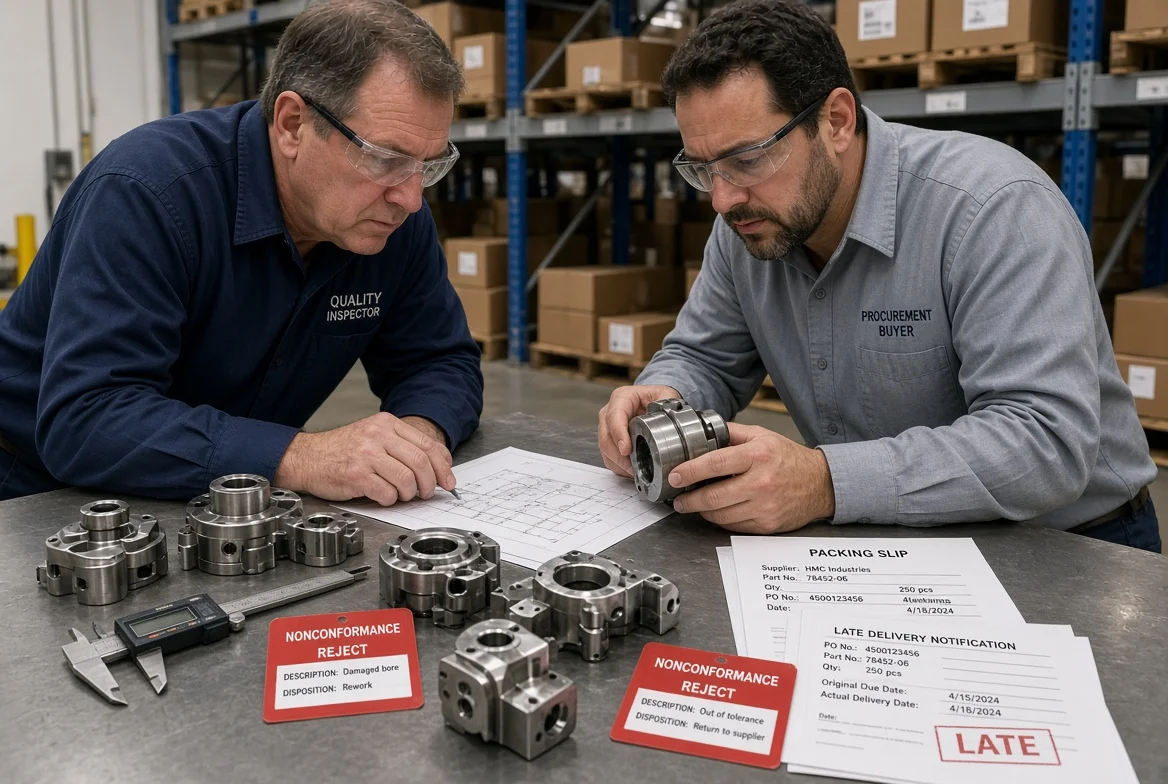
Deliveries in recent times have been marred by repeated problems with quality.
Don't treat the same late lot or same dimensional reject as a new emergency each month. All events use incoming inspection, warehouse space, production slots and customer service. Root-cause is not as expensive as a year of replacements and air freight for capability, process control, packaging or the original specification.
Step 1: Align Procurement With Production and Business Requirements
The first step to improving manufacturing procurement is simply asking the right question: What does the plant need to produce, when, from where, how, and for how much? Later process work will still follow up on the wrong demand if purchasing can't provide it from shared data.
Link up Procurement to Production Planning and MRP
Buying should be based on production schedules, MRP outputs, forecasts, on-hand and allocated inventory, open purchase orders and BOM data. MRP can only be as good as item lead times, inventory accuracy, BOM changes, and demands. Before it's orders, unusual signals should be checked. If the Buyer will hard code each exception without first understanding the reason, they will be subject to the same shortages and overstocks as last month.
Identify Production-Critical Materials
Identify objects that could block a line, impair safety, prevent a customer from moving through the line or require several months to qualify. Some helpful filters to consider are: lead time, number of qualified suppliers, technical complexity, substitution difficulty, current inventory coverage, and the cost of a stoppage. They receive earlier planning, more stringent supplier control and other inventory rules than a normal consumable.
Define Quality & Delivery Requirements – Before Sourcing
Prior to contacting suppliers, the following information should be written: grade, dimensions, tolerances, performance, inspection method, packaging, certificates, delivery window, and documentation. The comparison is not real if two quotes are based on different assumptions regarding thickness of coating or carton strength. The conflict will come with the first shipment.
Include Stakeholders Early
These are important categories to consider where engineering, quality, production, planning, finance, logistics and management come into play. Early involvement means that a buyer is not able to give a supplier a contract for a product that production cannot make, quality can't approve, finance can't pay on those terms or logistics can't receive on that Incoterm. The additional meeting is more cost effective than a first article failure.
Step 2: Segment Categories and Suppliers by Risk
A good procurement strategy for the manufacturer would not involve running one procedure for each one of the SKUs. Segmentation focuses effort at the highest value/protection area.
Use a business impact-based segmentation approach for materials.
Sort the products by production criticality, annual spend, quality risk, lead time, technical complexity, switching difficulty, and supply-market availability. At the opposite end are standard consumables, common MRO items. At the other end are custom parts, safety-related materials and electronics that are sole-sourced. The classification should affect the management of RFQs, stock and reviews.
Classify suppliers into strategic groups according to their importance.
Classify label suppliers as strategic, critical, preferred, approved, back-up, or transactional, depending on how the plant will use the labels. There should be a review, audit depth, contract structure and continuity planning following the label. No action is required for a catalog fastener supplier unless the review needs to be done at the end of each quarter. A customized molding partner like tools your housing does.
Link the value of the procurement with the level of risk in the category.
The following should follow the segment: RFQ content, qualification depth, technical approval, inspection, contracts, safety stock and escalation. Stronger controls are required where failure could prevent production or present a safety or compliance problem. Simple purchases should continue to be routine so purchasers have time to attend to the work at hand.
Step 3: Standardize Requirements, RFQs, and Supplier Evaluation
Standardisation reduces repeated work, allows a comparison of quotes and minimises disputes. Should not fit all the categories into one single template.
Ensure the uniform representation of Item Data and Specifications.
Prevention of the classic errors: two codes on one part, one description on two materials, or an order against a superseded drawing, is achieved by using controlled item codes, descriptions, drawings, revision numbers, units of measure, packaging details and quality notes. The errors are reflected in incorrect receipts and quote spreads that are inexplicable.
Develop Category Specific RFQ Templates
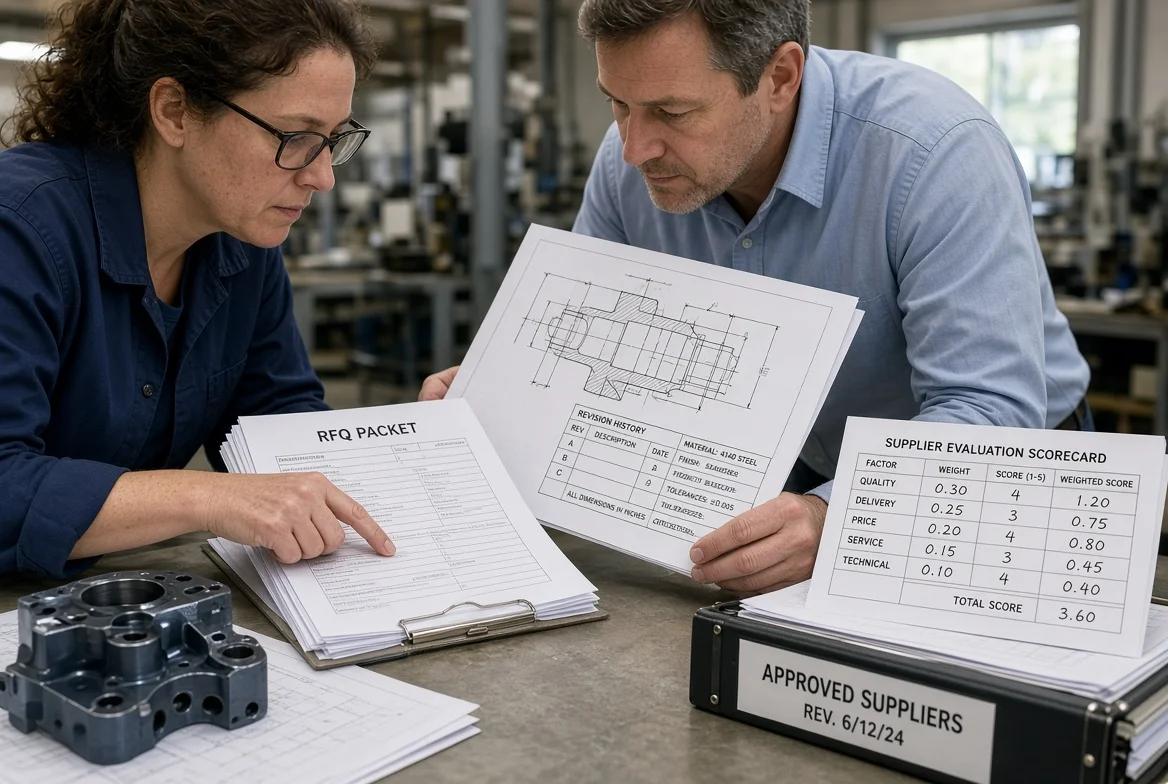
A good RFQ provides the supplier with information on how to quote, including quantity, any forecast, specification, revision, quality, inspection, packaging, delivery, payment terms and incoterms (if applicable), tooling, samples and the validity of the quote. The structures for standard materials, custom components, packaging, equipment and services are different. A one page price request will suffice for a catalog item. But this isn't sufficient for a tooled part.
Employ a supplier rating system (Supplier evaluation scorecard)
A scorecard can be developed based on price, total cost, quality, capacity, lead time, delivery history, technical capability, communication, compliance, and risk. Assign values to the criteria within each category. Try to not be the default winner for a safety-critical or long lead part. Write down what you scored and explain why to a subsequent team.
Keep an Approved Supplier List.
An approved list eliminates unapproved purchases, duplicate research, quality variations and duplicate qualification. Update whenever a supplier fails to meet performance criteria, loses a capability, or is not suitable for a category. Not an up to date list is control. It's a filing cabinet.
Step 4: Improve Supplier Selection and Sourcing Decisions
The value, risk, competition, technical complexity, and ease of switching within a category are all factors that influence the quality of the award and the amount of effort that goes into sourcing.
Use Competitive Sourcing for Standardized Categories
With materials that have clear specifications and multiple qualified sources, RFQs, price benchmarks, volume aggregation, and supplier consolidation are typical approaches. Competitive pricing simply works in providing help when the quote is for the same requirement, and the supplier is able to supply quality and lead time. However, a low result on an unfinished spec is no consolation.
Create Relationships of Strategic Value for Critical Categories
A more extended partnership can yield more than a quarterly price war through custom manufacturing, joint development, unique process capability and shared capacity planning. Strategic doesn't have to be unexamined. The rules of performance, commercial review and accountability remain. This is because of the length of the time period and the extent of planning.
Only use Dual Sourcing when necessary.
When lead time is long, the market is light, or a single plant shutdown would have significant impact, a second qualified source can be used to protect a line. All aspects of qualification cost, volume split, specification consistency, tooling and sufficient work to make the backup commercially viable must be planned. Low volume highly customized parts have shown to be more expensive and confusing when done in dual sourcing without substantial protection.
Assess the overall cost and manufacturing effects.
One line will be price per unit. Costs of freight, duties, tooling, quality failure, rework, extra inventory, payment terms and downtime all go together. Higher-priced supplier with stable delivery history may be more expensive than lower-priced supplier who has less on-time delivery performance with an eight-week lead time. The manufacturing perspective of that trade-off is called “total cost of ownership.”
Step 5: Integrate Procurement With Inventory and Production Flow
In manufacturing, efficient procurement ensures that materials are available without the need to purchase a material when it is needed twice or to stock up the facility “just in case.”
Increase the accuracy of Lead-Time and Reorder-Point.
Replenishment consists of the time that the supplier takes to produce the product. Include Internal Approval, Internal Inspection, Transport, Customs, and Production Release. A part that is 4 weeks of factory time may require 8 weeks door to line. The reorder points based on the short number will not work during any normal delay.
Maintain optimal Safety Stock and Inventory Cost.
Factors that should be considered in determining safety stock include: Variability of demand, Supplier reliability, Criticality, Replenishment time and Stoppage cost. A common cause of inventory aging and stockouts by item is one rule per item. Different coverage is not required for a weekly consumable and a custom shaft covering for 16 weeks.
Where possible, use Blanket Orders and Scheduled Releases
The reduction of repetitive purchase orders in combination with the fact that delivery dates are visible, through the use of framework agreements, supplier held stocks, releases and forecasting sharing, helps to minimize repetitive purchase orders. A forecast is not a firm commitment. A planned release does not mean an order the supplier has the capacity to schedule. Identify each of them.
Check Open Orders & Inventory Prior to Reordering.
Before ordering again, review on hand, allocated, in transit, open POs, actual consumption, and demand changes. When two people purchase the same product that is visible on the same SKU, and another critical item is still in short supply, it is a planning error, NOT a supplier error.
Step 6: Strengthen Supplier Quality and Performance Management
A manufacturing supplier management strategy is getting rid of recurring issues by structuring the performance work rather than through a new expedite every week.
Set Supplier Performance KPIs
Take appropriate measures commensurate with the supplier's responsibilities: timeliness of delivery, lead time variation, defect rate, corrective-action response, order accuracy, documentation completeness, capacity responsiveness, cost performance, and communications. It doesn't make sense for a tooling supplier to have an identical generic scorecard to a packaging supplier.
Implement Supplier Scorecards and Business Reviews.
Scorecards show trends. Scheduled reviews are needed on important suppliers for quality, delivery, capacity, cost, risk and open actions. All corrective actions must include an owner and a date. A Review without Follow-Up is a meeting.
Understand the relationship between Supplier Performance and Business Decisions
Allocation, development effort, future sourcing, safety stock, contracts and backup qualification should change to improve performance. The second time late delivery occurs, it should result in a capacity review, a recovery plan, a volume shift or another project, not a second "please.The second time late delivery occurs, it should lead to a capacity review, recovery plan, volume shift or another project, not another “please”.
Whether or not there is a business case, develop suppliers.
When the supplier is critical, then the hours spent on process improvement, incoming-quality support, capacity expansion, technical help and planning discipline can be valuable. Development is a long-term investment. Make sure to distribute it to all vendors and it's gone.
Step 7: Reduce Procurement Cycle Time Without Weakening Control
Manufacturing procurement process improvement accelerates the way by eliminating unnecessary steps, it does not mean skipping the technical, quality or commercial review.
Create Clear Approval Thresholds
A path should be set out by value, risk, category and supplier status. A reorder for approved items that are controlled is okay and can be short. If it is a new supplier, a custom product, high value equipment or a first purchase for a production critical product, more review is required. When all POs are waiting for the same signature, the threshold is either too low or risk is not being utilized.
Avoids duplicate data entry and manual handoffs
Shared item and supplier masters and a defined workflow reduce errors, as do a standard RFQ pack. Bad master data and unclear ownership will not be fixed by automation. It is still a wrong order if it is a faster one.
Automate routine purchases – if appropriate
Predictable, low-risk transactions include catalogs, reorder rules, PO automation, approval workflows, three-way match, supplier portals, and electronic documents. Human review should be maintained for high-risk and first-time technical buys. Select the right tools for the job depending on company size. A spreadsheet and discipline beats a poorly implemented platform.
Handle Exceptions, Don't Treat Everything as an Exception.
Upstream indicators like frequent emergency purchases, overrides, late approvals, one-off supplier requests often suggest that the forecast was wrong, bad lead times, approval delay, inventory inaccuracy, or engineering change that did not make it to purchasing. Monitor and correct source of exception volume. .
Step 8: Use Procurement Data and Technology Effectively
Systems are useful when the process and the data is already trusted. They don't develop a strategy and execute it.
Create a spend and supplier data foundation that is reliable.
Managing control item codes, suppliers details, category tags, purchase history, prices, lead time, MOQ, quality and delivery records, contracts and open orders. No spend analysis or performance reporting is possible due to duplicate supplier records, mixed units of measure, or missing category.
Integrate procurement, inventory and production data
Connect purchase orders, inventory, MRP, production schedules, supplier confirmations, receipts, inspections and invoices. It may be a stack of ERP, a lightweight purchasing tool, or well-governed files. The answer is asking whether a buyer can have a view of the demand, stock and open supply from one single place before ordering.
Take advantage of Dashboards for Decisions, Not Decoration.
Display shortages, late suppliers, trends in quality, price change, open actions, and risk exposure with an owner and due date. Disconnected charts don't make a buy.
Ensure Data Quality and Governance.
Assign master-data owners. Control access and revisions. Maintain accurate supplier records and contracts. Agree on definitions. As long as each manufacturer reports under a different name for the same factory, each report will disagree with the other.
How to Measure Manufacturing Procurement Efficiency
For manufacturing companies, procurement efficiency is an operating result of balancing off. Never use a single number (savings or PO cycle time) as a representation of the system.
Cost and total value metrics.
Monitor the following purchase-price variance, total landed cost, BOM cost variance, documented savings, cost avoidance, quality-related cost, emergency freight and inventory carrying cost. Where it is possible to define each measure with finance – then “savings” will not cover up a change of cost in freight or scrap.
Quality and Supplier Metrics
If the inputs are not stable, you'll be able to tell from the following measures: incoming defect rate, supplier rejection rate, corrective-action closure, first-pass acceptance, on-time delivery, lead-time variance, and capacity response.
Process Metrics and Workload Metrics.
The workload is represented by Cycle time, Approval time, RFQ turnaround, PO accuracy, Share of catalog or automated buys, Exception frequency, Invoice discrepancy rate, and Supplier-onboarding time. When a man runs quickly but without precision it is not an improvement.
Change the title of the inventory and production-impact metrics.
Purchasing is connected to the floor through stockouts, line interruptions, excess and aging inventory, emergency purchases, shortage incidents and material availability on production date.
Risk and Resilience Metrics
The vulnerabilities don't stop a line, but they include single-source exposure, qualified backup coverage, supplier concentration, completed risk reviews, and frequency of disruption.

Common Mistakes When Building an Efficient Procurement Strategy
Automating Poorly Defined Processes
Requirements will not become clear, item data will not be improved, approvals will not be strengthened or supplier records will not be cleaned up by software. Automating that work only throws the wrong PO out even quicker. Write down and streamline the process first.
The Impact of Measurement on Manufacturing Lost.
Rejects, delays, additional inventory, freight and supplier-management time are offset by a lower unit price. Record the total cost, quality, delivery, inventory and production impact next to the savings report.
Having the same treatment standards for every purchase.
A process over-controls a catalog item, and under-controls a custom, safety related part. Apply risk based categories, tiers of approval, segments of suppliers and proportionate qualification.
Skipping the input of Production and Engineering Stakeholders
The commercially attractive award fails if the buyer doesn't know the schedule, the drawing, the quality standard, an engineering change, or a no-substitution rule. Incorporate those functions into significant sourcing decisions.
Having too many suppliers who are not qualified or active.
A bloated list develops administration, mixed quality, weak leverage and dirty data. Discuss activity and results. Concentrate in areas of low risk. Have backup plans where one plan might be irresponsible.
Not tackling core issues of emergency purchases.
Common causes of repeated rushes are forecast error, lead-time error, unreliable suppliers, slow approvals, inventory error, and engineering change orders. Record the emergencies and correct the cause. Don't consider them as a regular purchase.
Summary Guidance – Efficient Manufacturing Procurement Connects Data, Suppliers, and Production
The manufacturers have built an efficient procurement strategy by connecting purchasing with production, categorizing suppliers and risks, standardizing the requirements and RFQs, selecting supplier based on TOTVs, integrating inventory and MRP, managing suppliers' quality, simplifying the right flow of procurement, and measuring the procurement cost, quality, delivery, inventory, process, and resilience together. This is the real life definition of an effective procurement program for manufacturers.
Begin with one really exciting category. Create a current map of the workflow. Identify the biggest waste/risk source. Standardize the requirement. Set supplier KPIs. Assign owners. Examine outcomes prior to using the same technique for the next category. The plants that improve are the ones that complete that loop, not the ones that rewrite a policy and halt at that point.